
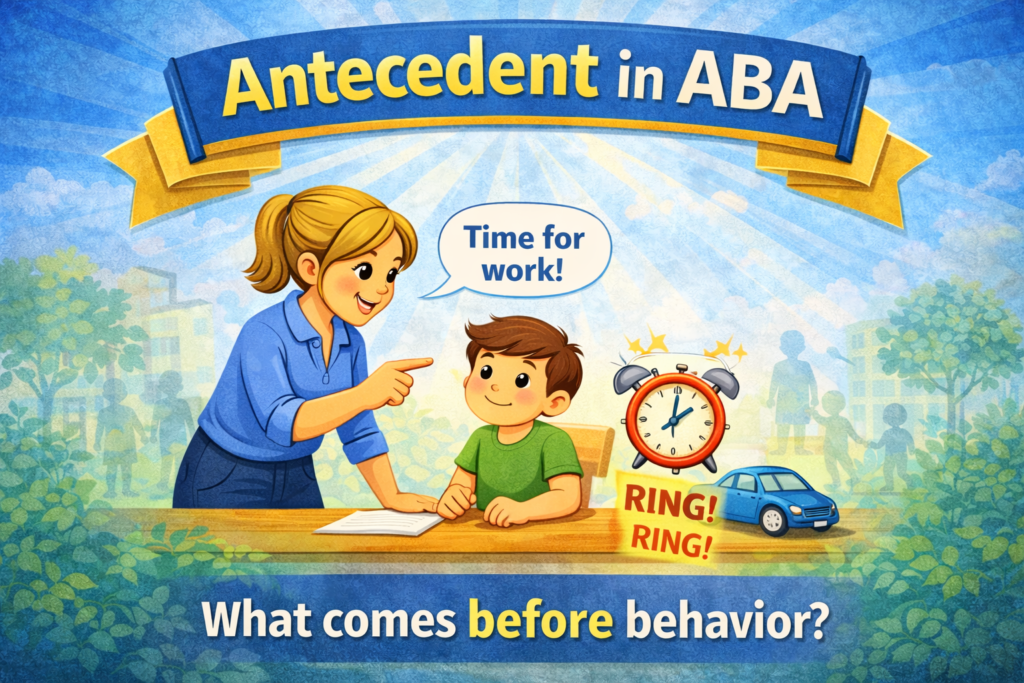
Antecedent in ABA: Why Many BCBA Candidates Get It Wrong
Antecedent is one of the earliest concepts introduced in applied behavior analysis, which is exactly why many BCBA candidates underestimate it. On the BCBA® exam, antecedent is rarely tested as a simple description of what happened before a behavior.
Instead, exam questions use this concept to evaluate whether candidates can correctly identify functional control, not whether they can recite the ABC sequence.
This distinction is where many candidates lose points.
Why Timing Alone Leads to Incorrect Answers
A common mistake is assuming that any event occurring immediately before a behavior automatically explains that behavior. While temporal order matters, timing alone is not sufficient for accurate analysis.
In ABA, a stimulus must change the likelihood of a response occurring to be functionally relevant. Events that merely precede behavior without influencing responding are often included in exam questions as distractors.
On the BCBA exam, irrelevant details are frequently placed before the target response specifically to test whether you can separate coincidence from functional influence.
When an Antecedent Actually Changes Behavior
An antecedent should be identified only when it has a demonstrable effect on responding.
On exam questions, this is typically indicated when:
-
The behavior occurs more frequently under a specific condition
-
Removing that condition reduces response likelihood
-
Discriminative control or motivation is clearly altered
-
Manipulating the condition produces predictable behavior change
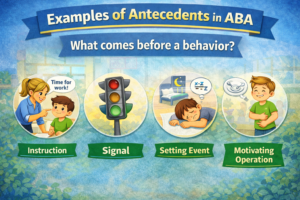
Instructional cues, task demands, and motivating operations often meet these criteria because they meaningfully influence responding.
A High-Frequency BCBA Exam Trap
One of the most common traps involves confusing background factors with immediate behavioral triggers.
Variables such as illness, fatigue, or schedule disruptions may influence behavior, but they often do so indirectly. Rather than directly evoking behavior, they typically alter the effectiveness of other environmental conditions.
When a question stem emphasizes background context instead of moment-to-moment control, selecting those factors as the correct answer is often incorrect.
Confusing Triggers With Outcomes
Another frequent error is mislabeling outcomes as causal conditions simply because reinforcement history is described earlier in the scenario.
BCBA exam questions may describe prior consequences before presenting the behavior itself. These details do not operate at the moment the response occurs and therefore should not be selected as the controlling factor.
A practical strategy is to ask whether the described condition is present and exerting influence at the time the behavior occurs.
Why This Matters on the BCBA® Exam
The BCBA exam does not reward identifying sequence. It rewards functional reasoning.
Antecedent analysis is tested as part of a broader decision-making process: predicting behavior change, identifying control, and selecting appropriate interventions.
When you encounter this topic on an exam question, pause before choosing the most obvious answer. The correct option is usually the one that reflects functional influence, not simple order.



