
The Verbal Behavior Milestones Assessment and Placement Program (VB-MAPP) is essential for professionals seeking to understand functional communication in autism treatment programsis. It is one of the most widely used assessment tools in Applied Behavior Analysis (ABA) for evaluating and guiding language and learning programs—especially for individuals with autism spectrum disorder or developmental delays. Developed by Dr. Mark Sundberg and based on B.F. Skinner’s analysis of verbal behavior, VB-MAPP combines assessment, curriculum planning, skill tracking, and placement decisions into one unified system.
For the original source and details, see: https://www.avbpress.com/vb-mapp/
Why Is VB-MAPP Important for ABA?
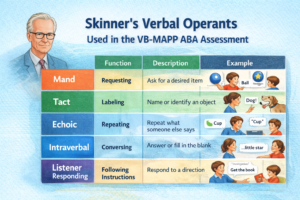
Unlike many language tests that focus on what a child can “say,” VB-MAPP assesses how language is used functionally—asking for help, labeling items, answering questions, or engaging socially. It focuses on verbal operants, a concept introduced by Skinner, which classifies language by function (not form). This distinction is critical in ABA because we are interested in observable, measurable behavior—and in teaching language that has purpose and meaning to the learner.
By identifying skill gaps across different verbal operants, VB-MAPP helps practitioners design targeted, developmentally appropriate interventions—a vital skill for BCBA® exam takers and practicing clinicians alike.
The Five Components of the VB-MAPP ABA Assessment: What Each Part Measures
VB-MAPP is structured into five distinct components that together offer a comprehensive profile of a learner’s language, learning, and social abilities.
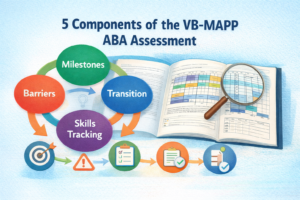
1. Milestones Assessment
This is the core of the VB-MAPP. It measures 170 functional milestones across three developmental levels (0–18 months, 18–30 months, and 30–48 months). These milestones span:
-
Manding (requesting)
-
Tacting (labeling)
-
Listener responding
-
Echoics
-
Intraverbals
-
Social behavior and play
-
Classroom routines
-
Group participation
-
Early academic readiness
Each milestone is observable, measurable, and aligned with natural developmental sequences. Scoring provides a snapshot of where the learner stands and which verbal operants are underdeveloped.
Detailed breakdown available at: https://www.relias.com/resource/vb-mapp
2. Barriers Assessment
This section evaluates 24 common barriers that interfere with learning, communication, and behavior. Examples include:
-
Prompt dependency
-
Scrolling
-
Inability to generalize
-
Weak reinforcer effectiveness
-
Self-stimulatory behavior
-
Behavior problems
This allows clinicians to not only assess what a learner can do but also identify why they may not be progressing, which is critical when developing effective intervention plans.
Real-world guide to barriers assessment: https://chicagoabatherapy.com/resources/articles/what-is-the-vb-mapp-how-is-it-used-in-pediatric-aba-therapy/
3. Transition Assessment
Designed to support educational placement decisions, this tool determines a learner’s readiness for less restrictive environments (e.g., mainstream classrooms). It assesses:
-
Adaptability to group instruction
-
Rate of learning
-
Independence
-
Spontaneity of responding
-
Ability to generalize skills
A high transition score may suggest that a child is ready to participate in more typical learning settings with reduced support.
More on transition planning here: https://www.verbalbeginnings.com/aba-blog/vbmapp/
4. Task Analysis and Skills Tracking
This section breaks each milestone into detailed teachable steps and provides a data-tracking system for monitoring progress. It’s ideal for day-to-day curriculum planning and aligns with both DTT (Discrete Trial Training) and NET (Natural Environment Teaching) approaches. This tracking tool enables precise data collection and helps teams assess generalization and maintenance of learned skills.
Task analysis structure explained: https://www.rethinked.com/resources/verbal-behavior-milestones-assessment-and-placement-program-vb-mapp/
5. Placement and IEP Goal Recommendations
Based on assessment data, VB-MAPP offers suggested goals and instructional objectives aligned with developmental readiness. This assists BCBAs and educators in building measurable, achievable IEP goals, ensuring consistency between assessment, intervention, and long-term educational planning.
Sample goal-setting based on VB-MAPP: https://blueabatherapy.com/autism/vb-mapp/
How the VB-MAPP ABA Assessment Connects to the BCBA® Task List
Many BCBA exam questions reference:
-
Types of assessments (e.g., criterion-referenced vs norm-referenced)
-
Verbal operants (e.g., mand, tact, intraverbal)
-
Curriculum planning and data collection
-
Behavior change systems
-
Instructional control
VB-MAPP is a criterion-referenced tool. That means it evaluates a learner’s progress based on specific behavioral criteria, not against a normative population. This is a testable concept for the exam, especially when distinguishing it from tools like the Vineland or CELF, which are norm-referenced.
Need a refresher on criterion- vs norm-referenced assessments?https://www.diffen.com/difference/Criterion-Referenced_Test_vs_Norm-Referenced_Test
Using the VB-MAPP ABA Assessment in Clinical and Educational Settings
In real-world ABA practice, VB-MAPP is used to:
-
Guide early intervention programs
-
Support insurance authorization for ABA services
-
Build IEPs with measurable language and learning goals
-
Train new staff on verbal operants and ABA curriculum
-
Track data over time to demonstrate clinical outcomes
It’s particularly useful for learners with limited or emerging language because it emphasizes functional skill acquisition. Unlike standardized assessments that may over- or under-estimate abilities, VB-MAPP focuses on what learners can actually use in daily life.
Research-backed implementation example: https://www.ncbi.nlm.nih.gov/pmc/articles/PMC4883535/
Comparing VB-MAPP to Other ABA Assessments
There are other ABA assessments in common use, including:
-
ABLLS-R (Assessment of Basic Language and Learning Skills – Revised)
-
AFLS (Assessment of Functional Living Skills)
-
PEAK (Promoting the Emergence of Advanced Knowledge)
VB-MAPP stands out because it is:
-
Grounded entirely in Skinner’s verbal behavior theory
-
Sequence-based and developmentally structured
-
Designed for learners from pre-verbal through conversational levels
-
Widely accepted by funding sources and educational teams
For a comparison chart of VB-MAPP vs ABLLS-R: https://www.abaedservices.com/wp-content/uploads/2021/02/Comparison-of-ABLLS-and-VB-MAPP.pdf
FAQs About VB-MAPP
Q: Who can administer VB-MAPP?
A: Typically BCBAs, BCaBAs, or trained behavior technicians under supervision. Some speech-language pathologists and special educators also use it.
Q: How long does it take to complete a VB-MAPP?
A: The full Milestones Assessment can take 4–10 hours depending on the learner’s skill level and attention span. Barriers and Transition assessments take additional time.
Q: Is there a digital version?
A: Yes. Many providers use the VB-MAPP App for electronic scoring and reporting.
https://www.vbmappapp.com/
Real URLs for Further Reading and Study
• Official VB-MAPP site from the author:
https://www.avbpress.com/vb-mapp/
• Overview of VB-MAPP functions and applications:
https://chicagoabatherapy.com/resources/articles/what-is-the-vb-mapp-how-is-it-used-in-pediatric-aba-therapy/
• Free guide to the five VB-MAPP components:
https://www.relias.com/resource/vb-mapp
• Research article on VB-MAPP’s application in language development:
https://www.ncbi.nlm.nih.gov/pmc/articles/PMC4883535/
• Real-world examples of VB-MAPP in educational settings:
https://theautismhelper.com/how-to-use-the-vb-mapp/
• Functional ABA blog breakdown:
https://blueabatherapy.com/autism/vb-mapp/
Final Thoughts
VB-MAPP is more than a milestone checklist—it’s a powerful, functional language assessment system that aligns with how children actually learn and use language. It teaches practitioners to assess not just what a learner knows, but how that knowledge serves them in real life.
For BCBA candidates, knowing how VB-MAPP works, how it compares to other tools, and how it connects to verbal behavior theory is not just test prep—it’s clinical readiness. The better you understand VB-MAPP, the better you can design meaningful, effective behavior plans that change lives.



