
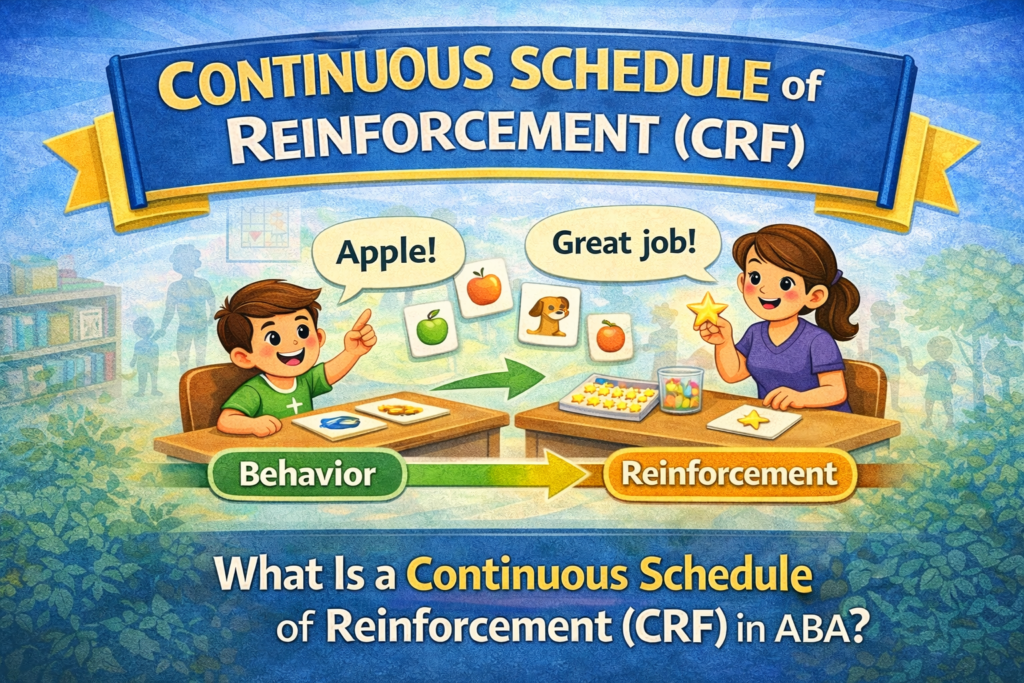
A continuous schedule of reinforcement (CRF) is one of the most basic and commonly taught concepts in applied behavior analysis (ABA). It is especially important for BCBA® candidates to understand because it frequently appears in questions related to reinforcement schedules, skill acquisition, and behavior change.
In this article, you will learn what a continuous schedule of reinforcement is, how it works, when it is used in ABA programs, and how it differs from other reinforcement schedules.
Definition of a Continuous Schedule of Reinforcement (CRF)
In ABA, a continuous schedule of reinforcement (CRF) means that every occurrence of a target behavior is reinforced.
In other words, each time the learner performs the behavior correctly, reinforcement is delivered.
This schedule is typically written as:
-
CRF or FR 1 (fixed ratio 1)
How a Continuous Schedule of Reinforcement Works
Under a continuous schedule, reinforcement follows each correct response without exception. This clear and consistent relationship between behavior and reinforcement makes CRF highly effective for:
-
Teaching new behaviors
-
Strengthening weak or emerging skills
-
Establishing stimulus–response relationships
Because reinforcement is predictable, learners quickly understand what behavior is being reinforced.
When to Use a Continuous Schedule of Reinforcement
A continuous schedule of reinforcement is most commonly used during the early stages of learning.
Common situations include:
-
Teaching a new skill
-
Introducing a new instruction
-
Establishing initial behavior change
-
Increasing motivation and engagement
For example, when teaching a child to label objects, every correct label may initially receive reinforcement.
Examples of Continuous Schedule of Reinforcement in ABA
Example 1: Teaching a New Skill
A therapist is teaching a child to request items using words. Each correct request is immediately reinforced with the requested item.
Example 2: Academic Skill Acquisition
A student receives praise or tokens for every correct math response during early instruction.
Example 3: Compliance Training
Each time a learner follows an instruction correctly, reinforcement is delivered.
In all of these examples, every correct response contacts reinforcement, which defines a continuous schedule.
Advantages of a Continuous Schedule of Reinforcement
Using CRF has several benefits:
-
Rapid skill acquisition
-
Clear learning contingencies
-
High motivation for learners
-
Strong behavior–reinforcement connection
Because reinforcement is consistent, learners are more likely to respond correctly during early instruction.
Limitations of a Continuous Schedule of Reinforcement
Despite its benefits, a continuous schedule also has limitations.
Common limitations include:
-
Behaviors may extinguish quickly when reinforcement stops
-
Not practical for long-term maintenance
-
Can lead to dependency on reinforcement
For these reasons, CRF is usually faded once the behavior is established.
Continuous Schedule of Reinforcement vs. Intermittent Schedules
Once a behavior is learned, practitioners typically shift from a continuous schedule to an intermittent schedule of reinforcement.
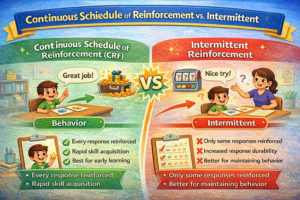
Key differences:
-
Continuous schedule: every response is reinforced
-
Intermittent schedule: only some responses are reinforced
Intermittent schedules help maintain behavior over time and make it more resistant to extinction.
How CRF Appears on the BCBA Exam
On the BCBA exam, questions about CRF often test whether candidates can:
-
Identify when CRF is being used
-
Distinguish CRF from other schedules
-
Select appropriate schedules for teaching new skills
-
Predict behavior changes when schedules are thinned
Exam questions may describe a scenario where reinforcement is delivered after every response—this always indicates a continuous schedule of reinforcement.
Common Mistakes to Avoid
BCBA candidates often make these errors:
-
Using CRF for too long
-
Failing to thin reinforcement
-
Confusing CRF with variable schedules
-
Assuming CRF is best for maintenance
Understanding when to move away from CRF is just as important as knowing when to use it.
Quick Study Checklist
Before the exam or clinical use, make sure you can:
-
Define a continuous schedule of reinforcement
-
Identify examples of CRF
-
Explain when CRF is most appropriate
-
Compare CRF with intermittent schedules
-
Apply CRF to real-world teaching scenarios
Final Thoughts
A continuous schedule of reinforcement is a powerful and essential tool in ABA, particularly during early learning. By reinforcing every correct response, CRF helps establish new behaviors quickly and effectively.
For BCBA candidates, mastering this concept is critical—not only for passing the exam, but also for designing effective, ethical, and data-driven interventions.



