
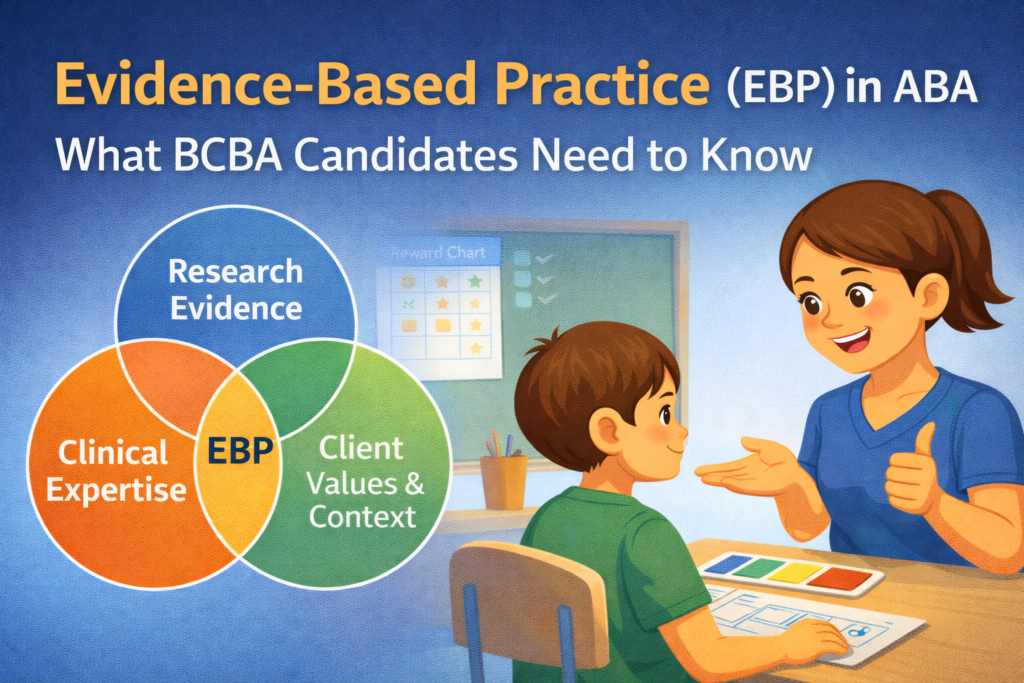
Evidence-Based Practice (EBP) in ABA Explained
Evidence-based practice (EBP) is a foundational concept in applied behavior analysis (ABA) and a topic that appears frequently on the BCBA® exam.
Many students can recite the definition of EBP but struggle to explain what it actually means in practice, how it guides clinical decision-making, or how it is tested on the exam. Understanding this concept goes beyond memorization—it requires knowing how research, clinical expertise, and client values work together.
This article explains evidence-based practice in clear, practical terms. You will learn the definition, core components, real-world examples, and key exam tips to help you apply EBP confidently.
What Is Evidence-Based Practice in ABA?
Definition (task-list style)
Evidence-based practice (EBP) in ABA refers to the integration of:
-
Best available scientific evidence
-
Clinical expertise
-
Client values and context
Effective ABA services are based on the combination of all three, not just one element alone.
Using research without considering the client, or relying only on experience without data, does not meet the standard of evidence-based practice.
The Three Core Components of EBP
1. Best Available Research Evidence
This includes findings from:
-
Peer-reviewed research
-
Single-subject experimental studies
-
Systematic reviews and meta-analyses
Interventions selected should be supported by scientific evidence demonstrating effectiveness.
2. Clinical Expertise
Clinical expertise involves the practitioner’s ability to:
-
Assess behavior accurately
-
Select appropriate interventions
-
Monitor progress using data
-
Adjust procedures when needed
Experience alone is not sufficient, but it plays a critical role in applying research effectively.
3. Client Values and Context
Client values include:
-
Family preferences
-
Cultural considerations
-
Practical constraints
-
Social validity
An intervention supported by research may still be inappropriate if it does not fit the client’s needs or environment.
Why Evidence-Based Practice Matters in ABA
Evidence-based practice ensures that interventions are:
-
Ethical
-
Effective
-
Defensible
-
Individualized

From a professional standpoint, EBP protects clients from ineffective or harmful procedures and helps practitioners justify their clinical decisions.
Everyday Example of Evidence-Based Practice
A BCBA is working with a child who engages in escape-maintained problem behavior during academic tasks.
-
Research evidence: Differential reinforcement and functional communication training are well-supported.
-
Clinical expertise: The BCBA knows the child responds well to visual supports.
-
Client values: The family prefers strategies that can be used at home and school.
The final treatment plan reflects all three elements, demonstrating evidence-based practice in action.
Evidence-Based Practice vs Research-Based Interventions
This distinction often appears on the BCBA exam.
-
Research-based intervention: Supported by studies
-
Evidence-based practice: Uses research plus clinical judgment plus client values
An intervention can be research-based but still fail to meet EBP standards if the other components are ignored.
Common Misunderstandings About EBP
ABA students often make these mistakes:
-
Thinking EBP means “only follow the research”
-
Ignoring client preferences
-
Assuming experience alone is evidence-based
-
Treating EBP as a single intervention
EBP is a decision-making framework, not a specific procedure.
How Evidence-Based Practice Appears on the BCBA Exam
Exam questions may ask you to:
-
Identify components of EBP
-
Choose the most appropriate intervention given client preferences
-
Evaluate whether a treatment plan meets evidence-based standards
Look for questions that describe balancing research, experience, and client context.
Quick Study Checklist
Before the exam, make sure you can:
-
Define evidence-based practice clearly
-
List and explain the three components
-
Distinguish EBP from research-based interventions
-
Apply EBP to real-world scenarios
-
Identify exam questions testing this concept
Final Thoughts
Evidence-based practice is at the heart of ethical and effective ABA services.
By integrating scientific evidence, professional expertise, and client values, practitioners deliver interventions that are both effective and meaningful. For BCBA candidates, mastering EBP strengthens exam performance and prepares you for real clinical decision-making.



