
What Are Behaviour Contracts in ABA? A Practical Guide
Behaviour contracts are a commonly used intervention in applied behavior analysis (ABA), especially with older children, adolescents, and adults.
Many ABA students and BCBA® candidates understand that behaviour contracts involve agreements and rewards, but feel unsure about how they actually work, when they are appropriate, or how they differ from simple reinforcement systems.
This practical guide explains behaviour contracts in clear, everyday language. You will learn what they are, how they are structured, when to use them, and how they appear in BCBA exam questions and real ABA programs.
What Are Behaviour Contracts in ABA?
Definition (task-list style)
Behaviour contracts are written agreements that clearly describe:
-
The target behavior
-
The expected performance
-
The consequences for meeting or not meeting the agreement
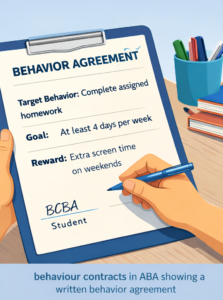
They are typically developed collaboratively between the practitioner and the learner.
In ABA, the contract functions as a rule-governed contingency, outlining what behavior will lead to which outcomes.
Why Behaviour Contracts Are Used in ABA
This intervention is especially useful when working with learners who:
-
Can read or understand verbal rules
-
Respond well to clear expectations
-
Benefit from predictability and structure
Behaviour contracts help by:
-
Clarifying expectations
-
Increasing commitment to behavior change
-
Reducing arguments and power struggles
-
Making reinforcement contingencies explicit
Rather than relying on moment-to-moment prompting, the learner can refer back to the agreement.
Key Components of an Effective Behaviour Contract
A well-designed contract is specific, measurable, and realistic.
1. Target behavior
The behavior must be clearly defined and observable.
❌ “Behave appropriately in class”
✅ “Remain seated during independent work for 20 minutes”
2. Performance criteria
The contract should state how often or how well the behavior must occur.
Examples:
-
“Complete homework 4 out of 5 school days”
-
“Arrive on time for all scheduled sessions this week”
3. Consequences
Both positive and negative outcomes should be specified.
-
Reinforcers for meeting the agreement
-
Loss of privileges or lack of reinforcement for not meeting it
The focus should remain on reinforcement, not punishment.
4. Review period
Contracts should include a clear time frame, such as:
-
Daily
-
Weekly
-
End of each session
This allows progress to be evaluated and adjustments to be made.
How Behaviour Contracts Work
From a behavioral perspective, behaviour contracts:
-
Establish rules that describe contingencies
-
Increase the likelihood of desired behavior through reinforcement
-
Reduce ambiguity around expectations
When followed consistently, the learner contacts reinforcement because the rule is followed, even before extensive direct experience with consequences.
Everyday Example of a Behaviour Contract
A middle school student frequently refuses to complete homework.
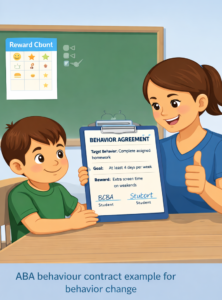
The BCBA and student create a written agreement:
-
Target behavior: Complete assigned homework
-
Criteria: At least 4 days per week
-
Reinforcement: Extra screen time on weekends
-
Review: Every Friday
The student signs the contract and keeps a copy. The caregiver and BCBA review progress weekly and adjust expectations as needed.
This structured approach often works better than repeated verbal reminders.
When Behaviour Contracts Are Most Effective
This strategy works best when:
-
The learner understands cause-and-effect relationships
-
Reinforcers are meaningful
-
Expectations are realistic
-
Data are collected to track performance
It is less effective for learners who lack the prerequisite skills to understand rules or who require more immediate, frequent reinforcement.
Common Mistakes to Avoid
ABA students and new practitioners often make these errors:
-
Writing vague or unrealistic expectations
-
Using contracts with learners who cannot understand them
-
Treating the contract as punishment-focused
-
Failing to follow through consistently
-
Not revising the agreement when progress stalls
A contract that is ignored or inconsistently applied quickly loses effectiveness.
Behaviour Contracts vs Token Systems
These two interventions are often confused.
-
Behaviour contracts rely on written rules and delayed outcomes
-
Token systems provide immediate reinforcement for behavior
Contracts are often more appropriate for older learners, while token systems may be better for younger individuals or those who need frequent feedback.
How Behaviour Contracts Appear on the BCBA Exam
BCBA exam questions may describe this intervention without using the term directly.
Look for scenarios involving:
-
Written agreements
-
Clearly stated expectations and rewards
-
Review periods and performance criteria
If the procedure emphasizes rule-governed behavior rather than immediate consequences, a behaviour contract is likely the correct answer.
Quick Study Checklist
Before the exam or clinical use, make sure you can:
-
Define behaviour contracts clearly
-
Identify the key components
-
Explain when they are appropriate
-
Distinguish them from token economies
-
Recognize exam questions describing contracts
Final Thoughts
Behaviour contracts are a practical and effective intervention when used with the right learners and implemented carefully.
By clearly defining expectations and consequences, they promote accountability, reduce conflict, and support long-term behavior change. For BCBA candidates, understanding how and when to use this strategy will strengthen both exam performance and real-world practice.


