
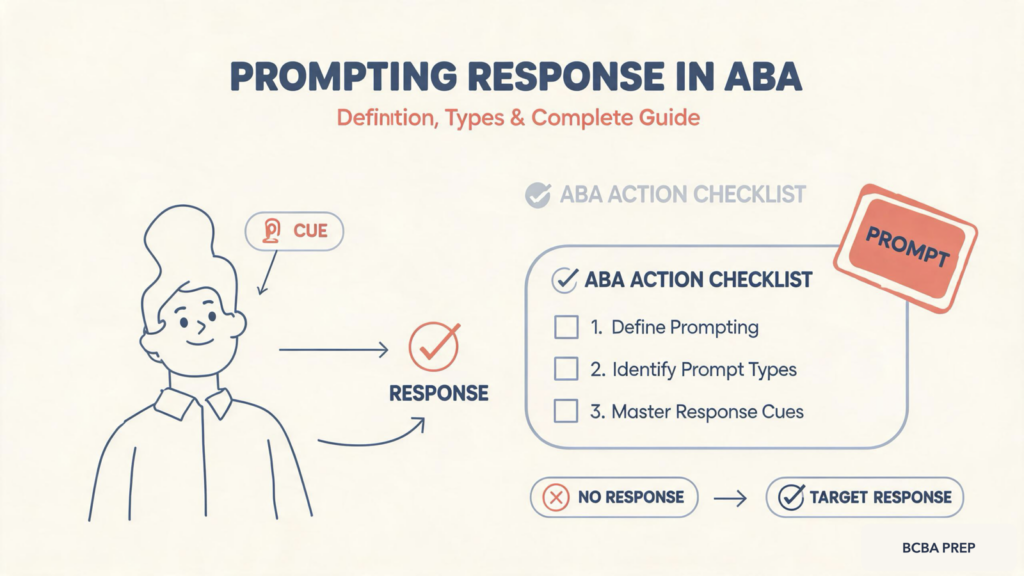
Understanding Response Prompts in ABA
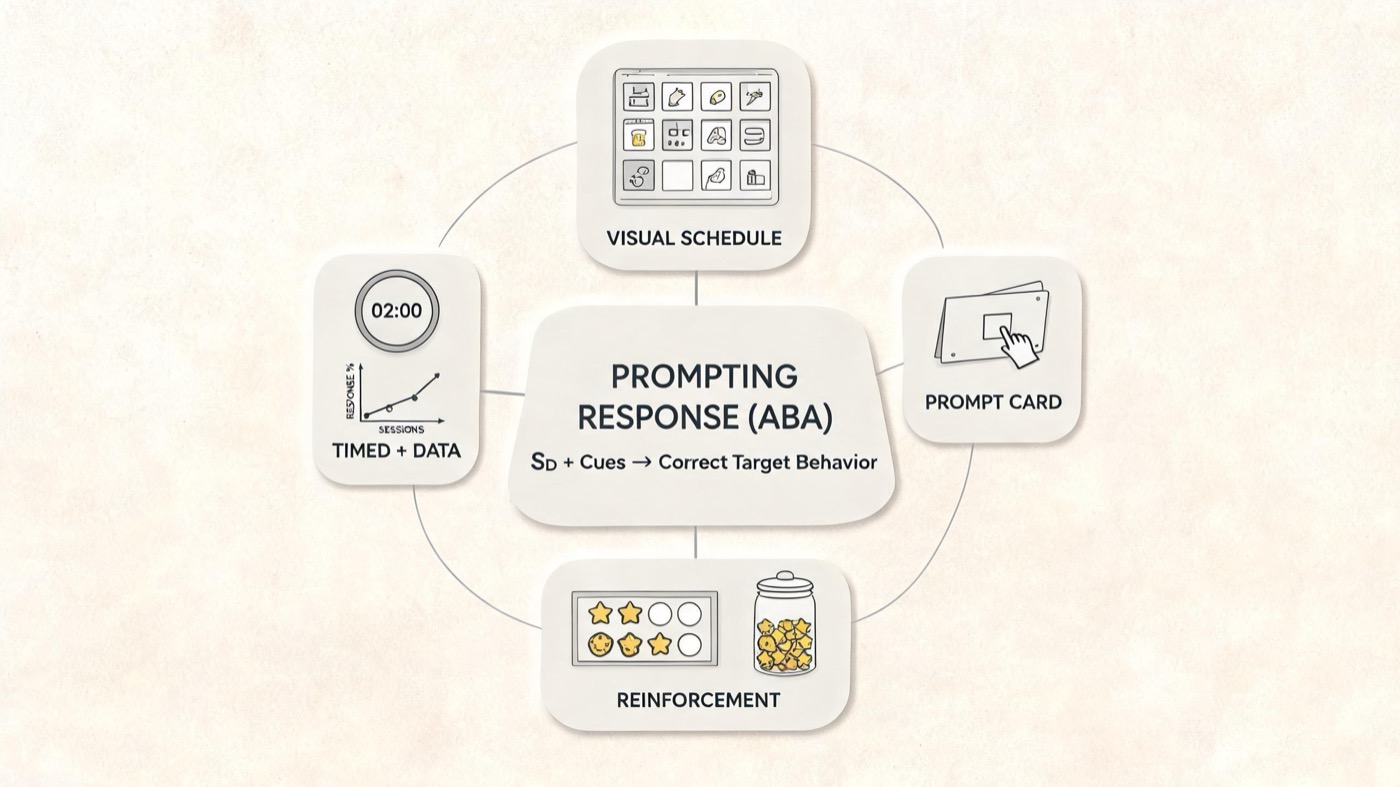
In applied behavior analysis, prompting response refers to the use of supplementary cues that help a learner engage in a target behavior. These cues are added to the discriminative stimulus (SD) to increase the likelihood of a correct response. Mastering this concept is crucial for the BCBA exam and for effective intervention planning.
Table of Contents
- Understanding Response Prompts in ABA
- Types of Response Prompts
- ABA Examples: Prompting Response in Action
- Exam Relevance and Common Traps
- Quick Checklist for Response Prompts
- Final Summary
What Are Response Prompts?
Response prompts are direct cues that guide the learner’s behavior. They come in four main types: verbal, gestural, modeling, and physical. Unlike stimulus prompts, which alter the antecedent environment, response prompts target the response itself.
Response Prompts vs. Stimulus Prompts
The key difference lies in what is modified. Response prompts are added to the SD to evoke a specific behavior, while stimulus prompts change the stimulus (e.g., highlighting, positioning) to make the correct choice more obvious. For the exam, remember that response prompts are temporary and should be faded to promote independence.
Here is a simple comparison:
- Response prompts: Verbal cue ‘Say ball,’ pointing to the correct item, modeling the action, physical guidance.
- Stimulus prompts: Enlarging a picture, color-coding, rearranging items to make one more salient.
Types of Response Prompts
Each type varies in intrusiveness. It is important to choose the least intrusive prompt that still ensures success, then fade systematically.
Verbal Prompts
Verbal prompts involve oral instructions or hints. For example, when teaching a child to request a ball, the therapist says ‘Say ball.’ This is a vocal prompt that directly tells the learner what to say.
Gestural Prompts
A gestural prompt includes pointing, nodding, or other body movements. Example: pointing to the correct picture card during a receptive identification task.
Modeling Prompts
Modeling involves demonstrating the target behavior. For instance, the therapist ties a shoe while the learner watches, then asks the learner to do it herself. This is a modeling prompt that provides a visual example.
Physical Prompts
Physical prompts range from light touch to full hand-over-hand guidance. A partial physical prompt might involve guiding the learner’s elbow, while a full physical prompt involves placing your hand over theirs to complete the action.
ABA Examples: Prompting Response in Action
Real-world examples help you understand how prompting works in therapy. Below are three detailed scenarios with ABC data and hypothesized functions.
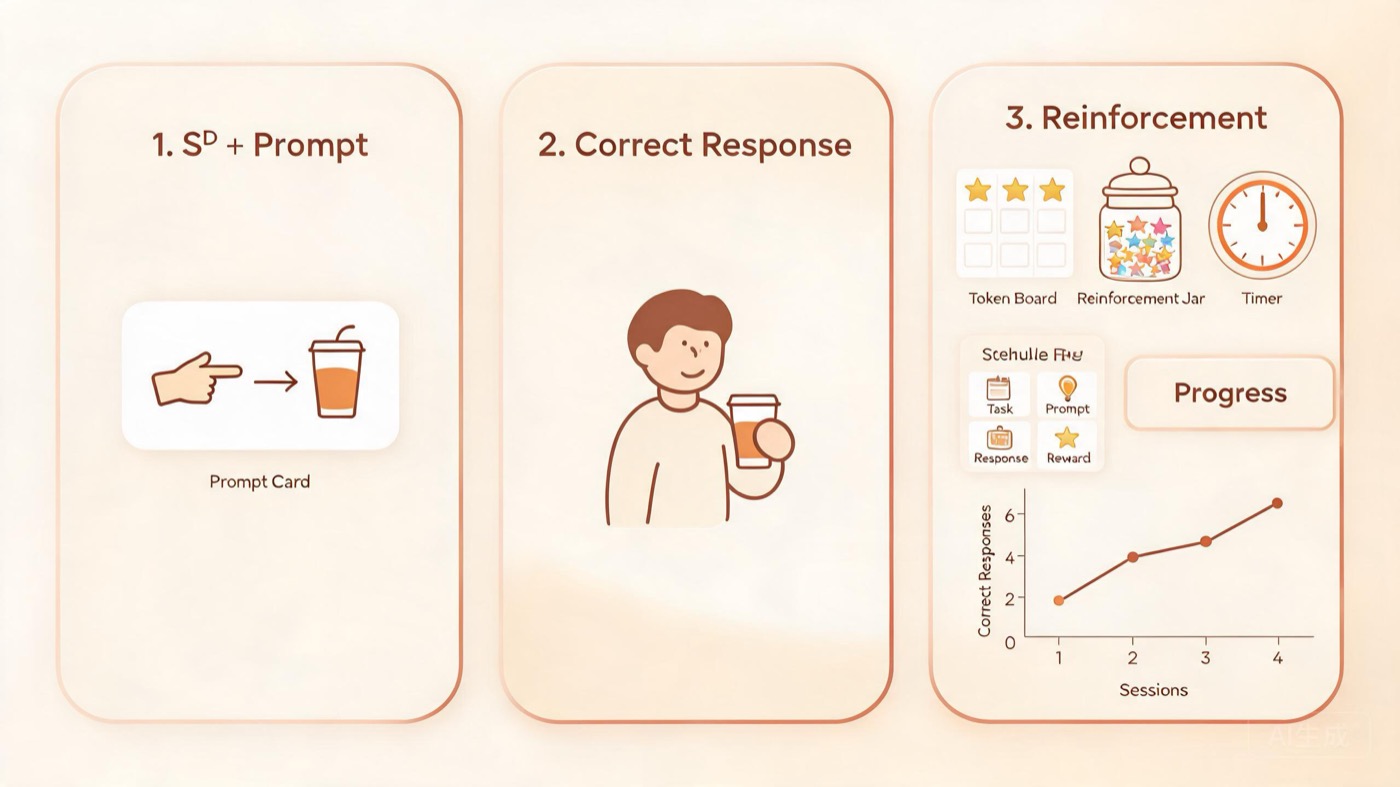
Example 1: Teaching Requesting (Manding)
Setting: A child wants juice. Antecedent: Juice is visible but out of reach. Prompt: Therapist says ‘Say juice.’ Behavior: Child vocalizes ‘juice.’ Consequence: Child receives juice. Hypothesized function: Access to tangibles. The verbal prompt was successful in evoking the correct response.
Example 2: Reducing Prompt Dependence
Setting: A learner relies on a gestural prompt to wash hands. Antecedent: Therapist stands at sink, no gesture. Behavior: Learner washes hands after a 3-second delay (increased independence). Consequence: Praise. Hypothesized function: Access to next activity. A time delay was used to fade the gestural prompt.
Example 3: Physical Prompt for Toileting
Setting: Child with autism learns to flush the toilet. Antecedent: After using toilet, therapist places hand gently on child’s hand. Behavior: Child flushes with partial physical guidance. Consequence: Verbal praise and access to a preferred toy. Hypothesized function: Attention and access to preferred activity. The physical prompt was gradually reduced until the child flushed independently.
Example 4: Modeling Prompt for Social Skills
Setting: A learner practices greeting peers. Antecedent: Therapist says ‘Watch me’ and waves while saying ‘Hi.’ Prompt: Modeling the greeting. Behavior: Learner imitates the wave and says ‘Hi.’ Consequence: Peer responds positively. Hypothesized function: Social interaction. Modeling provided a clear example of the expected behavior.
Exam Relevance and Common Traps
The BCBA exam often tests your ability to distinguish prompt types and apply fading procedures. Avoid these common mistakes:
Common Traps to Avoid
- Confusing response prompts with stimulus prompts: Remember, response prompts target the learner’s behavior; stimulus prompts alter the antecedent.
- Forgetting that response prompts are added to the SD: They are part of the antecedent, not a consequence.
- Assuming all prompts are equally intrusive: Use a hierarchy (least-to-most or most-to-least) to fade prompts.
- Mixing up modeling (response prompt) vs. environmental arrangement (stimulus prompt): Modeling involves demonstrating the behavior, while environmental arrangement changes the physical context.
- Ignoring prompt dependence: Over-prompting can lead to learner reliance. Always plan for fading.
How to Study
Use flashcards for each prompt type. Practice identifying prompt types from vignettes. Focus on prompt fading procedures such as most-to-least, least-to-most, and time delay. For more preparation, check out our BCBA mock exam for scenario-based questions.
Quick Checklist for Response Prompts
- Identify the prompt type: verbal, gestural, modeling, or physical.
- Determine if it is a response prompt or stimulus prompt.
- Plan for fading to avoid prompt dependency.
- Use ABC data to evaluate prompt effectiveness.
- Consider the function of the behavior when choosing prompts.
Final Summary
Response prompts are essential tools in ABA for teaching new skills. They include verbal, gestural, modeling, and physical cues, each varying in intrusiveness. The key is to use the least intrusive prompt necessary and fade it systematically. For the BCBA exam, focus on distinguishing response prompts from stimulus prompts, understanding fading procedures, and applying prompts to real scenarios. Master these concepts with our BCBA exam prep guide and practice questions. For further reading, the BACB provides official resources on ethical use of prompts.


