
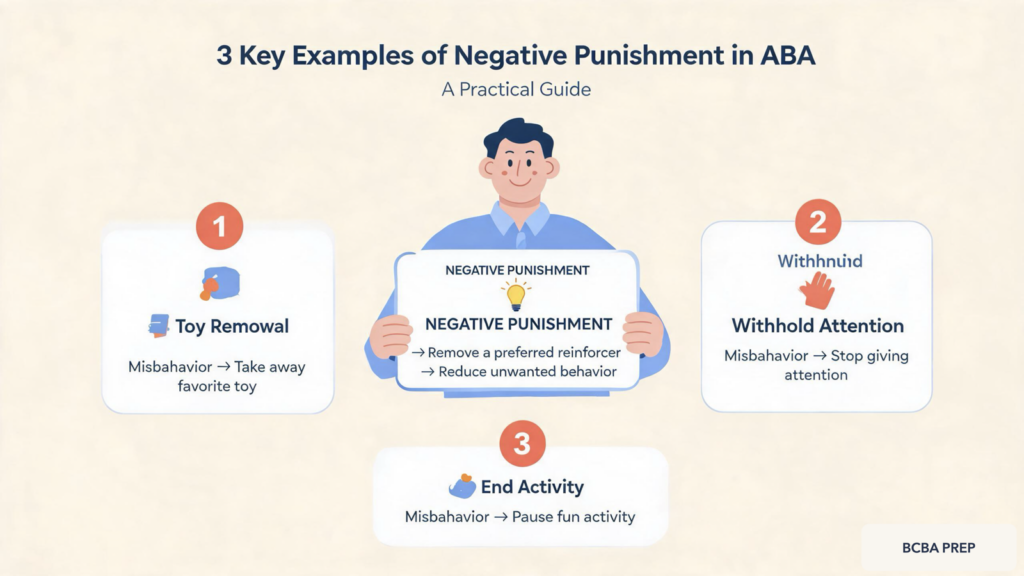
What Is Negative Punishment? A BCBA Candidate’s Guide
Negative punishment is a core concept in applied behavior analysis (ABA). It involves the removal of a preferred stimulus after a behavior, which leads to a decrease in that behavior over time. This is a fundamental procedure that BCBA candidates must master for the exam and for real-world practice.
Table of Contents
- What Is Negative Punishment? A BCBA Candidate’s Guide
- Detailed ABA Examples of Negative Punishment
- Negative Punishment on the BCBA Exam: Common Traps
- Quick Checklist for Negative Punishment
- Summary and Practice Prompt
Understanding examples of negative punishment in psychology helps illustrate how this principle works in everyday ABA interventions. Unlike positive punishment, which adds an aversive stimulus, negative punishment takes something away. The key is that the consequence must be something the individual values, and its removal must reliably reduce the target behavior.
Definition and Key Terms
Negative punishment is defined as a behavior reduction procedure in which a stimulus (usually a reinforcer) is removed contingent on a behavior, and the future frequency of that behavior decreases. Two common forms are response cost (loss of tokens, money, or privileges) and timeout (loss of access to reinforcement). Note that timeout refers to the removal of the opportunity to earn reinforcers, not simply a break from instruction.
When studying for the BCBA exam, pay close attention to the ABC contingency: Antecedent, Behavior, Consequence. The function of the behavior must be identified before implementing negative punishment, as the procedure only works if the removed stimulus is indeed a reinforcer for that individual.
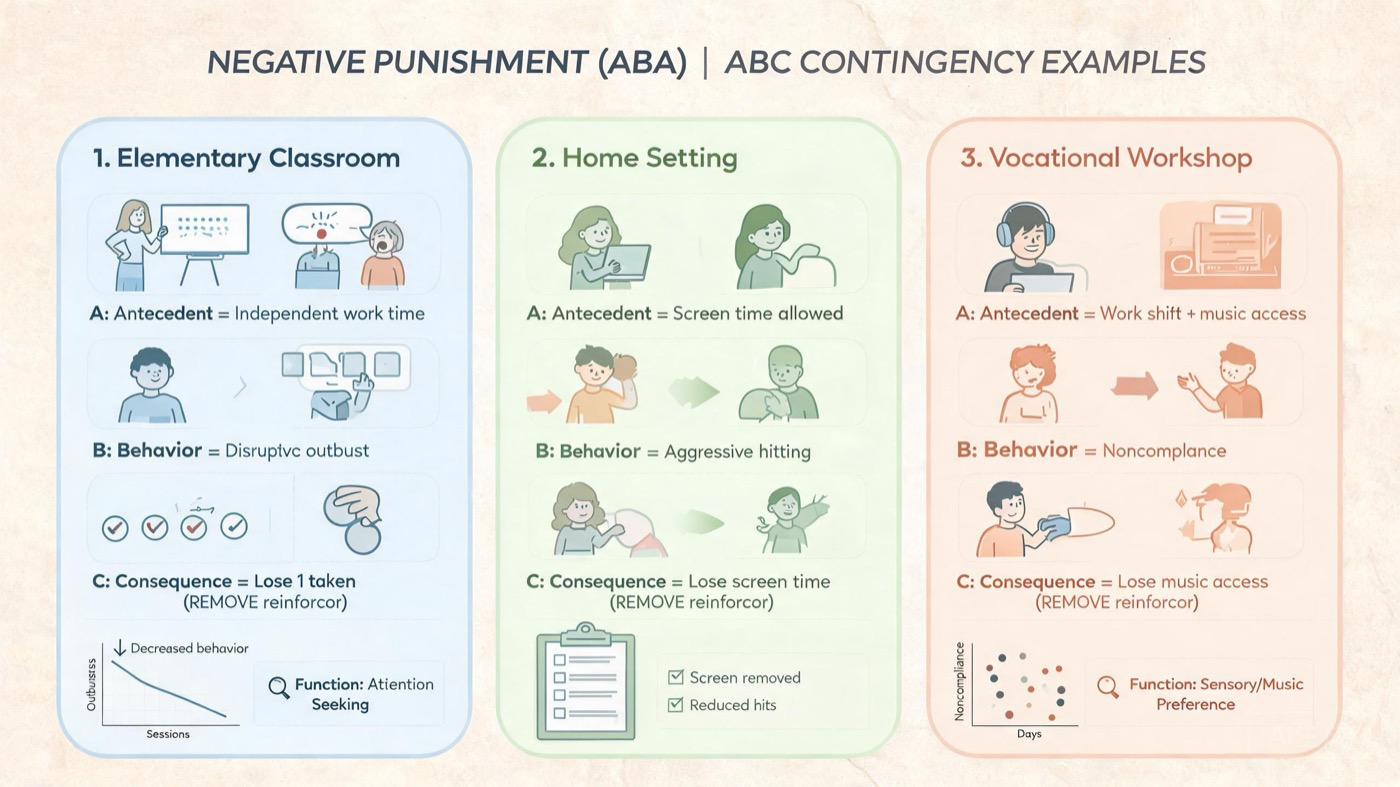
Detailed ABA Examples of Negative Punishment
The following three examples show how negative punishment is applied across different settings and age groups. Each includes the ABC contingency and the hypothesized function of the behavior.
Example 1: Timeout from a Token Economy
Setting: A classroom for elementary students with a token economy system. Each student earns tokens for on-task behavior and can exchange them for reinforcers (e.g., extra computer time).
- Antecedent: Teacher gives an instruction to complete a worksheet.
- Behavior: Student throws their pencil and shouts, “I won’t do it!”
- Consequence: Teacher removes 5 tokens from the student’s token board.
- Function: The behavior may be maintained by escape from the task (negative reinforcement) or attention. The removal of tokens (a conditioned reinforcer) reduces the behavior over time.
Exam trap: This is not extinction because the teacher is not withholding the reinforcer that maintained the behavior (e.g., escape). Instead, a different reinforcer (tokens) is removed. Make sure you can distinguish negative punishment from extinction on the exam.
Example 2: Response Cost for Incomplete Homework
Setting: A home environment with a teenage client. The client earns 30 minutes of video game time each evening if homework is completed by 7 PM.
- Antecedent: Parent reminds the teen that homework is due in 30 minutes.
- Behavior: Teen ignores the reminder and continues scrolling on their phone.
- Consequence: Parent deducts 30 minutes of video game time for that evening.
- Function: The behavior (ignoring) is likely maintained by automatic reinforcement (phone use) or avoidance of the task. The removal of a tangible reinforcer (game time) reduces the chance of future refusals.
This is a clear example of response cost, a specific type of negative punishment. Note that the removed stimulus (video games) is not the same as the reinforcer maintaining the behavior (phone use). That is acceptable, as long as the removed item is a known reinforcer.
Example 3: Loss of Car Privileges for Curfew Violation
Setting: A young adult with a car privileges contract. Curfew is 10 PM on school nights.
- Antecedent: Curfew time arrives; the individual is not home.
- Behavior: Arrives home at 11:30 PM, violating curfew.
- Consequence: Parents take the car keys for the weekend.
- Function: The late arrival may be maintained by social positive reinforcement (time with friends) or automatic reinforcement. The removal of car access (a preferred stimulus) decreases the likelihood of future curfew violations.
Remember that punishment is defined by its effect on future behavior, not by intention. If the loss of car keys does not reduce the tardiness, it is not punishment—it may be a reinforcing consequence or neutral. Always evaluate the behavioral outcome.
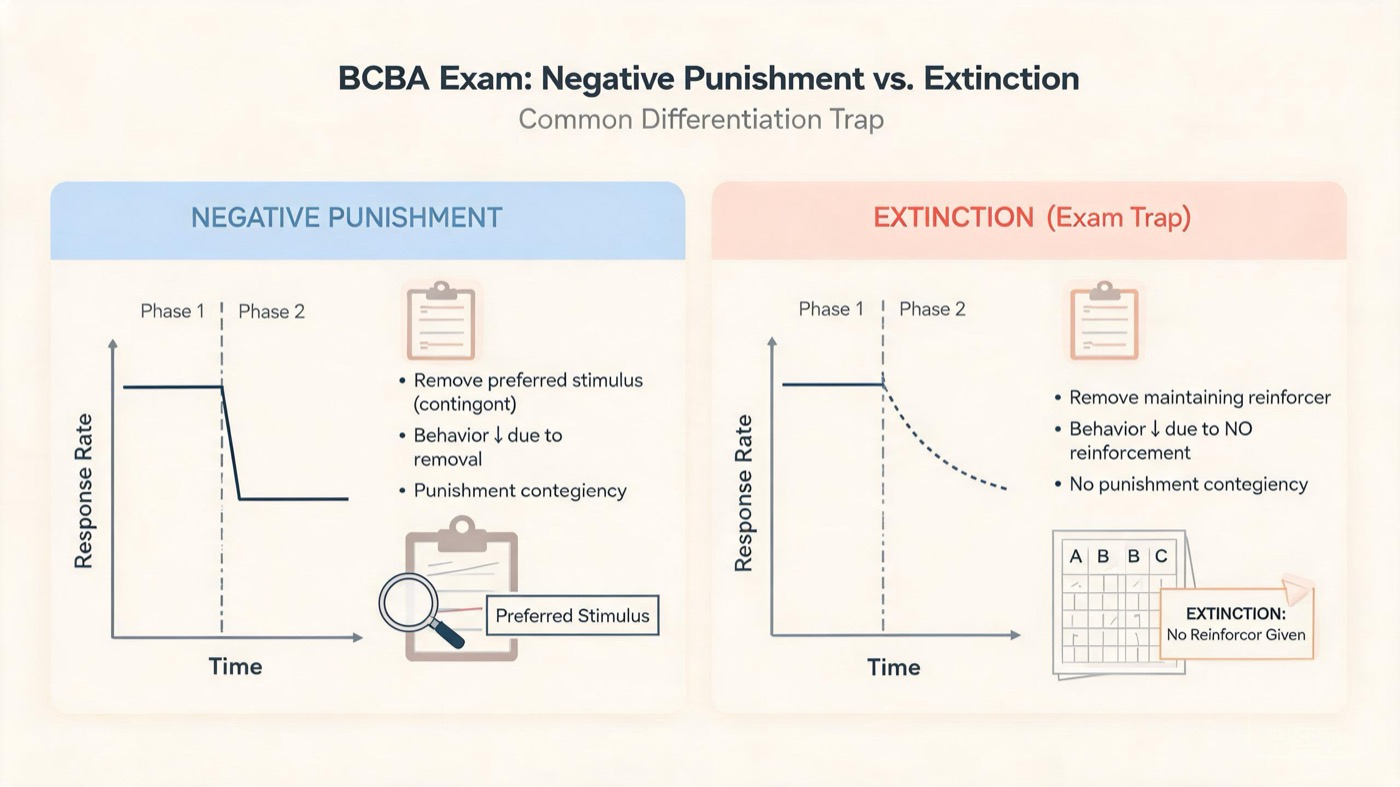
Negative Punishment on the BCBA Exam: Common Traps
The BCBA exam frequently tests your ability to identify negative punishment and differentiate it from other procedures. Here are two of the most common pitfalls.
Negative Punishment vs. Extinction
Both involve removal of a stimulus, but the mechanism differs. In extinction, the reinforcer that previously maintained the behavior is no longer delivered. In negative punishment, a different reinforcer is removed. For example, if a child screams to get attention, and the teacher ignores the screaming (no attention), that is extinction. If the teacher removes a token from the token board, that is negative punishment.
Exam questions often present a scenario and ask, “Is this negative punishment or extinction?” Look at what is removed. If it is the maintaining reinforcer, it is extinction; if it is another reinforcer, it is negative punishment.
Negative Punishment vs. Positive Punishment
The distinction is simple: positive punishment adds a stimulus (e.g., a reprimand, extra chores), while negative punishment removes a stimulus. Both aim to decrease behavior. A common trap is misidentifying a procedure because the consequence is framed as “taking away” when in fact something is added (e.g., adding a fine is positive punishment; removing a bonus is negative punishment).
For more practice, review our article on positive vs negative punishment in ABA.
Quick Checklist for Negative Punishment
Use this checklist when analyzing exam scenarios to confirm that a procedure qualifies as negative punishment.
- Behavior occurs: Identify the target behavior (e.g., tantrum, refusal, rule-breaking).
- Stimulus removed: A specific stimulus is taken away immediately after the behavior.
- Removed stimulus is a reinforcer: The stimulus must be something the individual wants (e.g., tokens, privileges, preferred items).
- Behavior decreases: The future frequency of the behavior reduces over time.
- Not extinction: Ensure the removed stimulus is not the same as the reinforcer maintaining the behavior.
- Function considered: The procedure is only appropriate if the removed stimulus is not the maintaining reinforcer.
Additionally, consider whether a reinforcer assessment has been conducted to verify that the removed stimulus is indeed a reinforcer. Without it, you might accidentally remove something neutral, which would not function as punishment.
Summary and Practice Prompt
Negative punishment is a vital tool in ABA for decreasing problem behaviors. The three examples covered—timeout from a token economy, response cost for incomplete homework, and loss of car privileges—illustrate how the removal of a preferred stimulus can effectively reduce behavior. On the exam, remember to analyze the ABC contingency carefully and watch for common traps like confusing negative punishment with extinction.
To solidify your understanding, try this practice scenario.
Practice Scenario
Scenario: During a reading session, a child yells loudly. The teacher removes one token from the child’s token board. The child’s yelling decreases over the next several sessions. Is this negative punishment? Identify the ABC contingency, the hypothesized function of the behavior, and explain why the procedure works.
Answer: Yes, this is negative punishment. Antecedent: reading task presented. Behavior: yelling. Consequence: removal of one token. The function of yelling might be escape from the task or attention. The procedure works because tokens are a conditioned reinforcer; their removal makes yelling less likely. It is not extinction because the teacher is not withholding escape or attention (the maintaining reinforcer).
For more exam-style practice, check out our BCBA mock exam. Also, read the BACB’s guidelines on ethical use of punishment to ensure you implement these procedures responsibly.


