
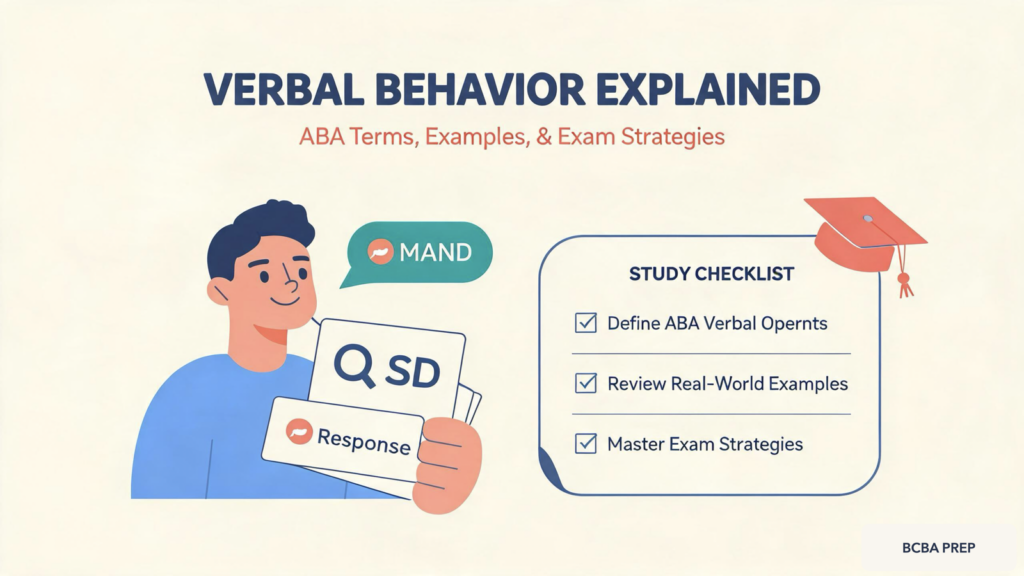
Introduction to Verbal Behavior
Welcome to this verbal behavior guide for BCBA exam candidates. Understanding how language functions as behavior is a core part of the BACB Task List. This article uses the term verbal behavior exactly once in the introduction to anchor your learning.
Table of Contents
- Introduction to Verbal Behavior
- ABA Examples of Verbal Operants
- Common Exam Traps and How to Avoid Them
- Quick Study Checklist for Verbal Behavior
- Summary and Exam Prep Reminders
What is Verbal Behavior?
B.F. Skinner (1957) defined verbal behavior as behavior that is reinforced through the mediation of another person. Unlike traditional views that treat language as a symbolic system, Skinner’s analysis focuses on the function of the speaker’s actions. For the BCBA exam, you must distinguish between the form of language (e.g., grammar) and its functional control: the antecedents and consequences that maintain verbal responses.
The Six Verbal Operants
Skinner described six primary verbal operants: mand, tact, echoic, intraverbal, textual, and transcription. The first four are most frequently tested. Each operant is defined by its unique antecedent stimulus and consequence. For example, a mand is controlled by an establishing operation (EO) and reinforced by a specific reinforcer, while a tact is controlled by a nonverbal stimulus and maintained by generalized social reinforcement.
Use this quick-reference table for the four primary operants:
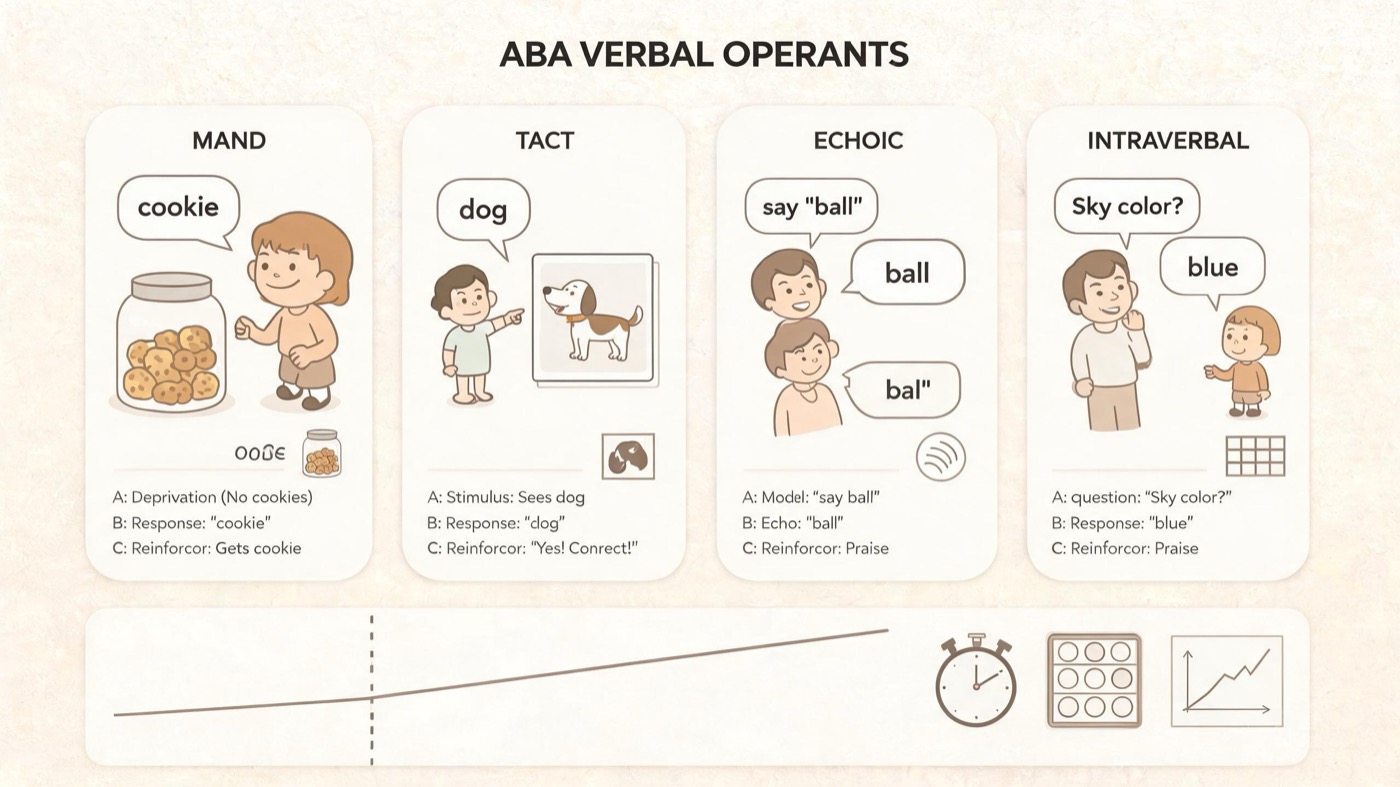
- Mand: Antecedent = EO – Response = request – Consequence = specific reinforcer
- Tact: Antecedent = nonverbal stimulus – Response = label – Consequence = generalized praise
- Echoic: Antecedent = verbal stimulus with point-to-point correspondence – Response = repeats – Consequence = generalized reinforcement
- Intraverbal: Antecedent = verbal stimulus without point-to-point correspondence – Response = answers, fills in – Consequence = generalized reinforcement
ABA Examples of Verbal Operants
To pass the BCBA exam, you must be able to identify each operant in real-world scenarios. Below are worked examples with ABC analysis and hypothesized function. The focus is on mand, tact, echoic, and intraverbal because these appear most often on the test.
Mand Example
A child says "cookie" while reaching toward the cookie jar. The establishing operation is food deprivation (hunger). The behavior is the vocal mand "cookie." The consequence is receiving a cookie, which functions as access to tangibles. On the exam, remember that mands are the only operant that directly benefit the speaker by producing a specific reinforcer.
Tact Example
While walking in the park, a child sees a dog and says "dog." The nonverbal stimulus (the dog) controls the response. The consequence is adult praise ("Yes, that’s a dog!"). The function is social attention. A key exam trap: tacts are often confused with mands because both can produce attention, but the controlling antecedent is different.
Echoic and Intraverbal Examples
Echoic: An adult says "ball" and the child immediately repeats "ball." The antecedent verbal stimulus has point-to-point correspondence, meaning the speaker’s response matches the model exactly. This operant is crucial for teaching vocal imitation.
Intraverbal: The therapist asks, "What’s your name?" and the child responds "Sam." There is no point-to-point correspondence between the question and the answer. Intraverbals include fill-ins, songs, and conversational responses. They are often tested with multiple control, where two or more variables influence the response (e.g., "Twinkle, twinkle, little ___" is controlled by both the verbal context and the song history).
Common Exam Traps and How to Avoid Them
The BCBA exam loves to test your ability to discriminate between operants. Here are three traps that regularly appear.
Distinguishing Mand from Tact
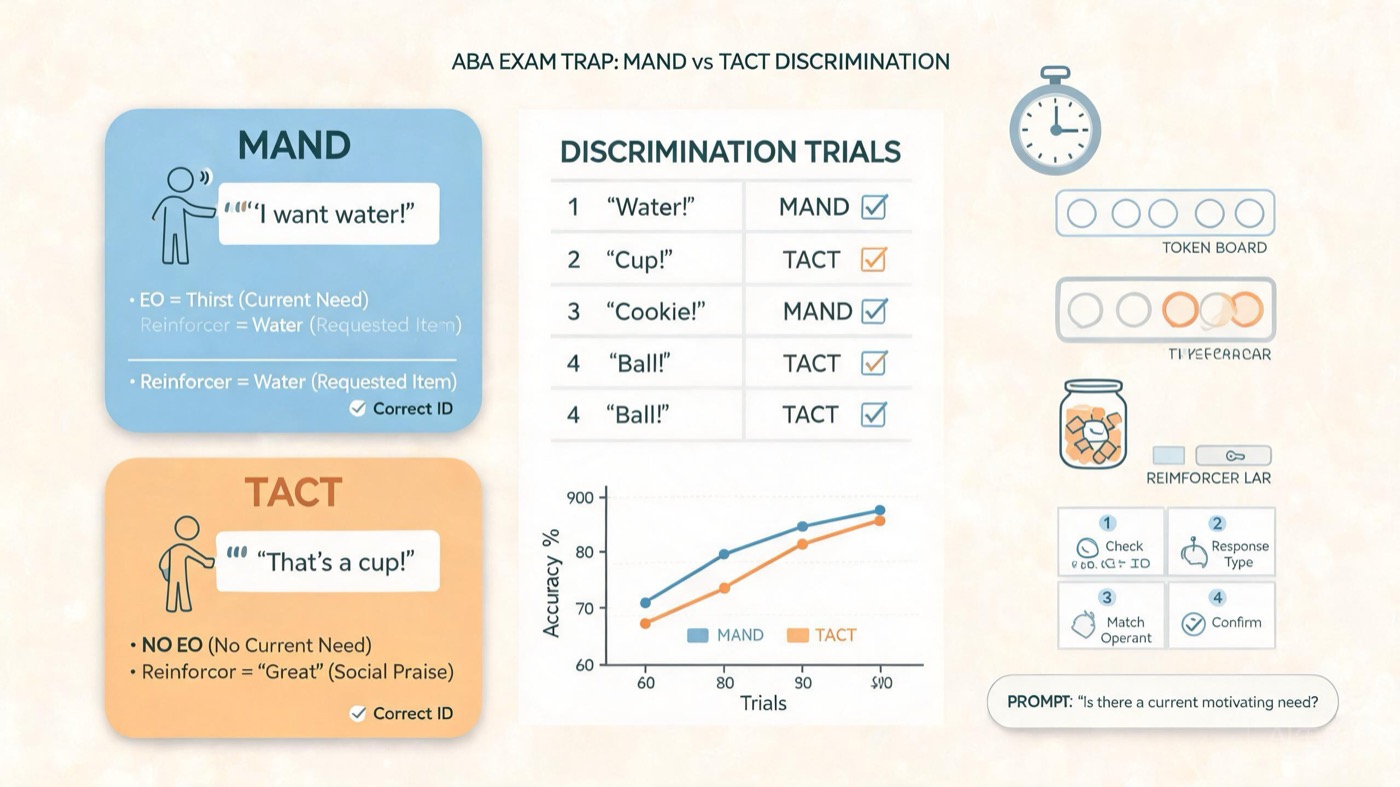
The most common error: confusing mand and tact when the response is a request or label. Remember: a mand always involves an establishing operation and produces a specific reinforcer. A tact is under control of a nonverbal stimulus and produces generalized reinforcement. If the question describes a child who says "juice" after not having access to juice, that’s a mand. If the child says "juice" upon seeing juice on the table, that’s a tact.
Oversimplifying Intraverbals
Many candidates assume intraverbals are simply "conversation." But beware: intraverbals can involve multiple control, such as when a verbal antecedent (question) and an EO combine (e.g., asking "What do you want?" when hungry). On the exam, read the scenario carefully: if the antecedent includes an EO, the response might be a mand under multiple control.
Ignoring Point-to-Point Correspondence
Echoic and textual require the verbal stimulus and response to share the same form (point-to-point correspondence). Intraverbal and mand do not. A question may describe a child who reads the word "cat" aloud: that’s textual, not tact. Another trap: if the teacher says "cat" and the child says "cat," that’s echoic; if the teacher says "What animal says meow?" and the child says "cat," that’s intraverbal.
Quick Study Checklist for Verbal Behavior
Use this checklist to solidify your knowledge before the exam. Each item targets a common weak area.
- Memorize definitions for all six verbal operants, focusing on the four primary ones.
- Practice with mock scenarios: Identify the operant from a written scenario, including antecedents and consequences.
- Review ABC for each operant: For every operant, state the controlling antecedent and typical consequence.
- Identify controlling variables: Distinguish between EO, nonverbal stimulus, verbal stimulus with/without point-to-point correspondence.
- Understand multiple control: Recognize when two operants jointly evoke a response (e.g., tact + mand).
- Complete at least five practice questions on verbal behavior from a reliable source, such as the verbal operants guide.
- Review BACB Task List items related to verbal behavior (e.g., F-5, F-6 in the 5th edition).
Summary and Exam Prep Reminders
Verbal behavior is one of the most frequently tested areas on the BCBA exam. Focus on the four primary operants: mand, tact, echoic, and intraverbal. Use the checklist above for a quick review the night before your test.
For more free practice questions and a full-length mock exam, visit our free BCBA mock exam page. You can also read the original study by Skinner: Verbal Behavior (1957) for deeper understanding. Good luck on your exam!


