
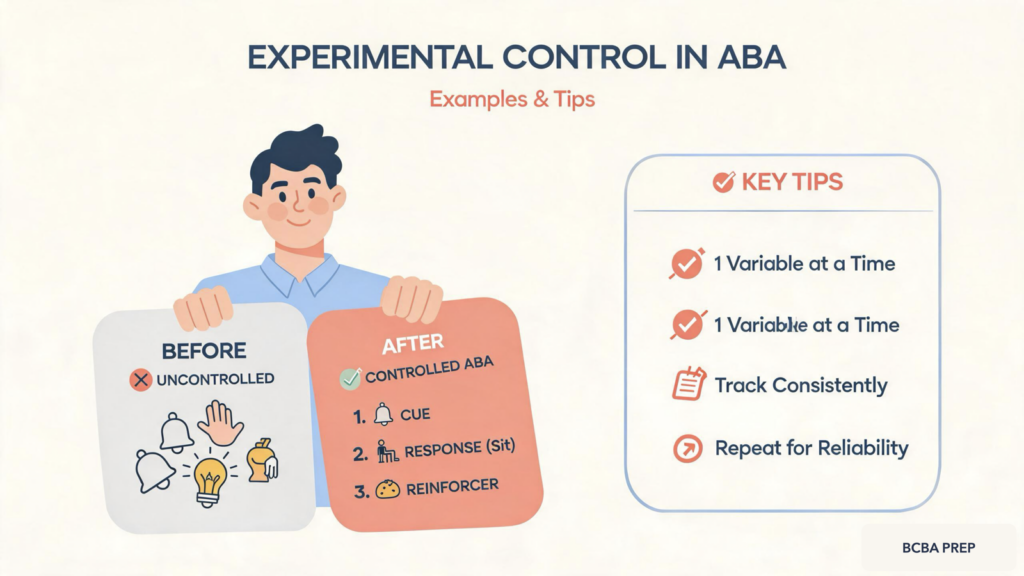
What is Experimental Control?
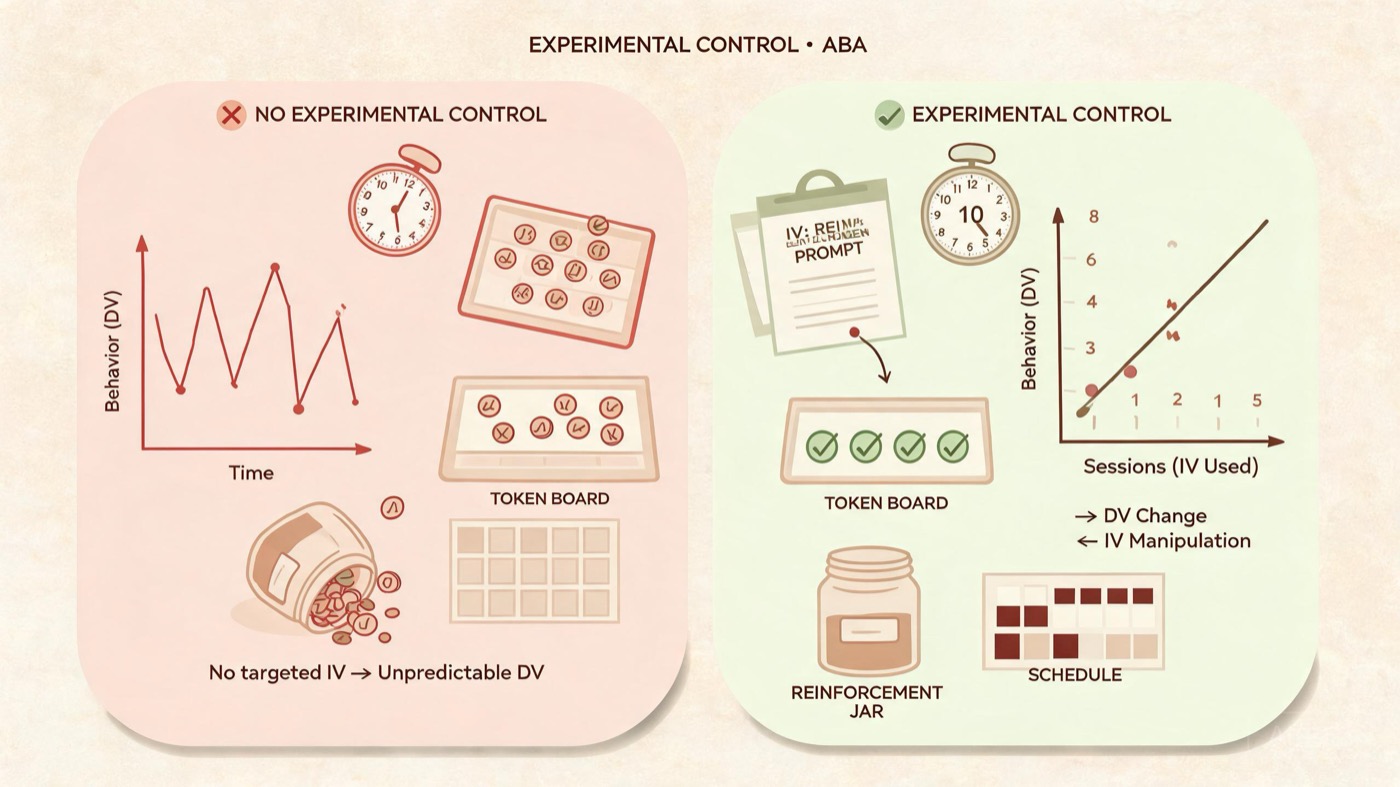
Experimental control is the degree to which a researcher can confidently attribute changes in the dependent variable to the manipulation of the independent variable. In applied behavior analysis (ABA), this is the foundation for demonstrating functional relations. Without experimental control, you cannot claim that an intervention caused behavior change.
Table of Contents
- What is Experimental Control?
- Why Experimental Control Matters for the BCBA Exam
- ABA Examples of Experimental Control
- Common Exam Traps and How to Avoid Them
- Quick Checklist for Experimental Control
- Summary: Experimental Control in ABA
In single-subject designs, experimental control is established through baseline logic: prediction, verification, and replication. The researcher predicts behavior will remain stable under baseline, verifies that behavior changes only when the independent variable is introduced, and replicates the effect across phases or participants to confirm the relationship.
Key Components of Experimental Control
- Independent variable manipulation: The researcher systematically applies and removes the intervention to observe its effect on behavior.
- Baseline logic: Uses prediction (stable baseline), verification (return to baseline), and replication (reintroduce IV) to demonstrate control.
- Replication: Repeating the effect across phases, subjects, or settings increases confidence that the IV caused the change.
- Elimination of confounds: Controlling extraneous variables (e.g., history, maturation) ensures the IV is the only plausible cause of behavior change.
Why Experimental Control Matters for the BCBA Exam
The BCBA exam frequently tests your understanding of experimental control because it is central to interpreting intervention outcomes. You will encounter questions that ask you to identify whether a design demonstrates control, what threatens it, and how to strengthen it.
Experimental Control vs. Internal Validity
While related, experimental control and internal validity are distinct. Experimental control refers to the specific procedures used to isolate the IV’s effect, such as baseline logic and replication. Internal validity is the overall confidence that the IV caused the observed change. You achieve internal validity by demonstrating experimental control. For a deeper look, check out our guide on independent and dependent variables in ABA.
Threats to Experimental Control
- History: Unplanned events outside the study that affect behavior (e.g., a new medication).
- Maturation: Natural physical or psychological changes over time (e.g., fatigue, learning).
- Instrumentation: Changes in measurement tools or observer drift.
- Carryover: Effects from a previous condition persist into the next phase (common in alternating treatments designs).
- Multiple treatment interference: When two or more treatments are applied, their effects may not be separable.
Identifying these threats is a common BCBA exam question. Practice with our BCBA mock exam (6th edition) to sharpen your skills.
ABA Examples of Experimental Control
Two classic ABA designs illustrate how experimental control is demonstrated: functional analysis and reversal design. Pay attention to how baseline logic and replication create a convincing demonstration.
Example 1: Functional Analysis of Aggression
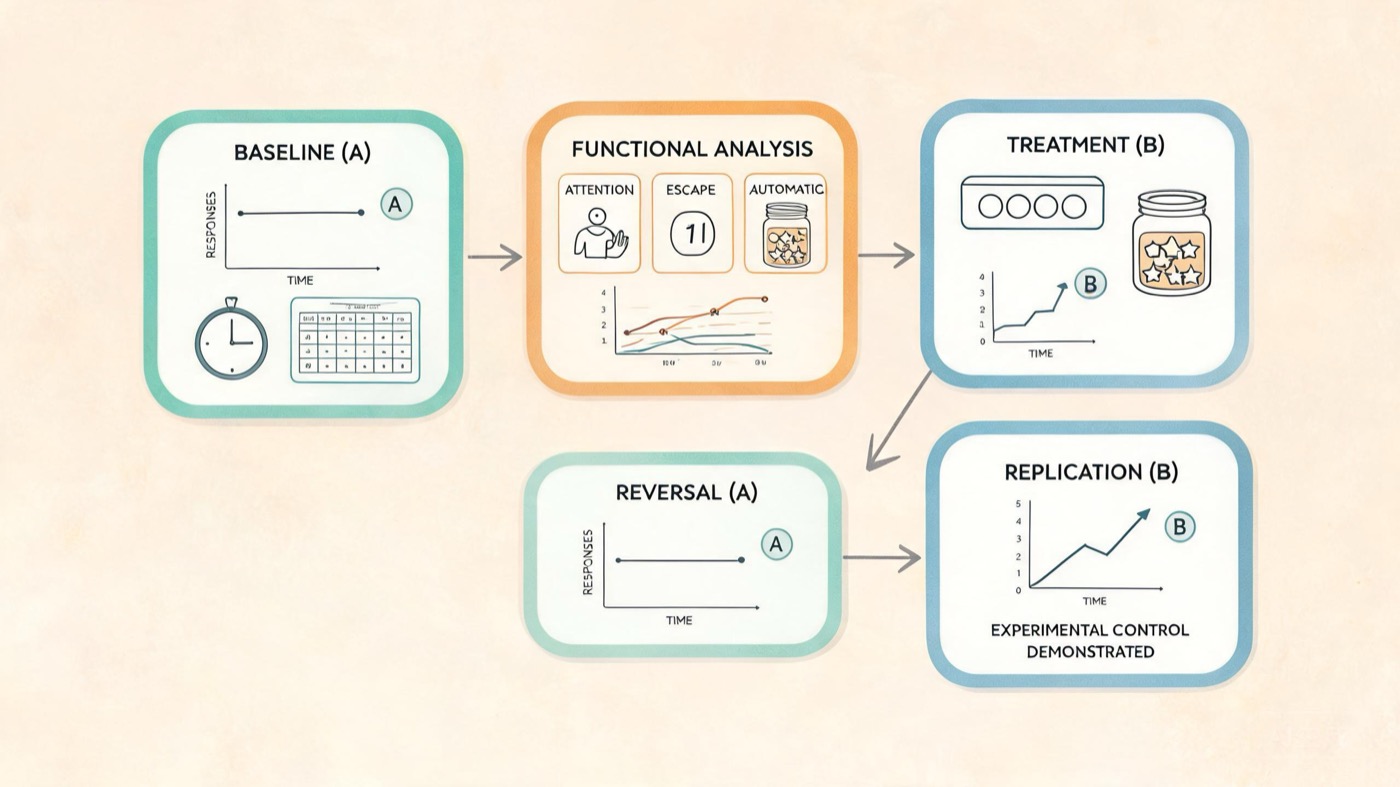
A functional analysis compares test conditions (e.g., escape, attention, alone) to a control condition (play). If aggression occurs mostly during the escape condition, and not during play, you have evidence that the behavior is maintained by escape from demands. Differential responding across conditions demonstrates experimental control because behavior changes only when the relevant establishing operation (demand) is present. This is the core logic of functional analysis.
Example 2: Reversal Design (ABAB) for Self-Injurious Behavior
In an ABAB design, baseline (A) shows high rates of self-injury. When intervention (B) is introduced, rates drop. Returning to baseline (A) sees rates increase, and reintroducing intervention (B) again reduces behavior. The replication of the effect across three phase changes (A to B, B to A, A to B) provides strong experimental control. Visual inspection of the data paths confirms a functional relation. For more on visual analysis, see our article on graphing and visual analysis in ABA.
Common Exam Traps and How to Avoid Them
Test-takers often confuse experimental control with other concepts. Here are two frequent pitfalls and how to sidestep them.
Confusing Correlation with Causation
Just because a behavior changes after an intervention does not mean the intervention caused it. Experimental control requires manipulation, not just co-occurrence. On the exam, look for designs that include baseline logic and replication. If a study only shows a pre-post change without a reversal or multiple baselines, it lacks experimental control.
Overgeneralizing Group Designs
ABA relies on single-subject experimental designs, not group comparisons. Experimental control in ABA is demonstrated within the individual, not by comparing groups. Exam questions may try to trick you by describing a group design and asking if it demonstrates experimental control. Remember: true experimental control in ABA requires intrasubject replication, not statistical group differences.
Quick Checklist for Experimental Control
Use this checklist when evaluating a study or designing an intervention. Each item should be answered ‘yes’ to claim experimental control.
- Manipulate the IV: Did you systematically introduce and remove the intervention?
- Stable baseline: Was there a clear, stable pattern before the intervention?
- Replication: Did the effect occur across at least three phase changes (e.g., ABAB) or across multiple baselines?
- Rule out confounds: Did you control for history, maturation, instrumentation, and other threats?
- Visual inspection: Do the data show a clear change in level, trend, or variability coinciding with phase changes?
For a comprehensive review of single-subject designs, visit our guide on single-subject experimental designs for the BCBA exam.
Summary: Experimental Control in ABA
Experimental control is the bedrock of ABA practice and a core topic for the BCBA exam. It involves manipulating the independent variable, using baseline logic, and replicating effects to demonstrate a functional relation. Remember to distinguish it from internal validity, watch for common threats, and always rely on visual inspection of single-subject data. As a final study tip, work through practice scenarios that ask you to identify designs with and without experimental control. For additional resources, the BACB offers guidelines on experimental design. Mastering this concept will help you not only pass the exam but also become a more effective behavior analyst.


