
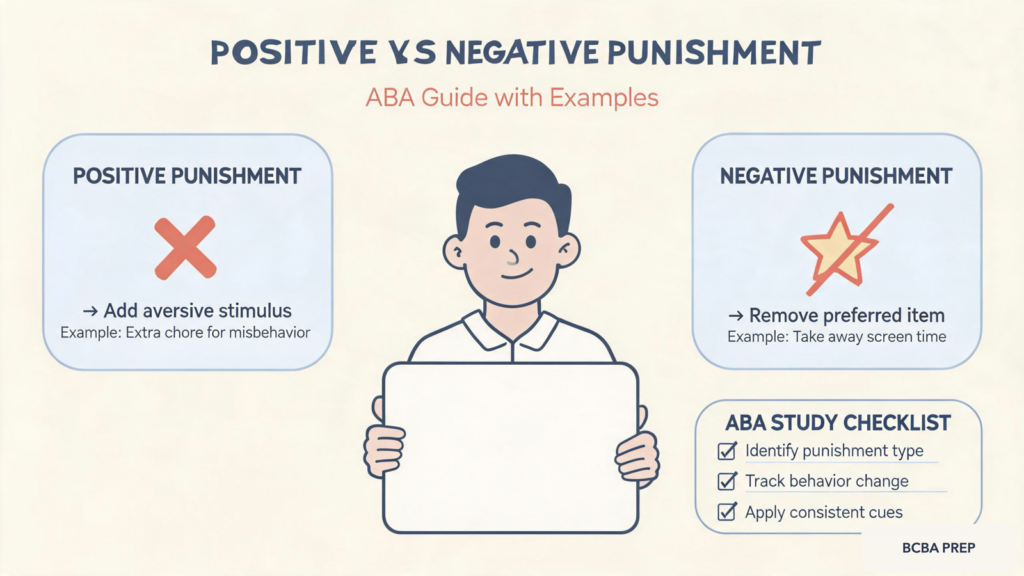
What Are Positive and Negative Punishment?
In applied behavior analysis (ABA), positive punishment and negative punishment are two types of punishment procedures. Both are used to decrease the future frequency of a behavior. The terms ‘positive’ and ‘negative’ refer to whether a stimulus is added or removed, not to whether the consequence is ‘good’ or ‘bad’.
Table of Contents
- What Are Positive and Negative Punishment?
- ABA Examples with ABC Data and Hypothesized Function
- Exam Relevance and Common Traps
- Quick Checklist: Positive vs Negative Punishment
- Final Summary: Why This Matters for the BCBA Exam
- References
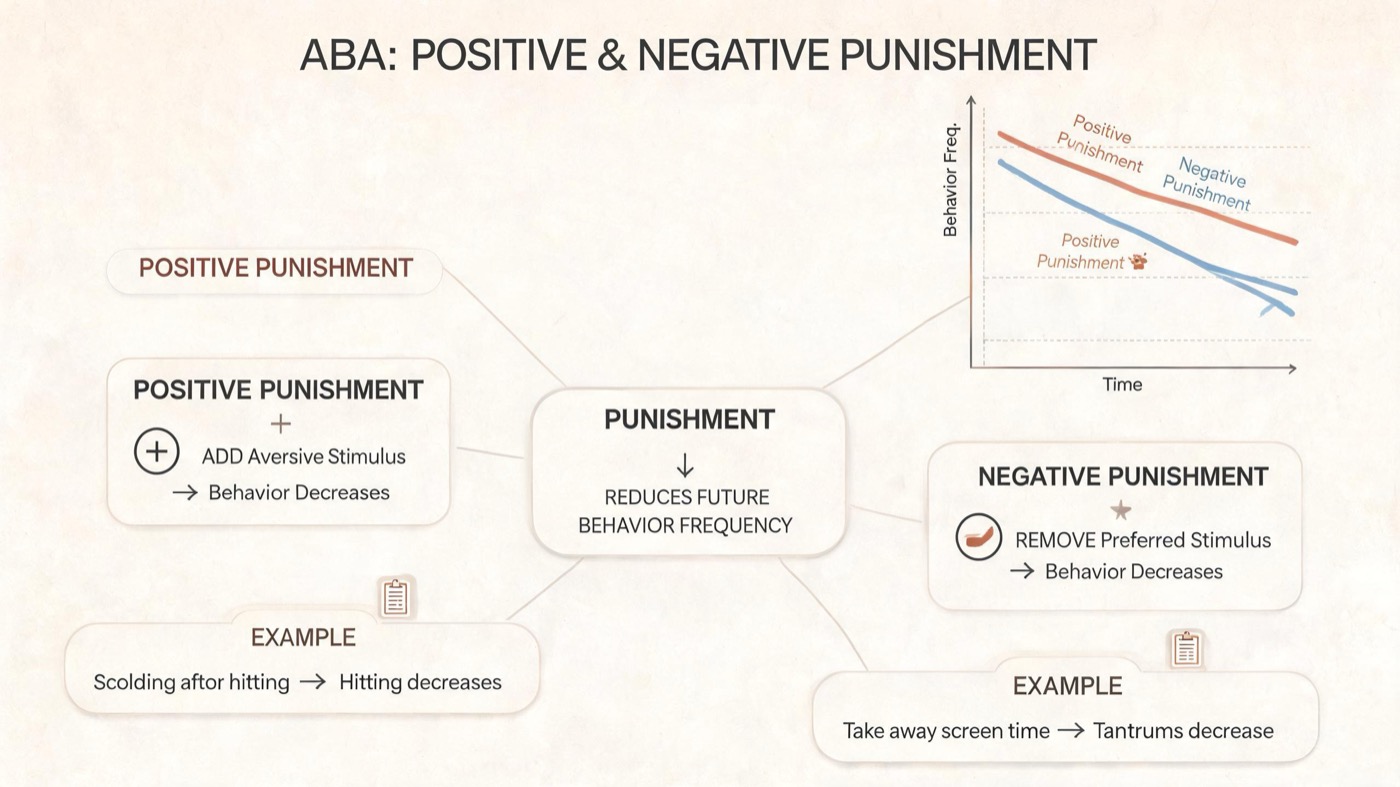
Positive Punishment Defined
Positive punishment occurs when an aversive stimulus is added immediately after a behavior, resulting in a decrease in that behavior. For example, a teacher gives a verbal reprimand (‘Stop that!’) after a student talks out of turn. The reprimand is added, and the talking is less likely to occur in the future.
Negative Punishment Defined
Negative punishment occurs when a reinforcing stimulus is removed immediately after a behavior, leading to a decrease in that behavior. For instance, a child loses access to their tablet for 10 minutes after hitting a sibling. The removal of the tablet (a reinforcer) reduces the likelihood of hitting.
Key Difference: Addition vs Removal
The core distinction is simple: positive = add something; negative = remove something. Many students confuse this because they associate ‘negative’ with ‘bad,’ but in ABA terms, it simply means subtraction. Always ask yourself: Was a stimulus added or taken away? If added, it’s positive punishment; if removed, it’s negative punishment.
ABA Examples with ABC Data and Hypothesized Function
Understanding punishment in context is essential. Below are two worked examples using the ABC (Antecedent-Behavior-Consequence) format, plus a hypothesized function for each.
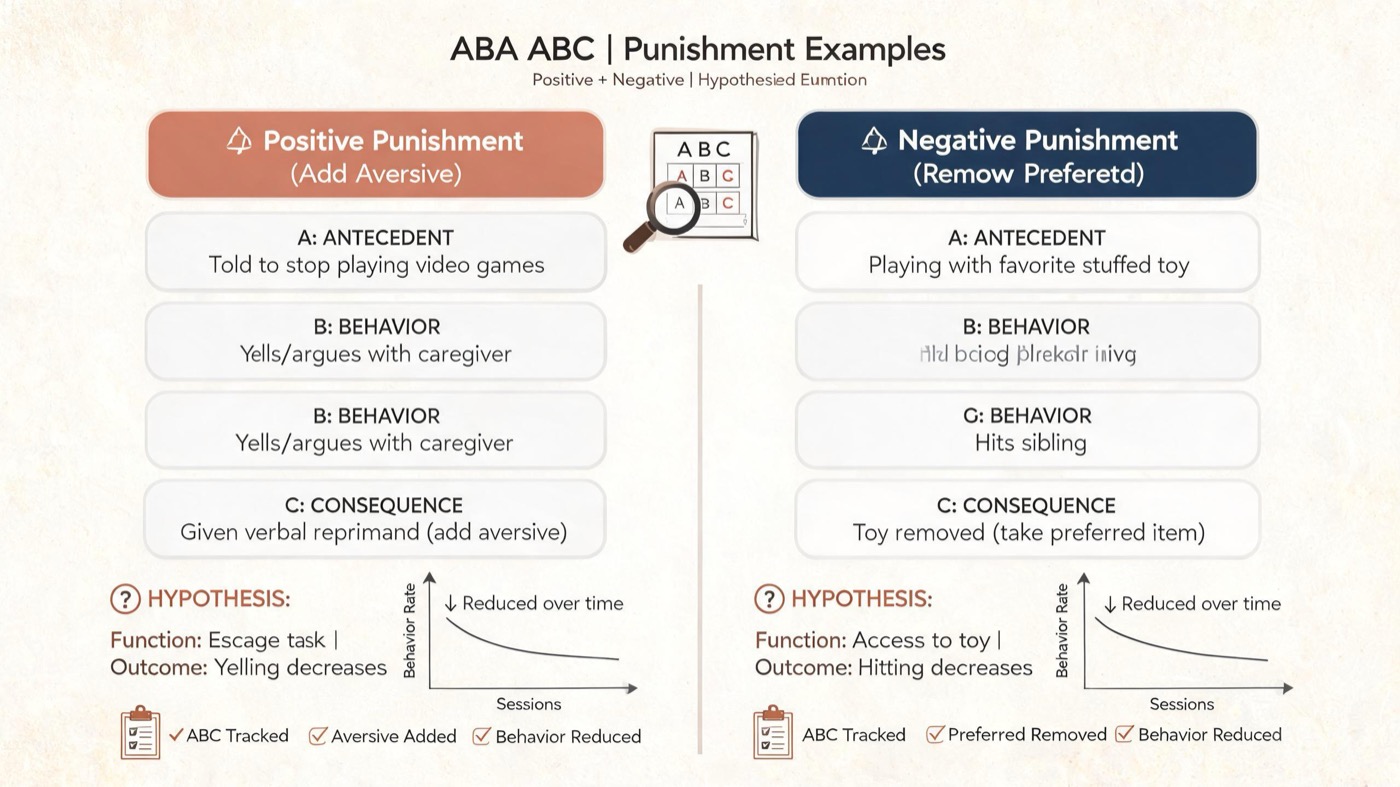
Example 1: Positive Punishment (Client Screaming)
- Antecedent: Therapist presents a math worksheet to a child.
- Behavior: Child screams and throws the worksheet on the floor.
- Consequence: Therapist delivers a loud verbal reprimand (‘No screaming!’). The reprimand is an added aversive stimulus.
- Hypothesized function: Escape from academic demands. The screaming likely serves to escape the worksheet. The reprimand may not be effective if the child’s behavior is maintained by escape; in fact, it might reinforce the behavior if attention is also a reinforcer. This illustrates why function-based interventions are critical.
Example 2: Negative Punishment (Loss of Tablet)
- Antecedent: Parent tells a child to clean up toys.
- Behavior: Child ignores the instruction and continues playing on a tablet.
- Consequence: Parent calmly takes the tablet away for 5 minutes. The tablet (a reinforcing stimulus) is removed.
- Hypothesized function: Access to tangible (tablet). The noncompliance is maintained by continued access to the tablet. Removing the tablet is a logically related consequence that decreases noncompliance.
Example 3: Positive Punishment (Self-Injurious Behavior)
- Antecedent: Caregiver removes preferred item from a child.
- Behavior: Child hits own head with hand.
- Consequence: Caregiver applies a brief cool compress to the child’s head (added stimulus).
- Hypothesized function: The self-injurious behavior may be maintained by automatic reinforcement (sensory stimulation) or by access to attention. The cool compress is an aversive stimulus added to decrease the behavior. This is a positive punishment procedure, though ethical considerations often prompt the use of reinforcement-based strategies first.
Exam Relevance and Common Traps
The BCBA exam frequently tests punishment concepts. Questions may present a scenario and ask you to identify the type of punishment or its side effects. Watch out for these common traps.
How the BCBA Exam Tests Punishment
- You may be given an ABC narrative and asked, ‘Is this an example of positive or negative punishment?’
- Questions about side effects of punishment: aggression, emotional outbursts, escape/avoidance behaviors.
- Scenarios that combine punishment with reinforcement (e.g., differential reinforcement) to see if you can distinguish procedures.
Trap 1: Confusing Negative Punishment with Negative Reinforcement
Negative reinforcement increases behavior because an aversive stimulus is removed (e.g., a child stops crying after being given a toy; crying increases). Negative punishment decreases behavior because a reinforcing stimulus is removed (e.g., toy taken away after crying; crying decreases). Always check whether the target behavior increases (reinforcement) or decreases (punishment).
Trap 2: Assuming Punishment is Always ‘Bad’
In ABA, punishment is a technical term; it does not imply ethical judgment. Punishment procedures can be part of a comprehensive intervention plan when used ethically and combined with reinforcement. However, the BACB ethics code emphasizes using least restrictive procedures and prioritizing reinforcement-based interventions.
Trap 3: Overgeneralizing Positive vs. Negative Based on the Word ‘Bad’
Some students think ‘positive’ means ‘good’ and ‘negative’ means ‘bad.’ This leads to errors. Remember: positive = addition (of any stimulus), negative = removal (of any stimulus). A punishment can be positive (adding a reprimand) or negative (removing a toy), and both are technically ‘punishment’ because they decrease behavior.
Quick Checklist: Positive vs Negative Punishment
Use this list when studying for the exam:
- Identify the behavior: Is it decreasing? If yes, it’s punishment.
- Ask: Was a stimulus added or removed? Added = positive punishment; removed = negative punishment.
- Check the function: Does the consequence logically relate to the behavior? For punishment to be effective, it should be immediate and contingent.
- Consider side effects: Punishment can lead to aggression, emotional outbursts, or escape behaviors. Always pair with reinforcement.
- Distinguish from negative reinforcement: Negative reinforcement increases behavior; negative punishment decreases it.
- Use ABC format: Write out the antecedent, behavior, and consequence to determine the procedure.
Final Summary: Why This Matters for the BCBA Exam
Mastering positive vs negative punishment is crucial for the BCBA exam. You will need to identify which type of punishment is being used in a given scenario, recognize common pitfalls, and understand the ethical considerations. Remember that punishment is just one tool in your intervention toolbox; reinforcement-based strategies should always be the first line of defense. For more practice, check out our BCBA Mock Exam 6th Edition and our Punishment in ABA guide. Practice with real scenarios to solidify your understanding and avoid the traps. Good luck!


