
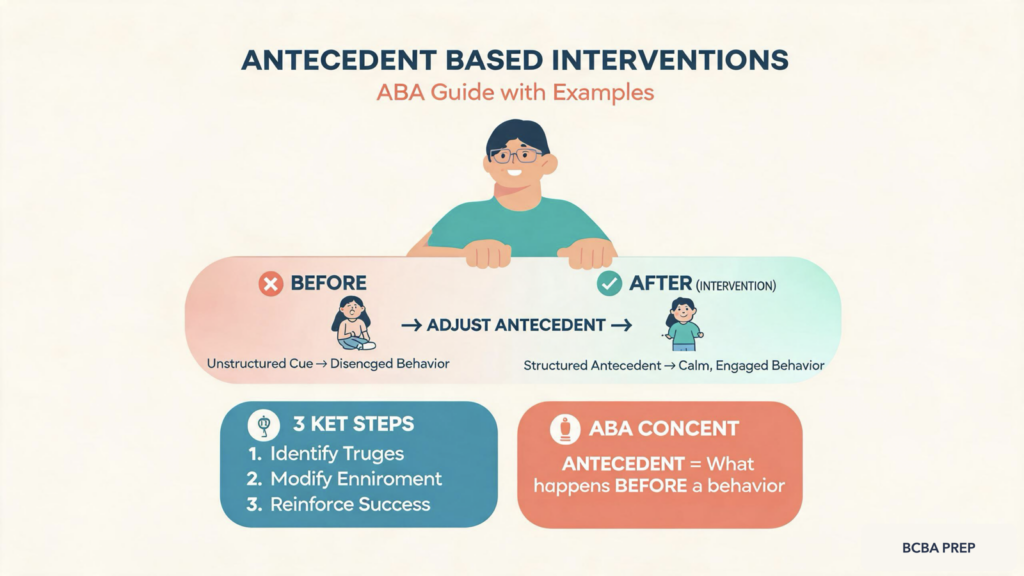
What Are Antecedent Based Interventions?
Antecedent based interventions (ABI) are a proactive strategy in applied behavior analysis that involves modifying the environment or circumstances that occur before a behavior to reduce the likelihood of challenging behavior or increase desired behavior. Unlike consequence-based strategies that respond after the behavior, ABI focuses on prevention.
Table of Contents
- What Are Antecedent Based Interventions?
- Antecedent Based Interventions in Action: Worked Examples
- Exam Relevance: What BCBA Candidates Need to Know
- Quick Checklist for Antecedent Based Interventions
- Summary: Integrating ABI into Your Practice
Definition and Core Principles
The official definition: ABI involves altering or arranging the environment to prevent problem behaviors or promote appropriate behaviors. The core principle is that by changing what happens before the behavior, you can reduce the motivating operation or discriminative stimulus that triggers the behavior. This is a key component of a comprehensive behavior intervention plan.
Difference from Consequence-Based Interventions
Consequence-based interventions (e.g., reinforcement, punishment) change what happens after the behavior. ABI changes what happens before. Think of it like this: ABI is like removing the ice (antecedent) to prevent a slip, not treating the fall. This distinction is critical for the BCBA exam, as many test questions ask you to identify whether an intervention is antecedent or consequence-based.
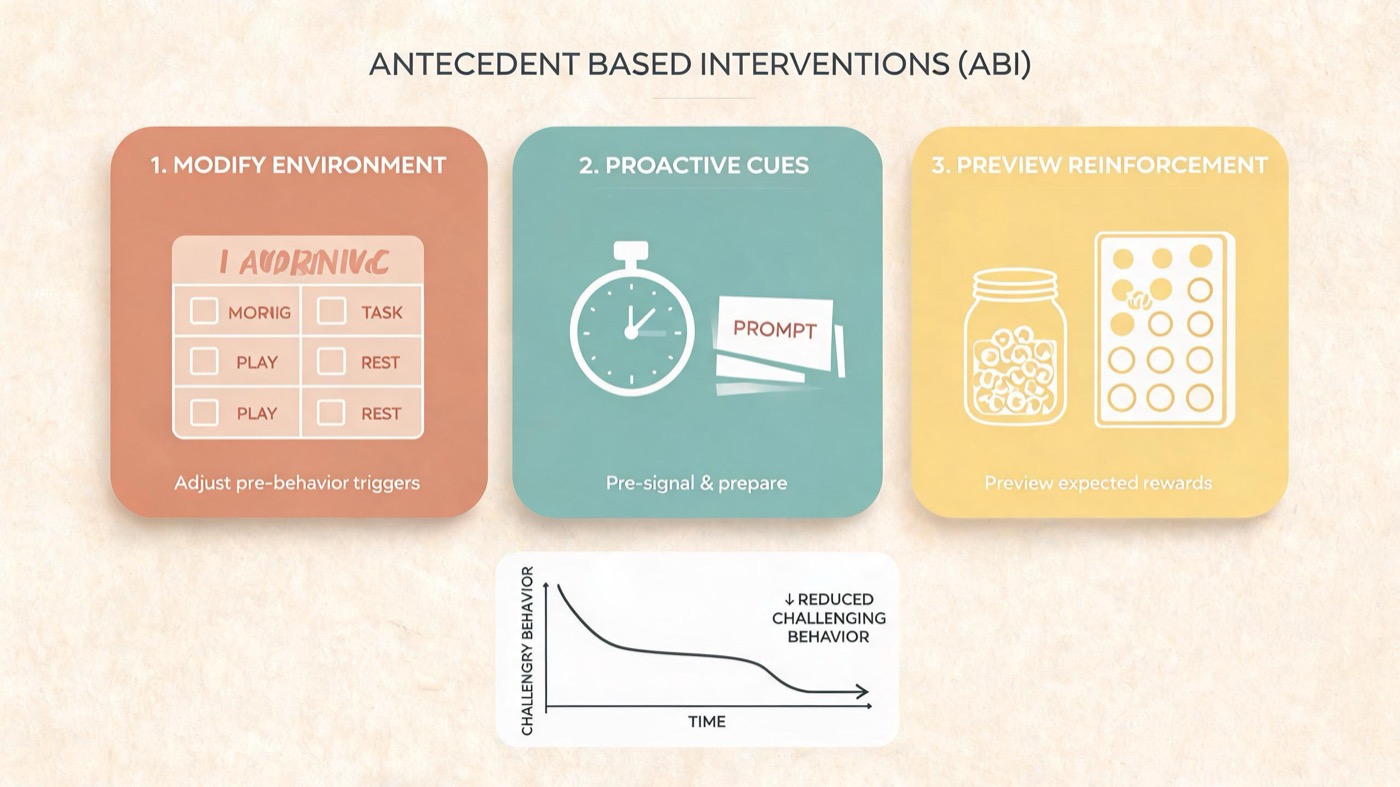
Antecedent Based Interventions in Action: Worked Examples
Let’s examine three real-world ABA examples that illustrate how antecedent based interventions are applied in practice. Each includes an ABC analysis and hypothesized function.
Example 1: Reducing Aggression During Transitions
A child screams and hits when told “Time to clean up.” ABC analysis: Antecedent = verbal instruction to transition; Behavior = screaming, hitting; Consequence = escape from the task. Hypothezised function: escape. Antecedent intervention: Use a visual timer and provide a 2-minute warning before the transition. This reduces the aversive nature of the sudden change and decreases aggression.
Example 2: Increasing On-Task Behavior with Task Modification
A student leaves their seat during lengthy worksheets. ABC: Antecedent = worksheet with 20 problems; Behavior = leaving seat; Consequence = brief break from non-preferred work. Hypothezised function: escape. Antecedent intervention: Break the worksheet into three smaller sections, each followed by a preferred activity (e.g., a short game). This reduces the task aversiveness and increases on-task behavior.
Example 3: Decreasing Vocal Stereotypy with Environmental Enrichment
A learner engages in humming when alone. ABC: Antecedent = no stimulation; Behavior = humming; Consequence = sensory input. Hypothezised function: automatic reinforcement. Antecedent intervention: Provide a sensory bin with preferred toys that offer similar sensory input. This enriches the environment and reduces the need for vocal stereotypy.
Example 4: Increasing Compliance with Choice-Making
A child refuses to complete math worksheets. ABC: Antecedent = teacher says “Do your math”; Behavior = refusal (e.g., cry, push materials away); Consequence = escape from task. Hypothezised function: escape. Antecedent intervention: Offer a choice between two math tasks (e.g., “Do page 1 or page 2?”) or a choice of where to sit. This provides autonomy and reduces escape-motivated refusal.
Exam Relevance: What BCBA Candidates Need to Know
The BCBA exam frequently tests your understanding of antecedent based interventions and how they fit into the broader behavior intervention plan. Here’s what you need to know.
Common Exam Traps
- Trap 1: Confusing ABI with extinction. Extinction removes the maintaining reinforcer (e.g., ignoring the behavior). ABI changes antecedents (e.g., altering the environment). They are not the same.
- Trap 2: Forgetting that ABI must be based on function. An antecedent intervention that does not match the function is ineffective. For example, providing a sensory toy for escape-maintained behavior will not reduce the problem.
- Trap 3: Assuming ABI alone will solve severe behaviors. For high-risk behaviors, ABI is often combined with consequence strategies like reinforcement or extinction. ABI is a proactive component, not a standalone solution.
- Trap 4: Overlooking environmental arrangements. Some candidates forget that ABI includes changes to the physical environment (e.g., seating, lighting, noise levels) and not just task modifications.
Task List Links
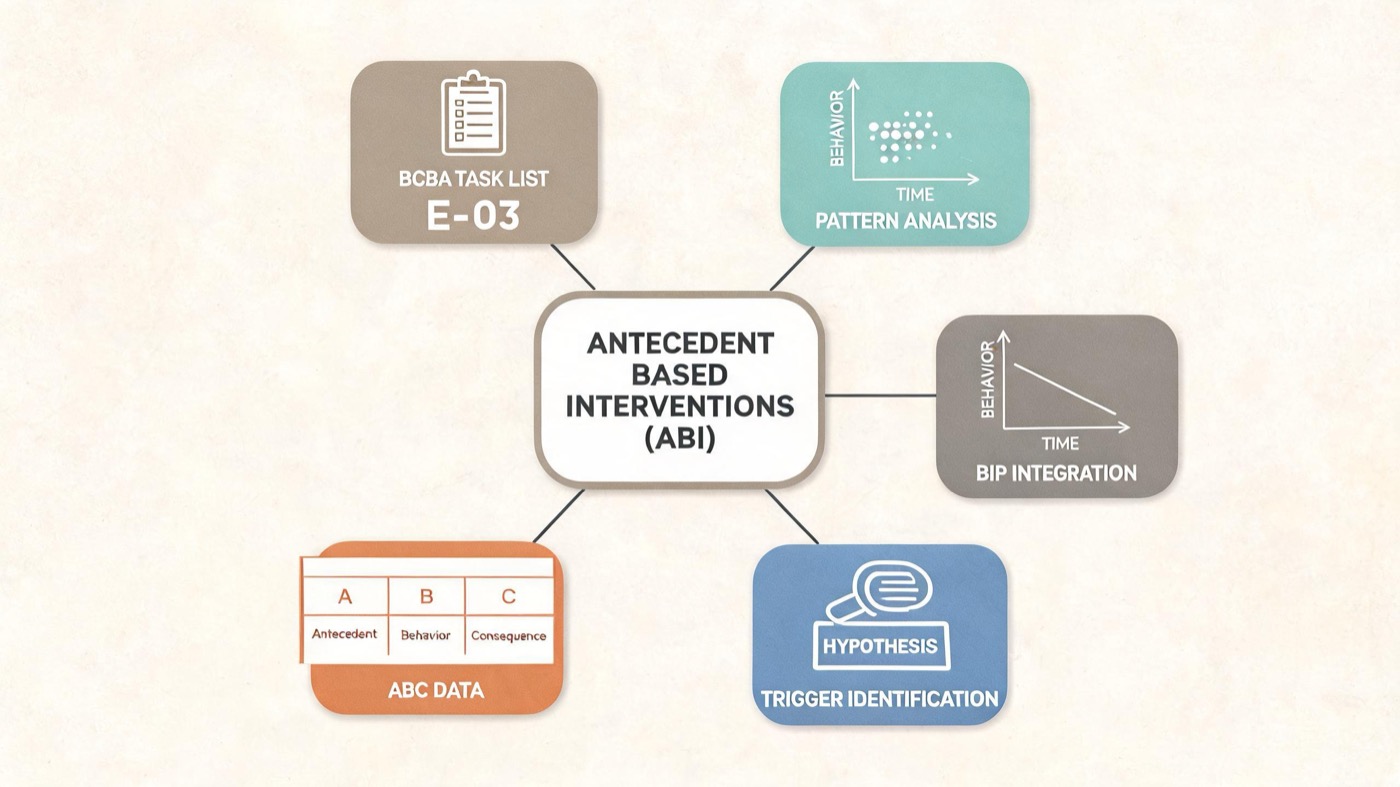
The BCBA 6th Edition Task List includes several items directly related to ABI: E-03 (use antecedent interventions), E-01 (use assessment data to select interventions), and E-05 (use extinction). On the exam, you may be asked to identify which antecedent modification would be most appropriate given a specific function. For more on this, check out our guide on functional behavior assessment.
Quick Checklist for Antecedent Based Interventions
Use this checklist when designing or evaluating an ABI for your exam scenarios or practice.
Five Steps to Implement ABI
- 1. Identify target behavior and hypothesized function. Conduct a functional assessment (e.g., ABC data, functional analysis) to determine what maintains the behavior.
- 2. Analyze antecedents. What specific triggers (e.g., time of day, noise, demand type) precede the behavior? Look for patterns in your data.
- 3. Select antecedent modification. Choose a strategy that matches the function. Options include: change environment, adjust task difficulty, provide choices, use visual supports, enrich the environment, or alter schedule.
- 4. Implement consistently. Train staff or caregivers to apply the modification with fidelity. Use a behavior intervention plan to standardize the approach.
- 5. Monitor and adjust based on data. Collect data on the target behavior to see if the ABI is effective. If not, reassess the function or try a different antecedent strategy.
Quick Memorization Aid
To remember key ABI types, think of the acronym CHOICE: Change environment, High-probability requests, Offer choices, Incompatible behaviors, Cues/visuals, Enrichment. This can help you quickly generate intervention ideas on the exam.
Summary: Integrating ABI into Your Practice
Antecedent based interventions are a cornerstone of proactive, function-based behavior support. By modifying what happens before a behavior, you can prevent problem behaviors and promote positive alternatives. For BCBA candidates, mastering ABI means understanding the function, selecting appropriate modifications, and avoiding common confusions with consequence strategies. Use the checklist and examples here to build your confidence. For more exam prep resources, explore our BCBA mock exams and other study materials. Also, read more about evidence-based practices from the Behavior Analyst Certification Board to deepen your knowledge.


