
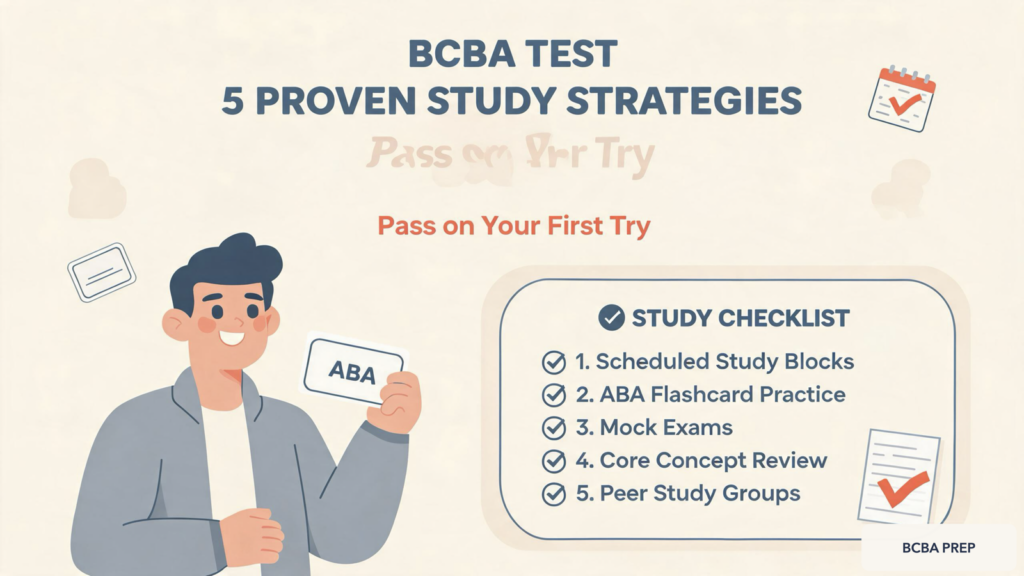
Understanding the BCBA Test: What’s on It and Why It Matters
Passing the BCBA test is a major milestone for anyone pursuing Board Certified Behavior Analyst certification. This comprehensive exam evaluates your knowledge of applied behavior analysis, ethics, and professional practice. A strong study plan is essential to cover the breadth of content and develop the application skills required.
Table of Contents
- Understanding the BCBA Test: What’s on It and Why It Matters
- 5 Study Strategies That Work for the BCBA Test
- Real ABA Examples: ABC Analysis You Might See on the Test
- Common Exam Traps and How to Avoid Them
- Your Quick BCBA Test Prep Checklist
- Final Summary: Your Path to Passing the BCBA Test
- References
The exam is based on the BACB Task List (5th or 6th edition). It includes 150 multiple-choice questions, with a 4-hour time limit. Content areas range from measurement and experimental design to behavior-change procedures and ethical conduct. Understanding the test structure helps you allocate study time effectively.
What is the BCBA Test?
The BCBA test is the certification exam administered by the Behavior Analyst Certification Board (BACB). It assesses your ability to apply ABA principles in real-world settings. You must demonstrate both conceptual knowledge and practical decision-making skills.
Test Format and Content Areas
- Number of questions: 150 multiple-choice (125 scored + 25 pilot)
- Time limit: 4 hours
- Domains: Measurement, Experimental Design, Behavior Assessment, Behavior-Change Procedures, and Ethics/Professional Conduct
- Scoring: Your raw score is converted to a scaled score; passing threshold is typically 80%–85% of items correct.
Why a Structured Study Plan is Critical
The BCBA test is known for its rigor. Many questions require you to evaluate scenarios and select the best intervention or explanation. A disorganized approach leads to gaps in knowledge. Following a structured plan ensures you cover all task list items and practice application under timed conditions.
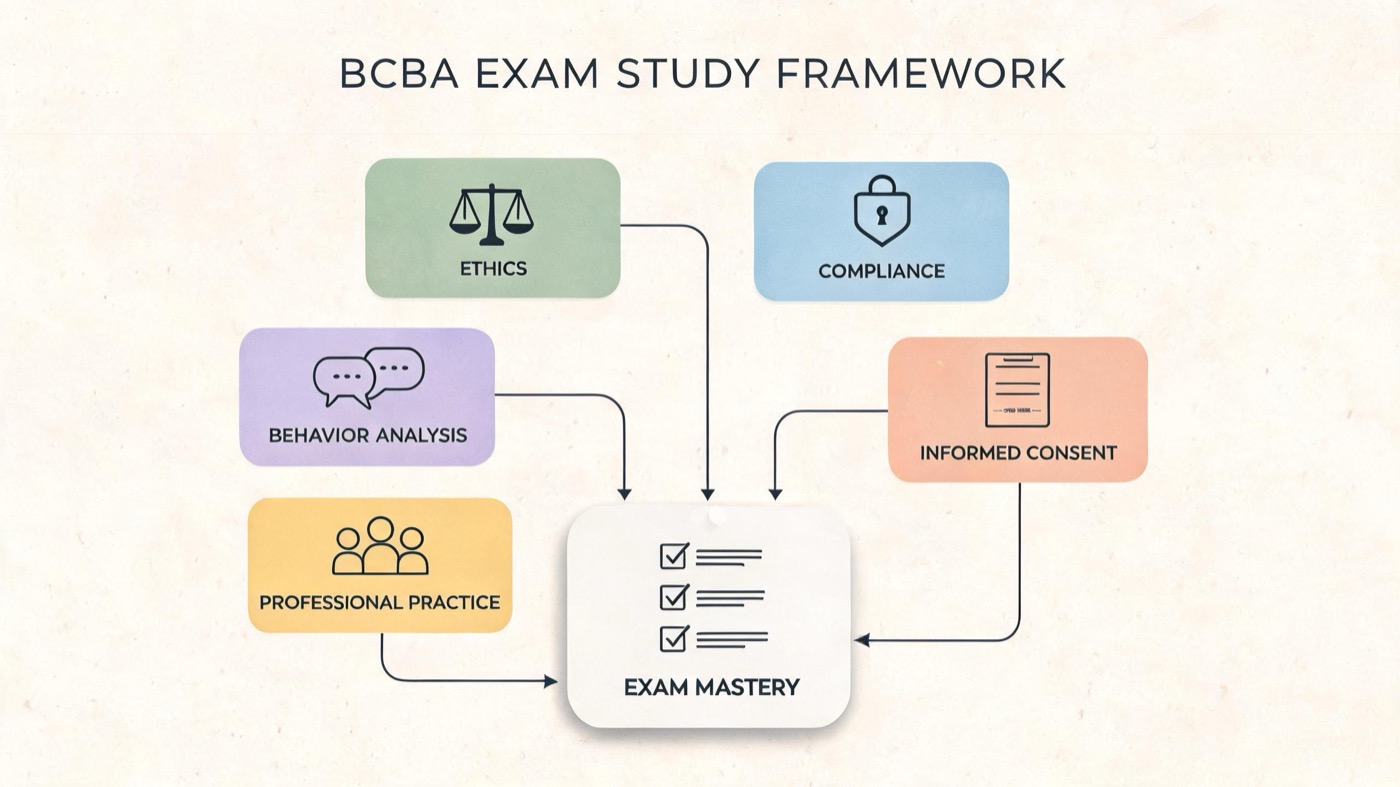
5 Study Strategies That Work for the BCBA Test
These evidence-based strategies will help you maximize retention and performance. Integrate them into your daily routine for consistent progress.
Strategy 1: Active Recall with Flashcards
Active recall is one of the most effective learning techniques. Use digital flashcards (e.g., Anki, Quizlet) with spaced repetition. Write definitions, key terms, and examples on the front; detailed explanations on the back. Review daily, focusing on cards you consistently get wrong.
Strategy 2: Work Through Real ABA Examples
Exam questions often present a clinical scenario. Practice ABC analysis by identifying antecedents, behaviors, and consequences. For instance, a child crying after a demand is removed suggests an escape function. The more examples you analyze, the faster you’ll recognize patterns on test day.
Strategy 3: Mock Exams Under Timed Conditions
Simulate the actual test environment. Take full-length mock exams from reputable sources, like BCBA Mock Exam 6th Edition. This builds time management skills and reduces anxiety. Review every incorrect answer to understand why your choice was wrong.
Strategy 4: Focus on the BACB Task List
Use the task list as your syllabus. Rate each item on a scale from 1 (need review) to 5 (mastered). Prioritize areas with low confidence. For each task, write a brief explanation or draw a diagram. Revisit the BACB Task List 6th Edition regularly to track progress.
Strategy 5: Group Study and Peer Teaching
Explaining concepts to others reinforces your understanding. Form a study group with peers or use online forums. Teach a concept like differential reinforcement or schedules of reinforcement. If you can explain it clearly, you’ve likely mastered it.
Real ABA Examples: ABC Analysis You Might See on the Test
Here are two authentic ABC examples that mirror exam questions. Practice identifying each component and hypothesizing the function.
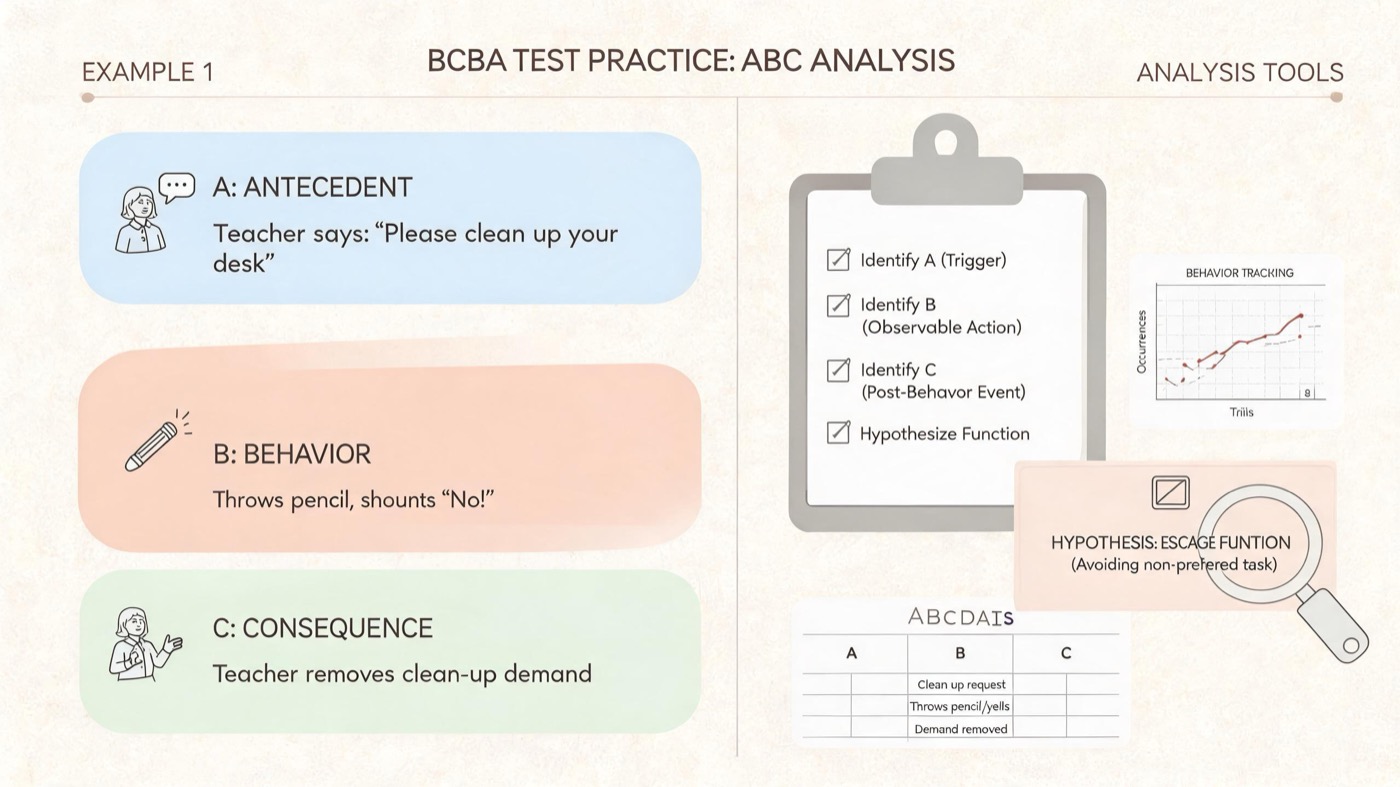
Example 1: Escape from Demands
Antecedent: Teacher says, “Please clean up your desk.”
Behavior: Student throws pencil and shouts “No!”
Consequence: Teacher removes the demand and lets the student sit quietly.
Function: Escape. The behavior allows the student to avoid a non-preferred task.
Example 2: Attention-Maintained Behavior
Antecedent: Mother is on the phone, ignoring the child.
Behavior: Child tugs on mother’s arm and screams “Mom!”
Consequence: Mother ends the call and says, “What do you need?”
Function: Attention. The behavior gains social interaction.
For more practice, review the four functions of behavior to deepen your understanding.
Common Exam Traps and How to Avoid Them
Many test-takers fall into predictable pitfalls. Awareness of these traps can save you valuable points.
Confusing Function with Topography
Don’t assume that similar-looking behaviors have the same function. For example, two students may both hit, but one does it to escape a difficult task and the other to gain peer attention. Focus on the maintaining consequence, not the form.
Misidentifying Reinforcement Schedules
Questions often test your ability to distinguish between fixed vs. variable and ratio vs. interval schedules. Remember: ratio schedules depend on number of responses; interval schedules depend on time. Use mnemonics like “VR is variable ratio” to recall quickly.
Overlooking Ethics in Scenarios
Many questions embed ethical dilemmas. Always check if the answer respects client dignity, confidentiality, and informed consent. Even if a behavioral intervention is effective, it may violate the BACB Ethics Code. Practice ethical decision-making alongside technical knowledge.
Rushing Through Data-Based Questions
When you see a graph or data table, take a moment to interpret trends, level, and variability. Don’t jump to conclusions. Identify which experimental design was used and whether a functional relation is demonstrated. Slowing down improves accuracy.
Your Quick BCBA Test Prep Checklist
- Create a study schedule covering all task list items
- Review flashcards daily using spaced repetition
- Complete at least two full-length mock exams under timed conditions
- Analyze every incorrect answer to identify patterns
- Practice ABC analysis with 10–15 real-life or practice examples
- Review the BACB Ethics Code and identify common violations
- Join a study group or find a study buddy for peer teaching
- Take a practice exam one week before the real test to gauge readiness
- Ensure you have required identification and know your testing center location
- Get adequate sleep and hydration the night before
Final Summary: Your Path to Passing the BCBA Test
Passing the BCBA test requires strategic preparation, not just hard work. By using active recall, mock exams, and focused review of the task list, you can build confidence and mastery. Analyze real ABA examples to sharpen your clinical judgment. Avoid common traps by always considering function over topography and ethics alongside technique. With a structured plan and consistent practice, you can pass on your first try. Good luck!


