
What Is Affirming the Consequent?
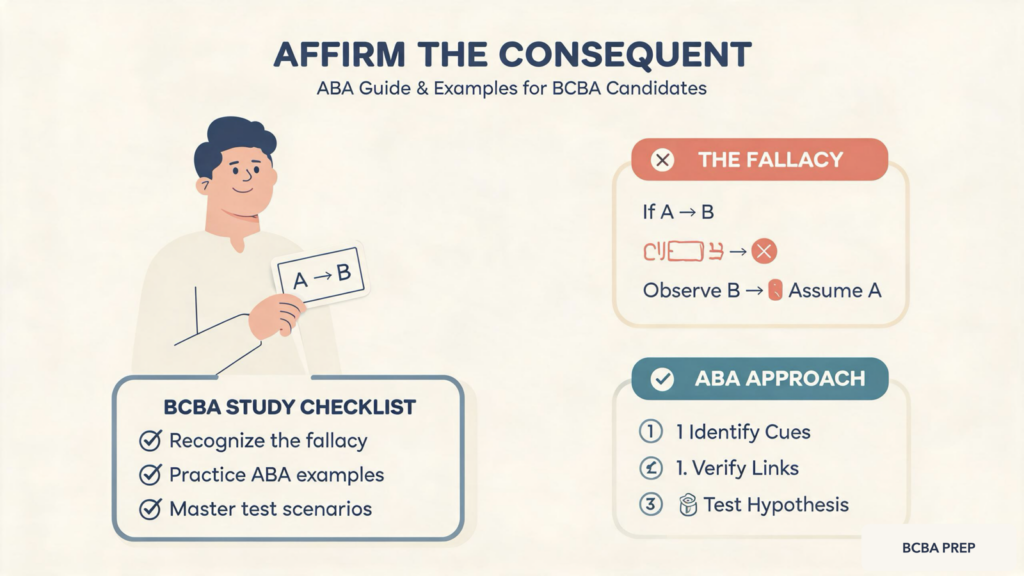
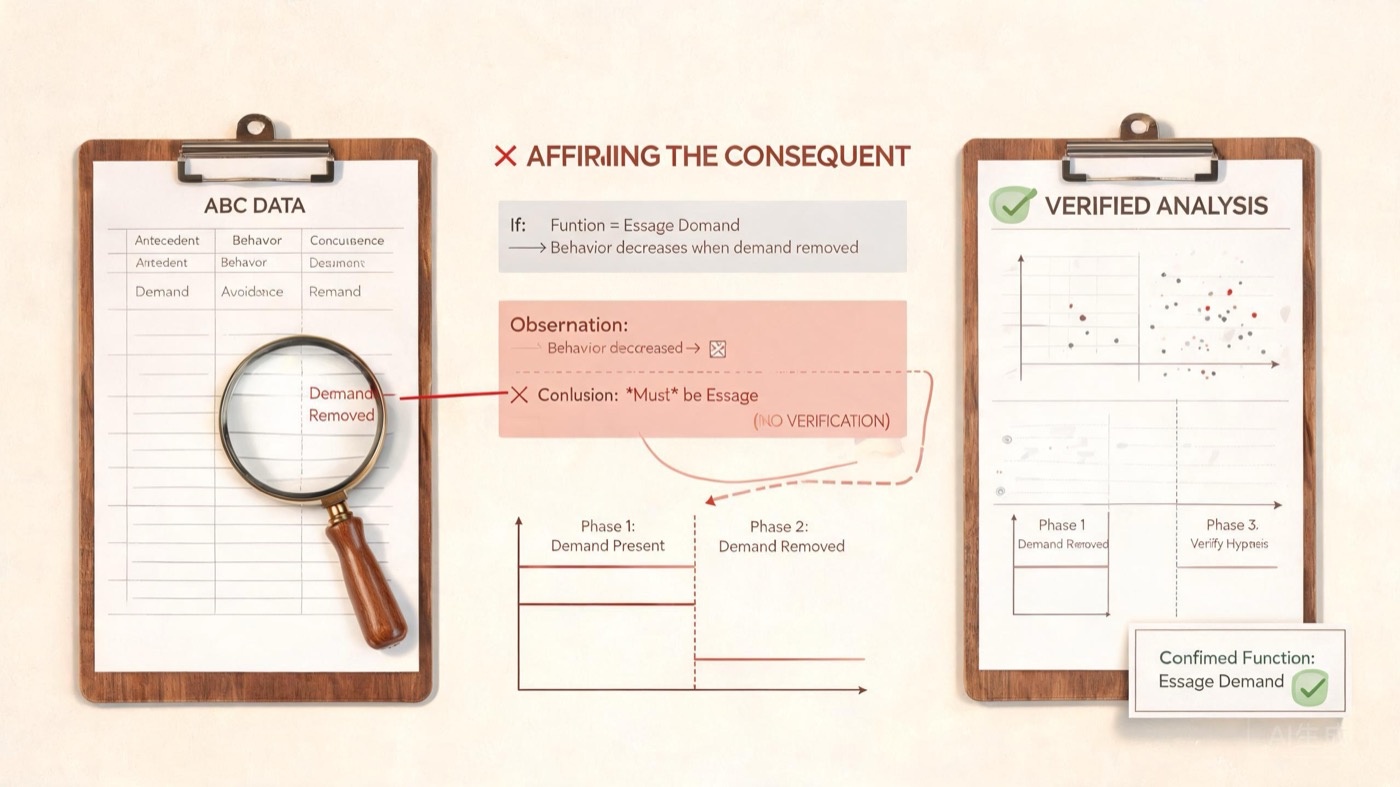
Imagine a therapist says: ‘If the behavior is maintained by escape, then removing the demand will decrease it. We removed the demand and the behavior decreased, so the function must be escape.’ This reasoning commits a logical fallacy known as affirm the consequent. In formal logic, it follows the pattern: If P then Q; Q is true; therefore P is true. This is invalid because Q could be caused by something else entirely.
Table of Contents
- What Is Affirming the Consequent?
- Affirming the Consequent in Behavior Analysis: Why It Matters
- Worked ABA Examples of Affirming the Consequent
- How the BCBA Exam Tests This Concept
- Quick Study Checklist: Affirming the Consequent for BCBA Candidates
For example, if it rains the ground gets wet. But seeing wet ground does not guarantee rain—a sprinkler could have caused it. In ABA, this fallacy leads to incorrect function assignments and ineffective interventions. Understanding this concept is critical for the BCBA exam, where you must identify flawed reasoning in scenarios.
The Logical Form of This Fallacy
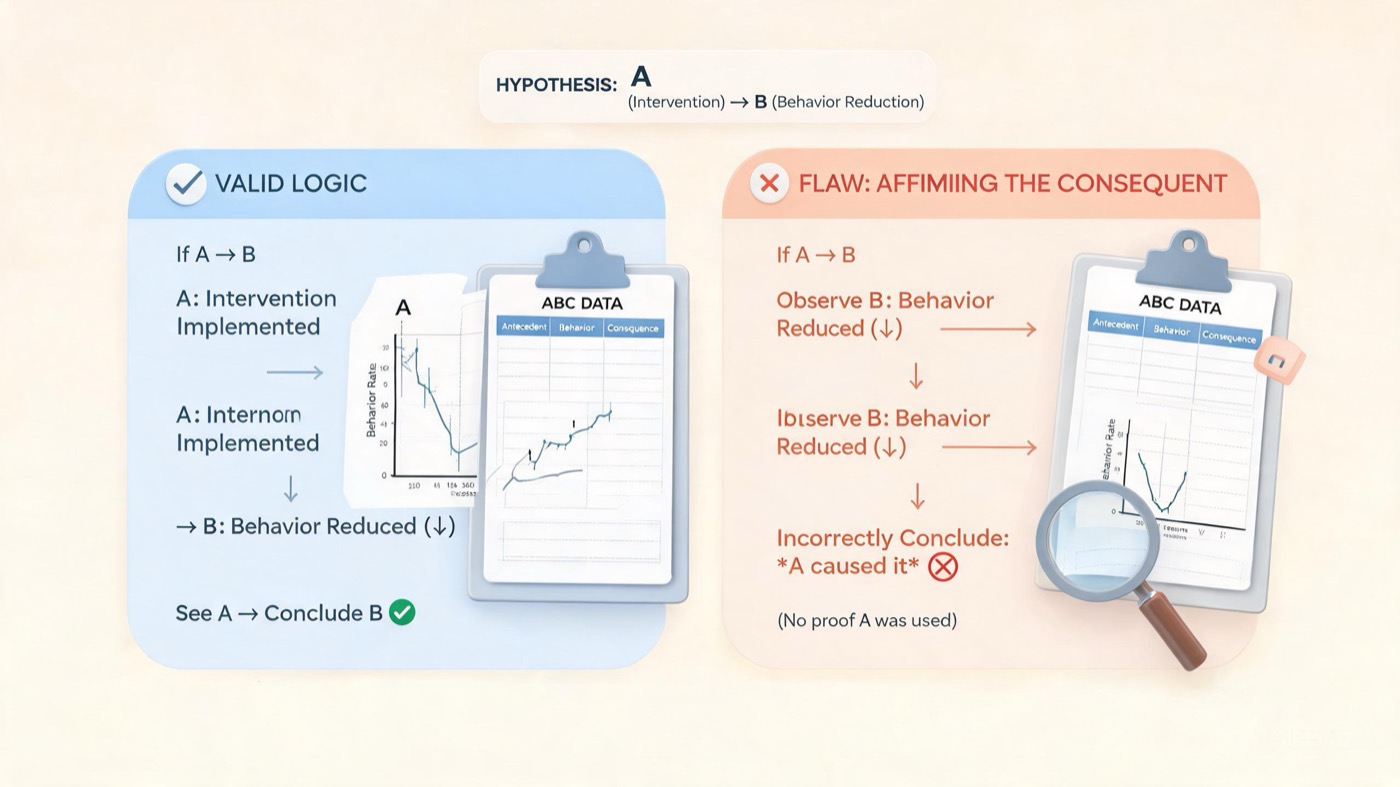
Formally: If P, then Q. Q is observed, so P is concluded. The error is ignoring alternative causes. In behavior analysis, P is often a hypothesized function, and Q is the observed behavior change. Without experimental control (e.g., a functional analysis), affirming the consequent is a threat to internal validity.
Affirming the Consequent in Behavior Analysis: Why It Matters
Behavior analysts rely on data to determine function. When we assume a function based solely on a correlation (e.g., behavior decreases after we remove a demand), we may commit the affirm the consequent error. This matters because it can lead to selecting interventions that match a presumed function rather than the actual one, wasting time and client progress.
Common scenarios include:
- After a descriptive assessment, hypothesizing a function without experimental verification.
- Assuming that because a behavior decreased after a consequence change, that consequence was the maintaining variable.
- Overlooking multiple control (e.g., behavior may be maintained by both escape and attention).
- Confusing functional control with mere temporal correlation.
The gold standard to avoid this fallacy is to conduct a functional analysis (FA) where conditions are systematically manipulated. Without FA, you risk affirming the consequent based on incomplete data.
Common Scenarios Where the Fallacy Appears
In practice, you might see a behavior consultant say: ‘The child tantrums when asked to do work; we give a break and tantrums stop; therefore, the function is escape.’ While plausible, this reasoning is invalid if the break also provides attention (multiple functions). The only way to confirm is to test each variable separately.
Worked ABA Examples of Affirming the Consequent
Let’s examine three concrete examples that illustrate how this fallacy can mislead a BCBA in training or practice.
Example 1: Escape-Maintained Behavior
Antecedent: Teacher presents a math worksheet. Behavior: Student throws pencil. Consequence: Teacher removes the worksheet. The behavior decreases. Hypothesis: Escape from demands. However, the demand removal also provides a break from the classroom noise (sensory escape). Without testing, one might affirm the consequent and incorrectly conclude escape is the sole function. An FA with a control condition (demand present, no break) is needed to confirm.
Example 2: Attention-Maintained Behavior
Antecedent: Parent is on the phone. Behavior: Child calls out loudly. Consequence: Parent says ‘Stop yelling!’ Hypothesis: Attention function. However, the parent’s reprimand also includes eye contact and proximity, which could be reinforcing. Also, the child may be engaging in automatic reinforcement (sensory stimulation from loud noise). Affirming the consequent here would overgeneralize attention as the only function, missing a possible automatic reinforcement component.
Example 3: Automatic Reinforcement
Antecedent: Client is alone in a quiet room. Behavior: Hand flapping. Consequence: Sensory feedback. Hypothesis: Automatic reinforcement. But what if the hand flapping previously led to caregiver attention (when they were present)? The behavior could be maintained by both automatic and social reinforcement. Assuming automatic alone is affirming the consequent unless properly tested via alone vs. attention conditions in an FA.
How the BCBA Exam Tests This Concept
The BCBA exam often presents scenario-based questions where you must identify flawed reasoning. You may be asked to choose whether a conclusion is valid or which logical error is present. Key terms include affirming the consequent, denying the antecedent, and modus ponens.
Common Traps to Avoid on Exam Day
- Confusing affirming consequent with modus ponens: Modus ponens is valid (If P then Q; P is true; therefore Q). Affirming consequent is invalid (If P then Q; Q is true; therefore P). Many students mix them.
- Ignoring alternative explanations: Just because a consequence follows behavior does not prove it maintains the behavior.
- Misidentifying the fallacy in a vignette: Read carefully: the scenario may present a hypothesis and a confirmed outcome, but the question may ask ‘which logical error is committed?’
- Overlooking the need for experimental control: Exam questions may describe a descriptive assessment result that ‘proves’ function. Recognize that descriptive data alone cannot confirm function due to affirming the consequent.
Practice with sample questions: For example, “A BCBA notices that when a client is given a break after aggression, aggression decreases. She concludes the function is escape. What error is she making?” The answer: affirming the consequent.
Quick Study Checklist: Affirming the Consequent for BCBA Candidates
- Define the logical form: If P then Q, Q, therefore P (invalid).
- Identify when a conclusion about function is based solely on observed correlation (e.g., descriptive assessment).
- Recognize that functional analysis is required to avoid the fallacy.
- Distinguish from modus ponens (valid) and denying the antecedent (invalid).
- In exam scenarios, look for the pattern: hypothesis + outcome = conclusion, but no experimental manipulation.
- Review at least three worked examples (escape, attention, automatic reinforcement).
- Use mnemonic: ‘If cause then effect; effect seen, but cause may not be the only one.’
Final Summary
Affirm the consequent is a logical fallacy that undermines accurate function identification in ABA. On the BCBA exam, understanding this concept helps you avoid choosing incorrect interventions and demonstrates critical thinking. Always seek experimental verification and question correlational conclusions. For more practice, check our free BCBA mock exam questions and explore related topics like functional analysis vs. descriptive assessment. Additionally, review the BACB’s resources on behavior analysis for foundational knowledge.


