
What Is a Stimulus? The ABA Definition
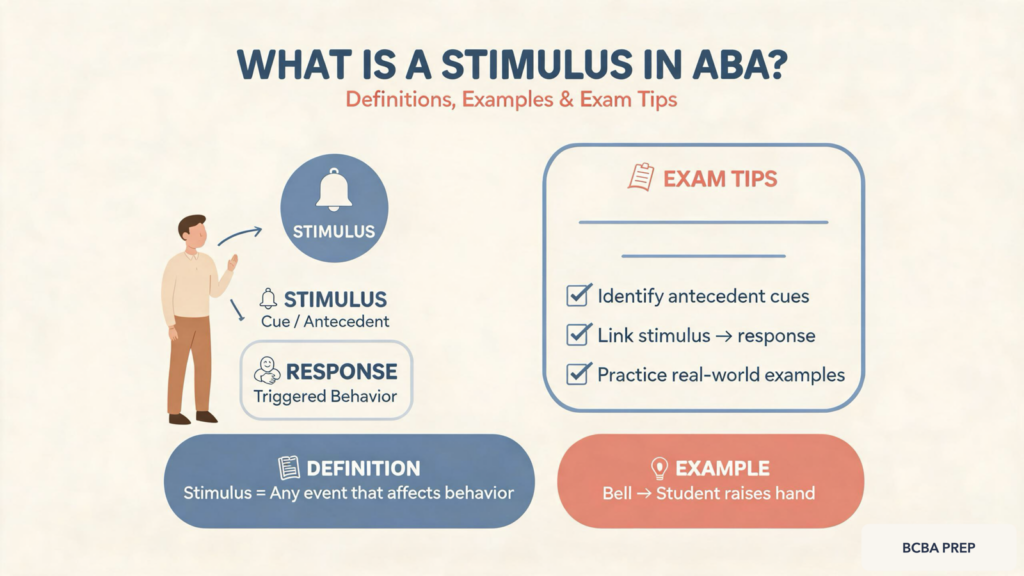
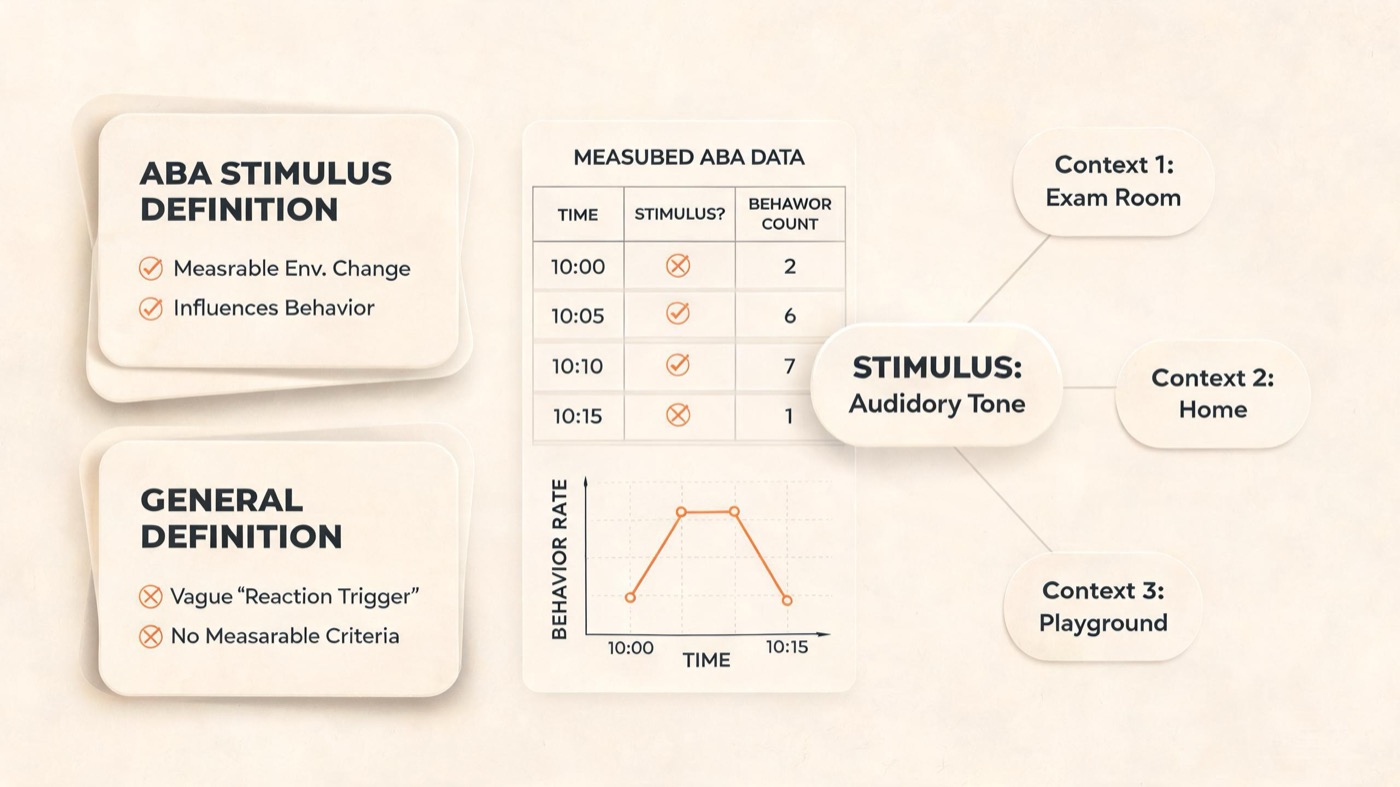
In applied behavior analysis, a stimulus is any specific environmental change that can influence behavior. Unlike a vague dictionary definition (‘something that causes a reaction’), ABA defines a stimulus precisely as a measurable event that occurs before, during, or after a behavior. Every time you see, hear, touch, or smell something that affects what a person does, you are observing a stimulus at work.
Table of Contents
- What Is a Stimulus? The ABA Definition
- Three Types of Stimuli Every BCBA Candidate Must Know
- ABA Worked Examples: Stimulus in ABC Data Collection
- Exam Relevance: How Stimulus Concepts Are Tested
- Quick Checklist for Identifying Stimuli on the Exam
- Summary: Key Takeaways About Stimulus in ABA
Understanding what a stimulus in ABA means is foundational for analyzing behavior and for scoring well on the BCBA exam. A stimulus is not the entire environment; it is a specific, identifiable component of the environment that can be manipulated or measured.
Stimulus vs. Environment: Clarifying the Difference
The environment includes everything around an individual. A stimulus, in contrast, is a particular environmental event that has a functional relationship with a behavior. For example, a teacher’s voice is part of the environment, but the teacher saying ‘What’s 2+2?’ is a stimulus if it reliably precedes a student’s answer. This distinction is critical for ABC data collection and functional analysis.
Three Types of Stimuli Every BCBA Candidate Must Know
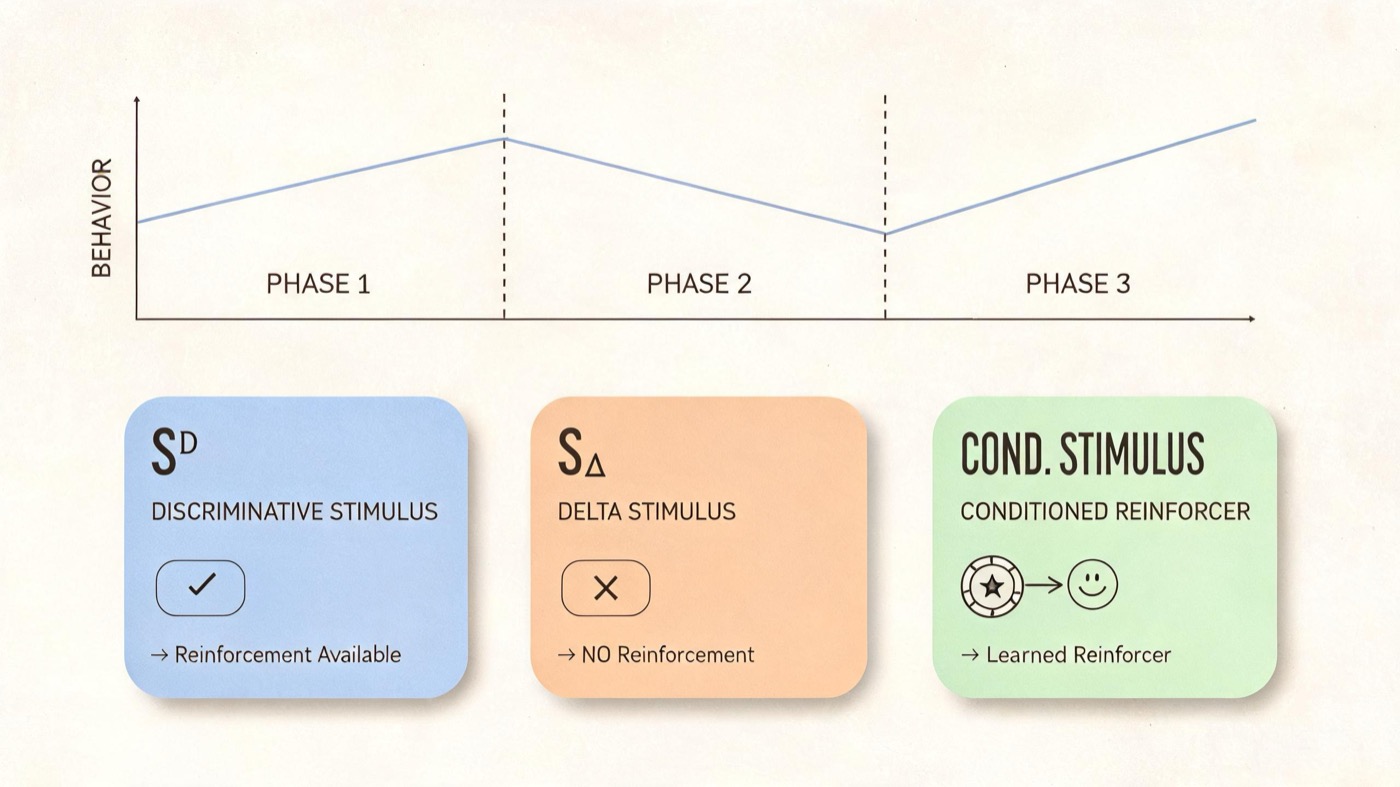
On the BCBA exam, you will encounter several types of stimuli. Mastering these three is essential for identifying antecedents, consequences, and discriminative stimuli in scenario questions.
Antecedent Stimulus: What Happens Before Behavior
An antecedent stimulus occurs immediately before a behavior and evokes or prompts that behavior. Examples include a teacher handing out a worksheet, a traffic light turning red, or a caregiver saying ‘Time to clean up.’ In ABA, antecedents include discriminative stimuli (Sᴰ) and motivating operations (MOs). For instance, when a teacher says ‘What’s 2+2?’ the spoken question is an antecedent stimulus that sets the occasion for a student to answer.
Consequence Stimulus: What Happens After Behavior
A consequence stimulus follows a behavior and affects the likelihood of that behavior occurring again. This includes reinforcement (e.g., a sticker for raising a hand) and punishment (e.g., losing a token for talking out of turn). On the exam, you must identify which consequence stimulus is maintaining or decreasing a behavior. For example, a child receives a sticker after completing a task; the sticker is a consequence stimulus that increases hand-raising.
Discriminative Stimulus (Sᴰ) and Motivating Operations (MOs)
A discriminative stimulus (Sᴰ) signals that a specific behavior will be reinforced. For example, a vending machine that is plugged in and has a dollar inserted is an Sᴰ for pressing buttons. A motivating operation (MO) alters the value of a reinforcer; for example, hours without food increases the value of snacks. Knowing the difference between Sᴰ and MO is a common exam topic. Check out our detailed guide on Sᴰ vs. MO differences for deeper study.
ABA Worked Examples: Stimulus in ABC Data Collection
Applying the concept of stimulus to real client scenarios helps you build a hypothesis of function. Here are three examples using the ABC (Antecedent-Behavior-Consequence) format.
Example 1: Tangible Function – Asking for a Toy
Antecedent: A peer removes a toy from the child’s hands. Behavior: The child cries. Consequence: The peer returns the toy. In this case, the removal of the toy is an antecedent stimulus, and the return of the toy is a consequence stimulus that reinforces crying. The hypothesis is access to tangible items.
Example 2: Escape Function – Difficult Task
Antecedent: A worksheet is placed on the desk. Behavior: The student throws the pencil. Consequence: The teacher removes the worksheet. Here, the worksheet is an antecedent stimulus, and its removal is a consequence that strengthens throwing. The hypothesis is escape from demands.
Example 3: Attention Function – Whining for Adult
Antecedent: Parent is on the phone. Behavior: Child whines. Consequence: Parent looks up and says ‘Stop whining.’ The parent’s phone use is an antecedent stimulus, and the verbal attention is a consequence stimulus. The hypothesis is access to attention.
Exam Relevance: How Stimulus Concepts Are Tested
The BCBA exam covers stimulus concepts under the BACB 6th Edition Task List, particularly in domains related to behavior change procedures and assessment. You will be asked to identify stimuli in scenarios, distinguish between types, and select appropriate interventions.
Common Exam Traps to Avoid
- Lumping all antecedents as Sᴰ. Not all antecedents signal reinforcement; some are MOs or neutral stimuli.
- Confusing consequence stimuli with reinforcers. A consequence stimulus is any event after behavior; a reinforcer is a specific consequence that increases behavior.
- Missing the distinction between stimulus and response. A stimulus is an environmental event; a response is the behavior itself.
- Ignoring motivating operations. MOs alter the effectiveness of consequences and are often tested alongside Sᴰ.
Review our article on antecedent exam traps for more pitfalls to avoid.
Quick Checklist for Identifying Stimuli on the Exam
Use this checklist when reading a scenario question to quickly pinpoint stimuli:
- Is the event observable and measurable? (If not, it may not be a stimulus.)
- Does it occur before the behavior? If yes, it is an antecedent stimulus.
- Does it occur after the behavior? If yes, it is a consequence stimulus.
- Does it signal that reinforcement is available? If yes, it is likely an Sᴰ.
- Does it change the value of a reinforcer? If yes, it is a motivating operation.
- Is the client’s behavior under stimulus control? That means the behavior occurs reliably in the presence of a specific stimulus.
Summary: Key Takeaways About Stimulus in ABA
A stimulus in ABA is any specific environmental change that affects behavior. Mastery of antecedents, consequences, Sᴰ, and MOs is essential for BCBA exam success. Use ABC charts to practice identifying stimuli in everyday scenarios. For more exam-focused content, visit our free BCBA practice questions. To learn more about the science behind behavior analysis, the BACB’s overview of behavior analysis is a valuable resource.


