
What Are Replacement Behaviors in ABA?
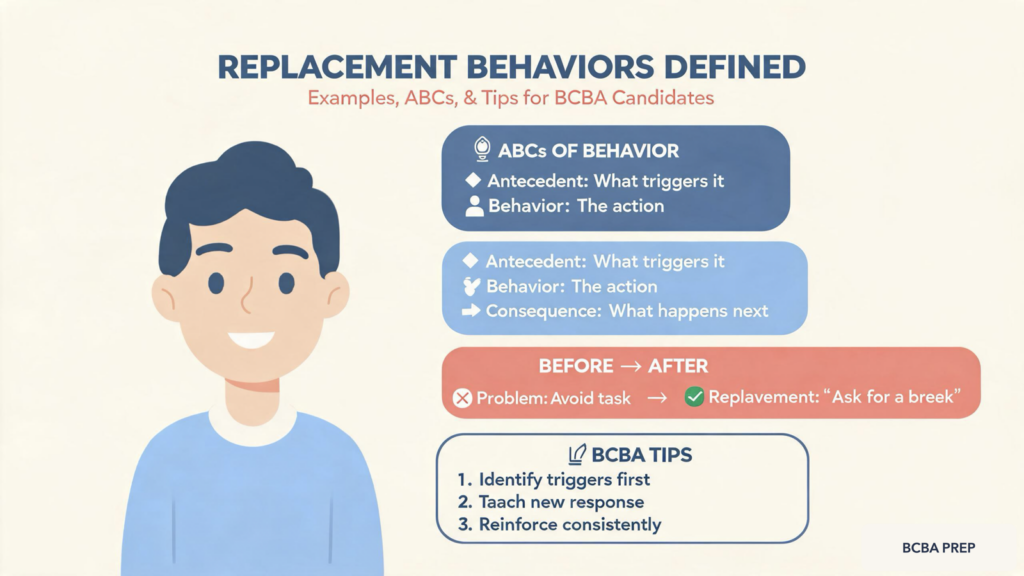
In Applied Behavior Analysis, replacement behaviors are socially acceptable actions that produce the same reinforcing outcome as a challenging behavior. The core idea is simple: you cannot simply reduce a problem behavior without teaching a more appropriate way to obtain the same result. A well-chosen replacement behavior must serve the same function as the undesired behavior.
Table of Contents
- What Are Replacement Behaviors in ABA?
- How to Choose a Replacement Behavior: A Step-by-Step Approach
- Real-World Examples: Replacement Behaviors in Action
- Exam Relevance: Common Traps and Tips
- Quick Checklist: Choosing a Replacement Behavior
- Why This Matters for Your BCBA Exam and Practice
Why Function Matters: Connecting Behavior to Purpose
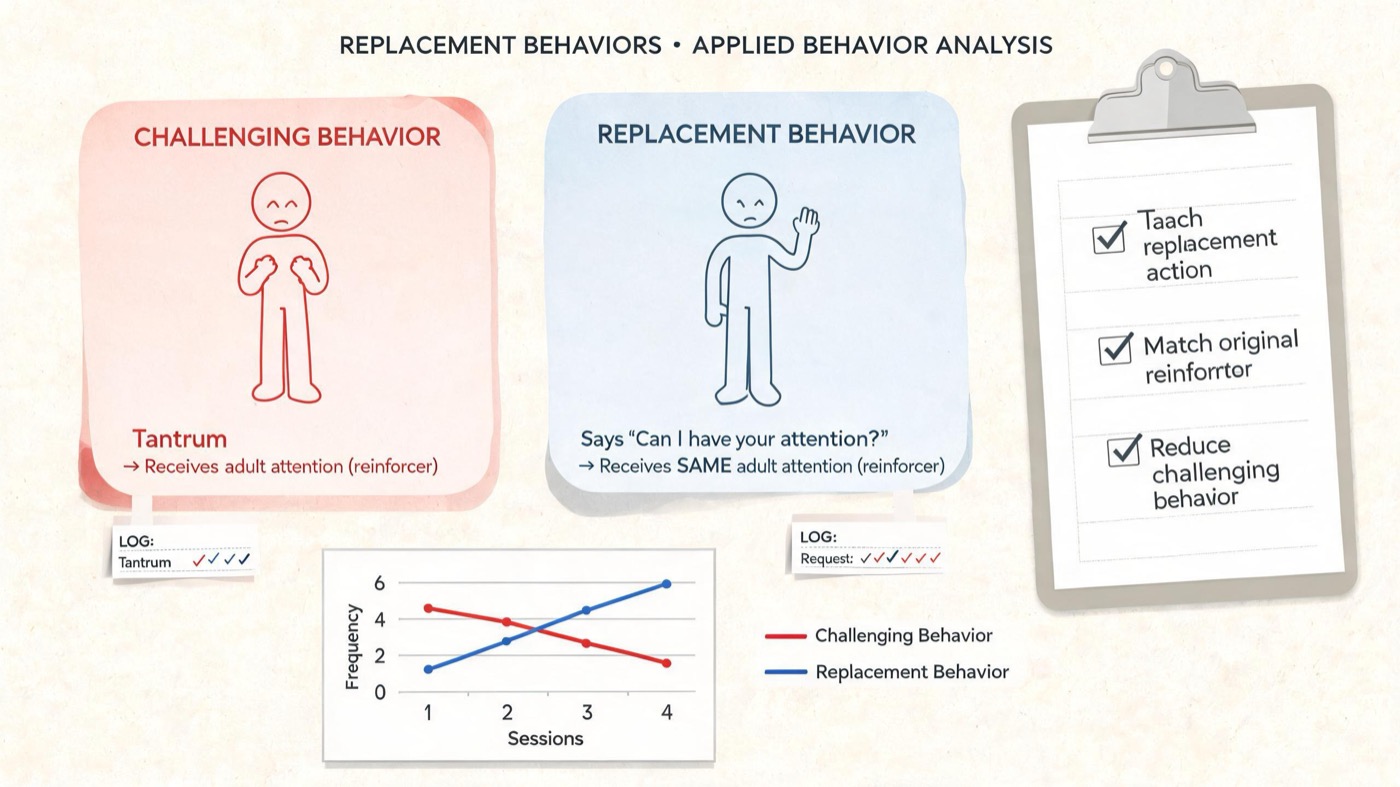
Every behavior happens for a reason. A functional behavior assessment (FBA) helps identify that reason. Whether the function is attention, escape, access to tangibles, or sensory stimulation, the replacement behavior must match it exactly. For example, if a student screams to escape math work, teaching a calm request (like saying ‘I need a break’) addresses the same escape function. If the replacement does not match, the challenging behavior will persist because the underlying need remains unmet.
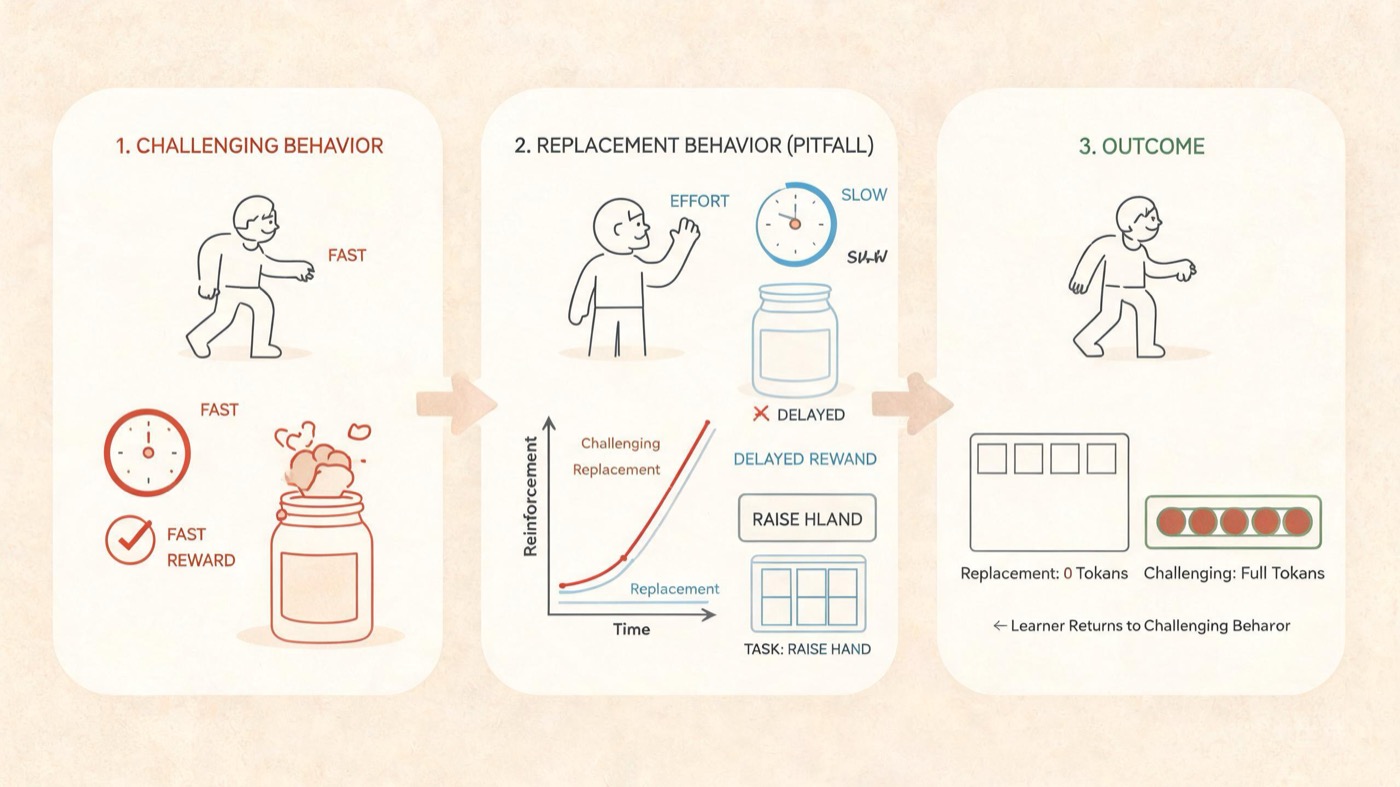
When selecting a replacement, ensure it is efficient and effective. The new behavior should be easier or at least as easy to perform as the challenging behavior. It should also produce the reinforcer quickly. If the replacement requires too much effort, the learner will revert to the old behavior.
For deeper insight into functional assessments, explore this guide on FBA.
How to Choose a Replacement Behavior: A Step-by-Step Approach
Step 1: Identify the Function
Use ABC data (Antecedent-Behavior-Consequence) to hypothesize the function. Record what happens before and after the behavior. Ask: what does the learner gain or avoid? This step is critical because function determines the replacement.
Step 2: Select a Behavior That Meets the Same Need
Choose a behavior that is socially appropriate and produces the same reinforcer. For example, if the function is attention, teach the learner to raise a hand or say ‘excuse me’ instead of whining. The replacement must be functionally equivalent.
Step 3: Teach and Reinforce the Replacement
Use differential reinforcement: reinforce every instance of the replacement behavior while withholding reinforcement for the challenging behavior. Initially, use a dense schedule; then gradually thin reinforcement to match natural contingencies. Consistency is key.
Real-World Examples: Replacement Behaviors in Action
Example 1: Escape from Demands
Scenario: A student elopes (leaves the classroom) during math worksheets. ABC Data: Antecedent: math worksheet presented. Behavior: elopement. Consequence: escape from worksheet. Function: escape. Replacement: teach the student to hand a ‘break card’ or say ‘I need help.’ When the student uses the card, provide a short break. Over time, shape the request to be more specific.
Example 2: Attention Seeking
Scenario: A child whines loudly while the parent is on the phone. ABC Data: Antecedent: parent on phone. Behavior: whining. Consequence: parent hangs up and scolds the child (attention). Function: attention. Replacement: teach the child to tap the parent’s shoulder and say ‘excuse me.’ Initially, immediately provide brief eye contact and a quiet ‘wait.’ Gradually lengthen the delay.
Example 3: Access to Tangibles
Scenario: A toddler grabs a toy from a peer. ABC Data: Antecedent: peer playing with preferred toy. Behavior: grab. Consequence: obtains toy. Function: access to tangible. Replacement: teach the child to say ‘my turn’ or exchange a picture card. Reinforce with access to the toy for a short time.
Example 4: Sensory Stimulation
Scenario: A student engages in hand-flapping to get sensory input. ABC Data: Antecedent: low stimulation environment. Behavior: hand-flapping. Consequence: sensory input. Function: sensory. Replacement: provide access to a sensory toy (e.g., a stress ball) that produces similar input but is less disruptive. Teach the student to request the toy or use it in designated settings.
Exam Relevance: Common Traps and Tips
BCBA candidates frequently make errors when distinguishing replacement behaviors from other behavior change strategies. Here are typical pitfalls.
Confusing Replacement, Incompatible, and Alternative Behaviors
- Replacement: serves the same function (e.g., asking for a break to escape).
- Incompatible: physically prevents the challenging behavior (e.g., hands in pockets can’t hit). This may or may not match the function.
- Alternative: any appropriate behavior, not necessarily functionally equivalent (e.g., deep breathing). The exam will ask you to identify which is which. Function is the key.
Efficiency and Effort: The Key to Effectiveness
If the replacement behavior is more effortful or slower to produce reinforcement than the challenging behavior, the learner will not use it. For example, teaching a three-step request to escape a demand may be too complex; a simple ‘break’ card is more efficient. Always consider response effort.
Reinforcement Schedules: Fading Support
Initially reinforce every occurrence of the replacement behavior (continuous schedule). Then thin to intermittent reinforcement that matches the natural environment. Watch for schedule thinning being done too quickly, which can cause relapse of the challenging behavior.
Common Exam Trap: Misidentifying Function
Many exam questions provide incomplete ABC data, leading you to choose the wrong function. Always ask: what consequence maintains the behavior? If the behavior is followed by escape, the function is escape—even if attention is also present. Focus on the maintaining consequence.
Quick Checklist: Choosing a Replacement Behavior
- Conduct a functional behavior assessment to identify the function.
- Select a behavior that is functionally equivalent (same reinforcer).
- Ensure the replacement is easier or equally easy to perform.
- Teach the replacement using explicit instruction (modeling, role-play, feedback).
- Use differential reinforcement: reinforce replacement, extinguish challenging behavior.
- Monitor efficiency: does the replacement produce reinforcement quickly?
- Plan for generalization: teach across settings and people.
- Thin reinforcement gradually to natural contingencies.
Why This Matters for Your BCBA Exam and Practice
Mastering replacement behaviors is essential for both passing the BCBA exam and designing effective behavior intervention plans. The ability to select function-based replacements sets apart skilled practitioners. For more exam-focused strategies, review our BCBA exam prep guide.
Remember: a behavior intervention plan without a strong replacement component is incomplete. Always pair reduction goals with skill-building. For additional reading, visit the BACB website for ethical guidelines on behavior change.


