
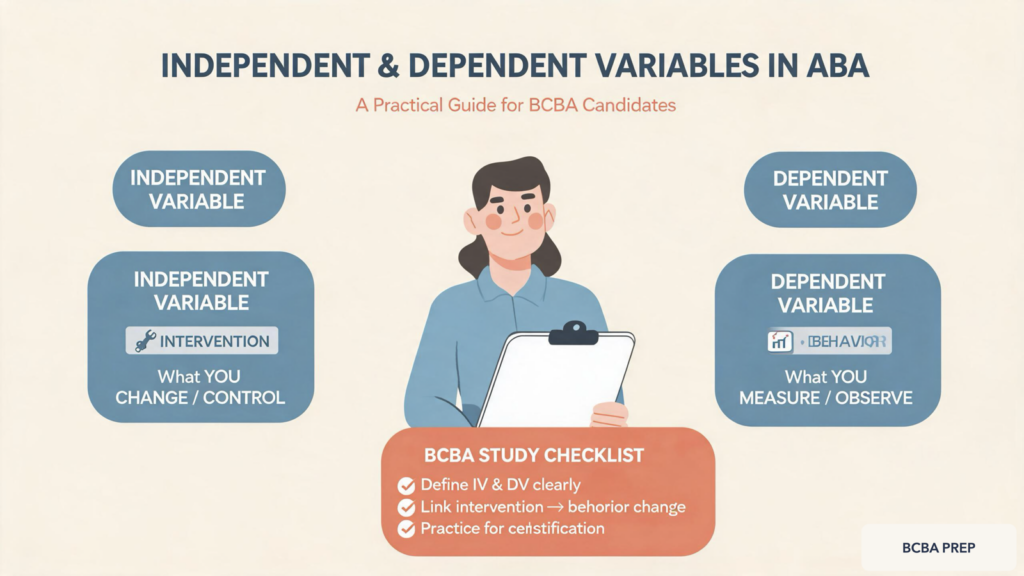
Understanding the relationship between the independent variable dependent variable and control is essential for the BCBA exam. These concepts form the backbone of experimental design in applied behavior analysis (ABA), allowing practitioners to draw conclusions about functional relations. This guide breaks down each term, provides concrete ABA examples, highlights common exam traps, and offers a quick checklist to solidify your knowledge.
Table of Contents
- What Are Independent and Dependent Variab
- ABA Examples: Independent, Dependent, and Control in Action
- Exam Relevance and Common Traps
- Quick Checklist for Exam Day
- Summary
- References
What Are Independent and Dependent Variab
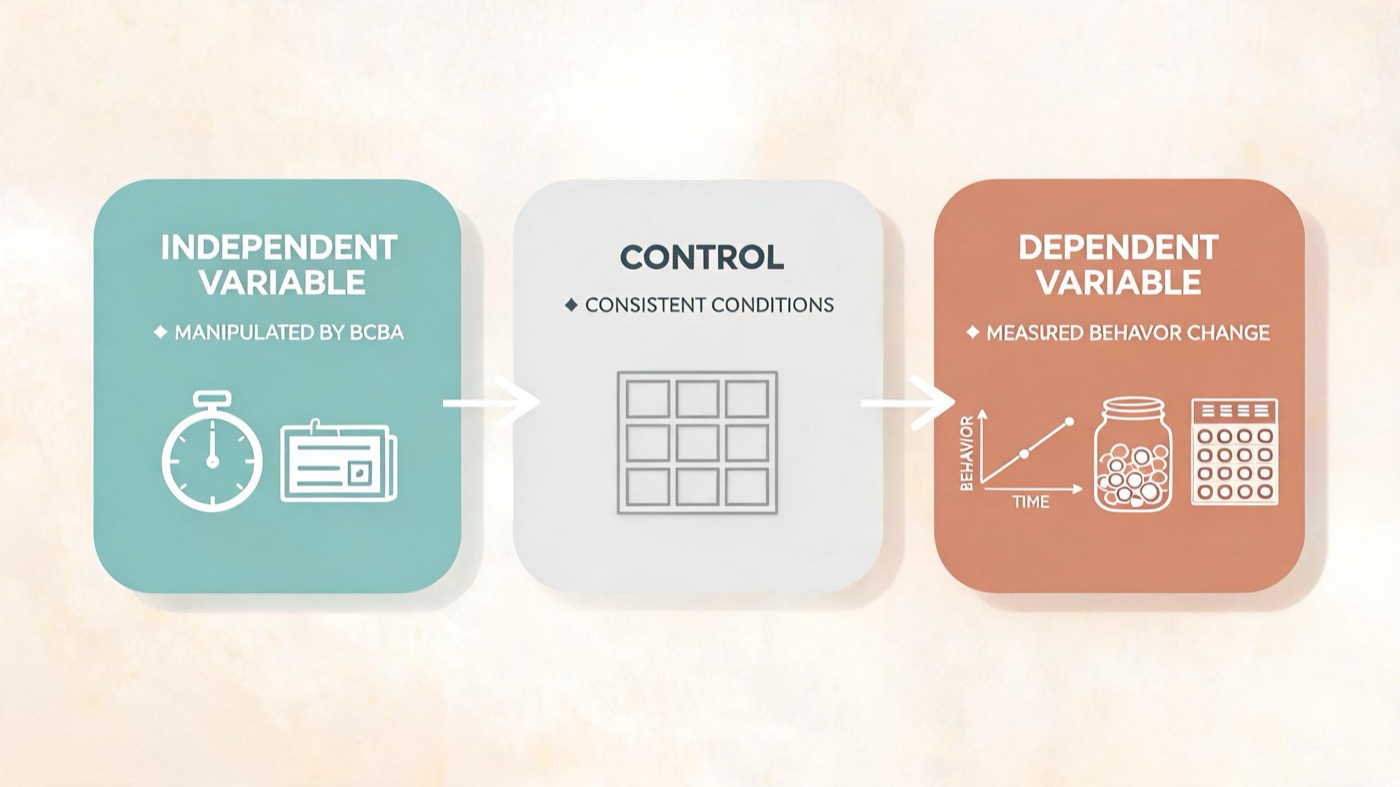
In ABA, the independent variable (IV) is the intervention or treatment that the experimenter manipulates. The dependent variable (DV) is the target behavior that is measured and expected to change as a result of the IV. Control variables are conditions kept constant to ensure that only the IV influences the DV, establishing experimental control.
Independent Variable (IV) in ABA
The independent variable is the component you deliberately change or manipulate to observe its effect on behavior. In ABA, the IV is always a treatment or environmental modification—such as a reinforcement schedule, prompting level, or instructional strategy. For example, implementing a token economy to increase on-task behavior: the token system is the IV. The experimenter actively controls when and how the IV is applied. A well-defined IV is measurable and replicable.
Dependent Variable (DV) in ABA
The dependent variable is the behavior that is measured; it is the outcome you are interested in changing. It must be operationally defined and objectively measurable. In the token economy example, the DV is the frequency or duration of on-task behavior. The DV is expected to vary as a function of the IV. If the behavior does not change when the IV is introduced, no functional relation exists.
Control Variables (Constants) in ABA
Control variables are all other factors that are held constant across conditions to prevent them from influencing the DV. These include the setting, time of day, therapist, and materials. Maintaining control ensures internal validity and allows the experimenter to attribute any behavior change to the IV. In ABA, establishing experimental control often involves demonstrating that the DV changes only when the IV is manipulated—often shown through ABAB or multiple-baseline designs. Learn more about single-subject experimental designs in our detailed guide.
ABA Examples: Independent, Dependent, and Control in Action
Applying these concepts to real ABA scenarios helps solidify understanding. Below are three examples that reflect common exam questions.
Example 1: Reducing Tantrums with Differential Reinforcement
IV: A differential reinforcement of alternative behavior (DRA) procedure—praising appropriate communication and ignoring tantrums. DV: Frequency of tantrums per session. Control: Same therapy room, same therapist, same session duration. The hypothesized function is attention. When the DRA is implemented, tantrums are expected to decrease while appropriate communication increases.
Example 2: Token Economy to Increase Task Completion
IV: Implementation of a token system where students earn tokens for completing math problems, exchangeable for preferred items. DV: Number of math problems completed per 20-minute session. Control: Consistent classroom schedule, identical token exchange rates, and a constant reinforcement menu (same items available). The function is access to tangibles. If task completion rises only when the token system is active, a functional relation is demonstrated.
Example 3: Visual Schedules for Transitions
IV: Presence versus absence of a visual schedule showing the sequence of activities. DV: Latency to transition from one activity to the next (in seconds). Control: Same staff-to-client ratio, same type of transition (e.g., from play to work), same time of day. The hypothesized function is escape from demand (transitions). The visual schedule may reduce escape-motivated behavior by providing predictability.
Exam Relevance and Common Traps
The BCBA exam frequently tests your ability to identify the IV, DV, and control variables in a vignette. Questions may ask you to select the IV from a list or determine whether experimental control was achieved. Watch out for these common pitfalls.
How the BCBA Exam Tests These Concepts
Exam items often present a single-subject design scenario and require you to identify the independent variable (the intervention), the dependent variable (the behavior), and whether adequate control was maintained. You might see a graph and need to determine if a functional relation exists. Understanding the logic of baseline-intervention comparisons is crucial.
Common Misconceptions and Traps
- Trap: Confusing control variable with control condition. A control variable is a constant (e.g., same room), while a control condition is a baseline phase where no IV is applied. Both are needed for experimental control, but they are different.
- Trap: Thinking the IV must be a formal therapy. The IV can be any environmental change, such as a prompt level, schedule of reinforcement, or even the presence/absence of a visual cue. Do not assume it must be a packaged intervention.
- Trap: The DV must be dead-obvious. The DV must be a clearly defined, measurable behavior. Subjective terms like “aggression” without operational definition are insufficient. For example, “hitting others” is better than “being aggressive.”
Quick Checklist for Exam Day
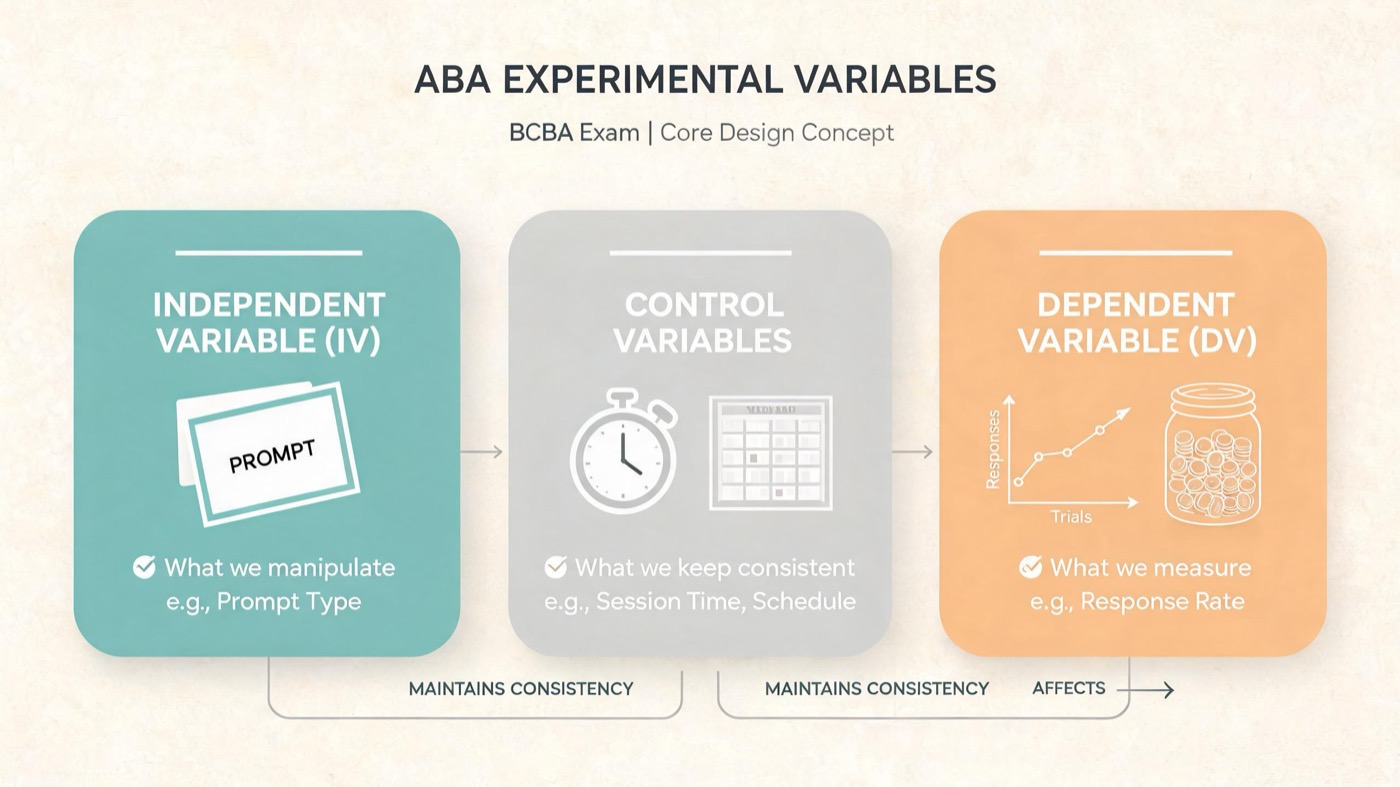
Use this checklist when analyzing exam scenarios to quickly identify the key components. For each question, mentally go through these steps.
- Identify the behavior changed → DV. Ask: What behavior is being measured? (e.g., frequency of tantrums, number of tasks completed, latency to transition)
- Identify what the experimenter manipulates → IV. Ask: What did the practitioner change between conditions? (e.g., added a token system, provided a visual schedule, implemented DRA)
- Identify kept-same factors → control variables. Ask: What stayed constant? (e.g., setting, time, therapist, materials)
- Ask: Is there a functional relation? Does the DV change only when the IV is present? Look for replication across phases or conditions.
For additional practice on identifying components in research, check out our guide on experimental control in ABA.
Summary
Mastering independent variable dependent variable and control is vital for BCBA exam success and for conducting rigorous ABA research. The IV is the intervention you manipulate; the DV is the behavior you measure; control variables are everything held constant. Use concrete ABA examples—like DRA for tantrums, token economies, or visual schedules—to anchor your understanding. Avoid common exam traps by always operationalizing the DV and remembering that control variables differ from baseline conditions. Use the quick checklist on exam day to quickly parse any scenario.


