
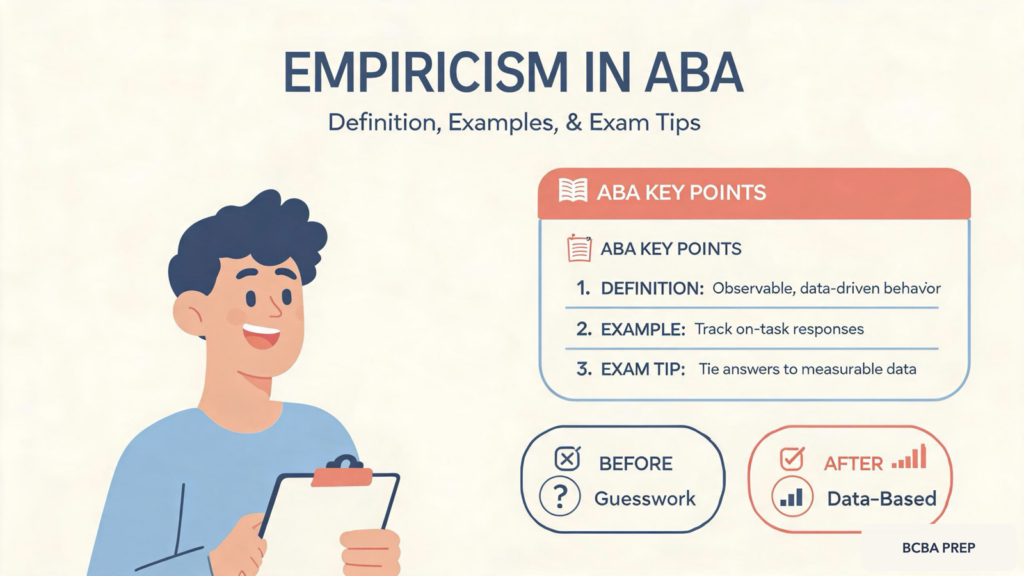
What Is Empiricism in Applied Behavior Analysis?
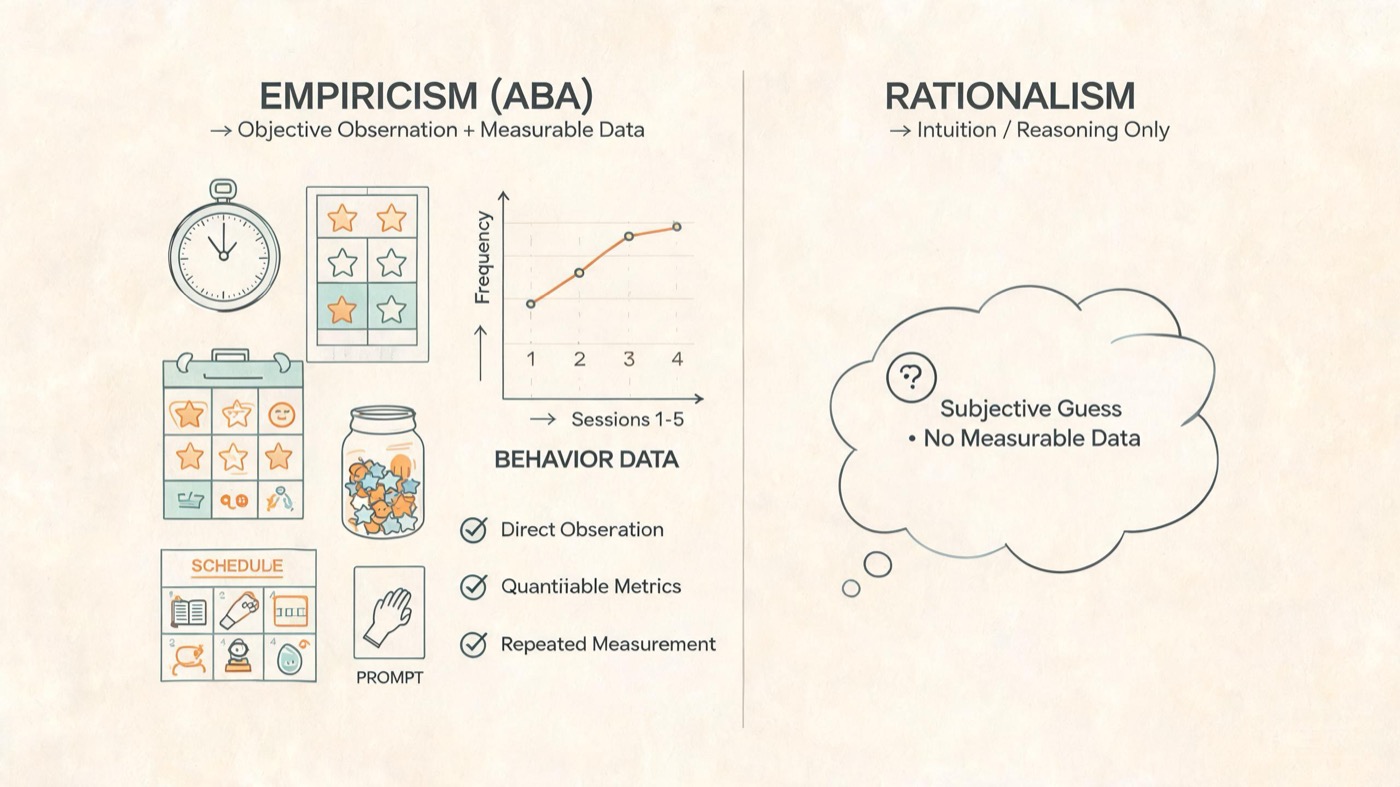
Empiricism in ABA is the philosophical assumption that knowledge about behavior should come from objective observation and measurable data. It stands in contrast to rationalism, which relies on reasoning or intuition alone. For BCBA candidates, understanding this concept is critical because it underpins every evidence-based intervention.
Table of Contents
- What Is Empiricism in Applied Behavior Analysis?
- Worked ABA Examples of Empiricism in Action
- How Empiricism Is Tested on the BCBA Exam
- Empiricism vs. Other Philosophical Assumptions
- Summary of Empiricism for BCBA Candidates
- References
The Core Meaning of Empiricism
At its heart, empiricism means that decisions are made based on what can be seen, measured, and verified. In behavior analysis, this translates to collecting data on behavior and environmental events before drawing conclusions. A practitioner who says ‘I think the child is aggressive because he’s angry’ is not being empirical. An empirical approach would require identifying the antecedents and consequences through direct observation.
Empiricism is one of the six philosophical assumptions of behavior analysis, alongside determinism, parsimony, pragmatism, selectionism, and mentalism. It ensures that interventions are not based on guesswork but on verifiable evidence.
Why Empiricism Matters for BCBAs
Without empiricism, behavior analysis would lose its scientific foundation. BCBAs use empirical methods to:
- Conduct functional behavior assessments (FBA) based on direct observation, not opinion.
- Evaluate treatment effectiveness using data from single-subject designs.
- Make data-driven decisions about modifying interventions.
- Ensure accountability and ethical practice by relying on objective measurement.
Worked ABA Examples of Empiricism in Action
Empiricism is best understood through real-world examples. Below are two scenarios showing how an empirical approach uses ABC analysis (Antecedent-Behavior-Consequence) to form and test hypotheses.
Example 1: Tantrum Behavior
A 4-year-old child frequently engages in tantrums (crying, screaming) when asked to stop playing and come to the table for dinner. An empirical practitioner records:
- Antecedent: Parent says ‘Time for dinner, put the iPad away.’
- Behavior: Child cries, screams, and throws toys.
- Consequence: Parent lets child continue playing with iPad.
Based on repeated observations, the hypothesis is that the tantrum is maintained by negative reinforcement (escape from the demand to transition). The intervention would involve teaching a replacement behavior and changing the consequence.
Example 2: Peer Aggression
A 7-year-old student in a classroom hits peers when they approach him during independent work. ABC data shows:
- Antecedent: Peer walks toward student’s desk.
- Behavior: Student hits the peer.
- Consequence: Peer walks away, teacher redirects peer elsewhere.
The empirical analysis suggests social negative reinforcement (escape from peer interaction). The intervention could include teaching appropriate requesting skills and modifying the environment.
Example 3: Self-Injurious Behavior
A non-vocal adult with autism frequently engages in head-banging. ABC data reveals:
- Antecedent: Staff member says ‘Time to work on sorting tasks.’
- Behavior: Head-banging against wall.
- Consequence: Staff stops task and offers a preferred item.
The hypothesis is that head-banging is maintained by automatic reinforcement (sensory stimulation) or escape. An empirical approach would test this by comparing conditions (e.g., alone vs. demand) using a functional analysis.
How Empiricism Is Tested on the BCBA Exam
The BCBA exam frequently includes questions that assess your understanding of empiricism as a philosophical assumption. You might be asked to identify which option reflects an empirical approach or to choose the best method for gathering objective data.
Common Traps to Avoid
Many candidates lose points by confusing empiricism with other assumptions. Watch out for these traps:
- Confusing empiricism with prediction/control. Empiricism is about objective observation, not about predicting or controlling behavior.
- Choosing intervention based on past experience alone. Even if a strategy worked before, an empirical approach requires current data.
- Overlooking measurement. A response that includes ‘client report’ without direct observation is not empirical.
- Assuming one observation is enough. Empiricism relies on repeated, systematic data collection.
- Mixing up radical behaviorism and empiricism. Radical behaviorism is a larger philosophical framework; empiricism is about the method of gaining knowledge.
Quick Checklist for Exam Success
When reviewing exam items, ask yourself:
- Is the answer based on objective measurement rather than subjective opinion?
- Are antecedent and consequence data clearly defined?
- Does the scenario use direct observation or inference?
- Is the hypothesis testable with additional data?
- Does the answer avoid mentalistic terms like ‘wants’ or ‘feels’?
For more practice on the philosophical assumptions, check out our guide on philosophical assumptions in behavior analysis.
Empiricism vs. Other Philosophical Assumptions
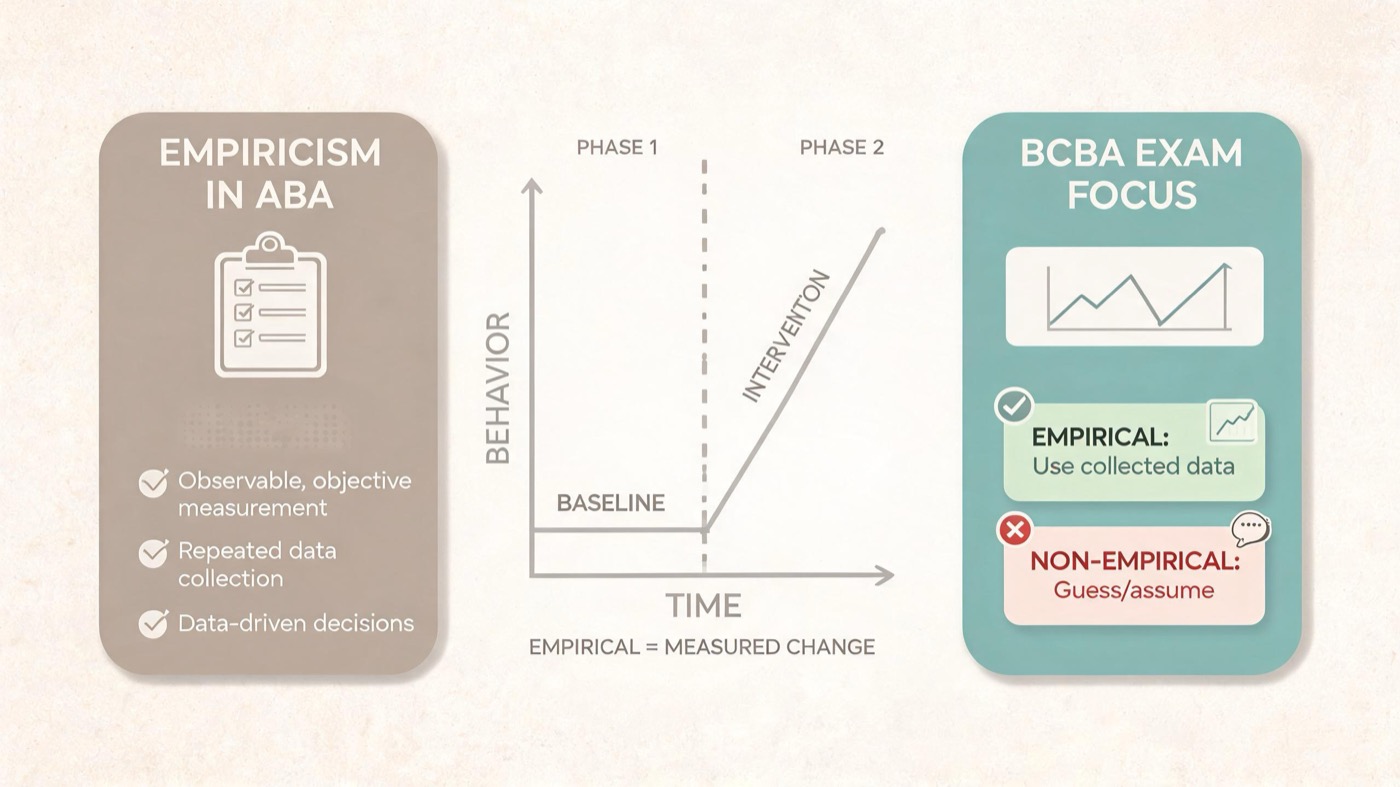
To deepen your understanding, it helps to see how empiricism relates to other assumptions. Determinism says behavior is caused by environmental events. Empiricism provides the method (observation) to discover those events. Parsimony urges using the simplest explanation. Empiricism ensures that simple explanations are based on data, not speculation. Pragmatism asks whether an intervention works; empiricism provides the evidence to answer that question.
When studying, practice distinguishing these concepts. For example, an exam item might describe a scenario where a BCBA assumes a behavior is caused by a child’s ‘attitude’ (mentalism). The correct answer would be to reject that explanation and collect empirical data.
Summary of Empiricism for BCBA Candidates
Empiricism is the bedrock of ethical, effective practice in ABA. Remember these key points:
- Empiricism = knowledge from objective observation and data.
- It is one of the philosophical assumptions of behavior analysis.
- On the exam, prefer answers that involve direct measurement and avoid mentalistic explanations.
- Use ABC analysis to apply empiricism in real-world scenarios.
- For additional exam strategies, see our BCBA exam prep guide.
By mastering empiricism, you not only pass the exam but also become a more competent, data-driven behavior analyst.


