
What Are the Types of Shaping?
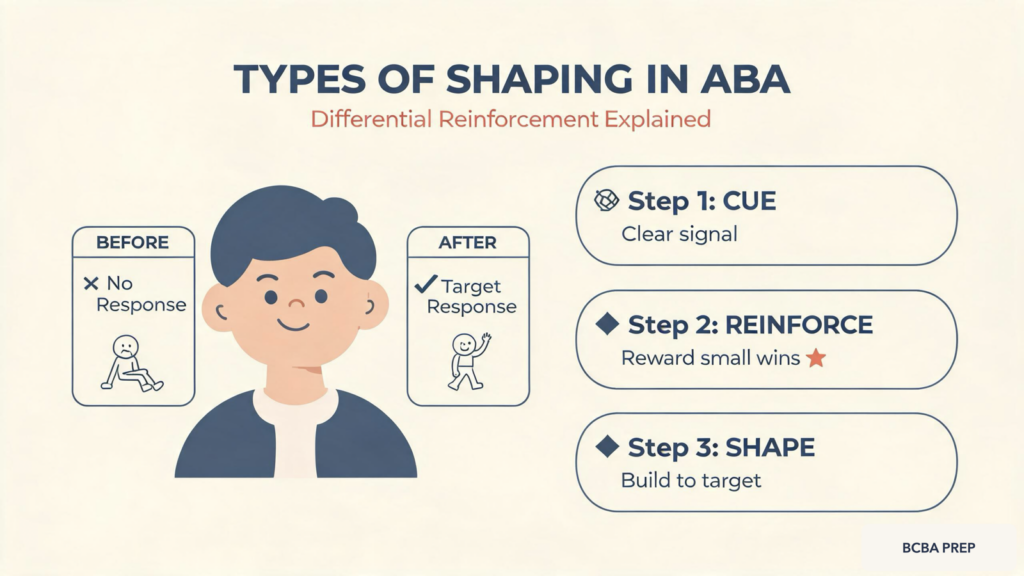
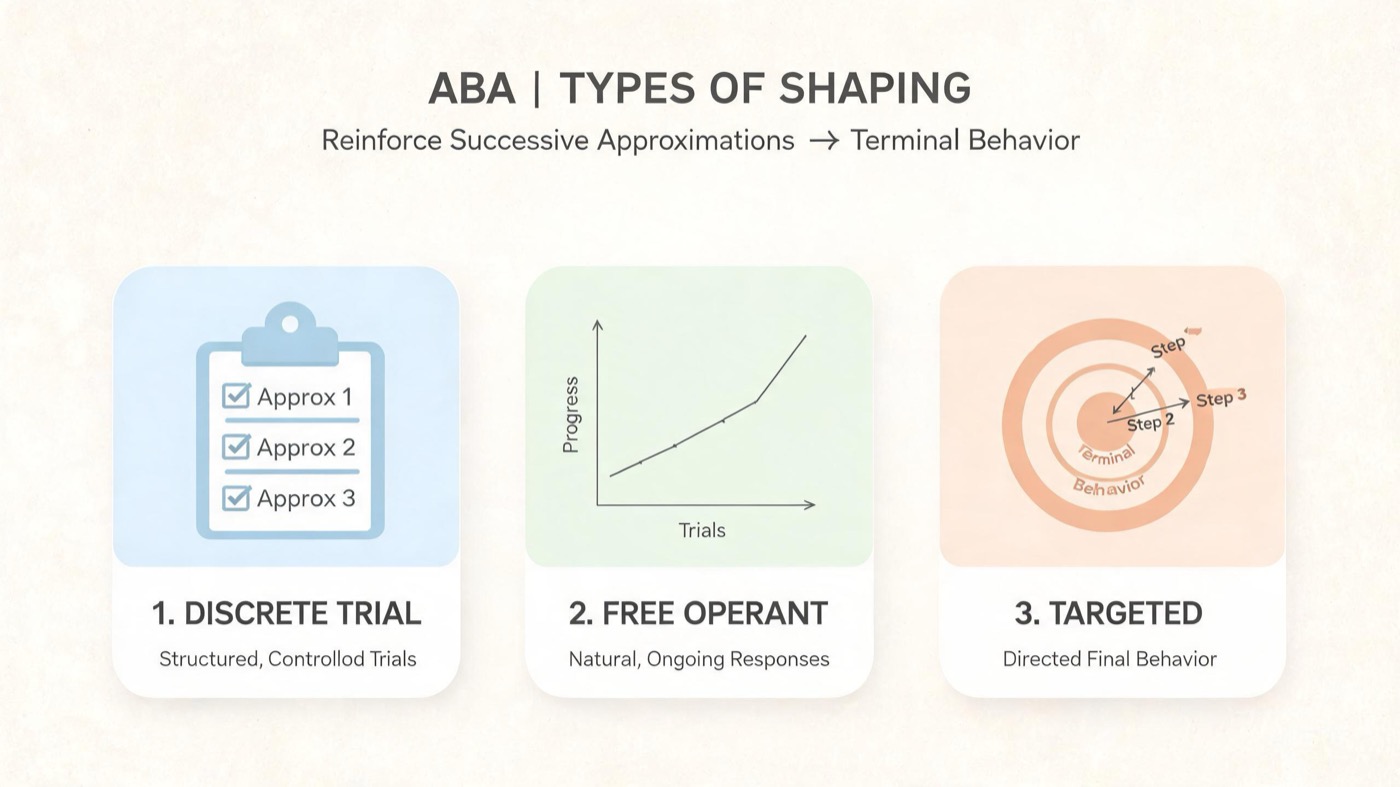
Shaping is a fundamental ABA procedure where you reinforce successive approximations toward a terminal behavior. Understanding the types of shaping is critical for the BCBA exam because questions often test your ability to identify which type is being applied. The two main categories are response differentiation and stimulus shaping.
Table of Contents
- What Are the Types of Shaping?
- Understanding Differential Reinforcement of Successive Approximations
- Worked ABA Examples of Shaping Types
- Shaping vs. Chaining: What the BCBA Exam Expects You to Know
- Quick Checklist for Mastering Types of Shaping
- Final Summary
Response Differentiation vs. Stimulus Shaping
Response differentiation involves reinforcing a specific response topography while extinguishing others. For example, you might reinforce only vocalizations that sound like ‘ball’ and not babbling. In contrast, stimulus shaping involves gradually changing the antecedent stimuli (e.g., fading prompts) while the response topography remains the same. Both fall under the broader category of shaping but require different analytical approaches.
Understanding Differential Reinforcement of Successive Approximations
At the heart of shaping is differential reinforcement of successive approximations. You systematically reinforce responses that are closer to the target behavior while withholding reinforcement for previous approximations. This process relies on a changing criterion – as the learner masters one step, the bar is raised.
Applying Differential Reinforcement in Shaping
Differential reinforcement can take several forms within shaping. DRA (differential reinforcement of alternative behavior) is often used when shaping a new behavior. DRO (other behavior) and DRL (low rates) are less common in initial shaping but may appear. The key exam point: only responses meeting the current criterion receive reinforcement. If you reinforce too early or too late, shaping will stall. A helpful resource on this topic is our guide on differential reinforcement for the BCBA exam.
Worked ABA Examples of Shaping Types
Applying these concepts through examples solidifies your understanding for the exam. Below are three worked examples with ABC analysis and hypothesized function.
Example 1: Shaping a Child’s Verbal Request
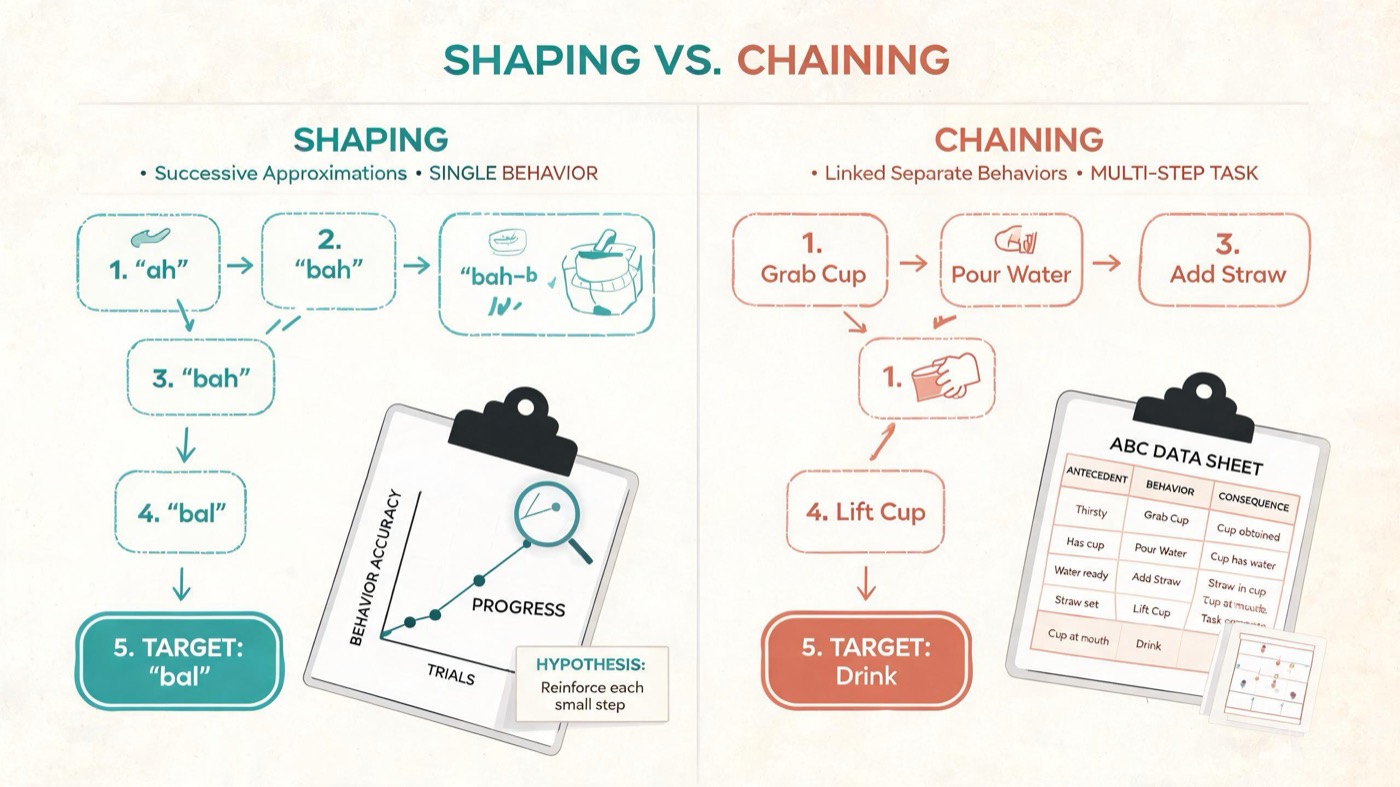
Antecedent: Child sees a toy out of reach. Behavior: Initially the child babbles (‘ah’); later says ‘ba’; finally says ‘ball’. Consequence: Therapist gives the toy and praise only when the vocalization matches the current approximation. Hypothesized function: Access to tangible. This is a classic response differentiation – you are differentially reinforcing better approximations of a verbal response.
Example 2: Shaping On-Task Behavior in a Classroom
Antecedent: Worksheet is presented. Behavior: Sitting for 1 minute, then 3 minutes, then 5 minutes. Consequence: Token delivered after each successful duration. Hypothesized function: Could be escape (from task) or attention (from teacher). Here the shaping involves changing the criterion for duration of behavior – a form of response differentiation based on a dimension of behavior.
Example 3: Stimulus Shaping for a Discrimination Task
Antecedent: A large red circle is presented; gradually the circle becomes smaller and the color fades to match a specific target stimulus. Behavior: Learner touches the correct stimulus. Consequence: Praise or token. Function: Access to reinforcer. This is stimulus shaping (prompt fading) – the antecedent changes shape and size while the response stays the same (touching). The BCBA exam may present this as a ‘within-stimulus prompt’ fading procedure.
Shaping vs. Chaining: What the BCBA Exam Expects You to Know
A common exam trap is confusing shaping with chaining. While both build complex behavior, they differ fundamentally. Shaping reinforces successive approximations of a single behavior (e.g., improving a vocalization). Chaining links separate behaviors into a sequence (e.g., washing hands: turn on tap, get soap, scrub, rinse). The BCBA exam often presents scenarios and asks you to identify which procedure is being used.
Key Differences and Exam Traps
- Shaping changes the form or criterion of one behavior; chaining links discrete behaviors.
- If the response topography is changing (e.g., from grunting to saying ‘water’), it’s shaping.
- If a series of different behaviors must be performed in order, it’s chaining.
- Common trap: a question describes a task analysis (steps) but calls it shaping – it’s actually chaining.
How to Identify Shaping in Exam Questions
Look for keywords like ‘successive approximations’, ‘gradually changing the criterion’, or ‘reinforcing closer and closer responses’. If the description involves fading prompts (stimulus shaping) or adjusting the response requirement (response differentiation), it’s shaping. Practice with sample questions to build fluency. Additional strategies can be found in our BCBA exam prep 2025 guide.
Quick Checklist for Mastering Types of Shaping
Use this checklist for last-minute review before the exam:
- Identify the type: Is it response differentiation (changing topography/criterion) or stimulus shaping (changing antecedent)?
- Check for differential reinforcement: Are only some responses reinforced? Is the criterion changing?
- Differentiate from chaining: Is it one behavior being refined (shaping) or a sequence of separate behaviors (chaining)?
- Apply ABC analysis: What is the antecedent? What behavior is reinforced? What is the hypothesized function?
- Watch for prompt fading: Stimulus shaping often involves within-stimulus prompts.
- Review BACB Task List items: Shaping appears under behavior-change procedures. The official BACB task list is available at bacb.com.
Final Summary
Mastering the types of shaping is essential for the BCBA exam. Remember the two major categories: response differentiation (changing what the learner does) and stimulus shaping (changing what precedes the behavior). Both rely on differential reinforcement of successive approximations. Use the worked examples to anchor these concepts, and watch for exam traps that confuse shaping with chaining. Keep this checklist handy for quick review. For more ABA exam content, explore our resources on bcbamockexam.com and check the BACB’s official materials for further depth.


