
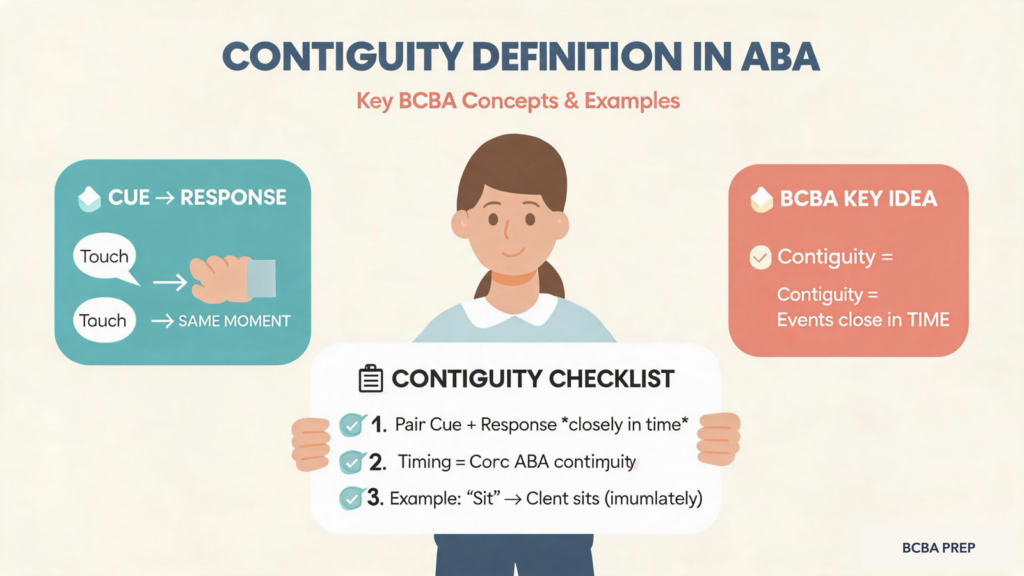
What Is Contiguity? Definition and Core Concept
In applied behavior analysis, contiguity refers to the close temporal pairing of two events. When a stimulus and a response, or a response and a consequence, occur very close together in time, they become associated. The contiguity definition ABA exam candidates need to remember is: temporal proximity between events, not necessarily a causal relationship.
Table of Contents
- What Is Contiguity? Definition and Core Concept
- How Contiguity Applies in ABA: Key Processes
- Worked ABA Examples of Contiguity
- Exam Relevance: Why Contiguity Matters on the BCBA Exam
- Quick Checklist for Mastering Contiguity
- Summary and Final Tips
Contiguity is a foundational concept because it explains how many learning processes begin. Without close pairing, conditioning is less likely to occur. On the BCBA exam, you will often see questions that ask you to identify whether a procedure relies on contiguity or another behavioral principle.
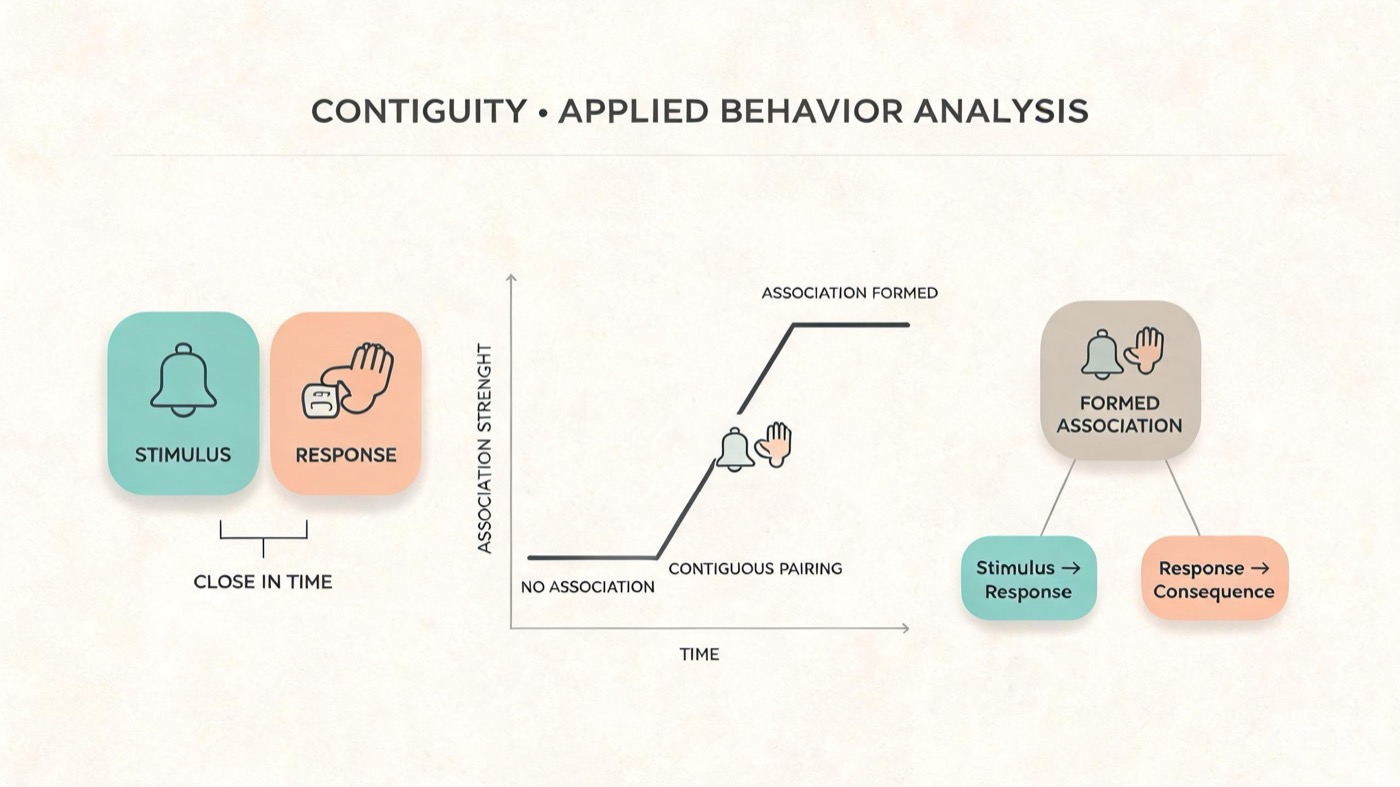
Contiguity vs. Contingency: A Critical Distinction
One of the most common confusions is mixing up contiguity with contingency. Contiguity is about temporal pairing; contingency is about a predictive relation between events. For example, if a bell rings and then food appears, contiguity is the close timing. Contingency is the probability that food follows the bell. A high contingency means the bell reliably predicts food, while a low contingency means the bell is an unreliable predictor.
On the exam, watch for scenarios where two events occur together but one does not reliably predict the other. This is contiguity without contingency. For a deeper dive into related principles, check out our guide on respondent conditioning.
How Contiguity Applies in ABA: Key Processes
Contiguity plays a role in both respondent conditioning and operant conditioning. Understanding these applications helps you answer scenario-based exam questions.
Contiguity in Respondent Conditioning
In respondent conditioning, contiguity between a neutral stimulus (NS) and an unconditioned stimulus (US) is essential. The closer the pairing, the faster the conditioned response develops. Two common types are:
- Delay conditioning: The NS begins before the US and overlaps. Typically most effective.
- Trace conditioning: The NS ends before the US begins, leaving a temporal gap. Less effective because contiguity is weaker.
Exam questions may ask which procedure produces the strongest conditioning—remember delay conditioning benefits from better contiguity.
Contiguity in Operant Conditioning
In operant behavior, contiguity between a response and its consequence increases the likelihood of reinforcement. For example, if a child raises their hand and receives immediate praise, the close pairing strengthens hand-raising. If praise is delayed, the connection weakens. Automatic reinforcement also relies on contiguity: when a behavior produces an immediate sensory consequence (e.g., flicking a light switch repeatedly), the behavior is maintained by the immediate effect.
Worked ABA Examples of Contiguity
Concrete examples help solidify the concept. Below are three scenarios using ABC format to illustrate contiguity in action.
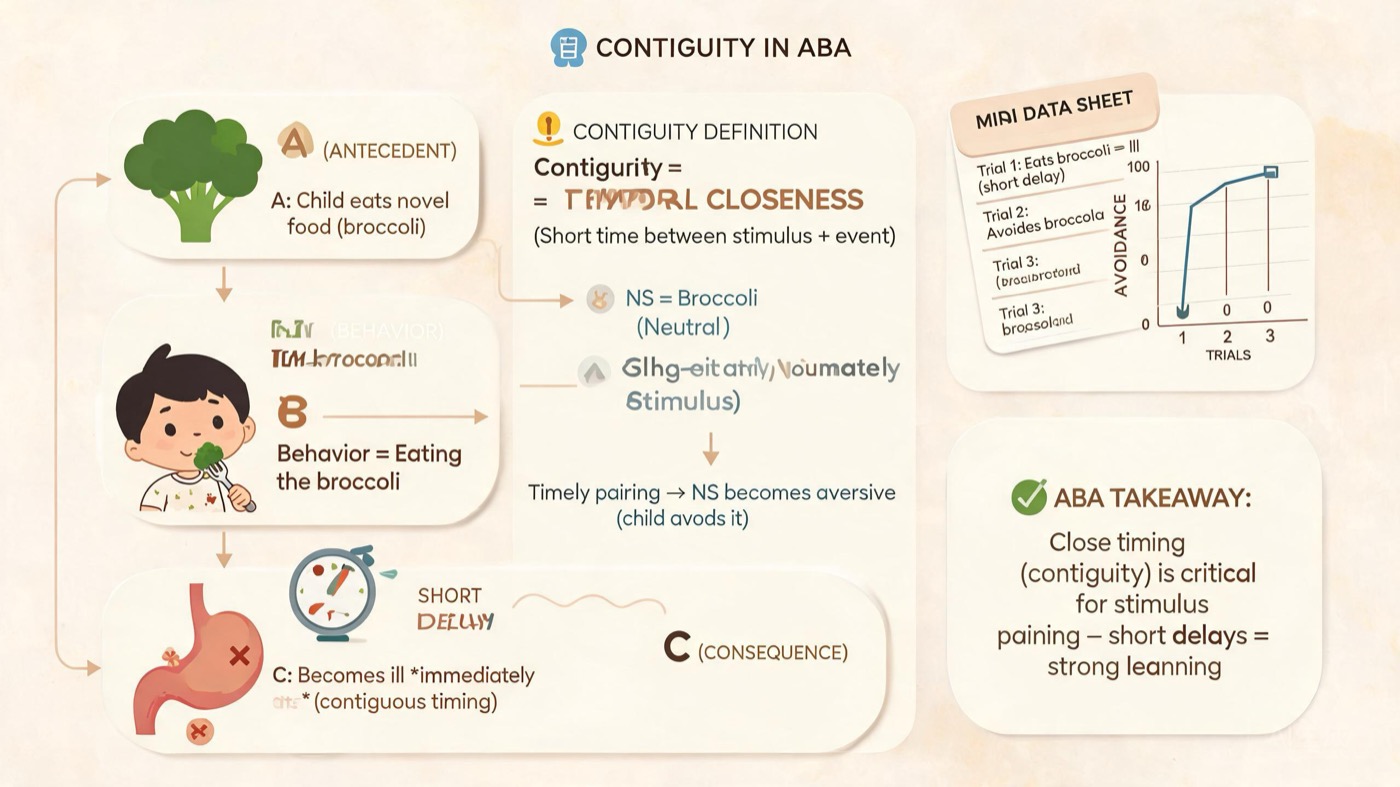
Example 1: Taste Aversion in a Child
Antecedent: Child eats a novel food (broccoli). Behavior: Eating. Consequence: Becomes ill shortly after. Due to contiguity, the novel food (NS) and illness (US) are paired, leading to a conditioned aversion. The child now avoids broccoli. The hypothesized function is avoidance of illness. This demonstrates how a single contiguous pairing can produce long-lasting learning.
Example 2: Pairing a Specific Sound with Praise
A therapist says ‘Good job!’ immediately after a correct response during discrete trial training. The temporal contiguity between the response and praise strengthens the behavior. If the therapist delayed the praise by even a few seconds, the response might not increase as reliably.
Example 3: Automatic Reinforcement from Sensory Stimulation
A child flaps their hands and sees a flickering shadow. The visual stimulation occurs contiguously with the hand-flapping. Over time, hand-flapping increases because the sensory consequence is automatically reinforcing. This highlights contiguity in the absence of a social mediator.
Exam Relevance: Why Contiguity Matters on the BCBA Exam
Contiguity appears in questions about pairing procedures, conditioned reinforcement, and respondent-operant interactions. You might be asked to identify which procedure relies on contiguity versus contingency, or to predict the effect of a temporal delay. Understanding contiguity also helps in analyzing functional analysis conditions where immediate versus delayed consequences are arranged.
Common Exam Traps and How to Avoid Them
Many candidates fall into these traps. Watch for:
- Confusing contiguity with reinforcement: Contiguity alone does not ensure reinforcement; the consequence must be motivating.
- Overlooking temporal gap effects: Even a short delay can weaken conditioning—exam questions often test this.
- Misidentifying contingency vs. contiguity: A question may describe two events that occur together but are not predictive; that’s contiguity, not contingency.
For more exam strategies, visit our BCBA exam study guide.
Quick Checklist for Mastering Contiguity
Use this checklist to test your readiness before the exam:
- I can define contiguity as temporal pairing.
- I can distinguish contiguity from contingency.
- I can explain how delay affects both respondent and operant conditioning.
- I can identify examples of contiguity in ABC data.
- I recognize that contiguity is necessary but not sufficient for learning.
If you check all boxes, you are ready for contiguity questions. For additional practice, explore our free BCBA mock exam questions.
Summary and Final Tips
Contiguity is a simple but powerful concept. Remember: temporal proximity between events sets the stage for learning. On the exam, focus on the timing of events in each scenario. If events occur close together, contiguity is at play. If one event reliably predicts another, contingency is involved. Keep practicing with real-world examples, and you will master this concept. Good luck with your exam preparation!
For further reading, review the BACB’s official resources and check behavior-analytic literature on conditioning processes.


