
What Is Shaping in ABA?
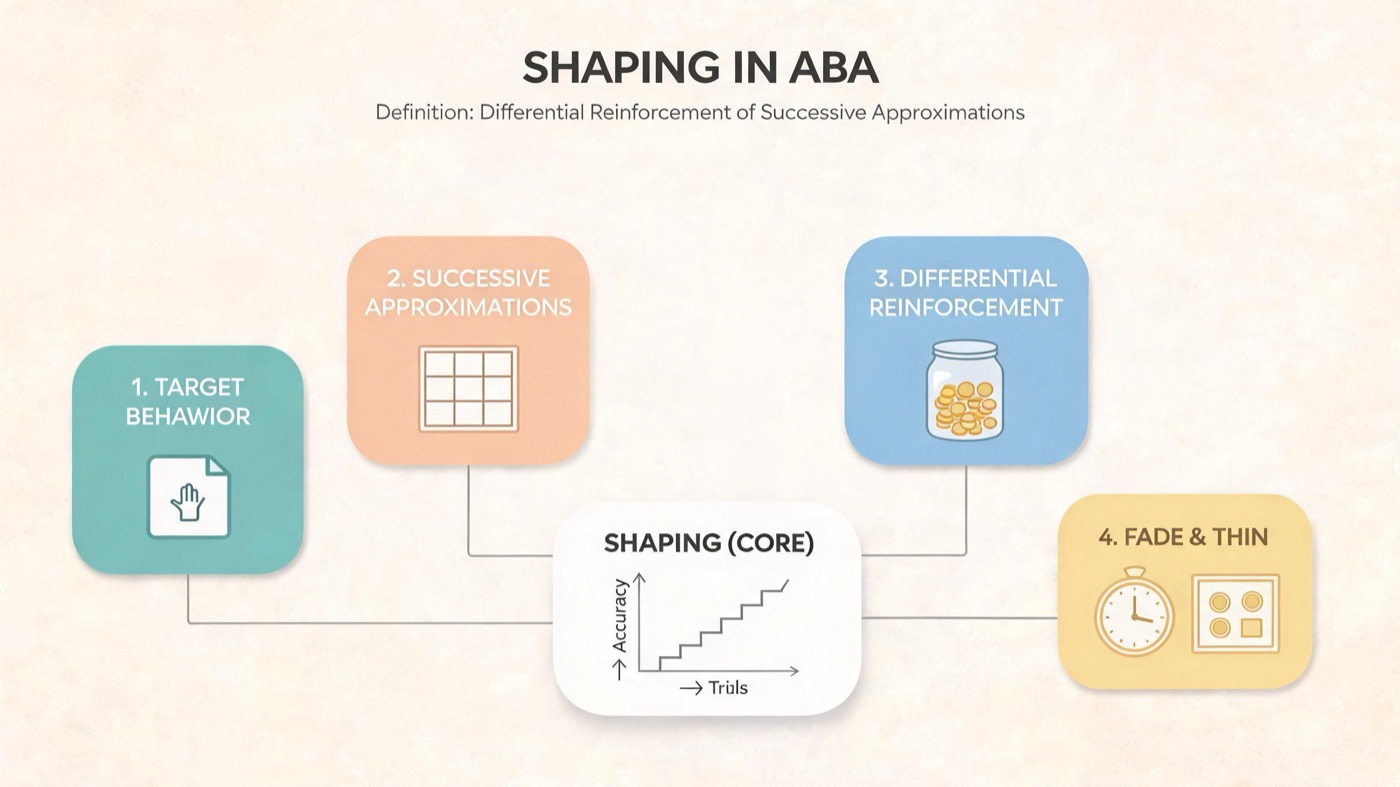
Shaping is a fundamental behavior-change procedure in applied behavior analysis. The precise shaping aba definition comes from the BACB Task List and Cooper, Heron, and Heward: shaping involves the differential reinforcement of successive approximations toward a terminal behavior. In simpler terms, you reinforce small, step-by-step improvements that gradually move closer to the final goal. This process is used when a learner does not yet exhibit the target behavior at all. Shaping is often necessary for teaching completely novel skills, such as first words, appropriate play, or academic tasks that require gradual progress.
Table of Contents
- What Is Shaping in ABA?
- Shaping ABA Examples: From Goal to Terminal Behavior
- Shaping on the BCBA Exam: What to Remember
- Shaping ABA Definition: Quick Checklist for BCBA Candidates
- Summary: Shaping in ABA and Your Exam Success
- References
Differential Reinforcement of Successive Approximations
To understand shaping, you must grasp two key concepts. Differential reinforcement means reinforcing responses that meet a specific criterion while withholding reinforcement for responses that do not. Successive approximations are the intermediate behaviors that increasingly resemble the terminal behavior. For example, if the goal is for a child to say ‘open,’ you might first reinforce any vocalization, then a sound like ‘oh,’ then ‘op,’ and finally the full word. The criterion changes only after the learner demonstrates consistent success at the current step.
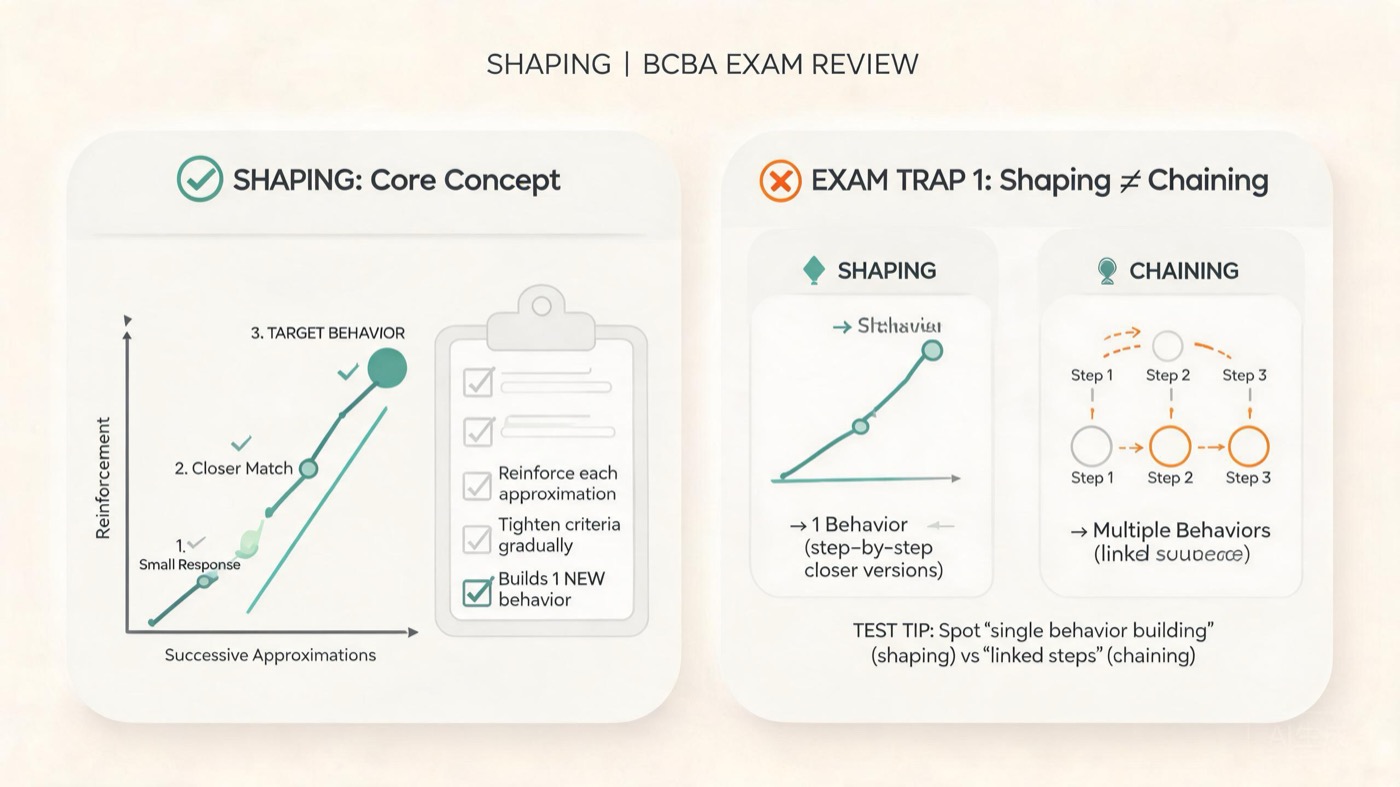
Shaping is distinct from chaining, which links a sequence of already-learned behaviors. It also does not involve punishment; instead, it relies entirely on positive reinforcement to build new skills. This procedure is widely used to teach language, motor skills, and appropriate social behaviors. Without shaping, many learners would never acquire complex behaviors because the terminal behavior is too far from their current repertoire.
Shaping ABA Examples: From Goal to Terminal Behavior
Seeing shaping in action makes the concept concrete. Below are two examples with ABC (antecedent-behavior-consequence) formats to illustrate how each step is reinforced. The first example targets a communication skill, and the second increases on-task behavior. Both demonstrate the gradual shifting of the reinforcement criterion.
Example 1: Teaching a Child to Request ‘Open’
Hypothesized function: Access to tangible items (opening a container). The child loves playing with a toy car inside a clear jar but cannot open it independently.
- Approximation 1: Antecedent: Child sees jar and reaches toward it. Behavior: Makes any vocal sound. Consequence: Immediate access to open jar and car.
- Approximation 2: Antecedent: Jar present. Behavior: Says ‘oh.’ Consequence: Access to jar opened.
- Approximation 3: Antecedent: Jar present. Behavior: Says ‘op.’ Consequence: Access to opened jar.
- Approximation 4 (terminal): Antecedent: Jar present. Behavior: Says ‘open.’ Consequence: Access to opened jar.
Example 2: Increasing On-Task Behavior in a Classroom
Hypothesized function: Escape from academic demands. A student with ADHD avoids completing math worksheets. The terminal goal is 10 minutes of continuous work. Shaping proceeds as follows:
- Approximation 1: Antecedent: Teacher places worksheet on desk. Behavior: Student looks at worksheet for 5 seconds. Consequence: Brief break (30 seconds without worksheet).
- Approximation 2: Behavior: Student writes one answer. Consequence: 30-second break.
- Approximation 3: Behavior: Student completes 3 problems. Consequence: 30-second break.
- Approximation 4 (terminal): Behavior: Student works continuously for 10 minutes. Consequence: 5-minute break.
In both examples, the reinforcement criteria are adjusted only after the learner consistently meets the current step. If progress stalls, you may need to reinforce a previous approximation more strongly. Remember, the practitioner must carefully monitor data to decide when to move to the next approximation.
Shaping on the BCBA Exam: What to Remember
The BCBA exam often tests shaping through scenario-based questions. You must recognize the procedure being described and avoid common traps. Up to 2–3 questions might present a scenario and ask you to identify the procedure being used.
Common Exam Traps about Shaping
Three traps appear frequently. First, confusing shaping with chaining: shaping builds new behaviors by reinforcing approximations; chaining links existing behaviors in a sequence. For example, teaching a child to tie shoes by reinforcing first the loop, then the pull-through is shaping only if the child could not previously perform those steps. If the child already knows each step, it is chaining. Second, assuming punishment is required: shaping uses differential reinforcement only—no punishment. Incorrect answer choices might suggest that you should reprimand approximations that are not close enough. Third, ignoring the need for differential reinforcement: simply reinforcing any behavior is not shaping; you must reinforce only closer approximations.
How to Identify Shaping in Exam Questions
Look for keywords such as ‘approximations,’ ‘gradual change,’ and ‘reinforcing closer behaviors.’ Example question: ‘A BCBA wants to teach a client to say ‘water.’ The client currently says ‘wa.’ The BCBA reinforces ‘wa’ and then only ‘wat’—this is an example of differential reinforcement of successive approximations.’ Another stem: ‘A teacher reinforces a student for raising his hand under his desk, then at shoulder level, then fully above the head.’ These scenarios describe shaping. Also be aware that shaping can be combined with other procedures; the exam might describe shaping within a token economy or discrete trial training.
Shaping ABA Definition: Quick Checklist for BCBA Candidates
Use this checklist to quickly recall the shaping process during your exam or practice sessions. Each item is a key step or principle. Reviewing this list right before the test can help you avoid careless mistakes.
- ✔ Define the terminal behavior clearly and objectively.
- ✔ Identify the starting approximation the learner can already perform.
- ✔ Break the path into small, achievable successive approximations.
- ✔ Use differential reinforcement: reinforce only behaviors that meet the current criterion.
- ✔ Adjust the criterion gradually; do not move too fast.
- ✔ Ensure the reinforcer is potent enough to maintain responding.
- ✔ Avoid punishing previous approximations; simply withhold reinforcement.
- ✔ Monitor progress and backtrack if needed (e.g., reinforce a previous step if the learner regresses).
Additionally, remember that shaping can be used to increase the frequency, duration, or intensity of a behavior, not just to teach new forms. For instance, you might shape longer durations of eye contact or louder volumes of speech. The BCBA exam may test these variations as well.
Summary: Shaping in ABA and Your Exam Success
Shaping is a powerful tool for building new behaviors when the learner cannot perform the terminal behavior. The shaping aba definition centers on differential reinforcement of successive approximations. On the BCBA exam, you will be tested on recognizing shaping in scenarios and distinguishing it from chaining and other procedures. Practice with multiple examples to solidify your understanding. For additional study resources, check out our shaping behavior in ABA guide and try our free BCBA mock exam practice questions. For authoritative reference, see the BACB Task List and Cooper et al. (2020) Applied Behavior Analysis (3rd ed.). Master shaping, and you will be well prepared for exam day.


