
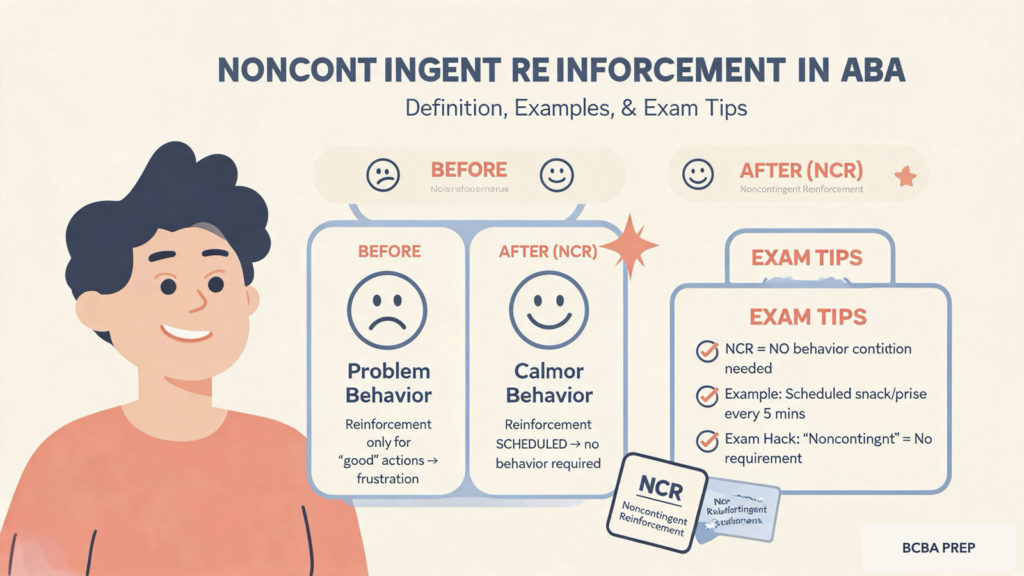
What Is Noncontingent Reinforcement in ABA?
Noncontingent reinforcement (NCR) is a procedure in which reinforcers are delivered on a fixed-time or variable-time schedule, independent of the learner’s behavior. Unlike typical reinforcement, NCR does not require a specific response to earn the reinforcer. It is classified as an antecedent intervention because it alters the environment before a behavior occurs.
Table of Contents
- What Is Noncontingent Reinforcement in ABA?
- Examples of Noncontingent Reinforcement in ABA Sessions
- Noncontingent Reinforcement and the BCBA Exam: What You Need to Know
- Quick Checklist: Implementing Noncontingent Reinforcement
- Common Exam Traps: Additional Pitfalls
- Final Summary
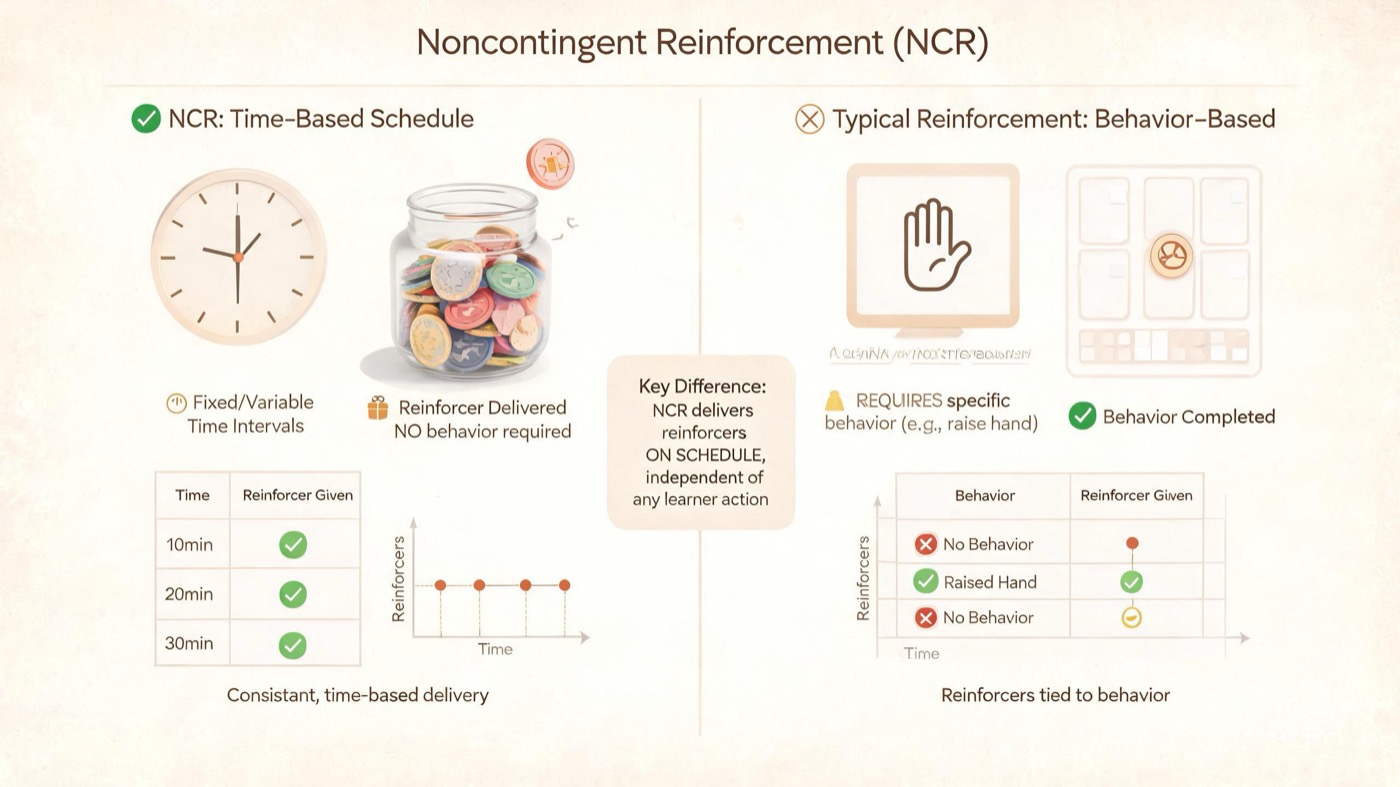
Noncontingent vs. Contingent Reinforcement: Key Differences
- Contingent reinforcement: The reinforcer is delivered only after a target behavior occurs (e.g., a child receives a sticker for completing a task).
- Noncontingent reinforcement: The reinforcer is delivered on a time-based schedule regardless of what the learner is doing (e.g., a teacher gives attention every 5 minutes no matter the behavior).
- The key distinction is the response-reinforcer contingency: it is present in contingent reinforcement and absent in NCR.
How NCR Reduces Problem Behavior
NCR reduces problem behavior through two mechanisms. First, it produces satiation or an abolishing operation: when the reinforcer is freely available, its value decreases, reducing motivation to engage in problem behavior to access it. Second, it breaks the response-reinforcer contingency that previously maintained the problem behavior. Over time, the individual learns that the behavior is no longer necessary to obtain the reinforcer.
Examples of Noncontingent Reinforcement in ABA Sessions
The following examples illustrate how NCR is applied based on the function of the problem behavior.
Example 1: Attention-Maintained Behavior
A child in a classroom frequently screams to gain the teacher’s attention. A functional behavior assessment confirms the function is access to attention. The intervention: the teacher delivers attention every 5 minutes on a fixed-time schedule, regardless of the child’s behavior. The AB C analysis shows:
- Antecedent: Time elapsed (5 minutes)
- Behavior: Any behavior (including screaming or quiet work)
- Consequence: Teacher delivers attention (e.g., praise, eye contact)
Because attention is now freely available, the child’s screaming decreases.
Example 2: Escape-Maintained Behavior
A student refuses to complete tasks and engages in disruption to escape demands. The function is escape from academic demands. NCR provides breaks on a variable-time schedule (every 5-8 minutes) regardless of work completion. The AB C:
- Antecedent: Time interval elapses
- Behavior: Any (including compliant work or disruption)
- Consequence: Break from demands (e.g., free time for 2 minutes)
The student no longer needs to engage in problem behavior to obtain breaks.
Example 3: Automatic Reinforcement (Sensory-Stimulated Behavior)
A child engages in hand-flapping that is maintained by automatic reinforcement (sensory stimulation). NCR involves providing alternative sensory input on a fixed-time schedule, such as access to a vibrating pillow every 3 minutes. This abolishes the establishing operation for sensory stimulation, reducing the frequency of hand-flapping.
Noncontingent Reinforcement and the BCBA Exam: What You Need to Know
NCR is a common topic on the BCBA exam. You must understand how it differs from other interventions and how to implement it correctly.
Common Exam Traps: NCR vs. DRO vs. Extinction
- NCR vs. DRO: NCR is an antecedent intervention that delivers reinforcers on a time schedule regardless of behavior. Differential reinforcement of other behavior (DRO) delivers reinforcers contingent on the absence of the problem behavior during an interval. DRO is a consequence-based procedure; NCR is not.
- NCR vs. Extinction: In extinction, the reinforcer is withheld following the problem behavior. In NCR, the reinforcer is provided freely, so extinction is not used. However, NCR is often combined with extinction in practice.
- Exam tip: If a question describes delivering reinforcers on a fixed-time schedule with no response requirement, it is NCR. If it describes delivering reinforcers only when the problem behavior does not occur, it is DRO.
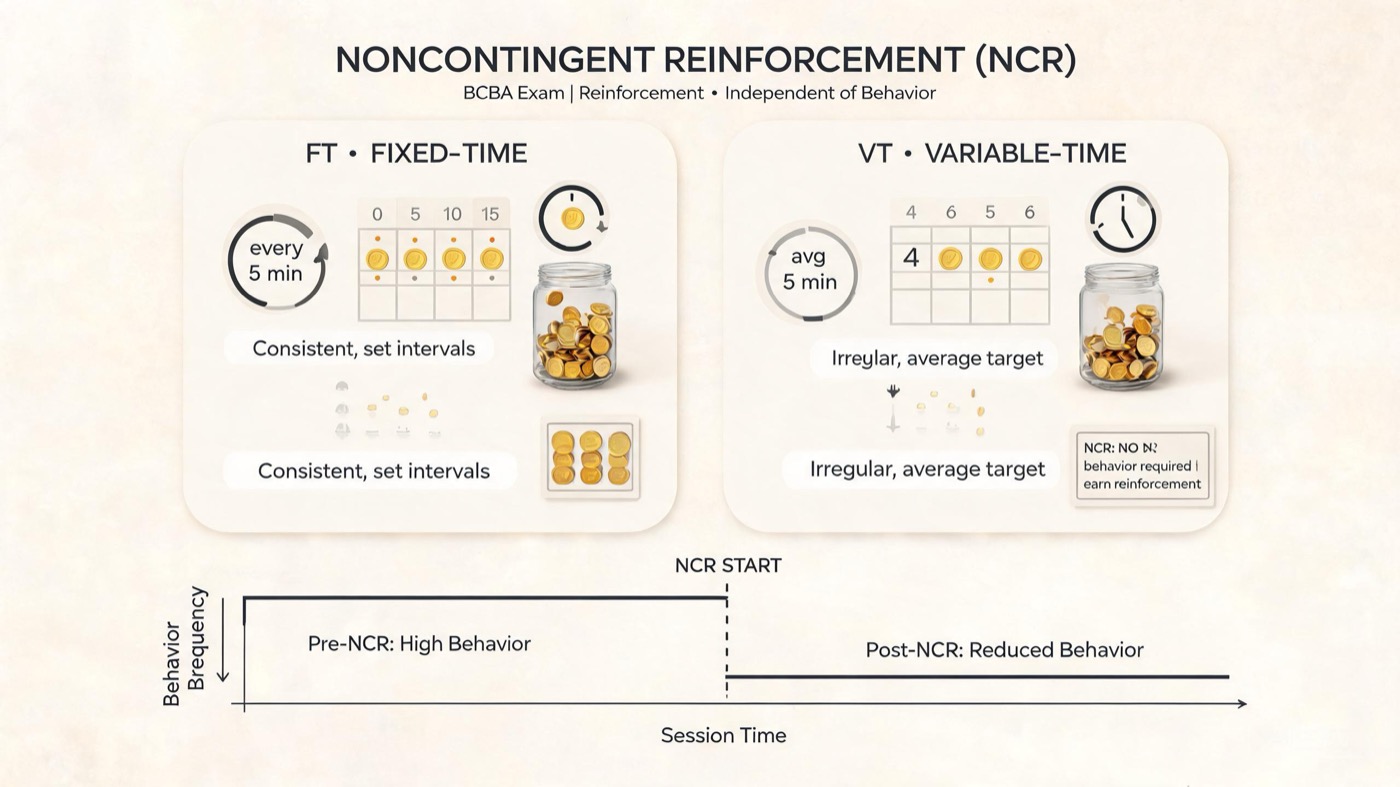
Schedules of NCR: Fixed-Time vs. Variable-Time
NCR can be delivered on a fixed-time (FT) schedule (e.g., every 5 minutes) or a variable-time (VT) schedule (e.g., an average of 5 minutes, ranging from 3 to 7 minutes). The choice depends on the context: FT schedules are easier to implement; VT schedules may prevent the learner from anticipating the reinforcer. During fading, the schedule is thinned gradually (e.g., from every 5 minutes to every 10 minutes) to maintain effects while reducing resource demands.
Quick Checklist: Implementing Noncontingent Reinforcement
Use this step-by-step guide to ensure fidelity when implementing NCR:
- Identify the function of the problem behavior via functional behavior assessment.
- Select the reinforcer that matches the function (e.g., attention, escape, tangible, sensory).
- Choose a schedule (FT or VT) and initial interval that allows frequent access to the reinforcer.
- Deliver the reinforcer on schedule, independent of behavior. Ensure no response requirement.
- Monitor behavior and adjust the schedule as needed; thin gradually when problem behavior reduces.
- Combine with extinction (if appropriate) by withholding the reinforcer if problem behavior occurs.
Common Exam Traps: Additional Pitfalls
Watch for these exam traps:
- Confusing NCR with fixed-time schedules that are contingent: Remember, NCR never requires a response. If the schedule requires the absence of behavior (DRO) or a specific alternative behavior (DRA), it is not NCR.
- Thinning too quickly: Thinning the NCR schedule too fast can re-establish the response-reinforcer contingency and increase problem behavior. Always thin based on data.
- Forgetting to match the function: NCR is only effective if the reinforcer matches the function. For example, giving attention for escape-maintained behavior will not reduce disruption.
Final Summary
Noncontingent reinforcement is a powerful antecedent intervention that reduces problem behavior by delivering the functional reinforcer on a time-based schedule. It differs from consequence-based procedures like DRO and extinction. On the BCBA exam, focus on the distinction between NCR and differential reinforcement, and remember that NCR is often combined with extinction. For more study resources, see our guide to differential reinforcement. Additional information can be found on the BACB website.


