
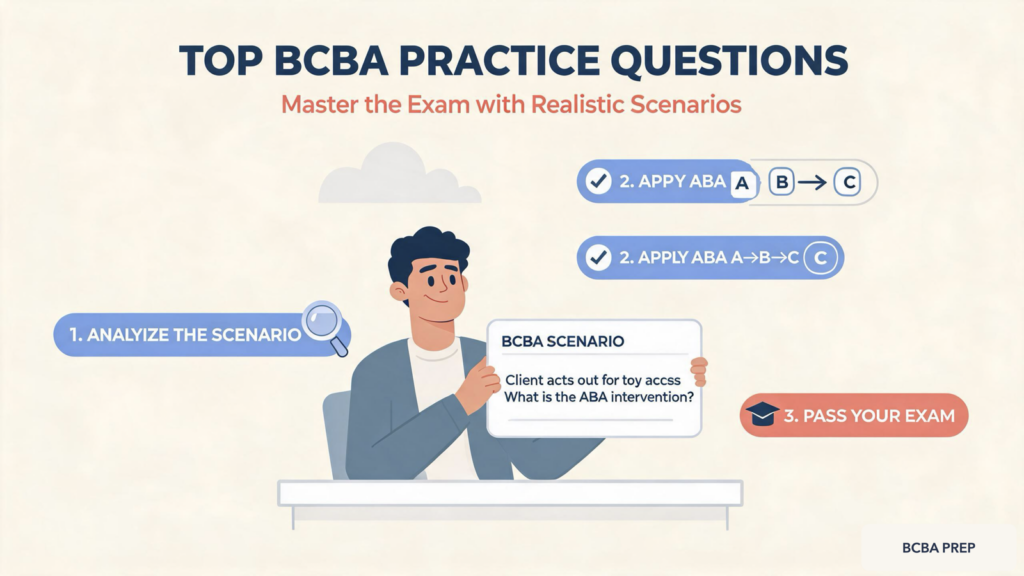
What Makes BCBA Practice Questions Effective?
Not all study materials are created equal. Effective BCBA practice questions mirror the format and complexity of the actual BACB exam. They present realistic scenarios that require you to apply ABA principles, not just recall definitions. This type of preparation builds both speed and accuracy.
Table of Contents
- What Makes BCBA Practice Questions Effective?
- Sample BCBA Practice Questions with Explanations
- Common Traps to Avoid During the BCBA Exam
- Quick Checklist for BCBA Practice Success
- Summary: Turning Practice into Mastery
High-quality questions target key areas from the task list, including measurement, experimental design, behavior change procedures, and ethical considerations. They also include detailed explanations that clarify why each answer is correct or incorrect, turning every question into a learning opportunity.
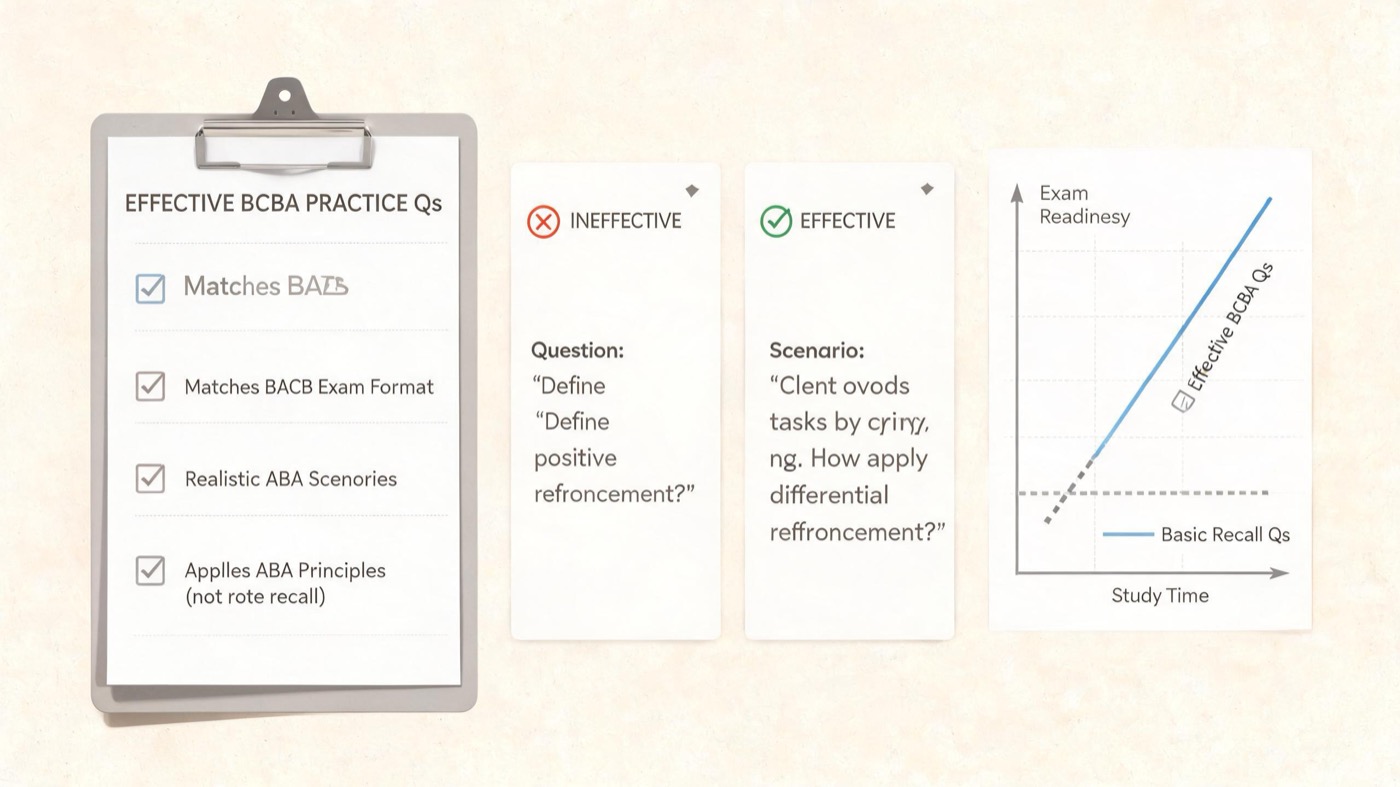
How Practice Questions Reflect the Real Exam
The BACB exam uses scenario-based items that test your ability to analyze behavior and select appropriate interventions. Good practice questions replicate this by embedding ABC data, graphs, and ethical dilemmas. They also challenge you to identify motivating operations, reinforcement schedules, and extinction procedures in context.
Key Skills Tested
- Measurement: Interpret data paths for level, trend, and variability.
- Experimental design: Choose between reversal, multiple baseline, or alternating treatments designs.
- Behavior change procedures: Apply DRO, DRI, DRL, and differential reinforcement.
- Ethics: Recognize violations and select appropriate actions per the BACB code.
Sample BCBA Practice Questions with Explanations
Let’s walk through three realistic questions that highlight common exam themes. Each example includes the scenario, correct answer, and rationale.
Question 1: Identifying Functions of Behavior
A child screams every time his mother puts away the candy jar. The mother immediately gives him a piece of candy. The screaming stops. What is the likely function of the screaming?
Answer: Access to tangible items. The child’s behavior is reinforced by receiving candy. The ABC sequence shows that screaming produces the item, making it an operant behavior maintained by positive reinforcement in the form of access to tangibles. A common error is to label this as attention-seeking, but the data show the reinforcer is the candy itself.
Question 2: Designing a DRO Schedule
A student calls out answers in class without raising his hand. The teacher wants to reduce this behavior. She decides to implement a DRO 5-minute schedule. What does this mean?
Answer: Reinforce the absence of calling out for 5 consecutive minutes. DRO stands for differential reinforcement of other behavior. The teacher delivers a reinforcer if no calling out occurs during the interval. A common mistake is to confuse DRO with DRI (reinforcing a specific alternative behavior). In DRO, any behavior other than the target is acceptable as long as the target does not occur.
Question 3: Interpreting a Graphed Data Path
Imagine a graph showing the frequency of self-injurious behavior across 10 sessions. The data points are: Session 1: 12, Session 2: 10, Session 3: 9, Session 4: 7, Session 5: 6, Session 6: 5, Session 7: 4, Session 8: 3, Session 9: 2, Session 10: 1. What is the trend and level?
Answer: Decreasing trend; moderate initial level. The data show a clear downward trend with low variability. The level starts at 12 (moderate) and ends at 1 (low). The visual analysis indicates the intervention is effective. A trap is to misinterpret a stable trend when variability is present, but here the data are consistent.
For more on interpreting graphs, see our guide on visual analysis in ABA.
Common Traps to Avoid During the BCBA Exam
Even well-prepared candidates make predictable errors. Recognizing these traps can save you valuable points.
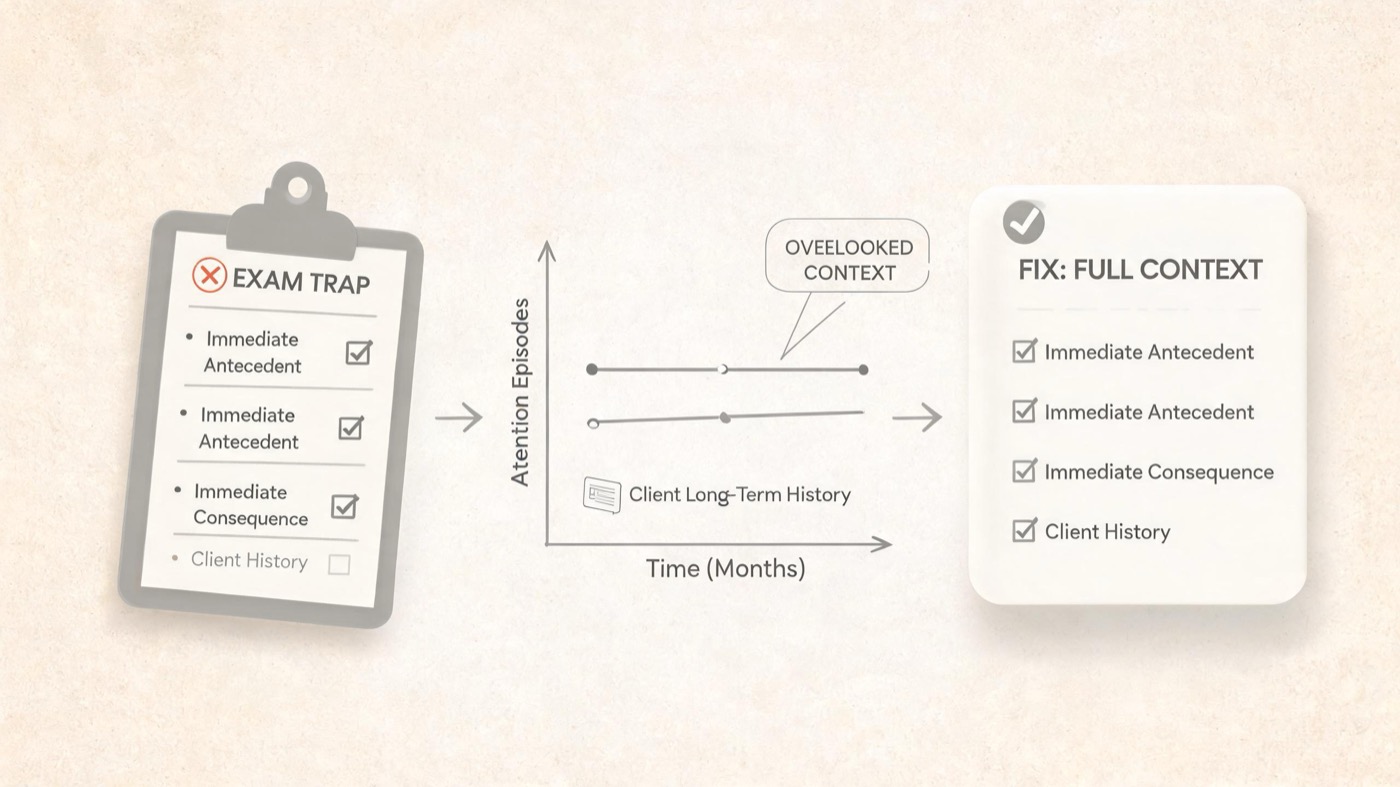
Overlooking Reinforcement History
Candidates often focus only on the immediate antecedent and consequence, ignoring the client’s history. For example, a child who has a long history of receiving attention for tantrums may still tantrum even when attention is withheld initially. Reinforcement history and establishing operations must be considered.
Misapplying Extinction Burst
Many test-takers confuse extinction burst (a temporary increase in behavior when reinforcement is withdrawn) with spontaneous recovery (the reappearance after extinction). In questions, look for context: an immediate increase after removal of reinforcement points to extinction burst; a later return after a break indicates spontaneous recovery.
Confusing Negative Reinforcement with Punishment
A frequent error is misidentifying negative reinforcement (removal of an aversive stimulus that increases behavior) with punishment (addition or removal that decreases behavior). For instance, if a student escapes a difficult task by eloping, and that escape increases future elopement, it is negative reinforcement, not punishment.
Quick Checklist for BCBA Practice Success
Integrate practice questions into your study routine with these actionable steps:
- Set a daily target: Complete 10–15 questions each day, focusing on one task list domain.
- Review explanations thoroughly: Even for correct answers, read the rationale to reinforce concepts.
- Identify error patterns: Keep a log of question types you miss (e.g., experimental design, ethics) and revisit those areas.
- Time yourself: Simulate exam conditions by answering questions within 2–3 minutes each.
- Mix in spaced repetition: Revisit old questions periodically to prevent forgetting.
- Use a reliable source: Choose question banks that align with the latest BACB task list (6th edition).
Summary: Turning Practice into Mastery
Mastering the BCBA exam requires more than passive reading. Working through BCBA practice questions that simulate real scenarios is one of the most effective strategies. By analyzing each question’s ABC sequence, identifying functions, and interpreting graphs, you build the clinical reasoning needed for both the exam and professional practice. Avoid common traps like overlooking reinforcement history or confusing extinction burst with spontaneous recovery. Use the checklist above to structure your prep, and consider taking a free BCBA mock exam to gauge your readiness. Consistent practice will transform your knowledge into mastery.
For deeper study, review the BACB’s official BCBA resources and the Ethics Code for Behavior Analysts.


