
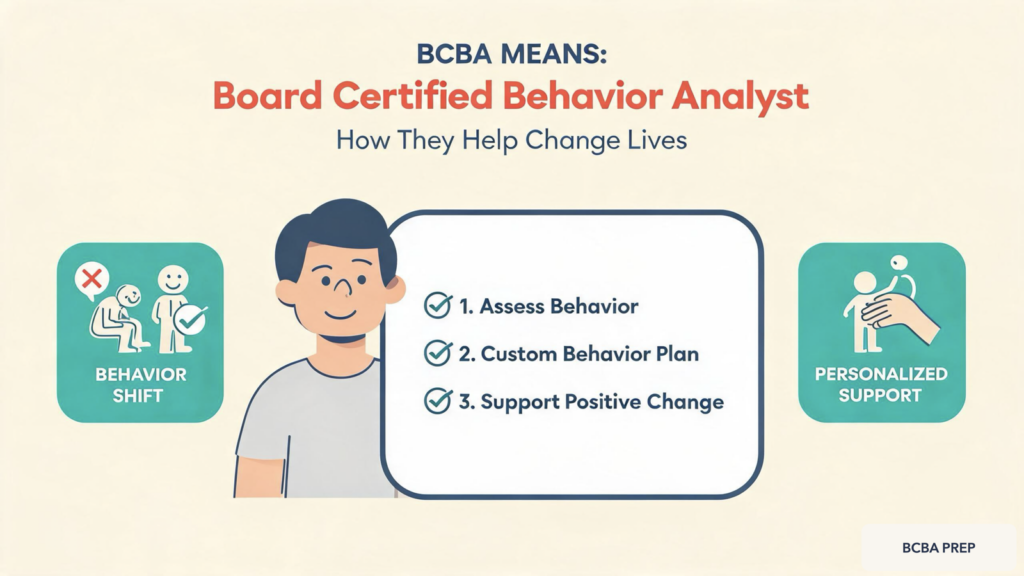
If you are exploring a career in applied behavior analysis, you have likely asked yourself: what exactly BCBA means? The acronym stands for Board Certified Behavior Analyst, a graduate-level certification that qualifies professionals to design, implement, and supervise behavior-analytic interventions. This credential is awarded by the Behavior Analyst Certification Board (BACB) and is widely recognized as the gold standard in the field of behavior analysis.
Table of Contents
- What Does BCBA Mean? The Official Definition
- What BCBA Means in Practice: Real-World ABA Examples
- How to Become a BCBA: Your Step-by-Step Roadmap
- Quick Checklist: Are You Ready to Pursue the BCBA Credential?
- Final Thoughts on What BCBA Means for You
Understanding what BCBA means goes beyond the acronym. It represents a rigorous set of competencies, ethical responsibilities, and practical skills that directly impact the lives of individuals with autism, developmental disabilities, and other behavioral needs. In this article, we will break down the official definition, explore real-world applications, and guide you through the certification process.
What Does BCBA Mean? The Official Definition
The BACB defines a Board Certified Behavior Analyst as a professional who has completed a specific sequence of coursework, supervised fieldwork, and a certification examination. BCBAs are trained to conduct functional behavior assessments, design behavior intervention plans, and oversee the implementation of interventions by Registered Behavior Technicians (RBTs) and Board Certified Assistant Behavior Analysts (BCaBAs).
At its core, BCBA means a commitment to evidence-based practice and ethical conduct. BCBAs operate under the BACB’s Professional and Ethical Compliance Code, ensuring that all interventions are socially significant and respect the dignity of clients.
BCBA vs. BCaBA vs. RBT: Understanding the Differences
The behavior analysis field includes three main credential levels. Knowing the distinctions helps clarify roles and responsibilities:
- BCBA (Board Certified Behavior Analyst): Master’s degree or higher, independent practice, supervises others.
- BCaBA (Board Certified Assistant Behavior Analyst): Bachelor’s degree, works under BCBA supervision, cannot practice independently.
- RBT (Registered Behavior Technician): High school diploma or equivalent, implements interventions under BCBA/BCaBA supervision.
Each level plays a vital role, but the BCBA holds the highest level of responsibility for assessment, program design, and ethical oversight.
What BCBA Means in Practice: Real-World ABA Examples
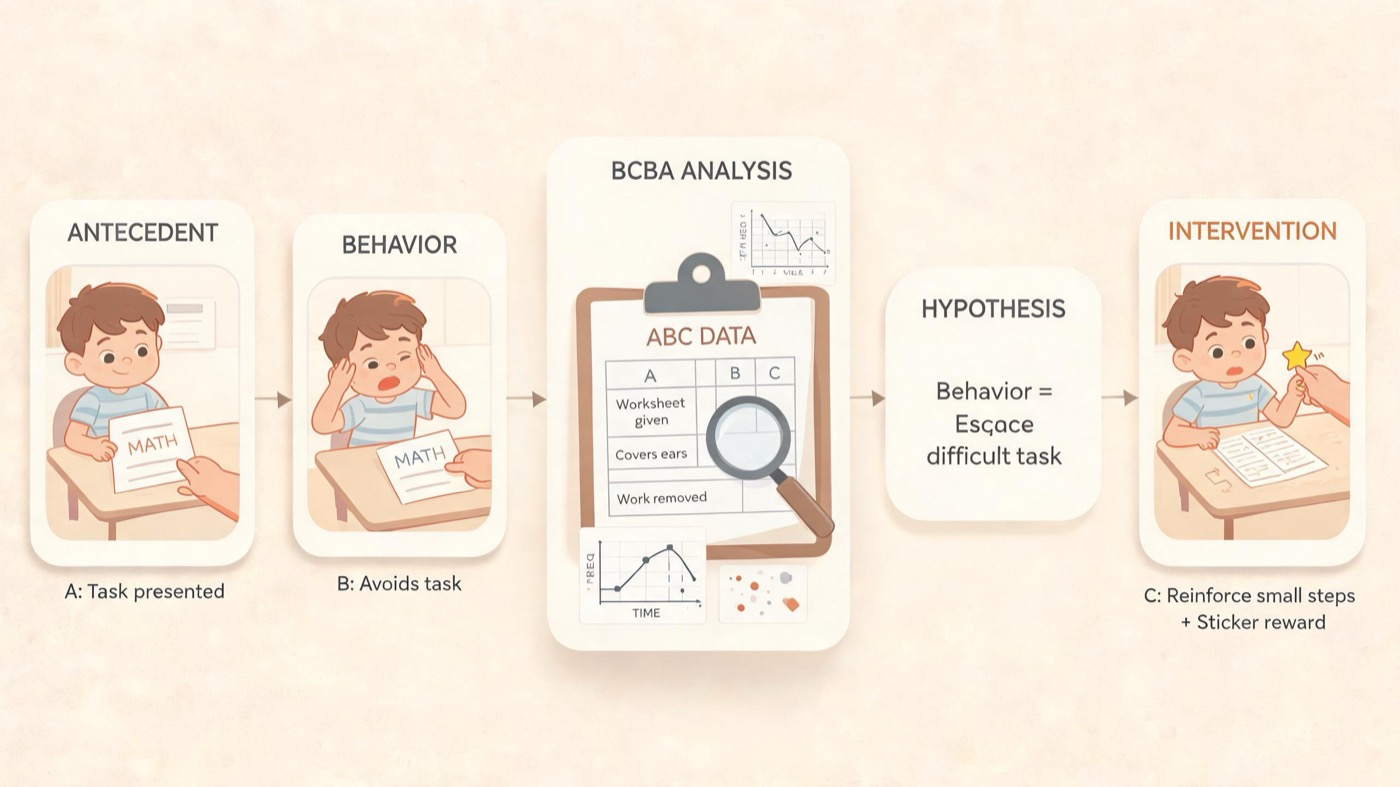
To fully grasp what BCBA means, it helps to see how BCBAs apply the principles of behavior analysis in everyday settings. Below are three examples illustrating the ABC (Antecedent-Behavior-Consequence) model and how a BCBA would design interventions.
Example 1: Reducing Aggressive Behavior in a Child with Autism
A 7-year-old boy with autism frequently hits his teacher when given a math worksheet. A BCBA conducts an ABC analysis:
- Antecedent: Teacher presents a math worksheet.
- Behavior: Child hits the teacher.
- Consequence: Teacher removes the worksheet and says, “No math.”
- Hypothesized function: Escape from demands.
The BCBA designs an intervention that includes teaching a functional communication response (e.g., asking for a break) and providing reinforcement for task engagement. Over time, the aggressive behavior decreases significantly.
Example 2: Increasing Compliance with Dental Hygiene Routine
A 4-year-old girl refuses to brush her teeth every night. ABC analysis reveals:
- Antecedent: Parent says, “Time to brush teeth.”
- Behavior: Child tantrums and runs away.
- Consequence: Parent postpones brushing and gives her a toy to calm down.
- Hypothesized function: Access to tangible (toy) and escape from non-preferred activity.
The BCBA implements a differential reinforcement procedure: the child earns a sticker for each tooth-brushing session and can exchange stickers for a preferred toy later. The parent also uses a visual schedule to prepare the child. Compliance increases to 90% within two weeks.
Example 3: Decreasing Self-Stimulatory Behavior in a Classroom
A 9-year-old student with autism repeatedly flaps his hands and vocalizes during independent work time. ABC analysis:
- Antecedent: Teacher instructs students to work quietly at their desks.
- Behavior: Hand-flapping and vocalizations.
- Consequence: Behavior persists without social interaction.
- Hypothesized function: Automatic reinforcement (sensory stimulation).
The BCBA introduces a differential reinforcement of alternative behavior (DRA) plan: the student is taught to engage in a replacement behavior (e.g., squeezing a stress ball) that provides similar sensory input but is less disruptive. Data collection shows a 70% reduction in hand-flapping after one month.
How to Become a BCBA: Your Step-by-Step Roadmap
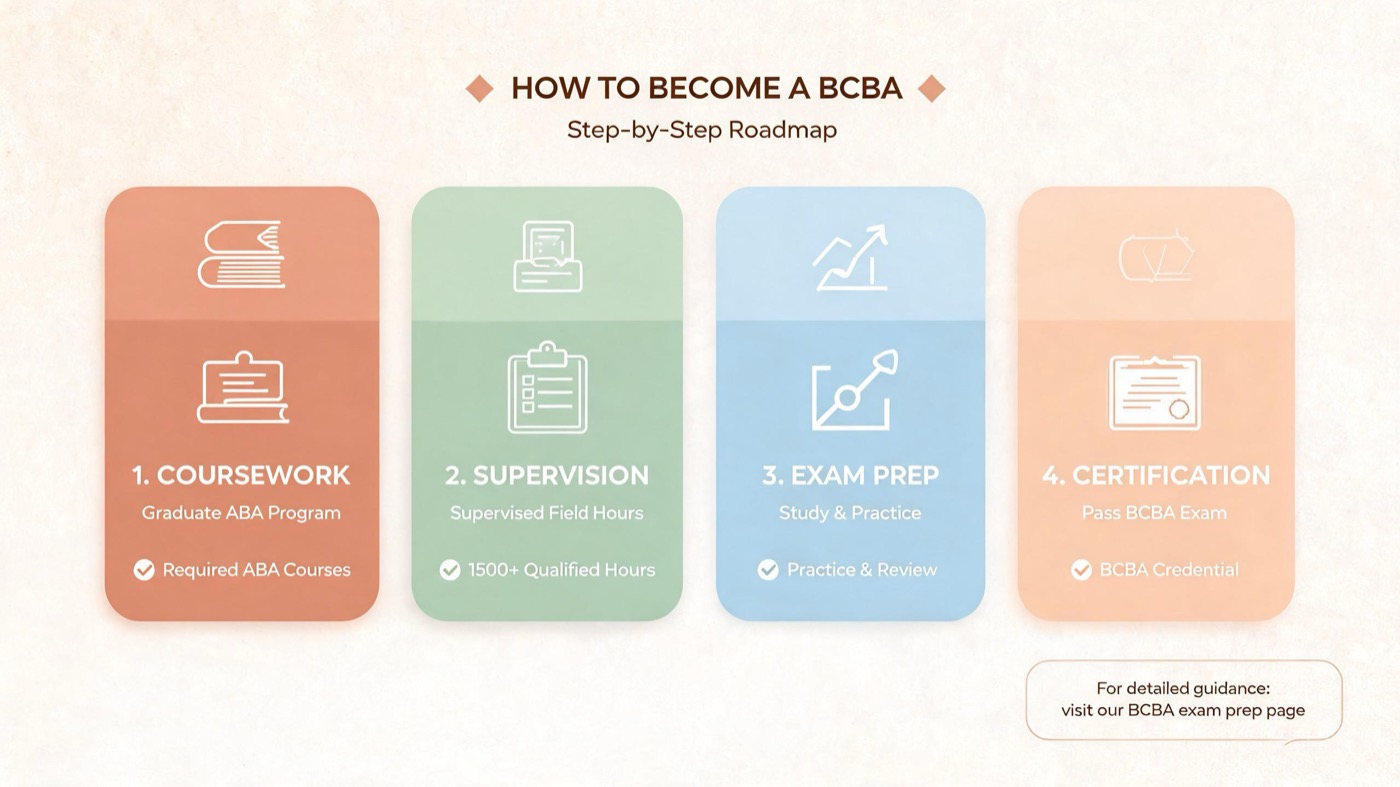
Now that you understand what BCBA means in practice, here is the official pathway to earning the credential. The process involves four main steps:
- Complete a master’s degree from an ABAI-accredited program or a qualifying university program with verified course sequence.
- Accumulate supervised fieldwork: 1,500 hours (concentrated) or 2,000 hours (standard) under a BCBA supervisor.
- Apply for the BCBA exam through the BACB’s gateway system.
- Pass the BCBA exam, a 185-question test covering the BACB 6th Edition Task List.
For more detailed guidance, visit our BCBA exam prep page.
The BCBA Exam: What You Need to Know
The BCBA exam is a rigorous, computer-based test with 185 multiple-choice questions (150 scored, 35 unscored). You have four hours to complete it. Content areas include behavior assessment, intervention, measurement, ethics, and supervision. The exam uses scenario-based items that require you to apply concepts rather than just recall facts.
To prepare effectively, focus on understanding the four functions of behavior (escape, attention, tangible, automatic) and the nuances of reinforcement schedules. Many candidates struggle with distinguishing positive and negative reinforcement—a key concept to master.
Common Exam Traps and How to Avoid Them
Even well-prepared candidates can fall into traps. Here are three frequent mistakes:
- Overgeneralizing functions: Assuming a behavior always serves the same function across contexts. Always conduct a proper functional assessment.
- Confusing positive and negative reinforcement: Remember that negative reinforcement involves removing a stimulus to increase a behavior, not punishment.
- Misapplying schedules of reinforcement: For example, using a fixed ratio schedule when a variable ratio schedule would be more resistant to extinction.
Practice with mock exams to identify your weak areas. Our 6th Edition BCBA mock exam simulates the real test and provides detailed feedback.
Quick Checklist: Are You Ready to Pursue the BCBA Credential?
Use this checklist to assess your readiness. Tick off each item as you confirm:
- I have or am working toward a master’s degree in behavior analysis or a related field.
- I have identified a BCBA supervisor for fieldwork hours.
- I am familiar with the BACB 6th Edition Task List content areas.
- I have taken at least one mock exam to gauge my baseline knowledge.
- I have a study schedule that covers all content areas before my exam date.
If you can check all items, you are well on your way. If not, focus on the missing steps first.
Final Thoughts on What BCBA Means for You
Understanding what BCBA means is the first step toward a rewarding career that transforms lives. BCBAs use the science of behavior analysis to help individuals learn new skills, reduce challenging behaviors, and achieve greater independence. The path to certification requires dedication, but the impact you can make is immeasurable.
Whether you are just starting your journey or preparing for the exam, keep building your knowledge and skills. For additional resources, check out the official BACB website for the latest requirements and ethical guidelines.


