
What Is Positive Punishment? A BCBA’s Definition
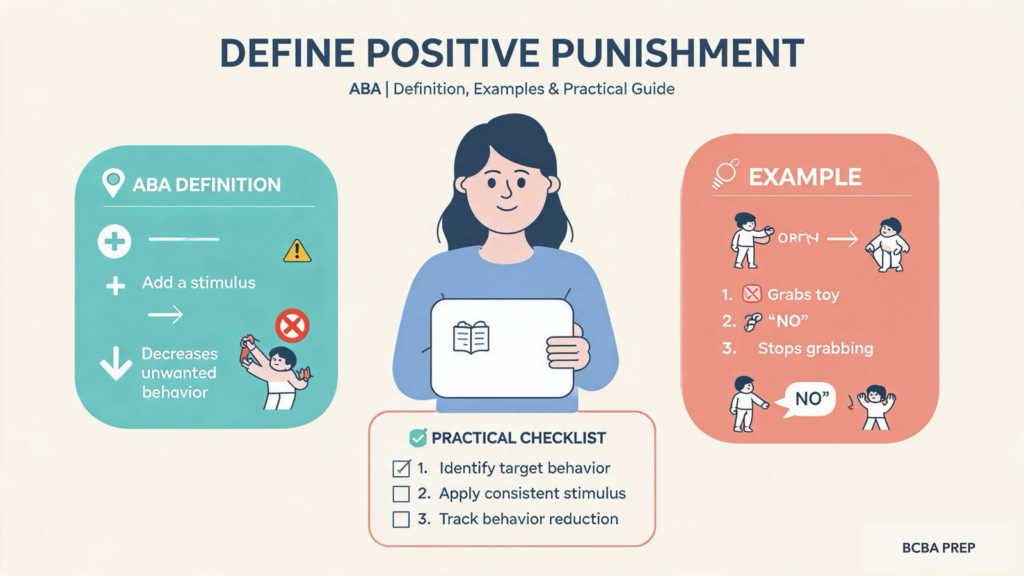
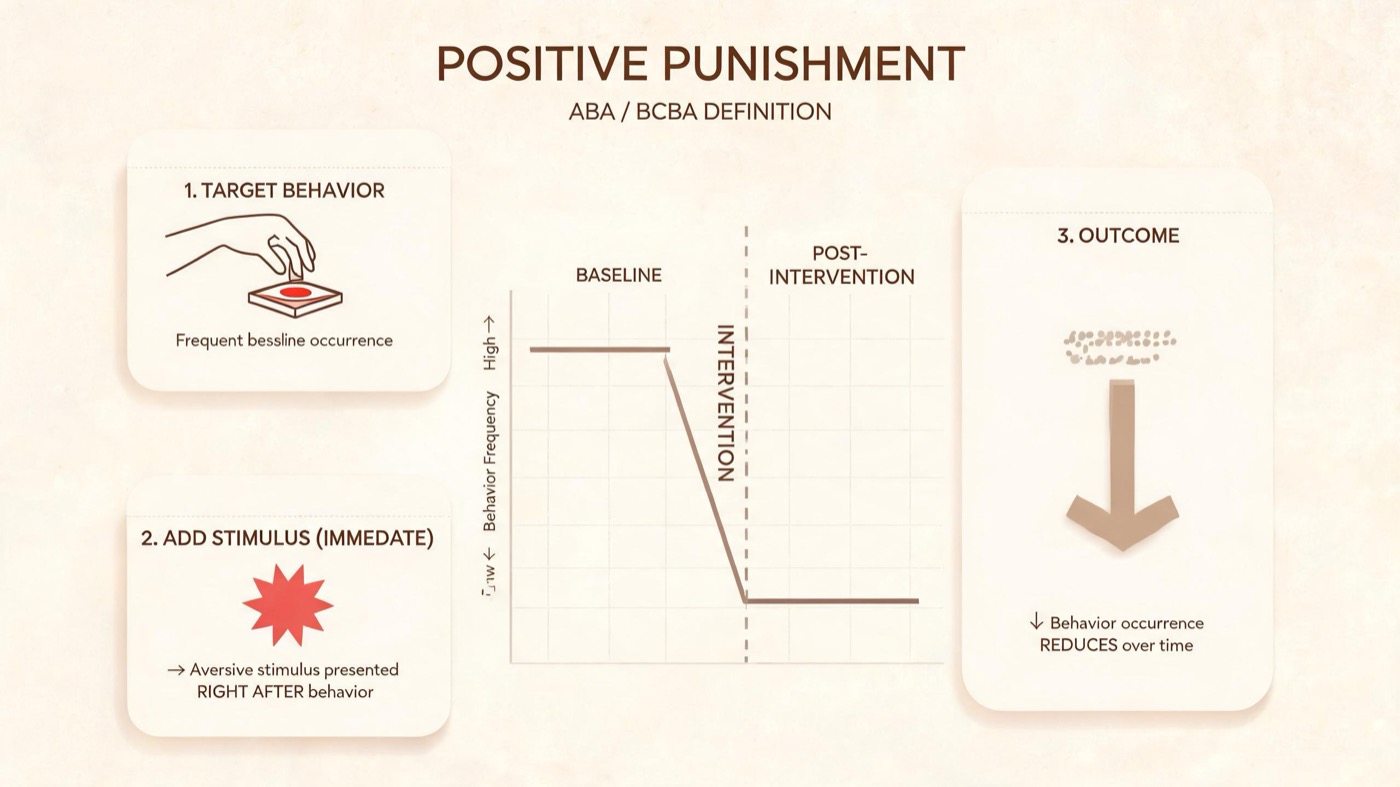
In applied behavior analysis, to define positive punishment accurately is essential for every BCBA candidate. Positive punishment is a type of consequence intervention where a stimulus is added immediately after a behavior, resulting in a decrease in the future frequency of that behavior. The key is that something is presented (added) to the environment, not removed.
Table of Contents
- What Is Positive Punishment? A BCBA’s Definition
- Positive Punishment Examples with ABC Analysis
- Exam Relevance: How Positive Punishment Is Tested
- Positive Punishment Quick Checklist for BCBA Candidates
- Summary: Positive Punishment vs. Other Procedures
- References
For example, if a child touches a hot stove (behavior) and feels pain (added stimulus), the child is less likely to touch it again. This is positive punishment because the pain is added, and the behavior decreases.
Key Components of Positive Punishment
- Behavior: The target behavior that needs to be reduced.
- Immediate Consequence: A stimulus is presented (added) contingent on the behavior.
- Future Decrease: The behavior occurs less often in the future.
- Stimulus Presented: The consequence involves adding something (e.g., a reprimand, extra work, a spray of water) – not removing anything.
Remember: positive punishment is only identified if the behavior decreases. If the behavior does not decrease, the added stimulus is not functioning as a punisher. Also, note that positive punishment is different from negative punishment, where a stimulus is removed.
Positive Punishment Examples with ABC Analysis
To help you apply this concept, here are three practical examples using the ABC (Antecedent-Behavior-Consequence) format. Each example includes a hypothesized function to link to real-world behavior intervention.
Example 1: Reducing Aggressive Behavior
- Antecedent: A peer takes a toy from a child.
- Behavior: The child hits the peer.
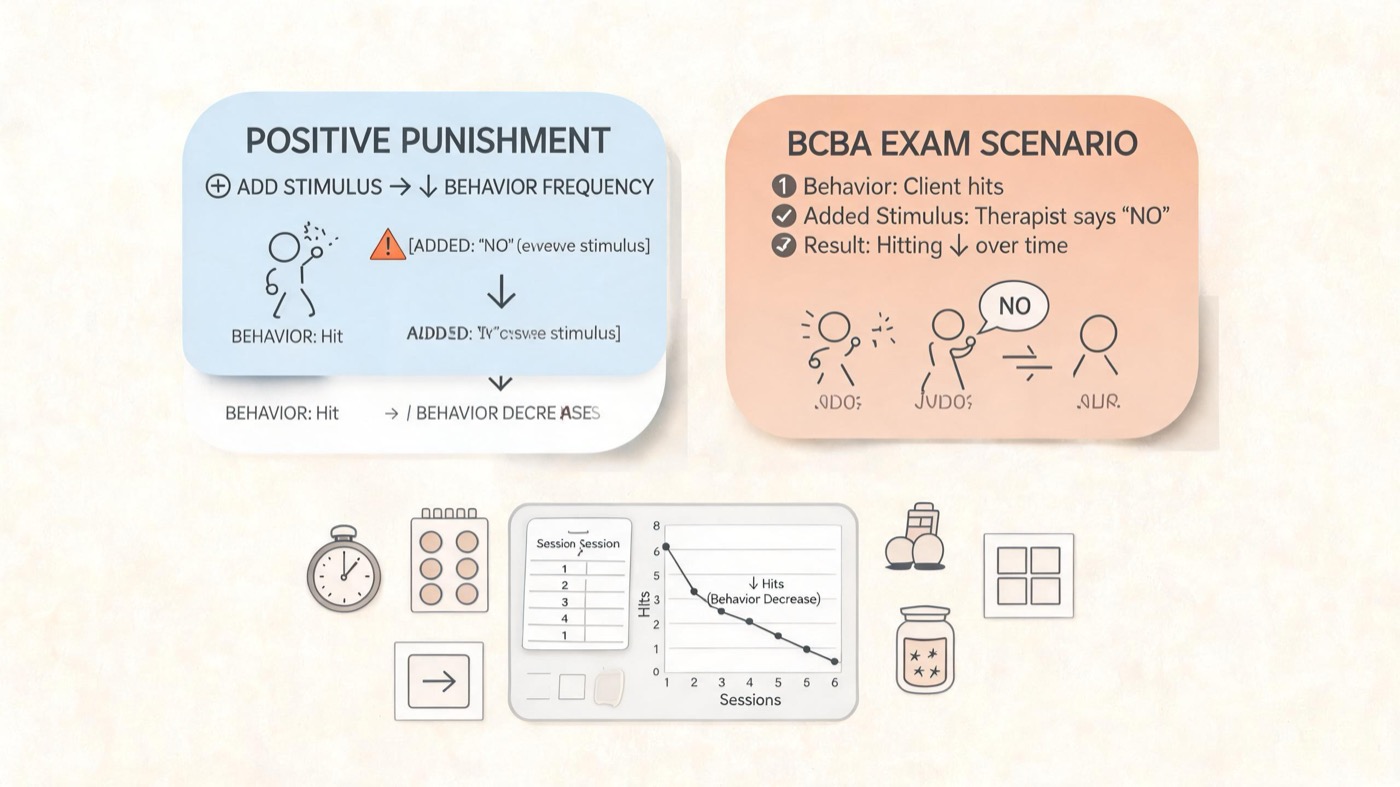
- Consequence: The teacher says, ‘No hitting!’ in a firm voice (added verbal reprimand).
- Hypothesized Function: Attention maintained. The reprimand adds social attention, which may decrease hitting over time if it is effective. However, careful monitoring is needed because the reprimand could inadvertently reinforce the behavior if the child finds it enjoyable.
Example 2: Reducing Pica (Eating Non-Food Items)
- Antecedent: A client with pica sees a small object on the floor.
- Behavior: The client picks it up and puts it in their mouth.
- Consequence: The therapist immediately sprays a small amount of water toward the client’s face (added stimulus).
- Hypothesized Function: Automatic (sensory) reinforcement. The spray of water may serve as a punisher by providing an aversive sensation. Note: This procedure must be used with caution and only after ethical approval; contrast with sensory extinction (blocking access to the sensory consequence).
Example 3: Reducing Elopement
- Antecedent: During a transition, a student runs toward the door.
- Behavior: The student leaves the classroom without permission (elopement).
- Consequence: A staff member gently guides the student back to the classroom using a hand-on-shoulder prompt (added physical guidance).
- Hypothesized Function: Escape maintained. The guided return may function as positive punishment if it adds an effortful or aversive consequence, thereby reducing elopement. However, overcorrection procedures (e.g., requiring the student to practice walking back correctly) must be implemented ethically and with a plan for fading.
Example 4: Reducing Inappropriate Vocalizations
- Antecedent: During independent work, a student makes loud, unrelated comments.
- Behavior: The student yells out a joke.
- Consequence: The teacher assigns one extra math problem to complete (added academic demand).
- Hypothesized Function: Attention maintained. The added work is intended to be aversive, decreasing yelling. Always monitor for side effects like escape-maintained escalation.
Exam Relevance: How Positive Punishment Is Tested
On the BCBA exam, you will be asked to define positive punishment and identify it in scenarios. Questions often present a description of a behavior and a consequence, and you must determine which operant principle is at work. Here are common formats and traps.
Common Exam Traps to Avoid
- Confusing positive punishment with negative reinforcement: In negative reinforcement, a stimulus is removed (e.g., removing a loud noise) to increase behavior. In positive punishment, a stimulus is added to decrease behavior. Remember: punishment always reduces behavior; reinforcement always increases it.
- Forgetting the added stimulus: The exam may describe a consequence that seems like punishment but does not explicitly state that something is added. If a stimulus is removed (e.g., taking away a toy), it is negative punishment, not positive.
- Overlooking function: A consequence that adds something may not be punishment if the behavior does not decrease. For example, if a reprimand actually increases the behavior, then it is reinforcement, not punishment.
- Ethical considerations: The BACB’s Ethics Code requires that punishment-based interventions are used only after reinforcement-based interventions have been tried and found ineffective, and that the least restrictive procedures are prioritized. For more on ethical use, see our guide on punishment in ABA ethics and side effects.
Ethical Considerations in Punishment
Punishment procedures, including positive punishment, are considered restrictive and should be used with caution. Behavior analysts must first attempt function-based reinforcement interventions (e.g., differential reinforcement of alternative behavior – DRA) and document their lack of effectiveness. Ethical use requires ongoing monitoring for side effects such as aggression, escape behaviors, or emotional distress. Refer to the BACB’s Professional and Ethical Compliance Code for detailed requirements.
Positive Punishment Quick Checklist for BCBA Candidates
Use this checklist when designing or evaluating behavior intervention plans that involve positive punishment. This ensures interventions are ethical, effective, and align with best practices.
- Verify that a stimulus is added (not removed) after the behavior.
- Confirm that the behavior decreases in future frequency. If not, the procedure is not punishment.
- Document that reinforcement-based interventions (e.g., DRA, NCR) were tried first and were insufficient.
- Obtain informed consent from caregivers and approval from a human rights committee if required.
- Monitor for undesirable side effects such as increased aggression, escape behavior, or emotional responses.
- Plan for fading the punisher once the behavior is reduced.
- Train all implementers on correct delivery with treatment integrity checks.
Summary: Positive Punishment vs. Other Procedures
Knowing the differences between positive punishment and other operant procedures is critical for exam success. Here is a quick recap:
- Positive Punishment vs. Negative Punishment: Positive adds a stimulus, negative removes a stimulus. Both decrease behavior.
- Positive Punishment vs. Positive Reinforcement: Positive reinforcement adds a stimulus to increase behavior; positive punishment adds a stimulus to decrease behavior.
- Positive Punishment vs. Extinction: Extinction involves no longer providing reinforcement for a behavior (the reinforcer is withheld), whereas positive punishment adds an aversive stimulus.
For more detailed comparisons, check out our guide on positive vs negative punishment in ABA and our free BCBA mock exam practice questions to test your knowledge.
By mastering how to define positive punishment and apply it in real-world and exam contexts, you will be well-prepared for related questions on the BCBA exam. Always stay ethical and data-driven in your practice.


