
Understanding Shaping in Psychology
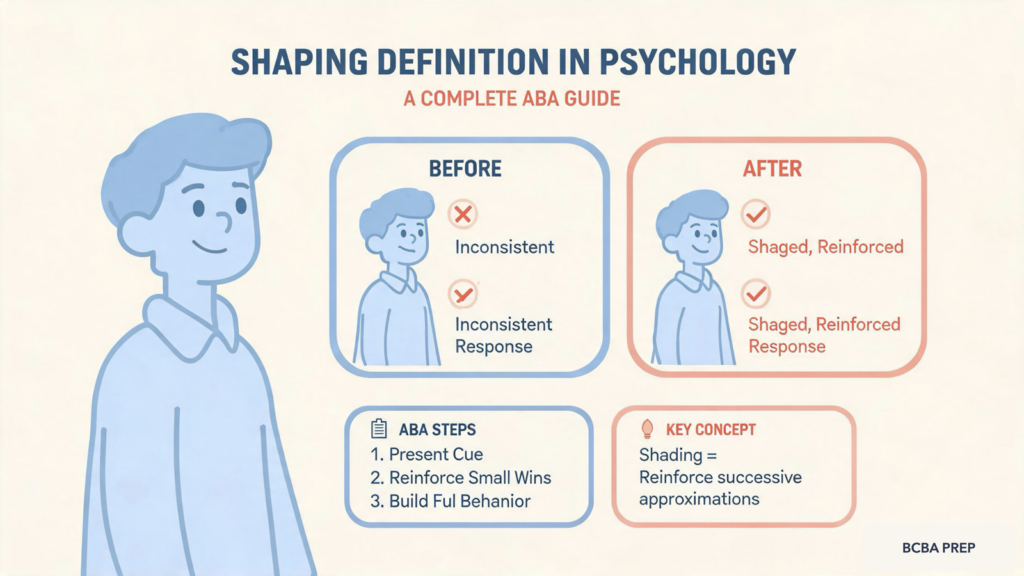
If you’re preparing for the BCBA exam, you’ll encounter the shaping definition in psychology early and often. Shaping is a fundamental procedure used to develop new behaviors by reinforcing successive approximations toward a terminal behavior. This technique is widely applied in ABA, from teaching communication skills to increasing on-task behavior.
Table of Contents
- Understanding Shaping in Psychology
- What Is Shaping in Psychology?
- The Step-by-Step Shaping Procedure
- Real-World ABA Examples of Shaping
- Shaping vs. Chaining: A Common Exam Trap
- Quick Exam Review Checklist
- Summary and Next Steps
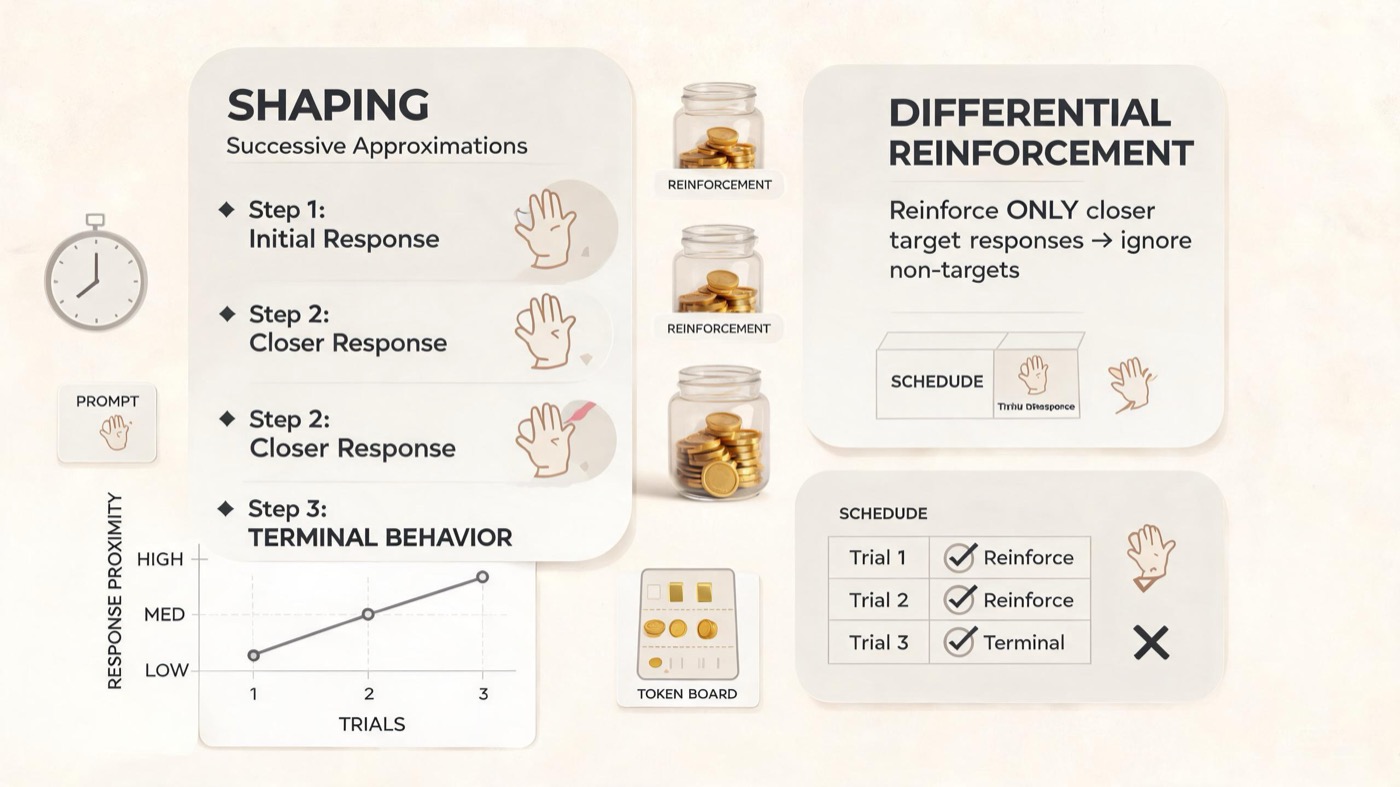
Shaping relies on differential reinforcement: reinforcing responses that are closer to the goal and extinguishing those that are not. It is not the same as chaining, prompting, or simple instruction. On the exam, you may be asked to identify when shaping is appropriate or to sequence the steps correctly.
What Is Shaping in Psychology?
Shaping is defined as the process of systematically and differentially reinforcing successive approximations to a terminal behavior. The term successive approximations refers to the sequence of gradually closer responses to the final desired behavior. For example, when teaching a child to say ‘water,’ you might first reinforce any vocalization, then the sound ‘wa,’ and finally ‘water.’
The Role of Differential Reinforcement
Differential reinforcement is the engine of shaping. It involves reinforcing a specific target behavior while withholding reinforcement for other behaviors. In shaping, you reinforce approximations that are closer to the terminal goal and place previous approximations on extinction. This process shapes behavior gradually without requiring the learner to emit the final behavior immediately.
On the BCBA exam, questions often test whether you can distinguish shaping from other procedures. For instance, if a question describes reinforcing closer and closer approximations, the answer is shaping. If it mentions linking discrete steps, it’s chaining.
The Step-by-Step Shaping Procedure
To apply shaping correctly, follow these five steps outlined in the BACB Task List. Each step is critical for exam success.
Step 1: Define the Terminal Behavior
Write an operational definition of the final desired behavior. For example, ‘The child will independently request a toy by saying the toy’s name.’
Step 2: Identify the Starting Behavior
Select a behavior already in the learner’s repertoire that approximates the terminal behavior. This could be a simple sound, a gesture, or any response that can be built upon.
Step 3: Select Successive Approximations
Break down the behavioral sequence into smaller, achievable steps. Each step should be a closer approximation to the terminal behavior. List them in order from easiest to hardest.
Step 4: Reinforce Each Approximation
Use differential reinforcement: provide reinforcement for the current approximation and withhold it for previous behaviors. This requires careful monitoring to ensure the learner progresses.
Step 5: Move Through Approximations at Appropriate Pace
Adjust the pace based on learner progress. If the learner masters a step quickly, move to the next. If they struggle, you may need to create intermediate approximations. Avoid moving too fast, which can cause frustration, or too slow, which can lead to boredom.
Real-World ABA Examples of Shaping
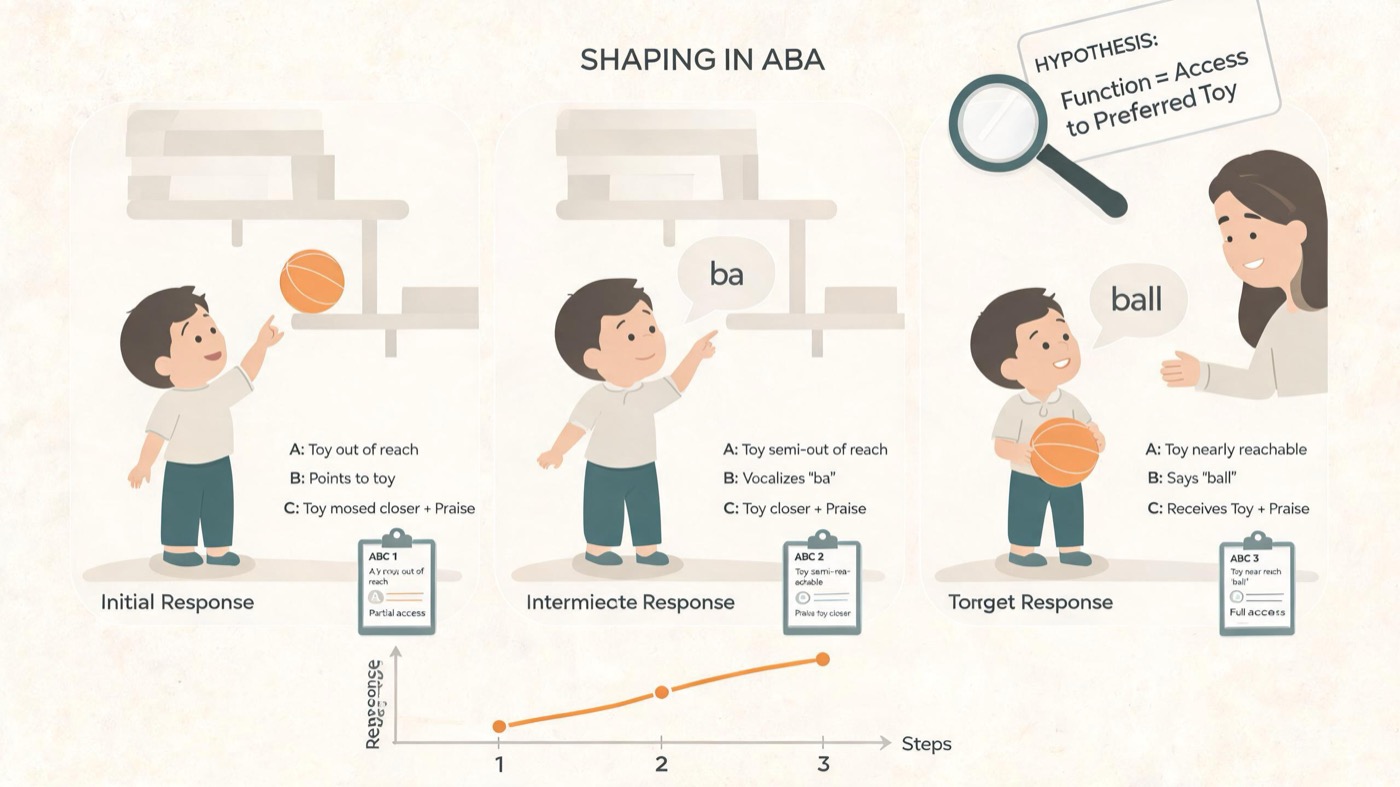
Here are three practical examples to illustrate shaping in different contexts. Pay attention to the antecedent-behavior-consequence (ABC) patterns and hypothesized function.
Example 1: Teaching a Child to Request a Toy
Antecedent: A preferred toy is placed out of reach. Behavior: The child first points, then says ‘ba,’ then ‘ball,’ and finally ‘I want ball.’ Consequence: The toy is delivered. The function is access to tangibles.
Example 2: Increasing Duration of On-Task Behavior
Antecedent: A work task is presented. Behavior: The student works for 1 minute, then 3 minutes, then 5 minutes. Consequence: A brief break and praise are provided. The function is negative reinforcement (escape from task) but shaped to increase on-task time.
Example 3: Teaching a Dog to Roll Over
Though often used in animal training, shaping is identical in principle. The dog is reinforced for lying down, then for turning its head, then for rolling onto its side, and finally for a full roll. This shows the generality of shaping across species.
Shaping vs. Chaining: A Common Exam Trap
Many BCBA candidates confuse shaping with chaining. The key difference lies in what is being changed. Shaping changes the topography or quality of a single behavior (e.g., making a response more accurate). Chaining links discrete behaviors into a sequence (e.g., washing hands: turn on water, soap, rinse, dry).
Key Differences
- Shaping: Reinforces successive approximations of a single behavior. Example: reinforcing louder speech volume.
- Chaining: Reinforces completion of a sequence of separate behaviors. Example: completing each step of a morning routine.
Exam Tip
On the exam, if the question mentions ‘reinforcing successive approximations,’ it’s shaping. If it mentions ‘link’ or ‘chain,’ it’s chaining. Also note that shaping is used to develop new behaviors, while chaining is used to teach complex sequences.
Quick Exam Review Checklist
Use this checklist to reinforce your understanding before the test:
- Define terminal behavior operationally.
- Identify a starting behavior in the learner’s repertoire.
- Select 3–5 successive approximations.
- Apply differential reinforcement at each step.
- Monitor progress and adjust the pace of approximations.
- Distinguish shaping from chaining on exam questions.
Summary and Next Steps
Shaping is a powerful, evidence-based procedure that allows you to teach complex behaviors by reinforcing gradual steps. Master the shaping definition in psychology and the five-step process to answer exam questions with confidence. For more practice, check out our BCBA mock exams and review differential reinforcement for deeper understanding. Also, consult the BACB website for official task list items related to shaping.


