
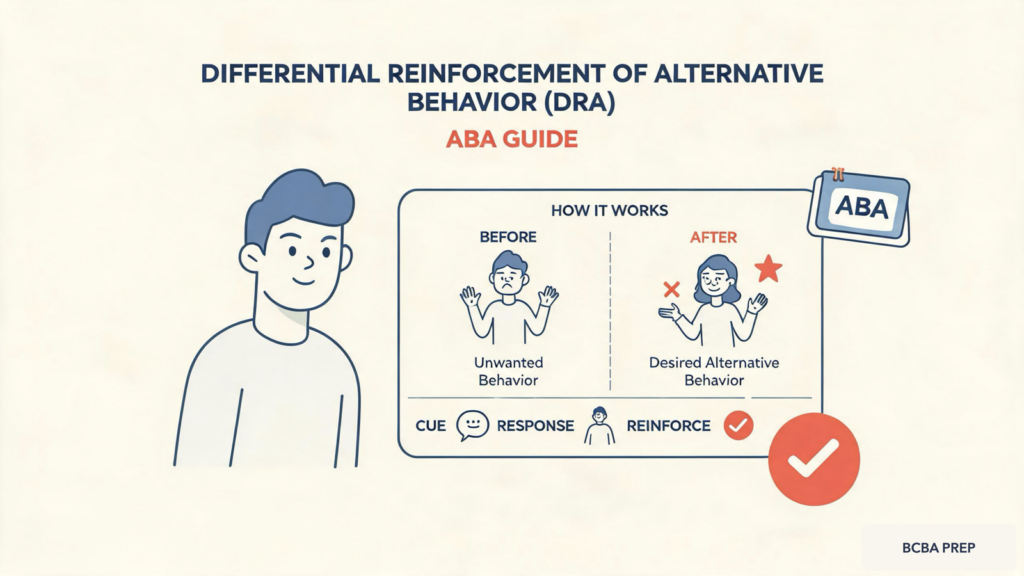
Definition and Core Components
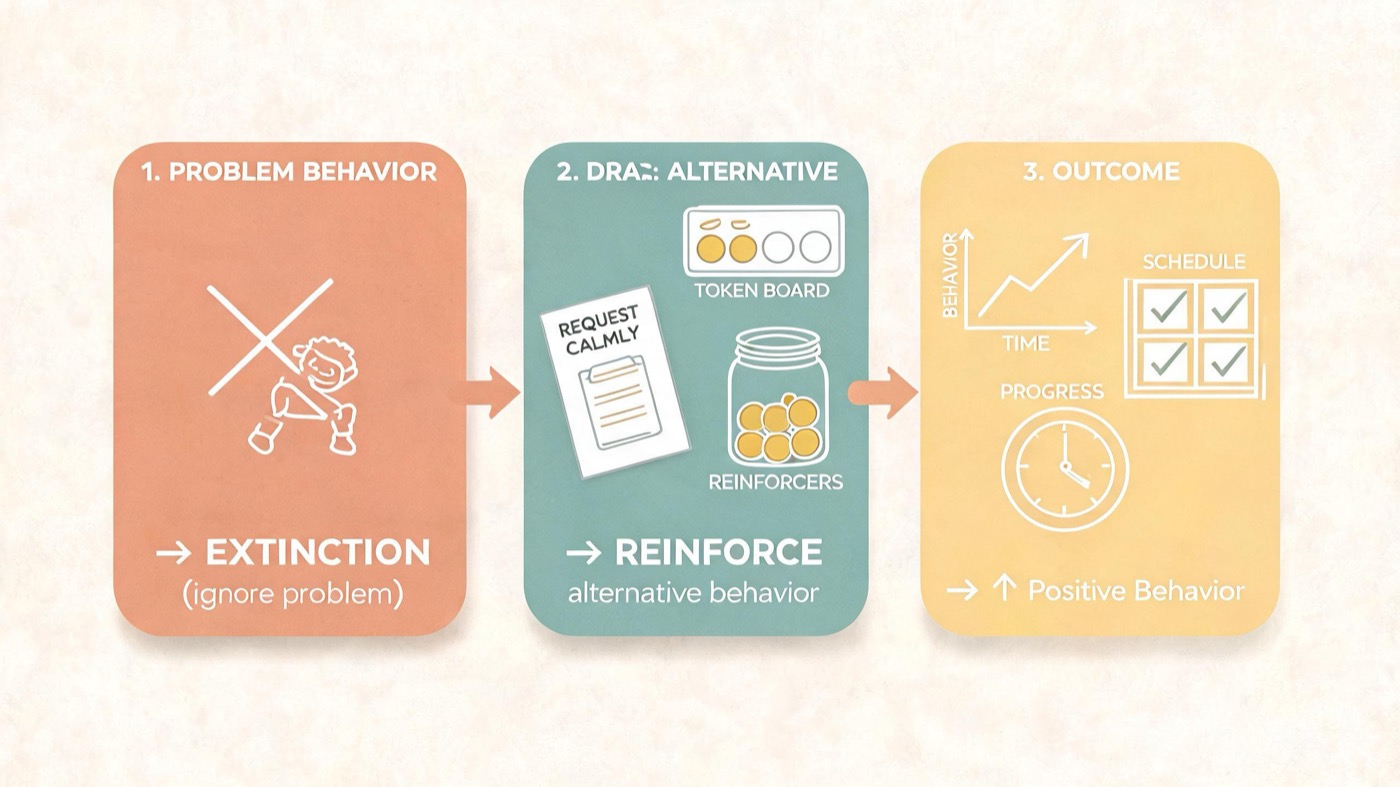
Differential reinforcement of alternative behavior (DRA) is a procedure in which a functionally equivalent alternative behavior is reinforced while the problem behavior is placed on extinction. This approach is widely used in applied behavior analysis to reduce challenging behaviors by teaching a more appropriate replacement. The key components include identifying an alternative behavior that serves the same function, consistently reinforcing that behavior, and withholding reinforcement for the target behavior.
Table of Contents
- Definition and Core Components
- How DRA Works: Function-Based Examples with ABC Data
- BCBA Exam Focus: DRA Questions and Common Traps
- Quick DRA Implementation Checklist
- Summary and Next Steps
What Makes DRA Different from DRO and DRI?
DRA is often confused with other differential reinforcement procedures. The table below clarifies the distinctions for exam questions.
- DRA (differential reinforcement of alternative behavior): Reinforces a specific alternative behavior (e.g., raising hand instead of yelling). Extinction applies to the problem behavior.
- DRO (differential reinforcement of other behavior): Reinforces the absence of the problem behavior during a set interval (e.g., no screaming for 5 minutes). No specific alternative is taught.
- DRI (differential reinforcement of incompatible behavior): Reinforces a behavior that is physically incompatible with the problem behavior (e.g., sitting vs. running).
When to Use DRA in Behavior Intervention Plans
DRA is appropriate when the learner already has the alternative behavior in their repertoire or can be taught it, and the alternative behavior requires less effort than the problem behavior to access reinforcement. It is particularly useful for functional communication training, where a communicative response replaces a challenging behavior. For example, if a child screams to get attention, teaching them to say ‘excuse me’ and reinforcing that response is a strong DRA intervention.
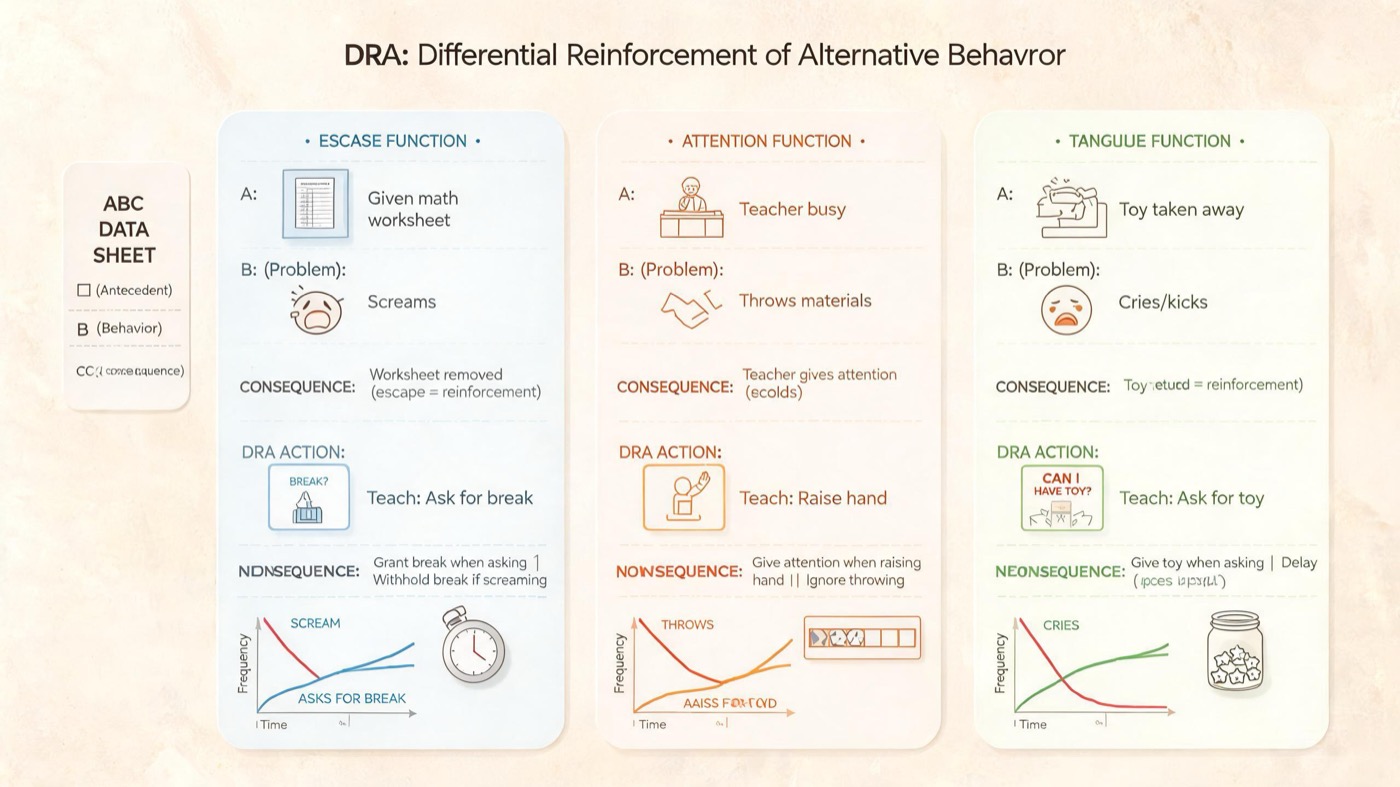
How DRA Works: Function-Based Examples with ABC Data
To implement DRA effectively, you must first hypothesize the function of the problem behavior. Below are three function-based examples showing how DRA is applied with ABC data.
Example 1: Escape-Maintained Behavior
A child screams when given a math worksheet (antecedent), the teacher removes the worksheet (behavior → escape), and screaming is reinforced by escape. With DRA, the child is taught to request a break using a card. The alternative behavior (handing over a break card) is reinforced with a 2-minute break, while screaming no longer results in escape.
- Antecedent: Math worksheet presented
- Problem behavior: Screaming
- Alternative behavior: Hand over break card
- Consequence for alternative: 2-minute break
- Consequence for problem: Extinction (no break)
Example 2: Attention-Maintained Behavior
A student taps the desk (antecedent: teacher busy), the teacher looks at the student and says ‘stop tapping’ (consequence: attention). Under DRA, the student is taught to raise a hand, and the teacher provides immediate attention. Tapping is placed on extinction.
- Antecedent: Teacher attending to others
- Problem behavior: Desk tapping
- Alternative behavior: Raise hand
- Consequence for alternative: Teacher says ‘yes?’ and provides attention
- Consequence for problem: Extinction (ignore tapping)
Example 3: Tangible-Maintained Behavior
A child cries to get a toy from a sibling. The parent gives the toy (consequence: access to tangible). DRA teaches the child to say ‘my turn’ or use a sign. The parent immediately provides the toy when the child uses the alternative behavior. Crying is ignored.
- Antecedent: Sibling playing with toy
- Problem behavior: Crying
- Alternative behavior: Say ‘my turn’
- Consequence for alternative: Toy provided
- Consequence for problem: Extinction (no toy given)
BCBA Exam Focus: DRA Questions and Common Traps
Exam questions often test your ability to distinguish DRA from other procedures and to select an appropriate alternative behavior. Watch for these common traps.
Distinguishing DRA from Extinction Burst Misconceptions
DRA includes extinction for the problem behavior, but many students mistakenly think DRA is simply ignoring the behavior. In DRA, you must reinforce the alternative while withholding reinforcement for the problem behavior. An extinction burst (a temporary increase in the problem behavior) may occur, but the correct response is to continue implementing DRA, not to give in.
Selecting an Appropriate Alternative Behavior
A common trap is choosing an alternative behavior that is not functionally equivalent or that requires more effort than the problem behavior. For example, if a child engages in aggression to escape demands, teaching them to ask for a break (escape function) is appropriate. Teaching them to ask for a hug (attention function) would not be effective because it does not match the function. Always ensure the alternative behavior produces the same reinforcer and is easier to emit.
DRA vs. DRO: When to Pick Which
Exam scenarios may present a behavior and ask which differential reinforcement procedure to use. Remember: DRA reinforces a specific alternative; DRO reinforces the absence of the target behavior for a period. If the goal is to teach a replacement skill, choose DRA. If the goal is to reduce behavior without teaching a specific replacement (e.g., for behaviors that are hard to replace), DRO may be appropriate.
Quick DRA Implementation Checklist
Use this checklist to guide your study or practice in developing a DRA intervention.
- Identify the function of the problem behavior (e.g., escape, attention, tangible, automatic).
- Select an alternative behavior that produces the same reinforcer and requires less effort.
- Teach the alternative behavior using prompting and shaping if needed.
- Reinforce the alternative behavior immediately and consistently following correct responses.
- Place the problem behavior on extinction (ensure no reinforcement is provided).
- Monitor for extinction bursts and plan for them.
- Collect data on both behaviors to evaluate treatment effectiveness.
Summary and Next Steps
Differential reinforcement of alternative behavior is a cornerstone of behavior intervention plans. By reinforcing a functionally equivalent replacement behavior and extinguishing the problem behavior, DRA promotes lasting behavior change. For more exam-focused content, explore our differential reinforcement study guide and practice with BCBA mock exams. Remember to review the BACB website for official task list updates. Master DRA and you will be well-prepared for exam questions on this essential procedure.


