
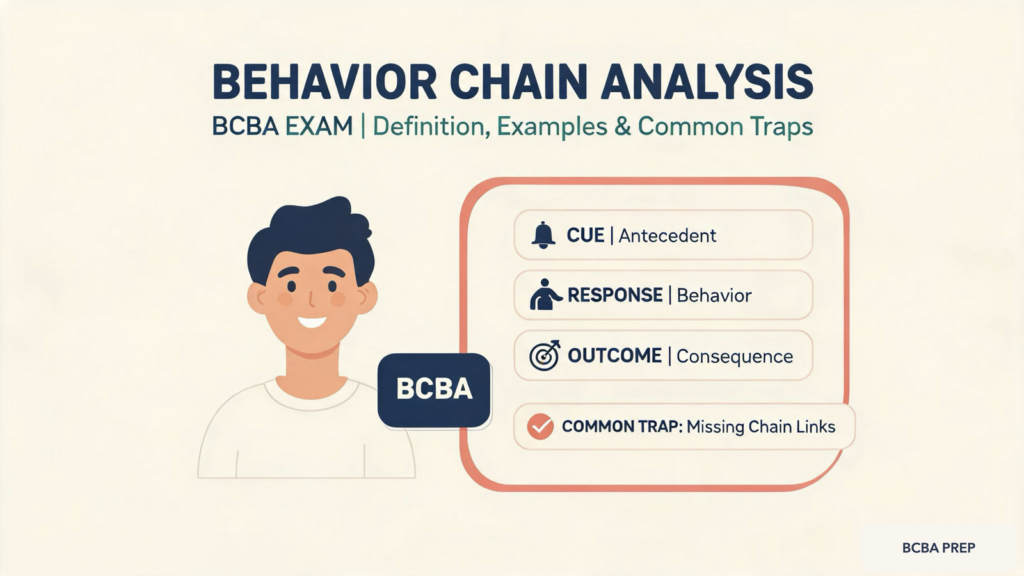
What Is a Behavior Chain?
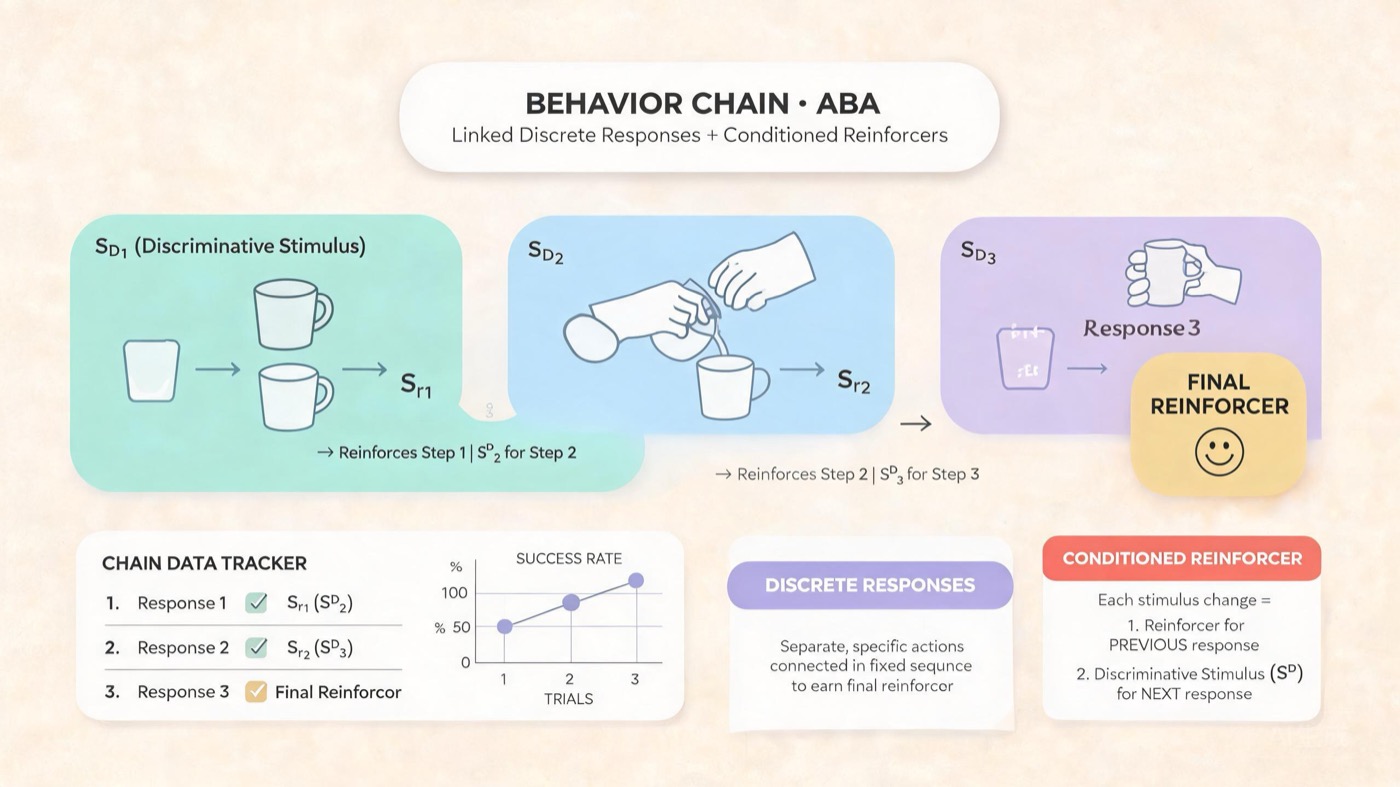
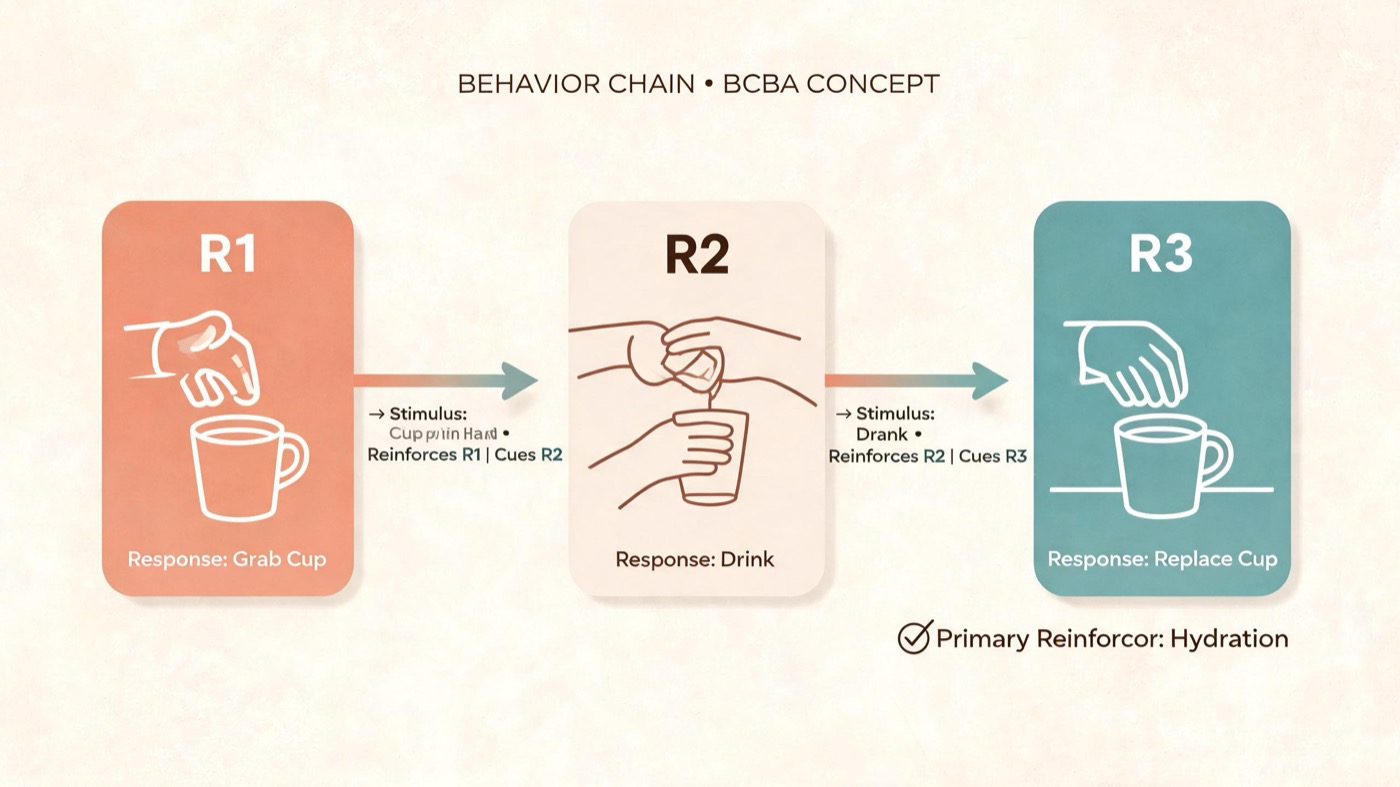
A behavior chain is a sequence of discrete responses that are linked together by conditioned reinforcers. Each response produces a stimulus change that serves as both a reinforcer for the previous response and a discriminative stimulus (SD) for the next response. This interdependency is what makes the sequence a chain.
Table of Contents
- What Is a Behavior Chain?
- Behavior Chain Examples with ABC Analysis
- Why Behavior Chains Matter on the BCBA Exam
- Quick Checklist: Behavior Chain Review
- Summary: Behavior Chains in ABA
Behavior Chain Definition in ABA
In applied behavior analysis, a behavior chain is defined as a sequence of behaviors where each step functions as an SD for the next step and as a conditioned reinforcer for the step that produced it. The entire chain produces a terminal reinforcer at the end. For example, hand washing involves turning on water, wetting hands, applying soap, scrubbing, rinsing, turning off water, and drying hands. Each step sets up the next.
How Behavior Chains Differ from Chaining Procedures
A common exam trap is confusing the chain itself with the teaching method. The behavior chain is the sequence of behaviors; chaining refers to instructional procedures (forward chaining, backward chaining, total task chaining) used to teach that sequence. On the BCBA exam, you may be asked to identify whether a scenario describes a chain or a chaining procedure.
Behavior Chain Examples with ABC Analysis
Understanding how to break a chain into its ABC components is essential for both assessment and intervention. Below are two worked examples.
Example 1: Washing Hands
Task analysis steps: (1) turn on water, (2) wet hands, (3) apply soap, (4) scrub for 20 seconds, (5) rinse, (6) turn off water, (7) dry hands. Let’s analyze step 4 (scrubbing) using the three-term contingency:
- Antecedent: Soap is on hands; SD for scrubbing
- Behavior: Rubbing hands together vigorously
- Consequence: Bubbles appear (conditioned reinforcer) plus sensory feedback (automatic reinforcement)
If a step is missing, the chain breaks. For example, if the learner turns on water but does not wet hands, the SD for applying soap is absent. The hypothesized function of the chain is automatic reinforcement (sensory stimulation from bubbles and water). Exam tip: Know the task analysis steps for common chains; you may be asked to identify which step is missing or which step was not reinforced.
Example 2: Completing a Math Worksheet (Academic Chain)
This chain involves reading a problem, computing the answer, writing it down, and checking the work. Let’s analyze step 3 (write answer):
- Antecedent: Problem solved on scratch paper (SD for writing)
- Behavior: Writing the answer in the answer box
- Consequence: Visual access to the next problem (conditioned reinforcer) and eventual teacher praise (tangible/attention)
Topic for analysis: If a student writes an answer but then stops, the chain may be broken due to escape from demand (the next problem is aversive). Alternatively, if the student seeks attention, the break may occur after writing to get a reaction. A broken chain can indicate the function of the problem behavior.
Why Behavior Chains Matter on the BCBA Exam
The topic appears in multiple content areas of the 6th Edition Task List, especially under assessment and intervention. You will encounter questions on task analysis, chaining procedures, and identifying breaks in chains. Mastering this concept helps you avoid common mistakes.
Common Exam Traps Involving Behavior Chains
Here are four traps that frequently appear on the BCBA exam:
- Confusing chain with chaining procedure: A scenario describes a sequence of steps (behavior chain) but the question asks about forward chaining (teaching method). Read carefully.
- Forgetting each step is a conditioned reinforcer: Many candidates think only the terminal reinforcer matters. Each intermediate step must function as a reinforcer for the previous response.
- Assuming all chains are linear: Some chains have branching steps or alternative routes. For example, a cooking chain may allow skipping a step if ingredients are pre-measured.
- Ignoring motivating operations (MOs): The strength of the terminal reinforcer affects the chain. If the learner is satiated, the chain may break early. MOs are critical to consider.
How to Study Behavior Chains for the Exam
Use these practical strategies to prepare:
- Create task analyses for common daily chains (brushing teeth, making a sandwich, putting on shoes). Practice writing each step as an observable behavior.
- Practice identifying broken chain steps in vignettes. Ask yourself: which step was not completed? What antecedent or consequence was missing?
- Review the three chaining procedures: forward chaining (teach first step then chain), backward chaining (teach last step first), and total task chaining (teach all steps at once with prompting).
- Use a quick checklist (see next section) for last-minute review.
Quick Checklist: Behavior Chain Review
Use this checklist to solidify your understanding before the exam.
- Behavior chain = sequence of discrete responses, each is an SD for the next
- Each step produces a conditioned reinforcer for the previous response
- Distinguish from chaining procedures (teaching methods)
- A task analysis is prerequisite; know the steps for common chains
- A broken chain can help assess function (e.g., escape, attention)
- Consider motivating operations that affect the terminal reinforcer
Summary: Behavior Chains in ABA
A behavior chain is a linked sequence of responses, each serving as both a reinforcer and an SD. On the BCBA exam, you must distinguish the chain from chaining procedures, analyze ABCs, and identify breaks. Practice with task analyses and mock exam questions to build fluency. For more targeted preparation, explore our BCBA mock exam questions that cover behavior chains and other core topics. Additional authoritative guidance can be found in the BACB Task List and behavior analysis textbooks.


