
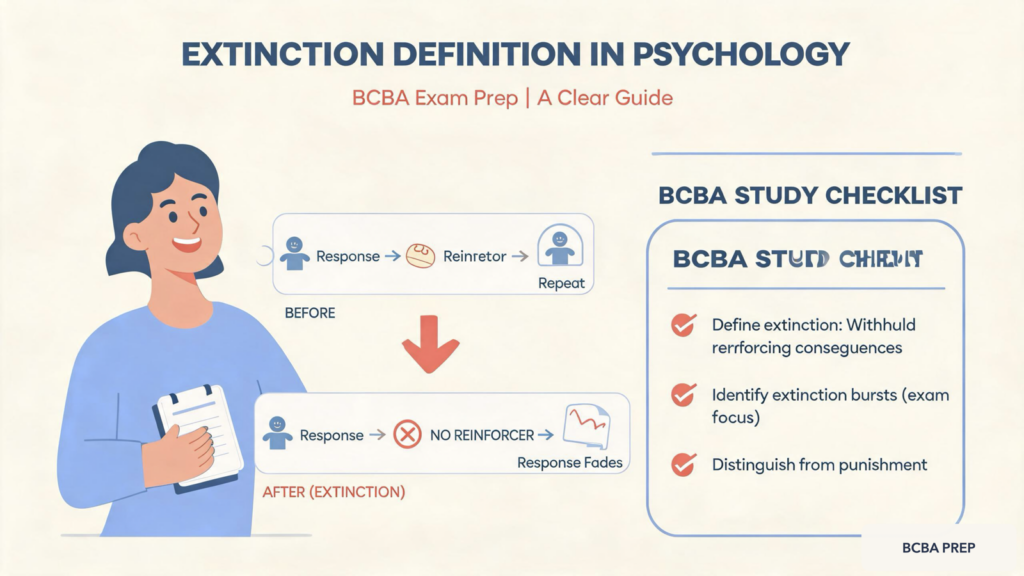
Extinction Definition in Psychology: What You Need to Kn
In psychology and applied behavior analysis, extinction definition psychology refers to the procedure of discontinuing reinforcement for a previously reinforced behavior. When a behavior no longer produces the maintaining consequence, its future frequency decreases. This is a core concept tested on the BCBA exam, often in questions about behavior reduction procedures.
Table of Contents
- Extinction Definition in Psychology: What You Need to Kn
- ABA Examples of Extinction with ABC and Hypothesized Function
- Common Exam Traps: Extinction Burst, Spontaneous Recovery, and More
- Quick Checklist for Extinction on Your BCBA Exam
Extinction is not about ignoring behavior generically. It must be implemented based on the function of the behavior. For example, if a child screams to get attention, extinction involves withholding attention after screaming. If a behavior is maintained by escape from a task, extinction means preventing escape. The key is that the reinforcer that maintains the behavior is no longer delivered.
How Extinction Differs from Other Behavior Reduction Procedures
Many BCBA candidates confuse extinction with punishment or negative reinforcement. Here is how they differ:
- Extinction vs. Punishment: Punishment involves adding an aversive stimulus (positive punishment) or removing a reinforcing stimulus (negative punishment) to decrease behavior. Extinction simply stops the delivery of the reinforcer that maintained the behavior. No aversive stimulus is added.
- Extinction vs. Negative Reinforcement: In negative reinforcement, a behavior increases because it removes or avoids an aversive stimulus. Extinction decreases behavior by discontinuing the reinforcing consequence, which may be escape or avoidance. For example, if a child whines to avoid homework, extinction would block escape (the child must complete the homework).
- Extinction vs. Differential Reinforcement: Differential reinforcement combines extinction for a problem behavior with reinforcement for an alternative behavior. Extinction alone does not teach a replacement behavior; it only reduces the target behavior.
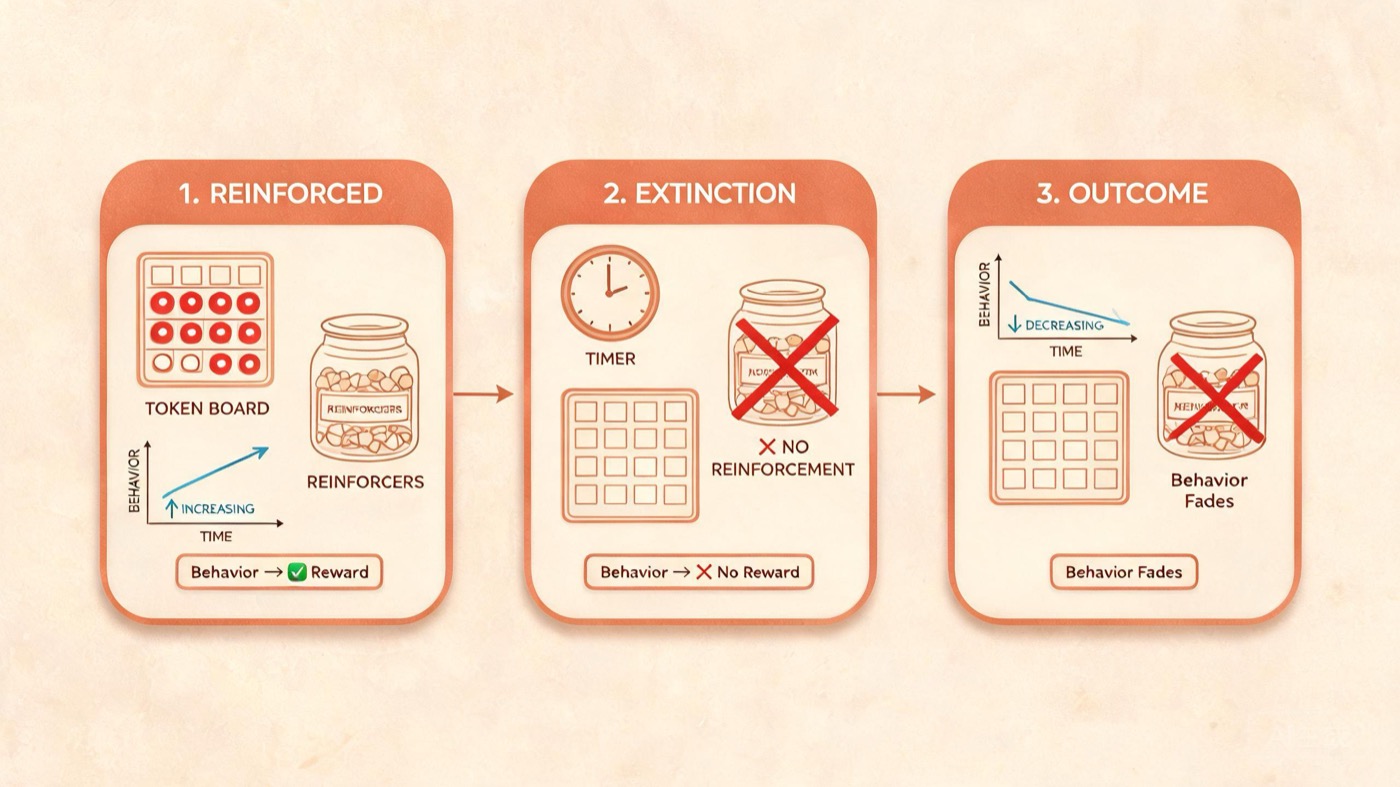
ABA Examples of Extinction with ABC and Hypothesized Function
Understanding extinction through real-world ABC (Antecedent-Behavior-Consequence) analysis helps you identify the maintaining reinforcer and choose the correct extinction procedure.
Example 1: Reducing Disruptive Behavior Maintained by Attention
A student in a classroom frequently shouts out answers without raising his hand. The teacher calls on him (attention), which maintains the shouting.
- Antecedent: Teacher asks a question.
- Behavior: Student shouts out answer.
- Consequence: Teacher calls on him (attention).
- Hypothesized Function: Attention from the teacher.
- Extinction Procedure: Teacher withholds attention when student shouts out (does not call on him, no eye contact, no verbal response). Instead, the teacher calls on students who raise their hands.
- Expected Outcome: Shouting may initially increase (extinction burst) but then decreases. Hand-raising may increase if reinforced.
Example 2: Decreasing Food Refusal Maintained by Escape
During meals, a child pushes the plate away when presented with broccoli. The caregiver removes the plate, allowing the child to escape eating broccoli.
- Antecedent: Caregiver places broccoli on child’s plate.
- Behavior: Child pushes plate away.
- Consequence: Caregiver removes the plate (escape from broccoli).
- Hypothesized Function: Escape from non-preferred food.
- Extinction Procedure: Caregiver does not remove the plate. The food remains on the plate until the child takes one small bite or until a set time passes. Escape is no longer available.
- Expected Outcome: The child may cry or push harder initially (extinction burst) but eventually learns that escape is not possible. With consistent implementation, food refusal decreases.
Example 3: Reducing Stereotypic Behavior Maintained by Automatic Reinforcement
A child with autism repeatedly flicks a string because it produces sensory feedback (automatic reinforcement).
- Antecedent: Child has access to string.
- Behavior: Flicking string.
- Consequence: Sensory stimulation (visual/tactile).
- Hypothesized Function: Automatic reinforcement (sensory stimulation).
- Extinction Procedure: Withhold the sensory consequence? This is challenging because the reinforcer is produced directly by the behavior. For automatically maintained behaviors, extinction involves blocking access to the sensory stimulation (e.g., removing the string) or providing alternative sensory input. However, extinction alone may not be practical; often, differential reinforcement or environmental enrichment is used.
- Expected Outcome: If the sensory stimulation is completely blocked, the behavior may decrease, but careful planning is needed to avoid deprivation.
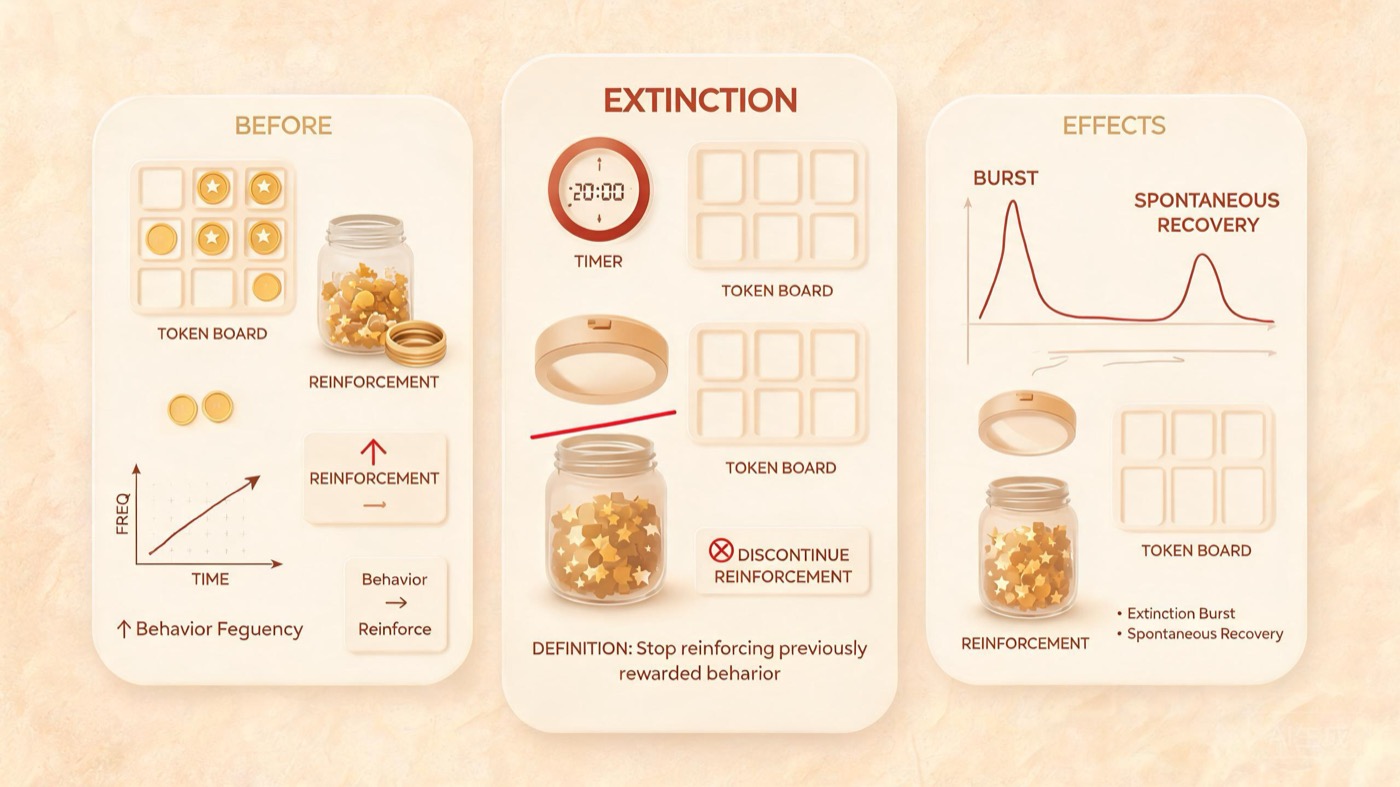
Common Exam Traps: Extinction Burst, Spontaneous Recovery, and More
BCBA exam questions often test your ability to distinguish between extinction-related phenomena and to identify when extinction is contraindicated.
Extinction Burst vs. Shaping vs. Resurgence
- Extinction Burst: A temporary increase in the frequency, duration, or intensity of the target behavior immediately after extinction begins. For example, a child who no longer gets attention for crying may cry louder and longer at first. This is a normal part of extinction.
- Shaping: Reinforcing successive approximations toward a terminal behavior. Shaping increases behavior, not decreases. Extinction burst is a temporary increase in the exact behavior being extinguished, not a new approximation.
- Resurgence: The reappearance of a previously reinforced behavior when a currently reinforced behavior is placed on extinction. For example, if a child was reinforced for yelling (previously) and then reinforced for raising hand (currently), when hand-raising is no longer reinforced, yelling may reappear. Resurgence involves a former behavior, not the same target behavior.
When Extinction is Contraindicated
- Dangerous Behaviors: If a behavior poses immediate risk (e.g., self-injury, aggression), extinction alone may not be safe. The extinction burst could escalate the behavior to dangerous levels. Alternative procedures like differential reinforcement or punishment (within ethical guidelines) may be necessary.
- Behaviors Maintained by Automatic Reinforcement: When the reinforcer is produced directly by the behavior (e.g., sensory stimulation), it may be impossible to withhold the reinforcer completely. For example, thumb-sucking produces tactile stimulation that cannot be easily blocked. In such cases, extinction is often combined with other strategies.
- Lack of Treatment Integrity: Extinction requires consistent implementation by all caregivers. If partial reinforcement occurs (e.g., sometimes the child gets attention for screaming), the behavior will be more resistant to extinction. In settings where consistency is not possible, extinction may fail.
Quick Checklist for Extinction on Your BCBA Exam
Use this checklist to quickly review extinction principles before the exam:
- Identify the maintaining reinforcer through a functional behavior assessment (FBA).
- Ensure the reinforcer can be consistently withheld by all caregivers.
- Plan for a possible extinction burst; do not misinterpret it as procedure failure.
- Combine extinction with differential reinforcement (e.g., DRA) to teach an alternative behavior.
- Monitor for spontaneous recovery and continue collecting data to confirm decreasing trend.
- Avoid extinction if the behavior is dangerous or maintained by automatic reinforcement alone.
- Document treatment integrity to ensure the procedure is implemented correctly.
- Review the BACB Task List items related to extinction (e.g., B.10, B.11 for 5th edition; B.8 in 6th edition).
For more practice, check our comprehensive guide on extinction in ABA. Also, refer to the BACB website for the most current task list.


