
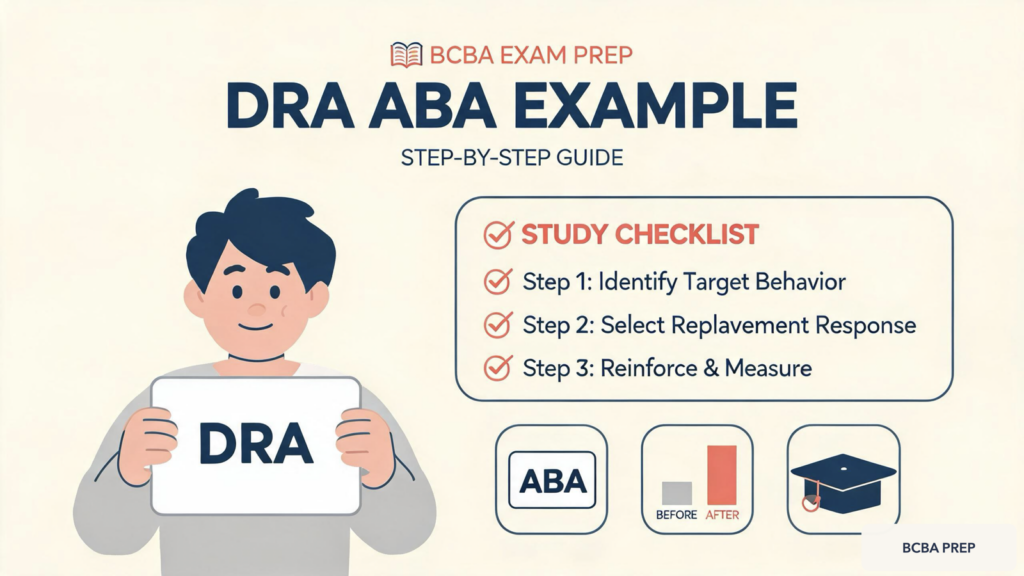
What Is Differential Reinforcement of Alternative Behavior (DRA)?
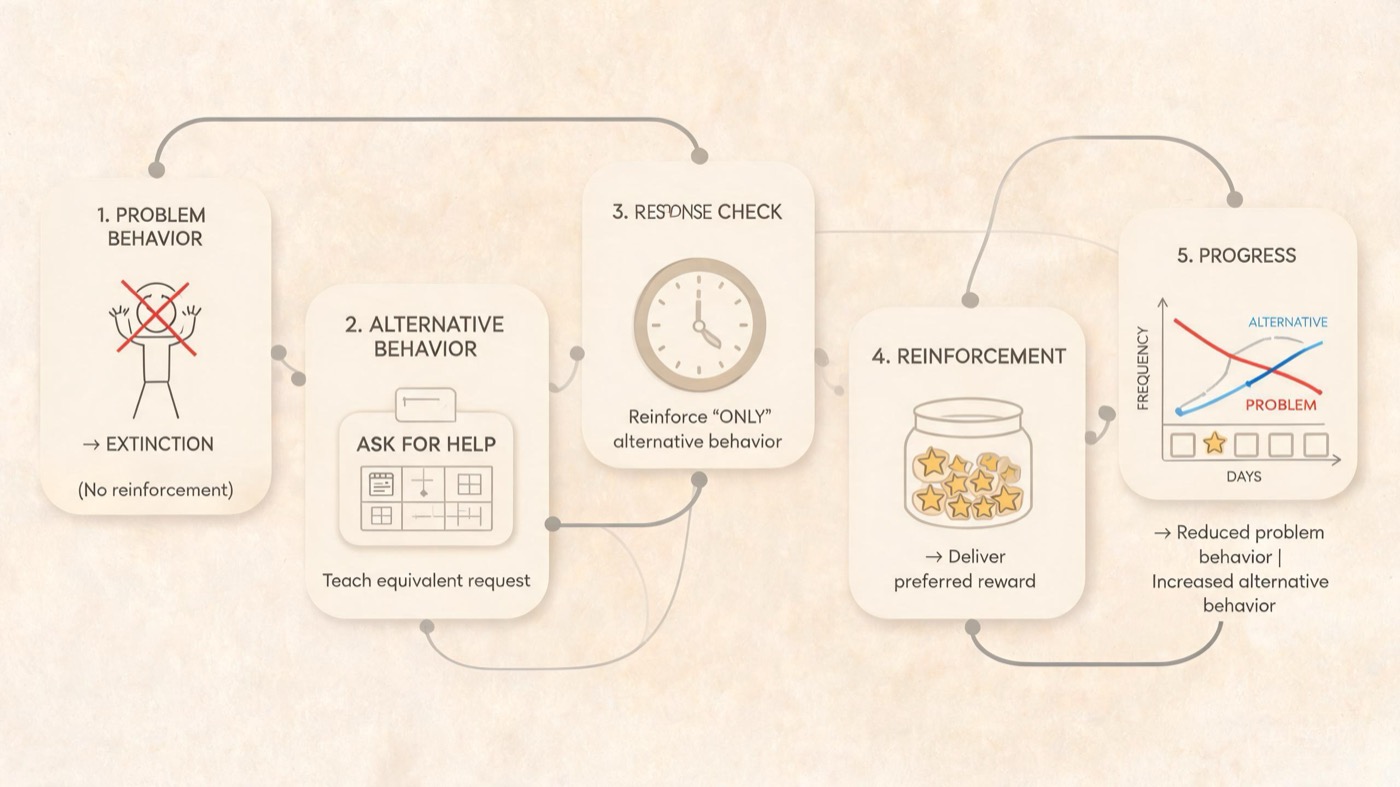
Differential Reinforcement of Alternative Behavior (DRA) is a behavior reduction procedure in which reinforcement is delivered for a functionally equivalent alternative behavior, while the problem behavior is placed on extinction. This means you stop reinforcing the challenging behavior and start reinforcing a more appropriate behavior that serves the same function.
Table of Contents
- What Is Differential Reinforcement of Alternative Behavior (DRA)?
- BCBA Exam Relevance: Why DRA Matters
- DRA ABA Example: 3 Worked-Out Scenarios with ABC Data
- Common Exam Traps and How to Avoid Them
- DRA Implementation Checklist for Practice and Exams
- Final Summary
- References
Key Components of a DRA Procedure
A well-designed DRA procedure includes:
- Identification of the function of problem behavior through functional behavior assessment (FBA).
- Selection of an alternative behavior that produces the same reinforcer as the problem behavior.
- Consistent reinforcement of the alternative behavior on a dense schedule.
- Withholding reinforcement (extinction) for the problem behavior.
- Ongoing data collection and monitoring to ensure effectiveness.
How DRA Differs from DRO and DRI
It is important to distinguish DRA from other differential reinforcement procedures. DRA reinforces a specific alternative behavior that is functionally equivalent to the problem behavior. In contrast, DRO (Differential Reinforcement of Other Behavior) reinforces the absence of the problem behavior for a set time interval, and DRI (Differential Reinforcement of Incompatible Behavior) reinforces a behavior that cannot occur simultaneously with the problem behavior. For example, if a child hits to gain attention, DRA might reinforce requesting attention verbally, while DRI might reinforce keeping hands in pockets (incompatible with hitting).
BCBA Exam Relevance: Why DRA Matters
DRA is a high-yield topic on the BCBA exam. You will encounter questions that ask you to identify the procedure, select the appropriate alternative behavior, or interpret data from a DRA intervention. Understanding DRA is essential for designing effective behavior intervention plans. The BCBA task list covers DRA under items related to behavior change procedures and differential reinforcement.
Common Test Questions for DRA
Exam questions often present a scenario and ask you to choose the correct differential reinforcement procedure or the best alternative behavior. For example:
- Given ABC data, identify the function of behavior and select the most appropriate alternative behavior to reinforce.
- Explain why DRA is preferable to DRO for a given client.
- Describe how to implement extinction when using DRA.
Task List Items Covered
The BACB 6th Edition Task List includes DRA under several assessment and intervention items. Specifically, content related to differential reinforcement procedures is tested in the Assessment (B-9) and Intervention (G-14) sections. Focus on understanding how DRA fits within function-based interventions.
DRA ABA Example: 3 Worked-Out Scenarios with ABC Data
Applying DRA correctly requires practice. Below are three realistic scenarios with ABC data, hypothesized functions, and step-by-step DRA implementation.
Example 1: Reducing Aggression by Reinforcing Requesting
Scenario: A 5-year-old boy with autism hits his teacher when he wants a specific toy. ABC data shows the behavior occurs most often when preferred items are visible but out of reach. Hypothesized function: Access to tangibles.
- Alternative behavior: Teaching him to say “I want [item]” or using a picture exchange.
- DRA implementation: Immediately reinforce any appropriate request (praise + toy). Extinguish hitting by not providing the toy and redirecting to requesting.
- Data collected: Frequency of hitting decreased from 12 per session to 2 per session within two weeks.
Example 2: Increasing Compliance by Reinforcing Following Instructions
Scenario: A 7-year-old girl with ADHD often refuses to clean up her desk, engaging in tantrums (crying, throwing items). ABC data indicates that when demands are presented, she tantrums and the demand is removed. Hypothesized function: Escape from demands.
- Alternative behavior: Complying with the instruction (e.g., putting away one item).
- DRA implementation: Deliver a brief break or praise immediately after compliance. For tantrums, do not remove the demand; instead, wait calmly and prompt compliance.
- Data collected: Compliance increased from 20% to 80% of opportunities.
Example 3: Reducing Vocal Stereotypy by Reinforcing Appropriate Verbalizations
Scenario: A 10-year-old boy engages in repetitive vocal sounds (e.g., “eeee”) during academic tasks. ABC data suggests the behavior is maintained by automatic reinforcement (sensory stimulation).
- Alternative behavior: Making comments or asking questions related to the task (matched stimulation).
- DRA implementation: Provide praise and attention for appropriate verbalizations. For stereotypic sounds, do not provide any reaction (extinction).
- Data collected: Stereotypic vocalizations reduced by 60% after one week.
Common Exam Traps and How to Avoid Them
Many BCBA candidates make mistakes when identifying or implementing DRA. Be aware of these common pitfalls.
Confusing DRA with DRI or DRO
The key distinction is that DRA reinforces a different but appropriate behavior that serves the same function (e.g., requesting instead of grabbing). DRI reinforces a behavior that is physically incompatible with the problem behavior (e.g., sitting on hands instead of hitting). DRO reinforces the absence of the problem behavior for a period of time. Practice discriminating between these on exam questions.
Ignoring Function When Choosing the Alternative Behavior
Always select an alternative behavior that matches the function of the problem behavior. For example, if a child elopes to gain attention, reinforcing compliance (which may be escape-maintained) will not work. Instead, reinforce an appropriate way to get attention, like saying “excuse me.”
DRA Implementation Checklist for Practice and Exams
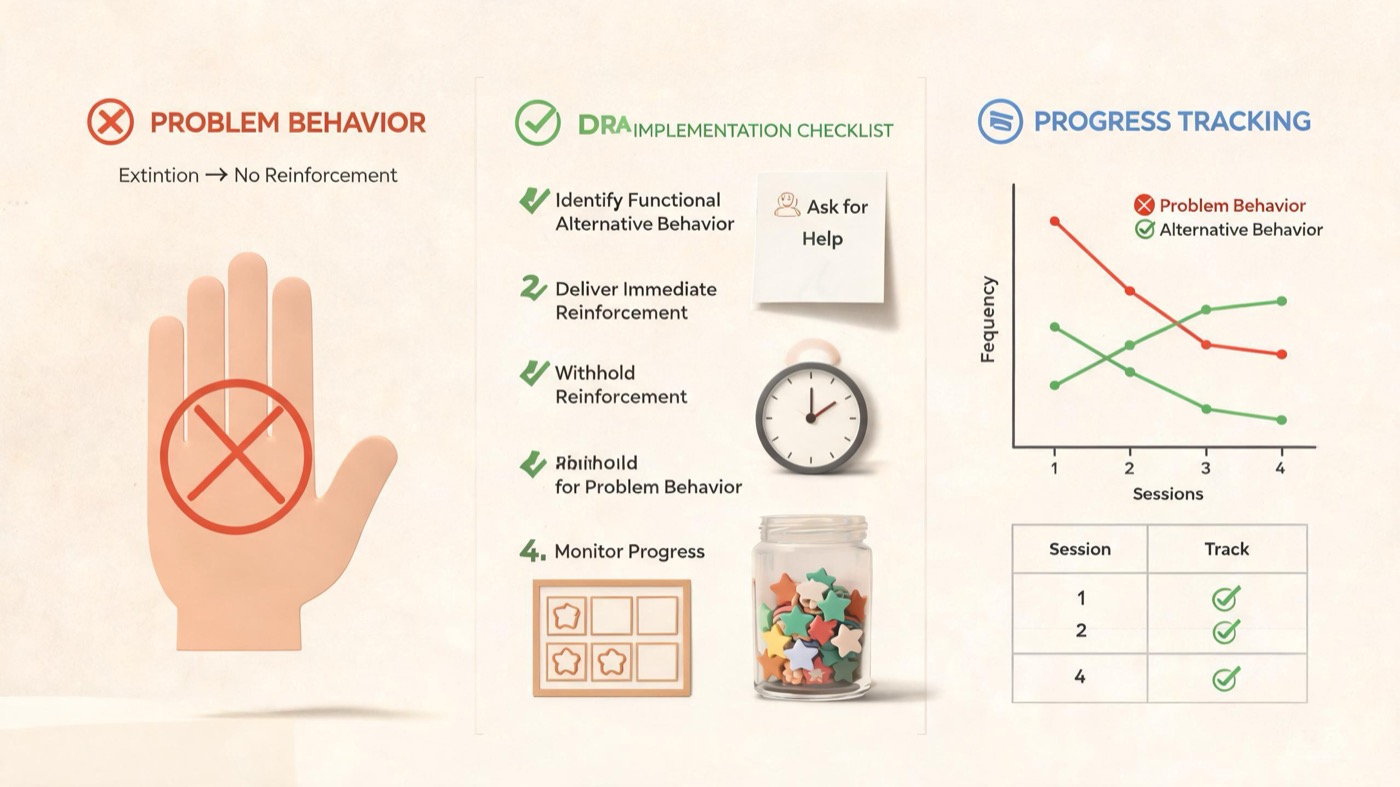
Use this quick checklist when designing or evaluating a DRA procedure. Following these steps will help you on the exam and in real-world practice.
Steps to Follow
- Identify the function of the problem behavior through FBA or ABC data.
- Select an alternative behavior that is functionally equivalent and easier or equally easy to perform.
- Reinforce the alternative behavior immediately and consistently on a dense schedule initially.
- Implement extinction for the problem behavior: ensure no reinforcement follows.
- Monitor data daily; adjust if the alternative behavior is not increasing or problem behavior persists.
- Plan for generalization and maintenance by thinning reinforcement gradually.
Final Summary
DRA is a powerful, function-based intervention that replaces problem behavior with an appropriate alternative. For the BCBA exam, focus on understanding the critical role of function, distinguishing DRA from DRO and DRI, and applying the steps to real-world scenarios. Use the worked examples above to practice identifying functions and selecting alternative behaviors. For more practice, check our Differential Reinforcement ABA Guide and take a free BCBA mock exam.


