
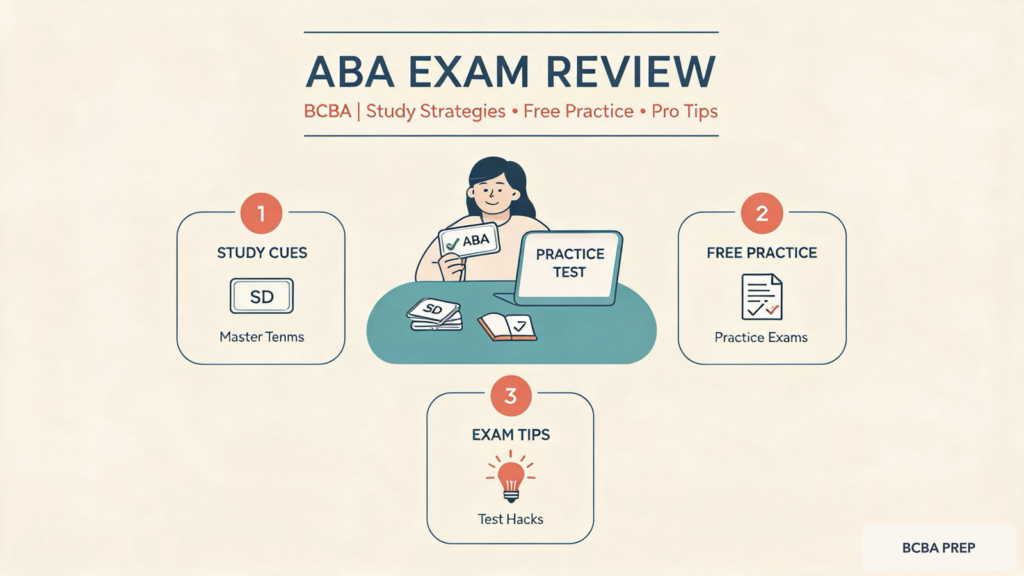
Introduction to ABA Exam Review
The Board Certified Behavior Analyst (BCBA) exam is the final step toward becoming a certified professional in applied behavior analysis. A focused ABA exam review is essential to consolidate your knowledge of the BACB Task List, practice applying concepts to vignettes, and build confidence. This guide covers key topics, worked examples, common pitfalls, and a last-minute checklist to help you succeed. For a complete study system, explore the free resources and full-length mock exams at BCBA Exam Prep Guide.
Table of Contents
- Introduction to ABA Exam Review
- Key Concepts You Must Master for the BCBA Exam
- Worked ABA Examples: From Scenario to Function
- Common Exam Traps and How to Avoid Them
- Quick Checklist: Last-Minute ABA Review
- Summary and Next Steps
Key Concepts You Must Master for the BCBA Exam
Mastering foundational principles is non-negotiable. The exam tests your ability to identify, compare, and apply these concepts in clinical scenarios. Below are three high-yield areas.
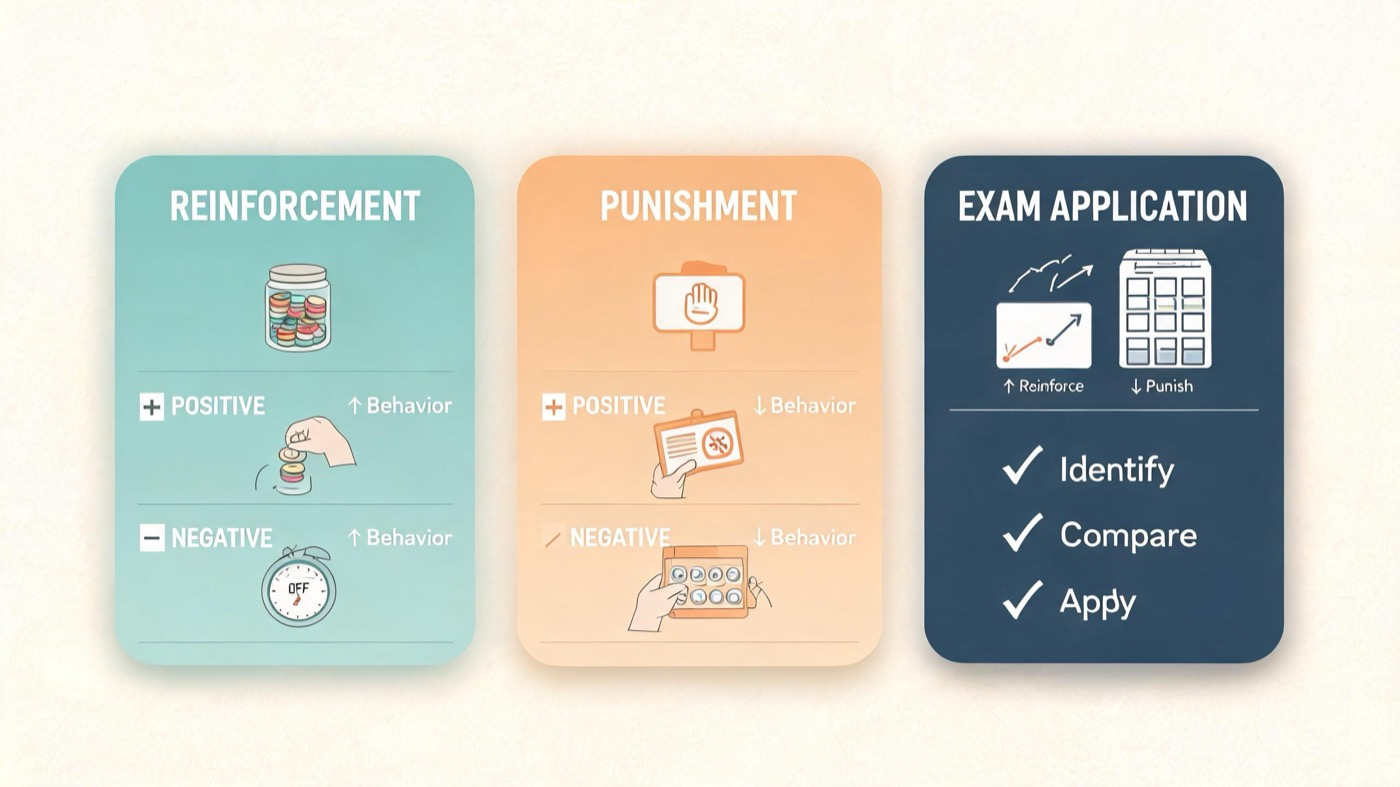
Reinforcement vs. Punishment
Both reinforcement and punishment involve the addition or removal of a stimulus. Reinforcement increases the future frequency of a behavior; punishment decreases it. Positive means adding a stimulus; negative means removing one.
- Positive reinforcement: Adding a preferred item after a behavior (e.g., giving a child a sticker for completing homework).
- Negative reinforcement: Removing an aversive stimulus after a behavior (e.g., turning off a loud alarm when a student sits down).
- Positive punishment: Adding an aversive stimulus (e.g., reprimanding a student for interrupting).
- Negative punishment: Removing a preferred stimulus (e.g., taking away a tablet after a tantrum).
A common exam trap is confusing negative reinforcement with punishment. Remember: both involve removal, but reinforcement increases behavior while punishment decreases it.
Functions of Behavior
The four functions, often remembered by the acronym SEAT, are: Sensory (automatic reinforcement), Escape, Attention, and Tangible. Identifying the function is critical for designing effective interventions. For example, a child who whines to leave a difficult task is likely seeking escape. An intervention might teach a functional communication response (e.g., asking for a break). For more details, see our guide on the four functions of behavior.
Measurement and Data Analysis
You must know how to select appropriate measurement systems. Frequency counts each occurrence; duration measures how long a behavior lasts; latency measures the time from an antecedent to the behavior; interresponse time (IRT) is the time between consecutive responses. The exam often asks which measure best captures a behavior. For instance, if you want to reduce the time it takes a student to start a task after instruction, use latency.
Worked ABA Examples: From Scenario to Function
Applying concepts to vignettes is a core skill. Below are three realistic exam-style scenarios with step-by-step reasoning.
Example 1: Attention-Maintained Aggression
Scenario: A 5-year-old boy hits his peer during group play. When the teacher immediately looks at him and says ‘No hitting,’ he stops. Over the next week, hitting increases.
- Antecedent: Group play setting, peer nearby.
- Behavior: Hitting peer.
- Consequence: Teacher provides immediate eye contact and a verbal reprimand.
- Hypothesized function: Attention (teacher’s response).
- Intervention implication: Provide attention for appropriate behavior (e.g., praising sharing) and use planned ignoring for aggression, combined with extinction.
Example 2: Escape-Maintained Task Refusal
Scenario: A 7-year-old student cries and throws worksheets when given math problems. The teacher removes the worksheet, and the student calms down. This pattern repeats daily.
- Antecedent: Math worksheet presented.
- Behavior: Crying and throwing.
- Consequence: Worksheet removed, task demand ends.
- Hypothesized function: Escape from the aversive task.
- Intervention implication: Use demand fading (starting with fewer problems) and reinforce task completion with a break.
Example 3: Automatic Reinforcement (Sensory Stimulation)
Scenario: A 9-year-old child repeatedly flaps his hands while alone, regardless of what is happening around him. The behavior persists even when no one is present.
- Antecedent: Alone time, no social demands.
- Behavior: Hand flapping.
- Consequence: No external consequence; behavior produces its own sensory stimulation.
- Hypothesized function: Automatic reinforcement (sensory).
- Intervention implication: Provide alternative sensory stimulation (e.g., a vibrating toy) or teach a replacement behavior, such as squeezing a stress ball.
Common Exam Traps and How to Avoid Them
The BCBA exam includes many questions designed to test your precision. Watch out for these frequent pitfalls.
- Confusing negative reinforcement with punishment: Both involve removal, but reinforcement increases behavior; punishment decreases it. Always ask: Does the behavior go up or down?
- Misidentifying function based on topograph: Two behaviors that look the same (e.g., crying) may have different functions. Look at the consequence pattern, not just the form.
- Ignoring baseline logic: When interpreting a graph, compare the intervention phase to baseline. A change in level, trend, or variability may indicate functional control.
- Overlooking ethical considerations: Many questions embed ethical principles from the BACB Code. Always consider client dignity, informed consent, and least restrictive procedures.
Quick Checklist: Last-Minute ABA Review
Use this checklist the day before your exam to ensure you have covered the essentials.
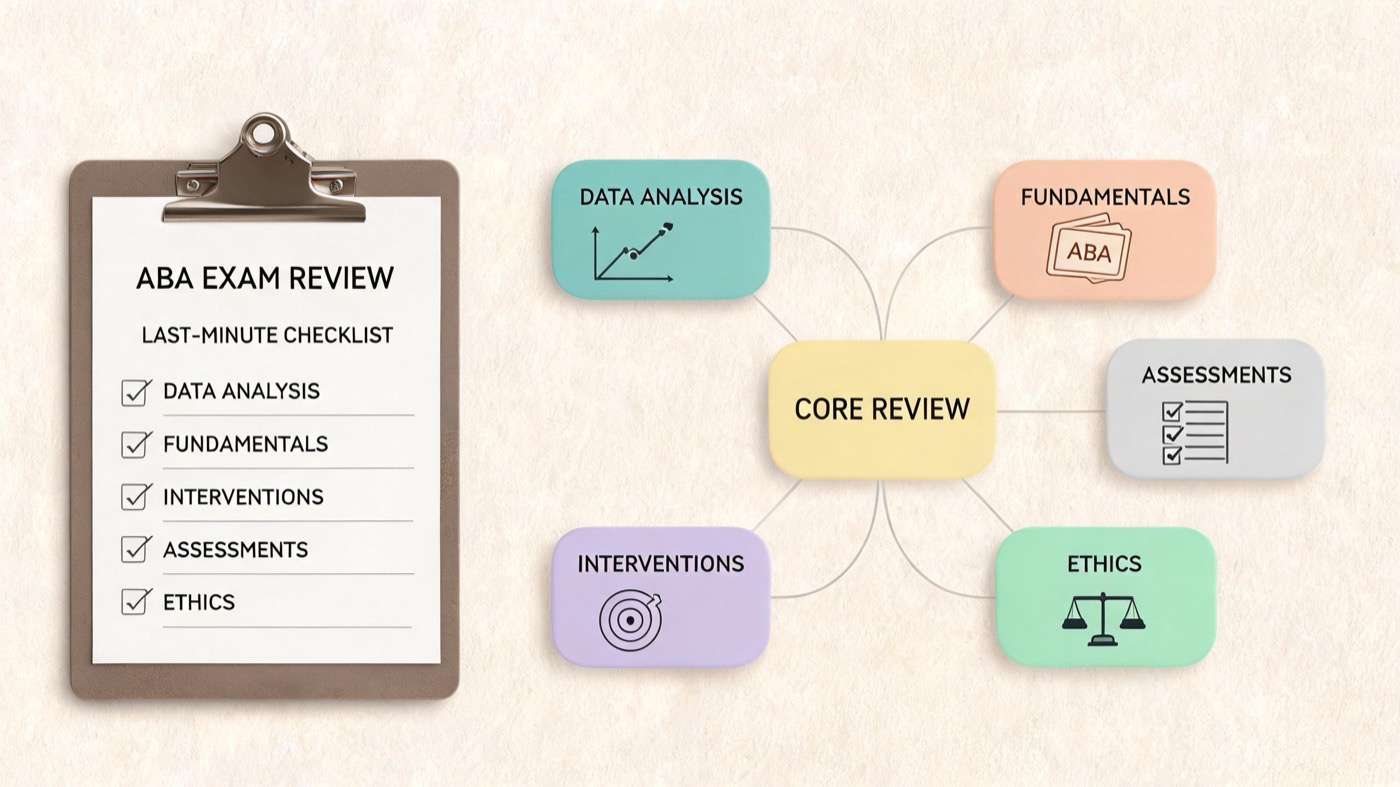
- Review the four functions of behavior (SEAT) with examples.
- Memorize IOA formulas: total count, point-by-point, and interval-by-interval.
- Know the difference between continuous and discontinuous measurement.
- Understand single-subject designs: reversal, multiple baseline, alternating treatments.
- Apply ethical principles: prioritize client welfare, maintain confidentiality, and seek supervision.
- Practice interpreting graphs for level, trend, and variability.
- Review the BACB Task List (6th edition) and identify weak areas.
Summary and Next Steps
This ABA exam review covered key concepts, worked examples, common traps, and a quick checklist. Consistent practice with mock exams is one of the most effective ways to prepare. Visit Free BCBA Mock Exam Practice Questions to access additional questions and full-length tests. Also, stay updated with official resources from the BACB website. Good luck on your exam!


