
What Is Affirming Consequent?
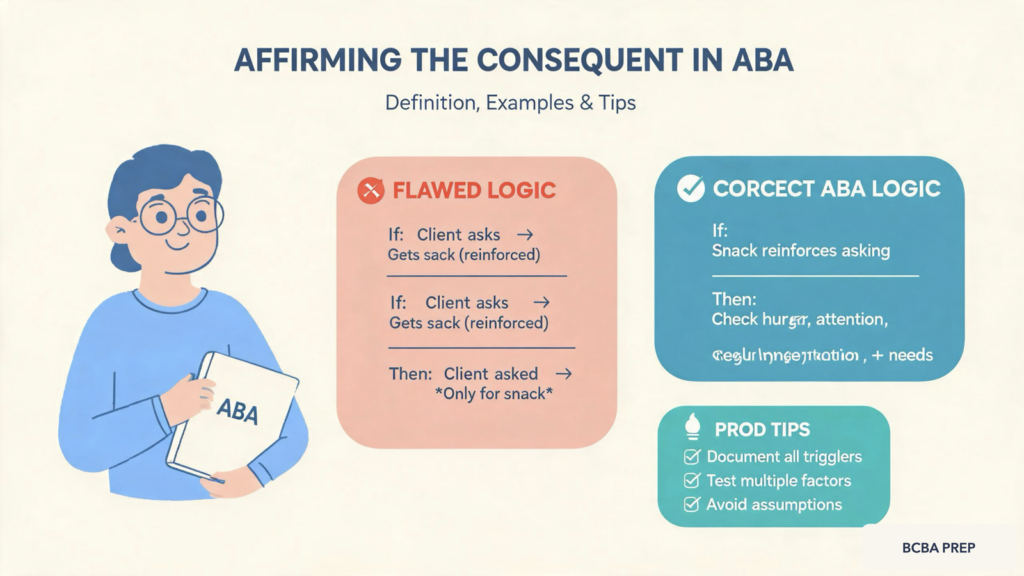
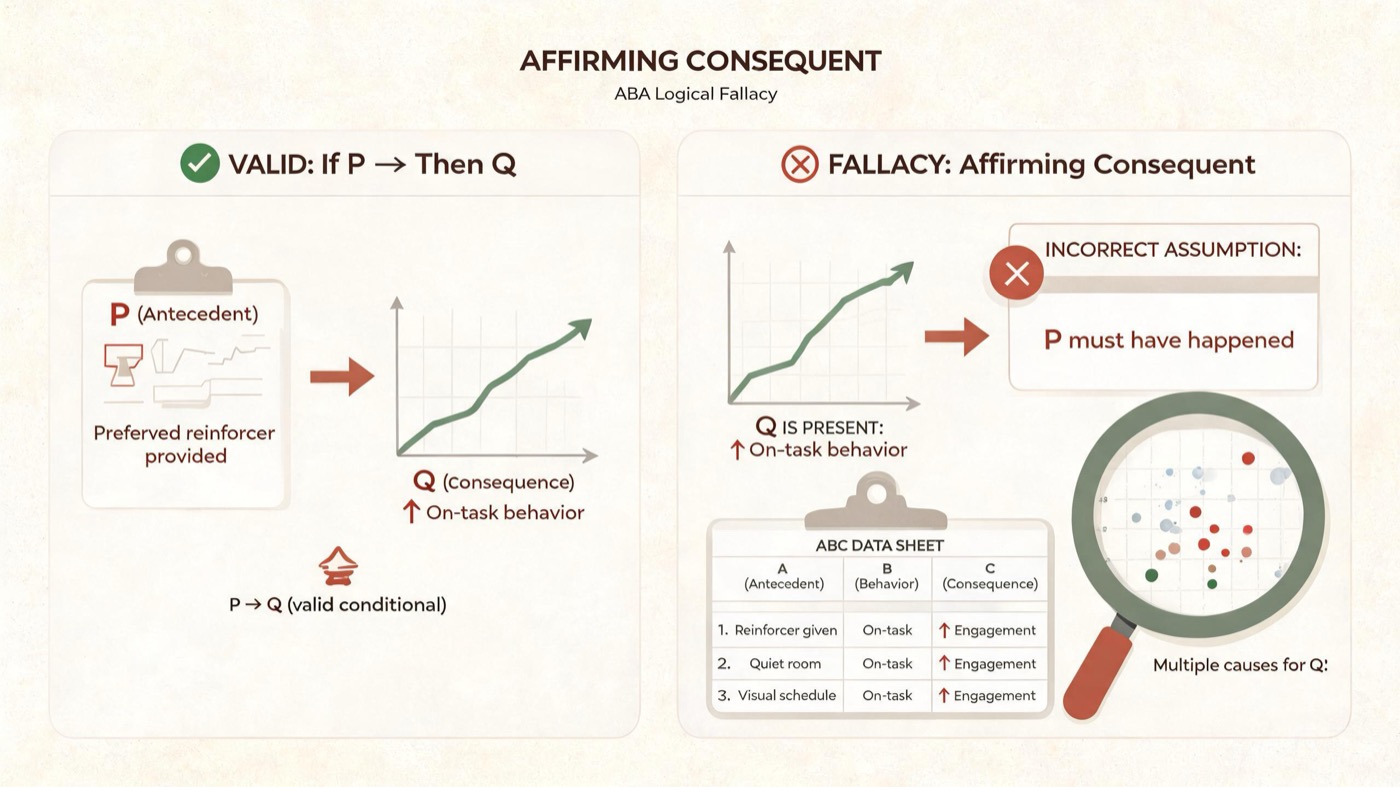
Affirming consequent is a logical fallacy that occurs when someone assumes that because a consequence is present, the specific antecedent condition must have occurred. In formal logic, it takes the form: If P (antecedent), then Q (consequent). Q is observed, therefore P must be true. This reasoning is invalid because other causes could produce the same consequence.
Table of Contents
- What Is Affirming Consequent?
- Real ABA Examples of Affirming Consequent
- Exam Relevance: How the BCBA Tests the Affirming Consequent Fallacy
- Quick Checklist to Avoid Affirming Consequent Errors
- Final Summary
In applied behavior analysis, this fallacy commonly appears during functional assessment when a practitioner observes a behavior followed by a reinforcer and jumps to the conclusion that the reinforcer is the sole function. However, multiple antecedent events can lead to the same behavior, and assuming a direct causal link without further evidence can lead to incorrect intervention plans.
The Formal Definition
The formal structure of affirming consequent is: If P, then Q. Q, therefore P. This is a deductive error because Q could be caused by factors other than P. For example, if a child cries and receives attention, we might conclude crying always indicates a need for attention. But crying could also stem from pain, frustration, or illness. The consequent (attention) does not logically confirm the antecedent (need for attention).
Why It Matters in ABA
Accurate functional assessment is essential for effective behavior intervention. Committing the affirming consequent fallacy can lead to misattributing function and implementing strategies that are at best ineffective and at worst harmful. For instance, treating all escape-maintained behaviors with escape extinction may inadvertently reinforce a sensory function if the actual cause was automatic reinforcement. Understanding this fallacy helps BCBAs design more precise and ethical interventions.
Real ABA Examples of Affirming Consequent
Seeing the fallacy in action makes it easier to spot. Below are three worked examples using ABC data.
Example 1: Attention-Maintained Behavior
Scenario: A child cries, and the mother immediately provides attention. The crying stops. The practitioner observes this pattern and hypothesizes that crying is maintained by positive reinforcement in the form of attention. However, the child might be crying due to an ear infection (antecedent of pain). The consequence of attention is present, but it does not confirm that the function is attention. The correct approach would be to conduct a functional analysis to isolate the controlling variable.
Example 2: Escape from Task
Scenario: A student throws a pencil during a difficult worksheet, and the teacher removes the worksheet. Throwing the pencil stops. A BCBA-in-training concludes that the behavior is maintained by negative reinforcement (escape). But the student might have been seeking sensory input from the sound of the pencil hitting the floor. The consequence (removal of task) is observed, but it does not rule out automatic reinforcement. Without a functional analysis, the true function remains unknown.
Example 3: Tangible Access
Scenario: A client with limited verbal skills says ‘candy’ and receives candy. The practitioner assumes that saying ‘candy’ is a mand for candy. However, the client might be echoing a word heard previously or requesting something else entirely. The consequence (receiving candy) does not confirm the antecedent (desire for candy). This example highlights the importance of verifying motivating operations and conducting thorough assessments.
Exam Relevance: How the BCBA Tests the Affirming Consequent Fallacy
The BCBA exam often presents scenarios where you must identify whether a conclusion is based on affirming consequent or other reasoning errors. Test questions may ask you to recognize the fallacy in a vignette or choose the correct interpretation of data.
Common Exam Traps
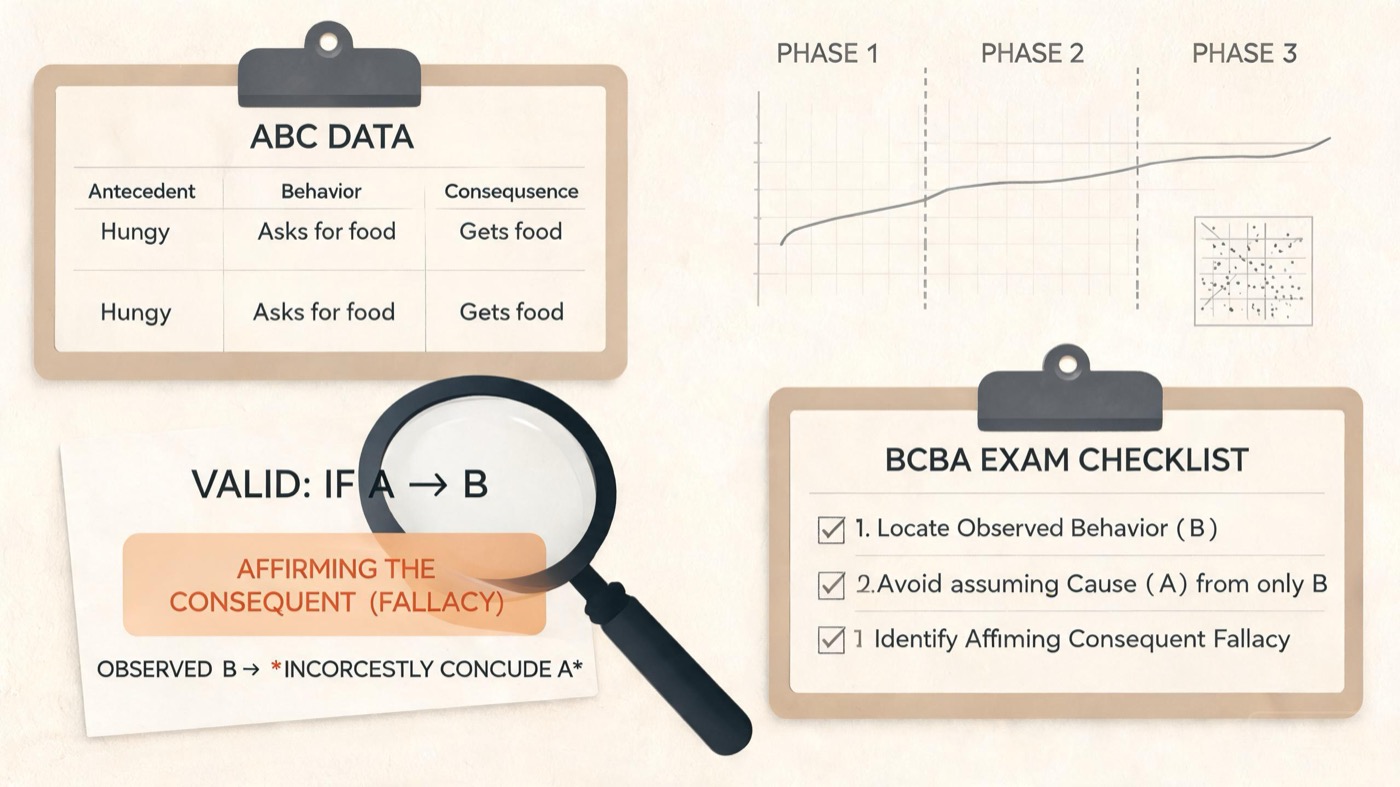
- Confusing with affirming the antecedent: If P, then Q; P, therefore Q. This is valid modus ponens, not a fallacy. Affirming consequent is often paired with denying the antecedent as a distractor.
- Overlooking alternative explanations: The exam may present a neat ABC pattern and tempt you to accept a single function without considering other variables.
- Misidentifying the fallacy in functional analysis: A correct functional analysis demonstrates experimental control; affirming consequent claims causation from correlation alone.
How to Approach Questions
Follow these steps when you encounter a scenario on the exam:
- Step 1: Identify the conclusion being drawn. Is it that a specific antecedent caused the behavior because a specific consequence followed?
- Step 2: Determine if the evidence supports causation or only correlation. Look for controlled variables or repeated measures.
- Step 3: Check if alternative functions are plausible. If the scenario mentions only one observation, the conclusion likely involves affirming consequent.
Quick Checklist to Avoid Affirming Consequent Errors
Use this checklist during your own practice and exam preparation to stay on track:
- ☐ Identify all possible antecedents that could have produced the behavior, not just the one that aligns with the observed consequence.
- ☐ Conduct a functional analysis when the function is unclear; do not rely solely on correlational ABC data.
- ☐ Rule out alternative functions (e.g., automatic reinforcement, medical causes) before finalizing a hypothesis.
- ☐ Review the logical structure: if you find yourself concluding P because Q, check whether Q could have other causes.
- ☐ Practice with exam vignettes that include distractors based on affirming consequent. For more practice, check out our BCBA Mock Exam 6th Edition.
Final Summary
The affirming consequent fallacy is a common reasoning error in ABA that can derail functional assessments. By understanding its logical structure, studying real examples, and practicing with exam-style questions, you can avoid this pitfall. Remember: observing the consequence does not prove the antecedent. Always gather additional evidence through functional analysis or repeated measures. For more on related logical reasoning in behavior analysis, refer to the BACB Task List and our BCBA Exam Prep 2025 guide.


