
What Are Behavior Development Solutions in ABA?
Behavior development solutions refer to a systematic framework for assessing, designing, and implementing interventions that promote meaningful behavior change. In applied behavior analysis, this approach integrates skill acquisition and behavior reduction strategies to address the whole person. For BCBA candidates, understanding this framework is essential because it appears across multiple exam content areas, including assessment, intervention, and measurement.
Table of Contents
- What Are Behavior Development Solutions in ABA?
- How to Apply Behavior Development Solutions: ABC Examples
- Exam Relevance of Behavior Development Solutions
- Quick Checklist for Behavior Development Solutions
- Summary and Next Steps
At its core, behavior development solutions emphasize the function of behavior as the foundation for any intervention. Whether you are increasing desirable behaviors or decreasing challenging ones, the process follows a structured sequence:
Core Components of Behavior Development Solutions
- Assessment: Conduct a functional behavior assessment (FBA) to identify environmental variables maintaining the behavior. This includes indirect assessments, descriptive observations, and functional analyses.
- Function Identification: Determine whether behavior is maintained by social positive reinforcement, social negative reinforcement, automatic reinforcement, or a combination. Accurate function identification is critical for selecting effective interventions.
- Intervention Design: Select function-matched strategies such as reinforcement-based procedures, antecedent manipulations, and teaching replacement behaviors. For example, if aggression functions to escape demands, teach a mand for break and provide escape extinction.
- Data Collection: Define measurable behavioral objectives and choose appropriate measurement systems (e.g., frequency, duration, latency). Ongoing data collection allows you to monitor progress and make data-driven decisions.
How to Apply Behavior Development Solutions: ABC Examples
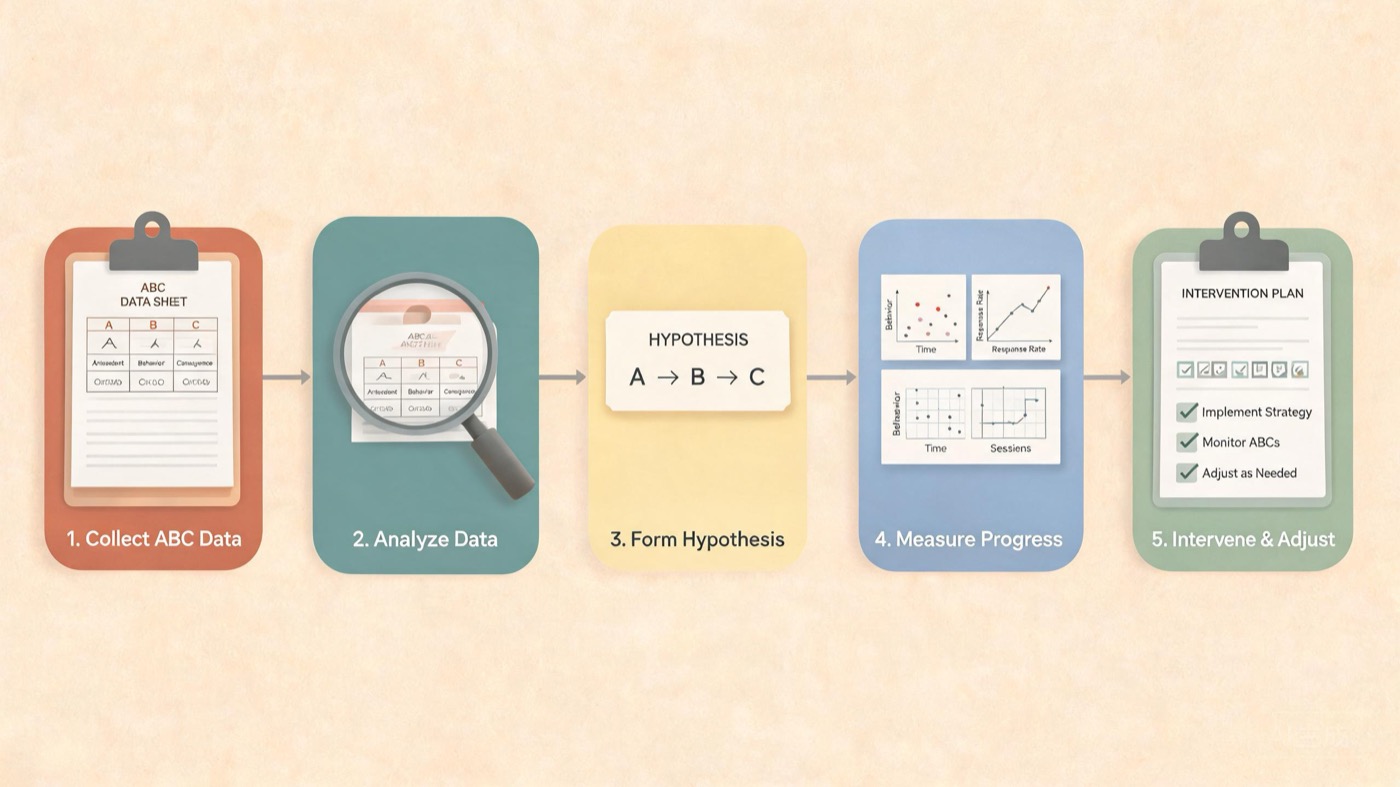
The ABC (Antecedent-Behavior-Consequence) model is a practical tool for analyzing behavior within the behavior development solutions framework. Below are three worked examples that illustrate how to identify function and guide intervention. Each example follows the same format: describe the context, analyze the ABC pattern, and hypothesize the function.
Example 1: Increasing On-Task Behavior
- Antecedent: Teacher gives a math worksheet to a student who often avoids independent work.
- Behavior: The student begins solving problems, writes numbers, and stays seated for 5 minutes.
- Consequence: Teacher immediately provides praise (“Great job working!”) and a token.
- Hypothesized Function: Positive reinforcement (access to social attention and tokens). The intervention should maintain consistent praise and gradually increase the work interval before delivery.
Example 2: Reducing Aggression
- Antecedent: A staff member presents a non-preferred task (e.g., folding towels) to a client with limited verbal skills.
- Behavior: The client hits the table and throws materials.
- Consequence: Staff removes the task and says, “Okay, let’s take a break.”
- Hypothesized Function: Negative reinforcement (escape from demand). A function-based intervention would teach the client to request a break using a picture card or sign, while ensuring the task is eventually completed after the break.
Example 3: Teaching Communication
- Antecedent: A child sees a preferred toy (an iPad) that is out of reach.
- Behavior: The child says, “May I have the iPad?” (mand).
- Consequence: The caregiver hands the iPad to the child and says, “Great asking!”
- Hypothesized Function: Positive reinforcement (access to tangible). To strengthen this skill, ensure that prompting and reinforcement are consistent, and gradually fade prompts to promote independent manding.
Exam Relevance of Behavior Development Solutions
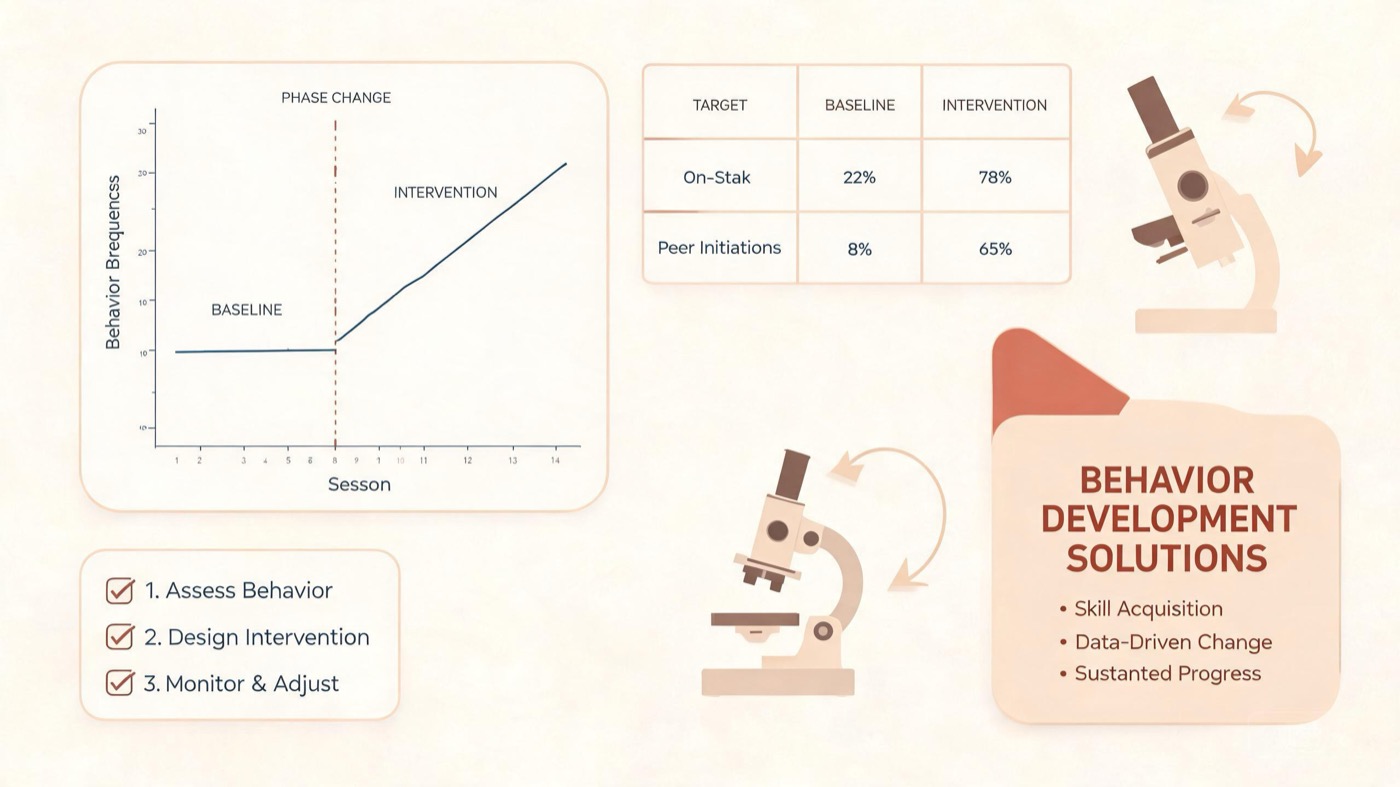
On the BCBA exam, behavior development solutions are frequently tested through scenario-based questions. You may be asked to identify the function from an ABC description, select a function-matched intervention, or evaluate data from a behavioral intervention. Understanding the nuances between topography and function is critical.
Common Exam Traps
Even well-prepared candidates fall into predictable traps. Here are the three most common mistakes seen on the BCBA exam regarding behavior development solutions:
- Confusing topography with function. Just because two behaviors look the same (e.g., screaming) does not mean they serve the same function. Always identify the maintaining consequence before selecting an intervention.
- Ignoring setting events or motivating operations. Forgetting to consider sleep deprivation, medication changes, or satiation/deprivation can lead to incorrect function identification. These variables alter the value of consequences and must be assessed systematically.
- Mismatching intervention to function. For example, using a time-out (negative punishment) for behavior maintained by escape may inadvertently reinforce the behavior by providing a break. Instead, extinction of the escape function (i.e., ensuring the demand is not removed) combined with differential reinforcement is appropriate.
To avoid these traps, always ask yourself: “Why is this behavior happening?” before jumping to intervention. Practicing with function analysis guides can sharpen your ability to discriminate functions under time pressure.
Quick Checklist for Behavior Development Solutions
Use this rapid review tool on test day to ensure you haven’t missed essential steps. Memorize this flow to quickly analyze any behavior scenario:
- Identify the antecedent: What triggers the behavior? Note environmental changes, demands, or events.
- Describe the behavior in observable, measurable terms. Avoid labels like “angry;” instead use “hits table with fist.”
- Identify the consequence: What happens immediately after the behavior? Is it delivered or removed?
- Hypothesize the function: Is it social positive, social negative, or automatic? Use the four-function model.
- Select a function-matched intervention: Choose reinforcement-based procedures first (e.g., DRA, FCT), then consider antecedent interventions and extinction.
- Plan data collection: Define the target behavior, choose a measurement system, and schedule data collection times.
- Consider generalization and maintenance: How will the skill transfer to natural settings and persist over time?
Summary and Next Steps
Behavior development solutions form the backbone of effective ABA practice and are heavily represented on the BCBA exam. By mastering the systematic process of assessment, function identification, intervention design, and data collection, you set yourself up for success. Remember: every behavior tells you something about the environment. Your job is to listen to what the function reveals and respond with evidence-based strategies.
To solidify your understanding, practice with mock scenarios and timed quizzes. Explore our BCBA mock exam to test your knowledge in a realistic format. Additionally, review the BACB’s official task list to ensure you cover all exam domains. Consistent application of behavior development solutions will improve both your exam performance and your future clinical work.


