
What Is Behavior Skills Training (BST) in ABA?
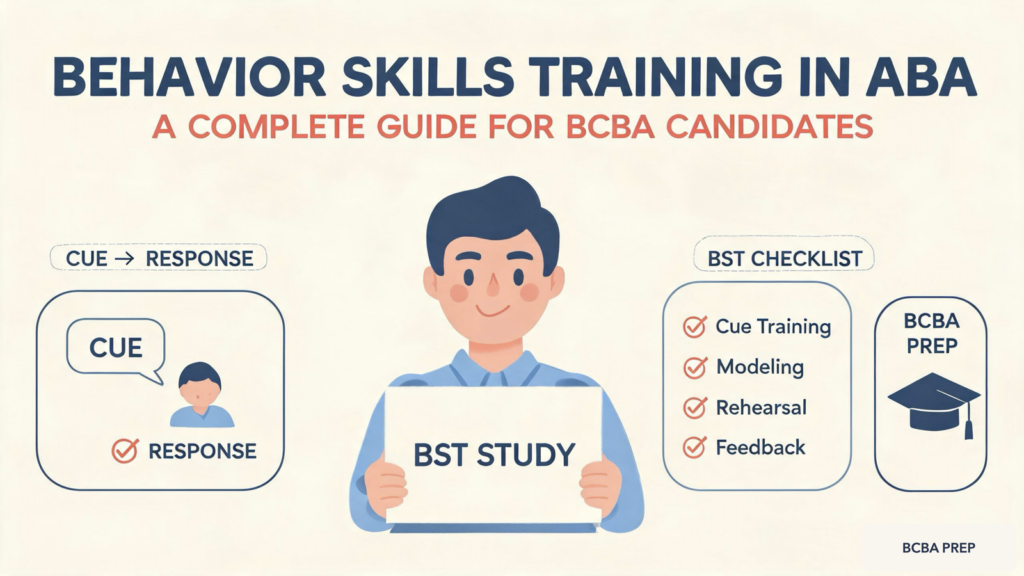
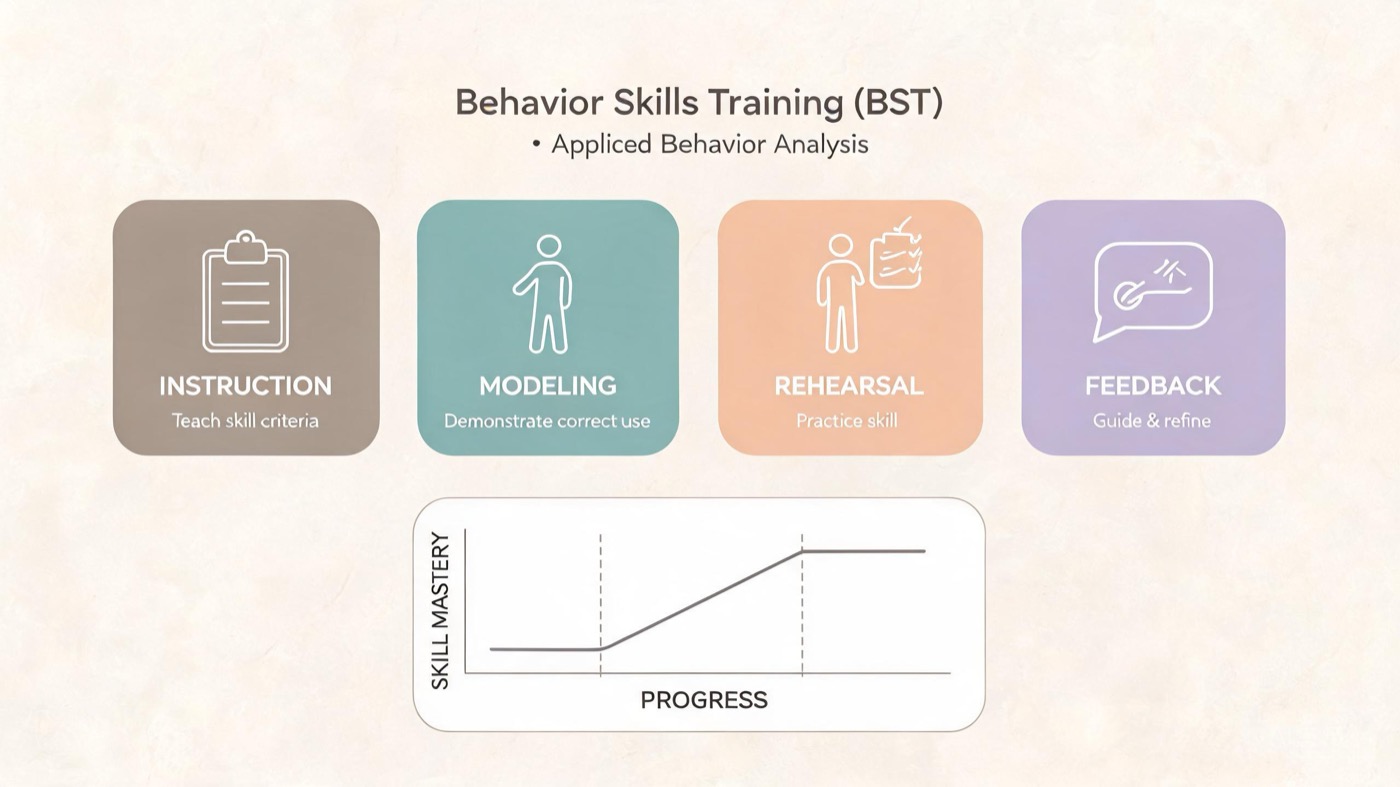
Behavior skills training (BST) is an evidence-based teaching package used by behavior analysts to train staff, parents, and other stakeholders. It combines instruction, modeling, rehearsal, and feedback to build new skills efficiently. BST is widely applied in organizational behavior management (OBM) and parent training, and it appears frequently on the BCBA exam.
Table of Contents
- What Is Behavior Skills Training (BST) in ABA?
- BST in Practice: Two Worked ABA Examples
- BST and the BCBA Exam: What to Know
- Quick Recap Checklist
- Summary: Why BST Is Essential for Your BCBA Exam Prep
The Four BST Steps
BST consists of four sequential components. Each step must be present for the procedure to be complete.
- Instruction: Provide a clear, concise description of the target skill. Include when and why to use it.
- Modeling: Demonstrate the skill correctly. The model should show the exact steps the learner is expected to perform.
- Rehearsal: The learner practices the skill in a role-play or real setting. This step allows for active participation.
- Feedback: Deliver specific praise for correct performance and corrective guidance for errors. Feedback should occur immediately after rehearsal.
Why BST Matters for Behavior Analysts
BST is a core competency in the BACB Task List (e.g., F-8). It promotes treatment integrity by ensuring that implementers can perform interventions accurately. For exam purposes, remember that BST is used to teach new behaviors—it is not a standalone intervention for reducing problem behavior, though it can be part of a comprehensive plan.
BST in Practice: Two Worked ABA Examples
Applying BST to real scenarios helps solidify your understanding for the exam. Below are two examples with a focus on the four steps and the underlying behavior principles.
Example 1: Teaching a Parent to Use Discrete Trial Training (DTT)
Scenario: A parent needs to implement DTT to reduce their child's elopement during mealtime. The hypothesized function of elopement is escape from demands (and perhaps attention when chased). A BCBA decides to use BST to train the parent.
- Instruction: The BCBA explains the DTT sequence: present a demand, prompt if needed, reinforce correct responses, ignore problem behavior (except for safety). They also explain that consistency will reduce elopement.
- Modeling: The BCBA demonstrates a complete DTT trial with the child, including how to prompt and deliver reinforcement.
- Rehearsal: The parent practices with the child while the BCBA observes. The parent struggles with the pace of prompts.
- Feedback: The BCBA praises the parent for using a clear vocal instruction, then suggests waiting 2 seconds before prompting. After another rehearsal, the parent improves.
ABC analysis: Antecedent – child sees food; Behavior – parent delivers DTT trial; Consequence – child stays seated (reinforced). The parent's correct implementation is reinforced by the child's compliance, maintaining the parent's behavior.
Example 2: Training Paraprofessionals to Deliver Social Narratives
Scenario: A paraprofessional must deliver a social narrative to a student with ASD to prepare for a schedule change. The function of the student's distress is access to routine. BST is used to train the paraprofessional.
- Instruction: The BCBA describes the social narrative procedure: read each page, ask a comprehension question, and use a calm tone.
- Modeling: The BCBA reads the narrative aloud to the student, modeling pacing and enthusiasm.
- Rehearsal: The paraprofessional leads the narrative with the student. The staff member speaks too quickly.
- Feedback: The BCBA says, 'Great job keeping eye contact. Try slowing down after each sentence.' After two more tries, the staff member meets criteria.
ABC analysis: Antecedent – scheduled change; Behavior – paraprofessional delivers narrative; Consequence – student follows routine without distress (reinforces staff delivery).
BST and the BCBA Exam: What to Know
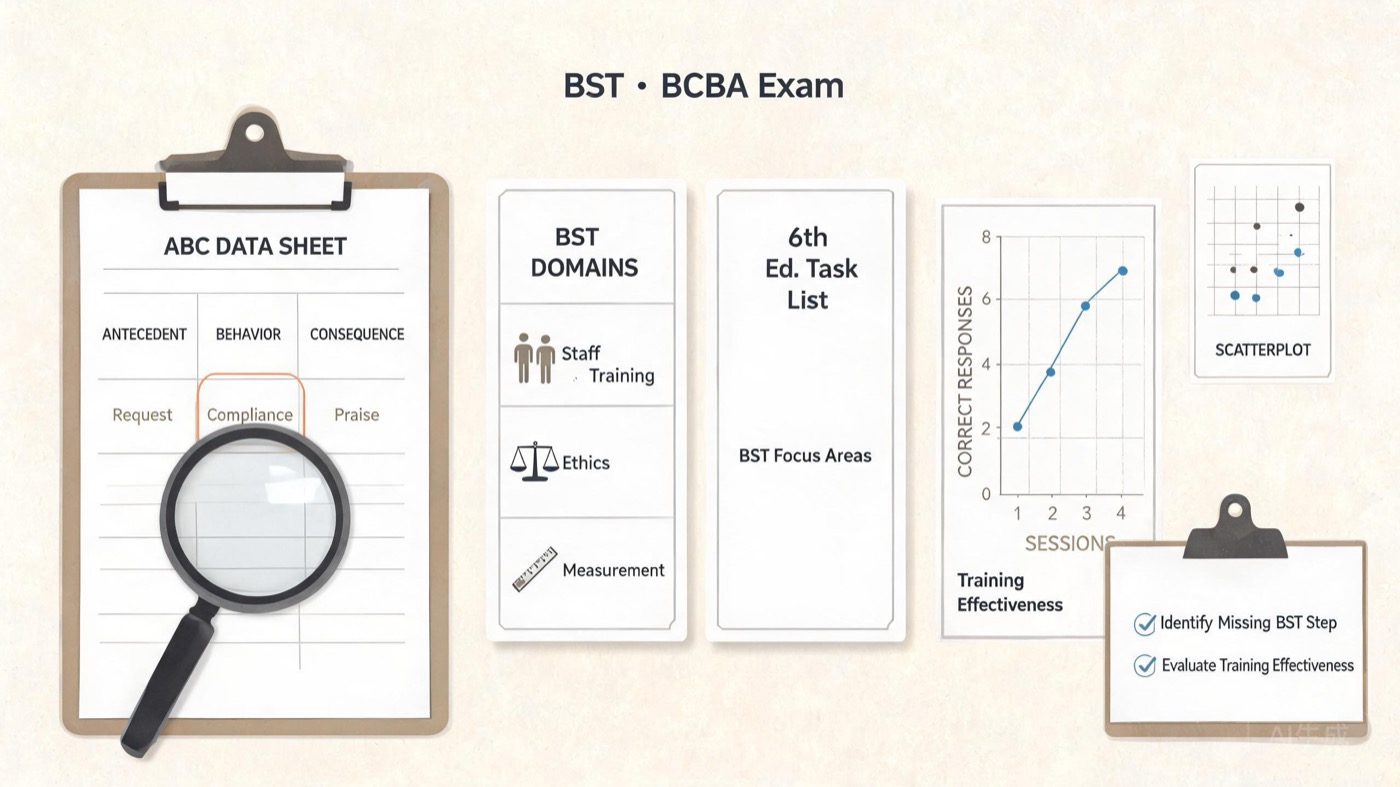
BST is a popular topic on the BCBA exam because it crosses multiple domains: staff training, ethics, and measurement. You may be asked to identify which BST step is missing in a scenario or to evaluate the effectiveness of a training program.
Exam Relevance of Behavior Skills Training
On the 6th Edition Task List, BST is directly linked to F.8 (train others to implement interventions) and indirectly to F.9 (evaluate effects of training). You might also see BST in questions about procedural integrity or social validity. For more on related topics, check out our guide on treatment integrity and social validity.
Common Exam Traps About BST
- Confusing BST with other procedures: BST is not the same as behavioral skills training used in sports (e.g., practice drills). In ABA, it always includes instruction, modeling, rehearsal, and feedback.
- Forgetting a step: A scenario may omit feedback or rehearsal. Read carefully and identify the missing component.
- Misidentifying the step: For example, if the trainer describes the skill but does not show it, the missing step is modeling, not instruction.
- Assuming BST is for learners: BST is typically used to train staff or caregivers, not directly for clients (though clients can be trained with BST as well).
- Ignoring function: Even in staff training, the function of the staff's behavior matters. Use reinforcement to maintain their new skills.
Quick Recap Checklist
Use this checklist when reviewing BST for the exam. Check off each item to ensure you have mastered the concept.
- Identify the four BST steps in any scenario.
- Differentiate BST from modeling alone or instruction alone.
- Apply BST to staff training and parent training examples.
- State the BACB Task List code associated with BST (F.8).
- Analyze BST in terms of ABC: the trainer's behavior is reinforced by the implementer's correct performance.
- Review common pitfalls: missing feedback, skipping rehearsal, or confusing BST with other trainings.
For additional practice, take a free BCBA mock exam that includes BST scenarios.
Summary: Why BST Is Essential for Your BCBA Exam Prep
Behavior skills training is a foundational procedure that appears across the BCBA exam in various forms. Mastering the four steps and understanding their role in training others will help you answer staff-training questions confidently. Remember to look for the complete sequence: instruction, modeling, rehearsal, and feedback. With the examples and checklist above, you are now better prepared to tackle BST questions on exam day. For further study, review our BCBA exam prep guide and additional resources from the BACB.


