
Introduction
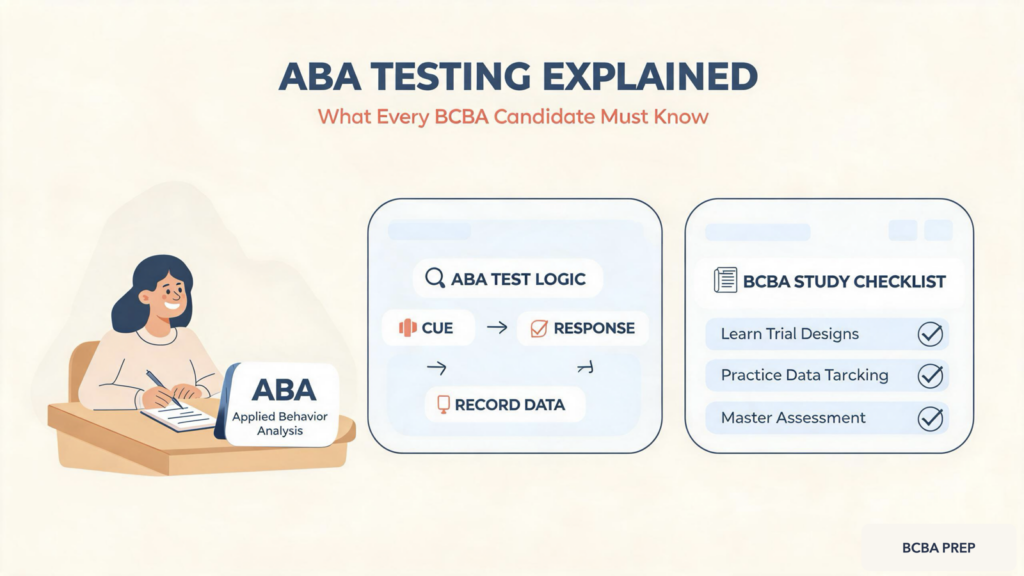
As a BCBA candidate, you will encounter questions that assess your understanding of ABA testing methods. These methods are the backbone of functional behavior assessments (FBAs) and behavior intervention plans (BIPs). Mastering them is not optional; it is essential for exam success and clinical competence. This guide breaks down what ABA testing is, how it works in real-world scenarios, and how to avoid common pitfalls on the BCBA exam.
Table of Contents
- Introduction
- What Is ABA Testing?
- Real-World Examples of ABA Testing
- Exam Relevance and Common Traps
- Quick Checklist for ABA Testing
- Summary
What Is ABA Testing?
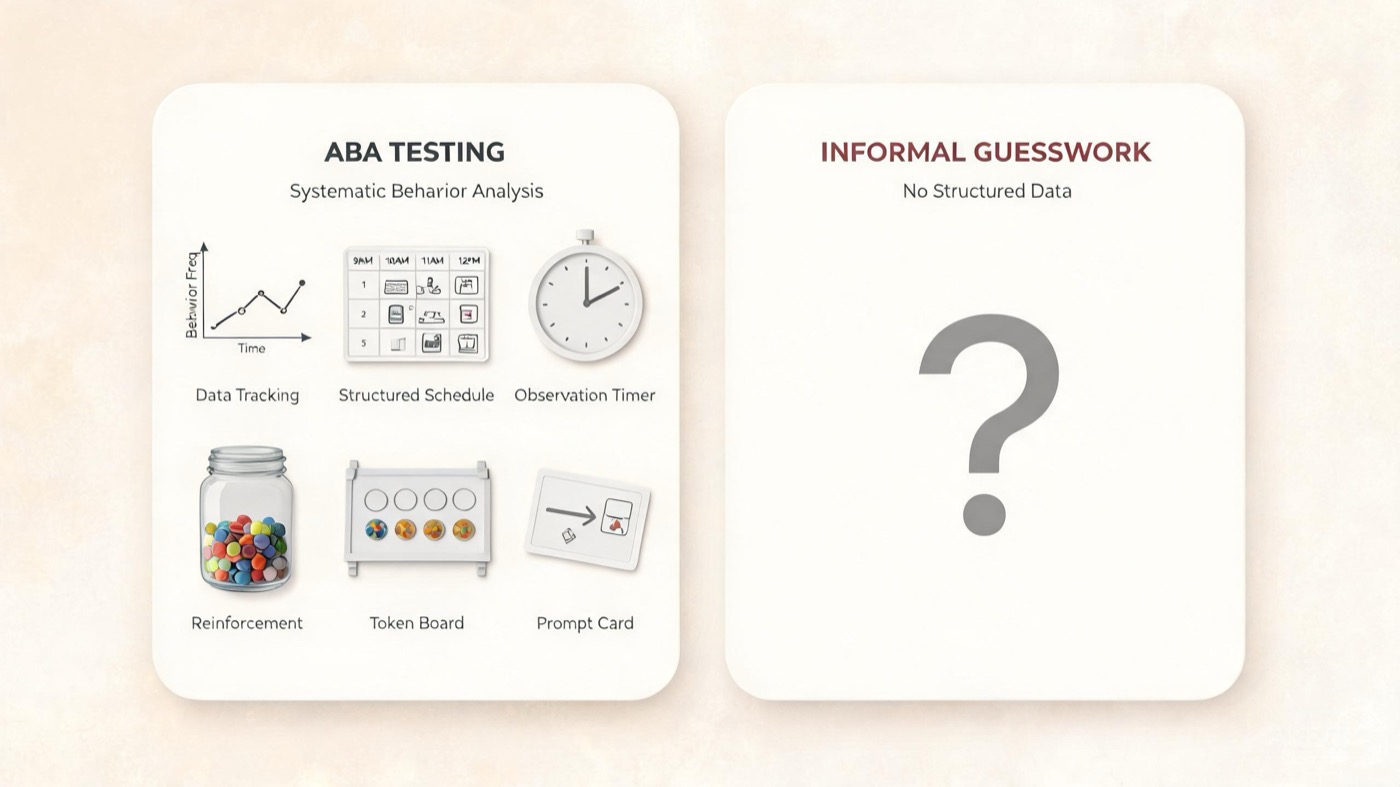
ABA testing refers to systematic procedures used to identify the function of a behavior. It involves direct observation, data collection, and controlled manipulations of environmental variables. Unlike informal guesswork, testing is data-driven and allows behavior analysts to determine why a behavior occurs. This information directly informs intervention strategies.
Core Components
- Direct observation: Watching the behavior in its natural context without interfering.
- Data collection: Recording antecedents, behaviors, and consequences (ABC data) in real time.
- Environmental manipulation: Systematically changing conditions to test hypotheses (e.g., providing attention, removing demands).
- Functional analysis (FA): A controlled experiment where each condition tests a specific function (e.g., escape, attention, tangible, automatic reinforcement).
Why It Matters for BCBA Candidates
The BCBA exam heavily tests your ability to differentiate between assessment types. You must know when to use a descriptive assessment versus a functional analysis. Understanding ABA testing is foundational for tasks like interpreting graphs, selecting interventions, and ensuring ethical practice. Many exam questions present a scenario and ask you to identify the next step in the assessment process.
Real-World Examples of ABA Testing
Seeing how testing works in practice solidifies your conceptual knowledge. Below are three examples with ABC analysis and hypothesized functions.
Example 1: Aggressive Behavior in a Classroom
Scenario: A 7-year-old student hits peers when asked to complete a math worksheet.
- Antecedent: Teacher presents a demand (math worksheet).
- Behavior: Student hits the peer next to him.
- Consequence: Teacher removes the worksheet and sends student to a quiet corner.
- Hypothesized function: Escape from task demands.
During testing, the analyst alternates between conditions where demands are present and absent. If hitting occurs more during demand conditions, escape is confirmed. This demonstrates the power of controlled functional analysis to isolate function.
Example 2: Self-Injurious Behavior at Home
Scenario: A 4-year-old child with autism bangs his head against the wall when his mother talks on the phone.
- Antecedent: Mother’s attention is diverted (phone call).
- Behavior: Head-banging.
- Consequence: Mother hangs up and attends to the child.
- Hypothesized function: Access to attention.
Testing might include an attention condition (mother ignores the child unless head-banging occurs) and a play condition (continuous attention). Higher rates of head-banging in the attention condition confirm the hypothesis. This example highlights the difference between analog testing (structured sessions) and naturalistic observation.
Example 3: Noncompliance During Therapy
Scenario: A toddler cries and runs away when his therapist asks him to sit at the table.
- Antecedent: Therapist instruction (e.g., “sit down”).
- Behavior: Crying and running.
- Consequence: Therapist follows the child, provides verbal redirection, and eventually allows access to a preferred toy to calm him.
- Hypothesized function: Could be escape from instruction or access to tangibles (toy).
Testing can help rule out multiple functions. The analyst runs separate conditions: one where escaping the instruction is possible, and another where the child receives a preferred item after crying. If crying only occurs when the toy is not available, the function is likely access to tangibles. This illustrates how testing clarifies ambiguous cases.
Exam Relevance and Common Traps
How Testing Is Tested on the BCBA Exam
Exam questions often ask you to identify the type of assessment being described or to interpret data from a functional analysis. Key terms you must know include:
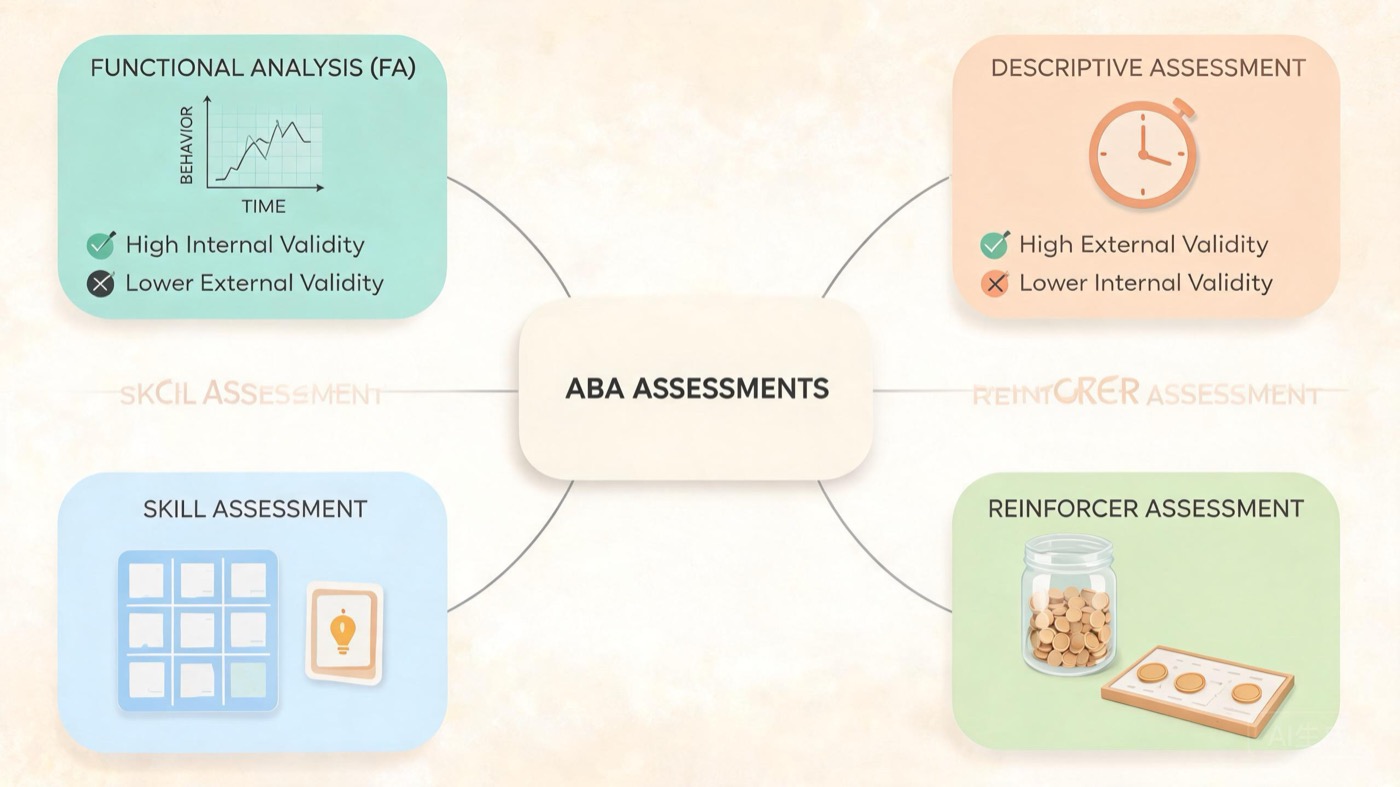
- Functional analysis (FA): Experimental conditions with precise control.
- Descriptive assessment: Observing behavior without manipulating variables (e.g., ABC recording, scatterplots).
- Indirect assessment: Using interviews or questionnaires to gather information.
Be prepared to compare these methods: for instance, FA has higher internal validity but lower external validity than descriptive assessments. Questions may also ask about ethical considerations, such as the risks associated with FA (e.g., reinforcing dangerous behavior).
Common Pitfalls
- Confusing ABC recording with functional analysis: ABC recording is descriptive; FA involves systematic manipulation.
- Misidentifying functions: A behavior may serve multiple functions, so check all conditions.
- Ignoring multiple functions: For example, a behavior could be maintained by both escape and attention.
- Overinterpreting limited data: A few data points are not enough to confirm a function; look for consistent patterns.
- Forgetting the role of automatic reinforcement: Not all behaviors are socially mediated; some are self-stimulatory.
Test-Taking Tips
When you see a question about testing, first identify the assessment type: Does the question describe controlled manipulation? If yes, it is likely FA. If it describes observation only, it is descriptive. Use elimination to rule out obviously wrong functions. Also, pay attention to the consequence in ABC data; it often hints at the function. Practice with mock scenarios to build speed and accuracy. For more practice, check out our BCBA mock exams and BCBA exam prep resources.
Quick Checklist for ABA Testing
Use this checklist when reviewing assessment plans or preparing for exam scenarios:
- Define the behavior in measurable terms.
- Conduct a descriptive assessment (ABC recording, scatterplot) to gather preliminary data.
- Form one or more hypotheses about function.
- Design a functional analysis to test hypotheses (include control, test conditions, and replication).
- Collect and graph data using a multi-element design or reversal design.
- Analyze the graph for differentiation (higher rates in one condition indicate function).
- Consider multiple functions and test them separately.
- Interpret results with caution: consider confounding variables like carryover effects.
- Translate findings into an effective behavior intervention plan.
Summary
ABA testing is a critical skill for BCBA candidates and practicing analysts. It involves systematic data collection and experimental manipulation to identify why behavior occurs. This guide covered the definition, core components, three practical examples, exam relevance, common traps, and a study checklist. By internalizing these concepts, you will be better prepared for both the BCBA exam and real-world clinical practice. Keep practicing with scenarios and review the BACB Task List for more detail. For a deeper dive, refer to the BACB website or peer-reviewed journals like the Journal of Applied Behavior Analysis.


