
What Is Shaping? A Foundational ABA Concept
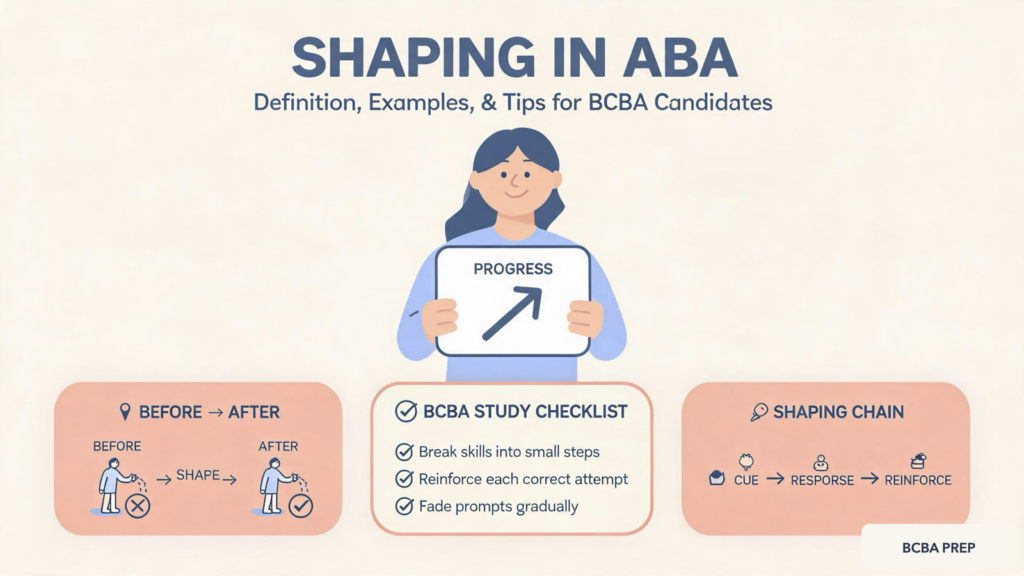
Shaping is a procedure used in Applied Behavior Analysis to develop a new behavior by reinforcing successive approximations toward a terminal goal. Instead of waiting for the full behavior to occur, you reinforce small steps that gradually get closer to the desired response. This shaping psychology example shows how complex behaviors can be built from simple actions.
Table of Contents
- What Is Shaping? A Foundational ABA Concept
- Real-World Shaping Psychology Example: Teaching a Child to Request
- Another Shaping Example: Increasing On-Task Behavior in a Classroom
- Shaping on the BCBA Exam: Common Traps and How to Avoid Them
- Quick Checklist: Applying Shaping in Scenarios
- Summary: Why Shaping Is Essential for Every BCBA
Shaping is different from chaining and fading. Chaining links a sequence of discrete steps into a behavior chain, while fading reduces prompts over time. Shaping changes the topography of a single behavior, making it essential for skill acquisition programs.
Shaping vs. Other Procedures
Here are key distinctions to keep in mind for the BCBA exam:
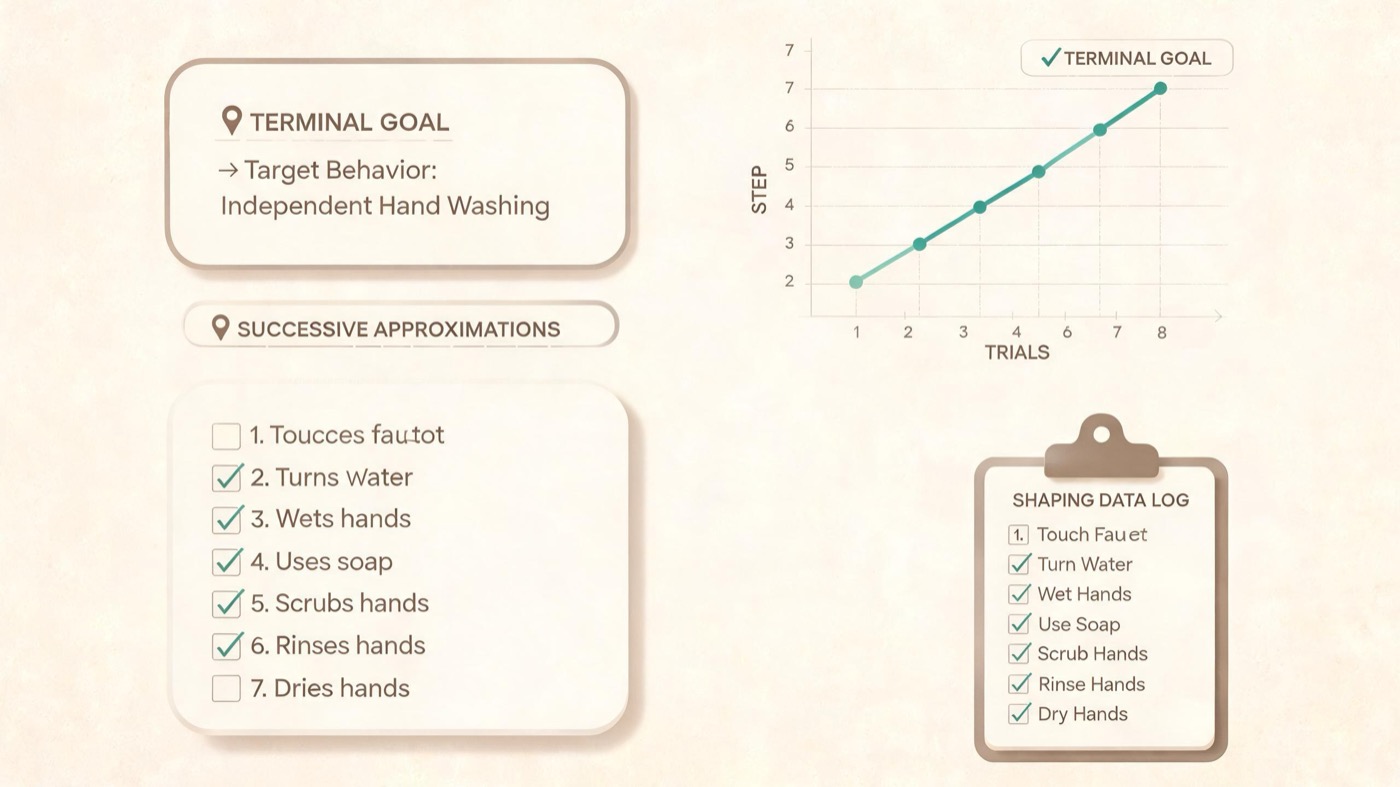
- Chaining: connects separate behaviors into a sequence (e.g., hand-washing steps). Shaping never involves a sequence of different behaviors; it refines one behavior.
- Fading: reduces prompt intensity or frequency. Shaping changes the response itself, not the level of assistance.
- Extinction: stops reinforcement for a previously reinforced behavior. During shaping, extinction is applied to earlier approximations while reinforcing closer ones.
Understanding these boundaries helps you avoid confusing procedures on the exam. For a deeper dive, check out our guide on shaping behavior in ABA.
Real-World Shaping Psychology Example: Teaching a Child to Request
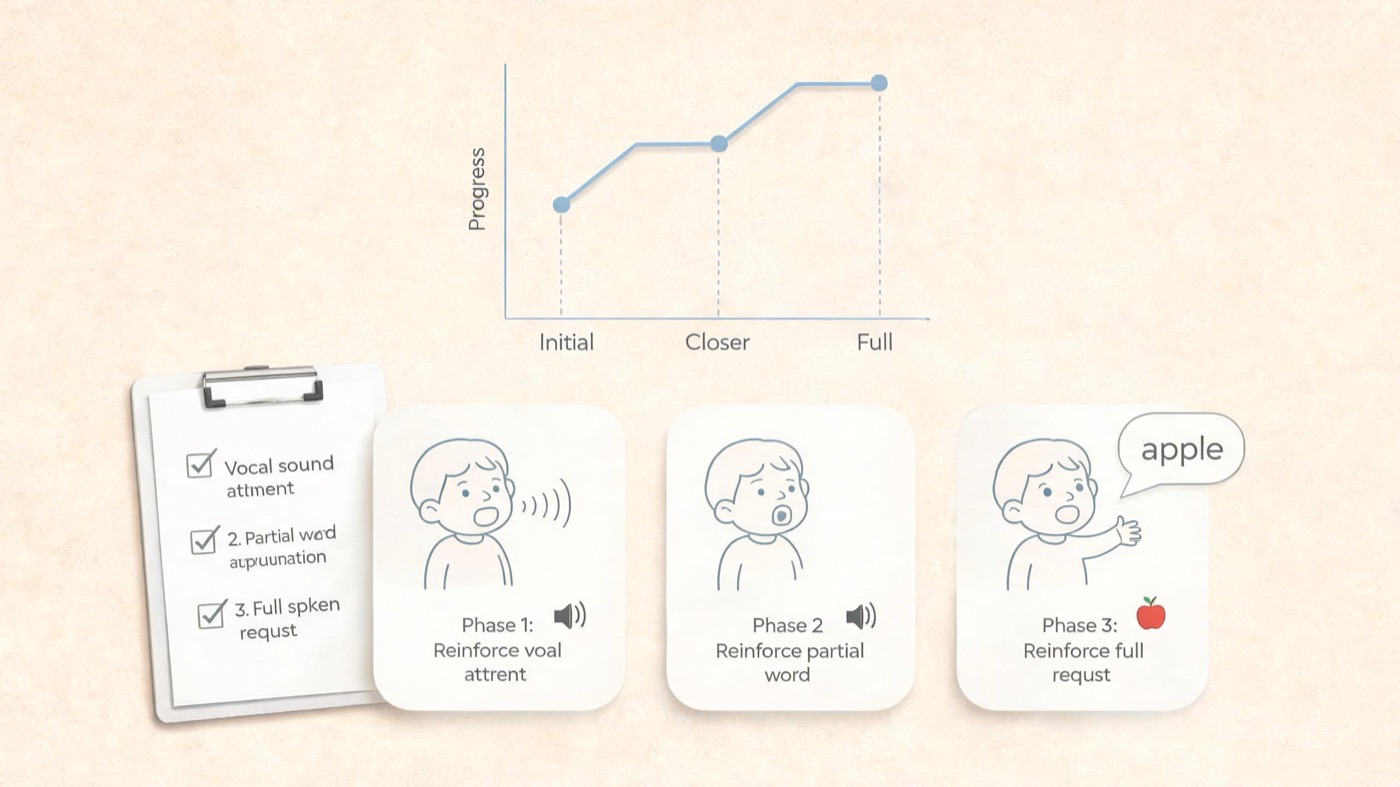
Imagine a non-vocal child who wants a preferred toy. The terminal behavior is saying “ball.” The shaping psychology example below demonstrates how to build this mand using successive approximations.
Breaking Down the Steps: Successive Approximations in Action
Each approximation is reinforced only when the previous level is mastered. Here is a sample ABC data table:
- Approximation 1: Child makes any vocalization (e.g., “ah”) → reinforcer delivered immediately (access to ball).
- Approximation 2: Child says “buh” → reinforced. Previous “ah” is placed on extinction.
- Approximation 3: Child says “ba” → reinforced. “Buh” no longer produces the toy.
- Approximation 4: Child says “ball” → reinforced with enthusiastic praise and toy.
Each step required differential reinforcement: only responses that meet the current approximation receive the reinforcer. This builds the behavior gradually without frustration.
Hypothesized Function: Why This Reinforcer Works
The function of the behavior is access to tangibles (the ball). The child’s motivation (establishing operation) is the toy being visible but out of reach. By reinforcing closer approximations to “ball,” the therapist shapes a clear, functional mand. The reinforcer is directly related to the child’s desire, making shaping efficient.
Another Shaping Example: Increasing On-Task Behavior in a Classroom
Now consider a student with short attention span. The goal is to work on a task for 10 minutes. Shaping can increase duration using differential reinforcement of higher rates (DRH) of on-task behavior.
From 1 Minute to 10: Shaping Attention Span
Here is a step-by-step progression:
- Step 1: Student stays on task for 1 minute → earns a sticker. Off-task behavior is ignored.
- Step 2: Requirement increases to 2 minutes of continuous on-task behavior → reinforced with sticker. Off-task after 1 minute no longer works.
- Step 3: Then 4 minutes, then 7, and finally 10 minutes. Each reinforcement must be earned with longer sustained attention.
The ABC data shows: Antecedent (task presented), Behavior (on-task for criterion duration), Consequence (sticker plus praise). This is a classic shaping procedure for behavior that already exists at low rates.
Shaping on the BCBA Exam: Common Traps and How to Avoid Them
Many BCBA candidates lose points on shaping questions due to subtle misunderstandings. Here are three traps and how to sidestep them.
Trap 1: Moving Too Fast – Forgetting Prerequisite Behavior
Shaping requires that the learner already emits the starting approximation. If you skip prerequisites, the procedure fails. Always verify that the initial behavior is in the learner’s repertoire before beginning. On the exam, look for scenarios where the target is too advanced.
Trap 2: Confusing Shaping with Chaining
Remember: shaping changes topography (form) of one behavior; chaining links separate behaviors. If the question describes a sequence of different actions (e.g., turn, pick up, insert), it is chaining, not shaping. Watch for key words like “approximation” (shaping) vs. “step” (chaining).
Trap 3: Overlooking Extinction Burst During Shaping
When you stop reinforcing an earlier approximation, the learner may show an extinction burst—an increase in the old behavior or emotional responding. This is normal. Do not mistake it for regression; continue reinforcing the new approximation after the burst subsides.
Quick Checklist: Applying Shaping in Scenarios
Use this checklist when solving shaping questions on the exam:
- Identify the terminal behavior clearly.
- Define the starting approximation that already exists.
- List 3–5 intermediate approximations that bridge the gap.
- Choose a powerful reinforcer and deliver it immediately for each correct approximation.
- Withhold reinforcement for previous approximations (implement extinction).
- Adjust criteria only when the current approximation is stable.
- Document using ABC data to track progress.
For more practice, visit our BCBA mock exam 6th edition to test your knowledge.
Summary: Why Shaping Is Essential for Every BCBA
Shaping is a core ABA procedure that allows practitioners to teach new behaviors without error. This shaping psychology example illustrates its power in communication and academic settings. On the BCBA exam, you will be asked to identify shaping, design approximation steps, and avoid confusing it with similar procedures. Mastering shaping is not optional—it is a fundamental skill for effective behavior change. Refer to the Behavior Analyst Certification Board for official guidelines and the full task list.


