
Introduction: Why These Variables Matter o
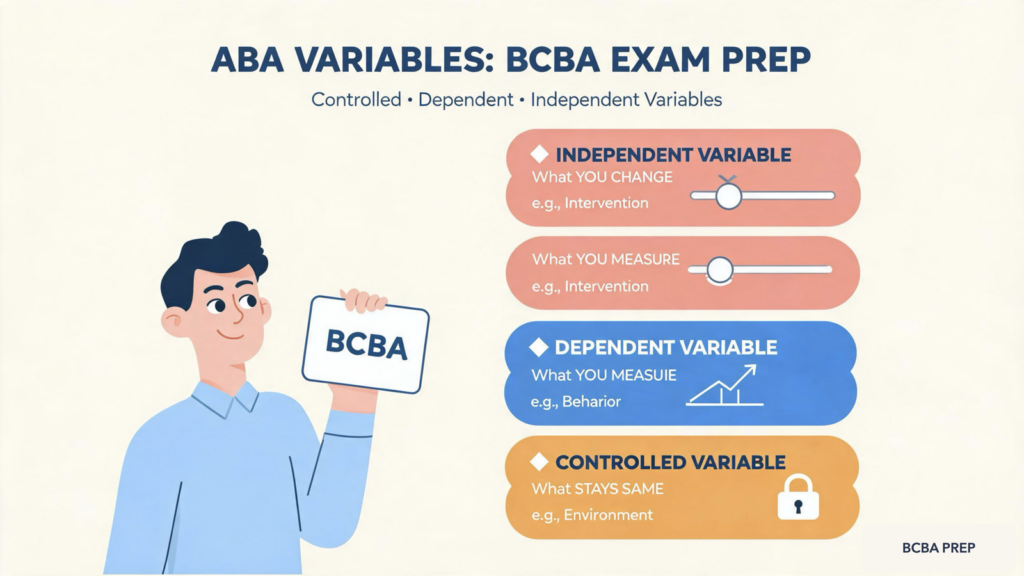
Understanding controlled dependent and independent variables is essential for designing and interpreting ABA experiments. The BCBA exam frequently tests your ability to identify which variable is manipulated, which is measured, and which must be held constant to ensure internal validity. Without this foundational knowledge, you risk misreading experimental design questions and losing easy points. In this guide, we will break down each variable type, walk through real ABA scenarios, and highlight common exam traps to help you succeed.
Table of Contents
- Introduction: Why These Variables Matter o
- Defining the Three Types of Variables
- Worked ABA Examples: Linking Variables to the ABC Model
- Exam Relevance and Common Traps
- Quick Checklist for Variable Identification
- Summary: Master These Concepts for Exam Day
Defining the Three Types of Variables
Every ABA experiment involves three core variable types. Knowing their roles is the first step to mastering experimental control.
Independent Variable (IV)
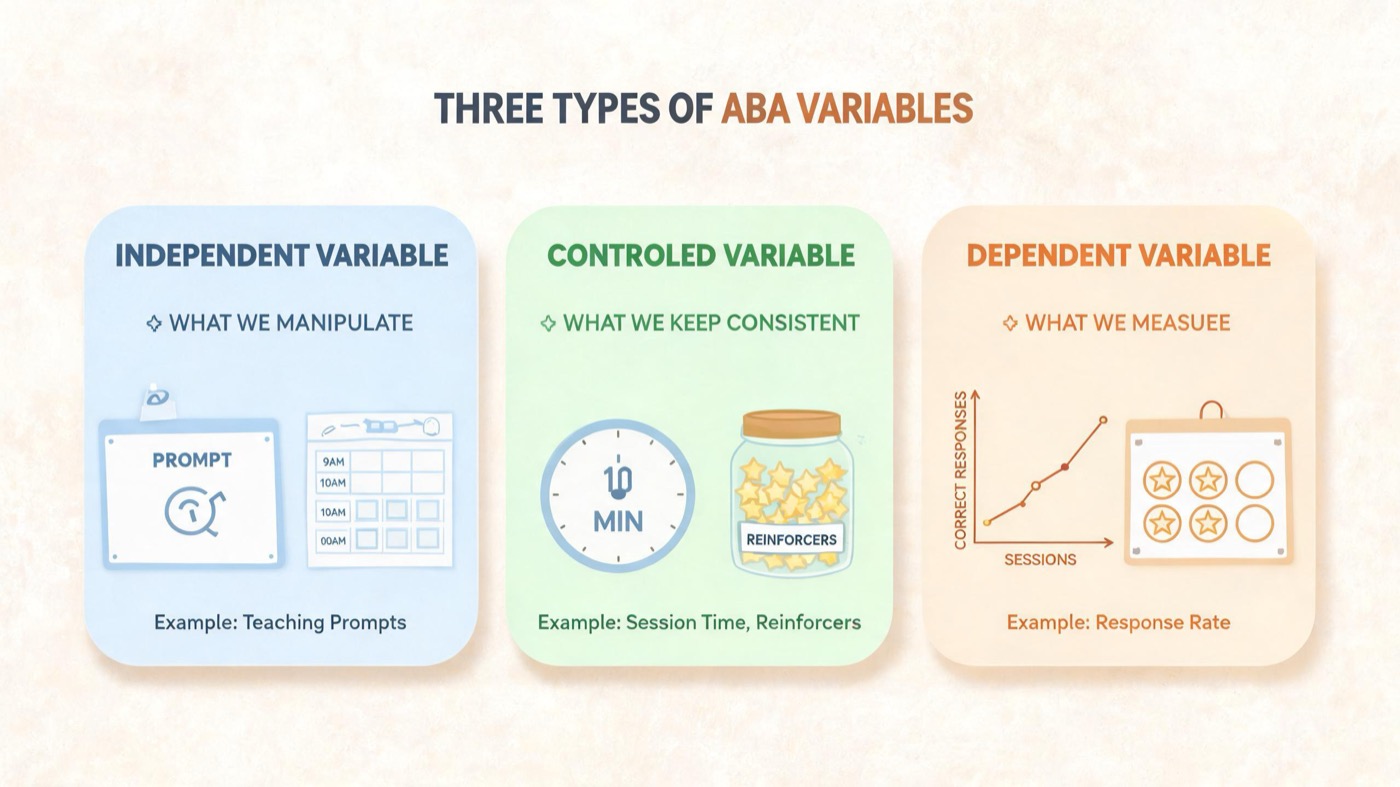
The independent variable is the intervention or condition manipulated by the experimenter. In ABA, this is typically a treatment, such as a token economy, differential reinforcement of alternative behavior (DRA), or a prompting strategy. The IV is what you, as the BCBA, change to observe its effect on behavior. For example, if you implement a token system to increase on-task behavior, the token system is the IV.
Dependent Variable (DV)
The dependent variable is the target behavior being measured. It is the primary outcome that you expect to change as a result of the IV. In the token system example, the DV would be the frequency of on-task behavior. The DV must be operationally defined so that it can be reliably counted or measured.
Controlled Variable (CV)
Controlled variables are extraneous factors that are held constant to prevent them from influencing the DV. Common controlled variables in ABA include session duration, time of day, setting, therapist, and materials. If these are not controlled, you cannot be sure that the IV caused the change in behavior. For instance, if sessions are held at different times each day, the time of day could become a confound.
Worked ABA Examples: Linking Variables to the ABC Model
Applying these definitions to realistic scenarios clarifies how variables interact in practice.
Example 1: Reducing Aggression with NCR
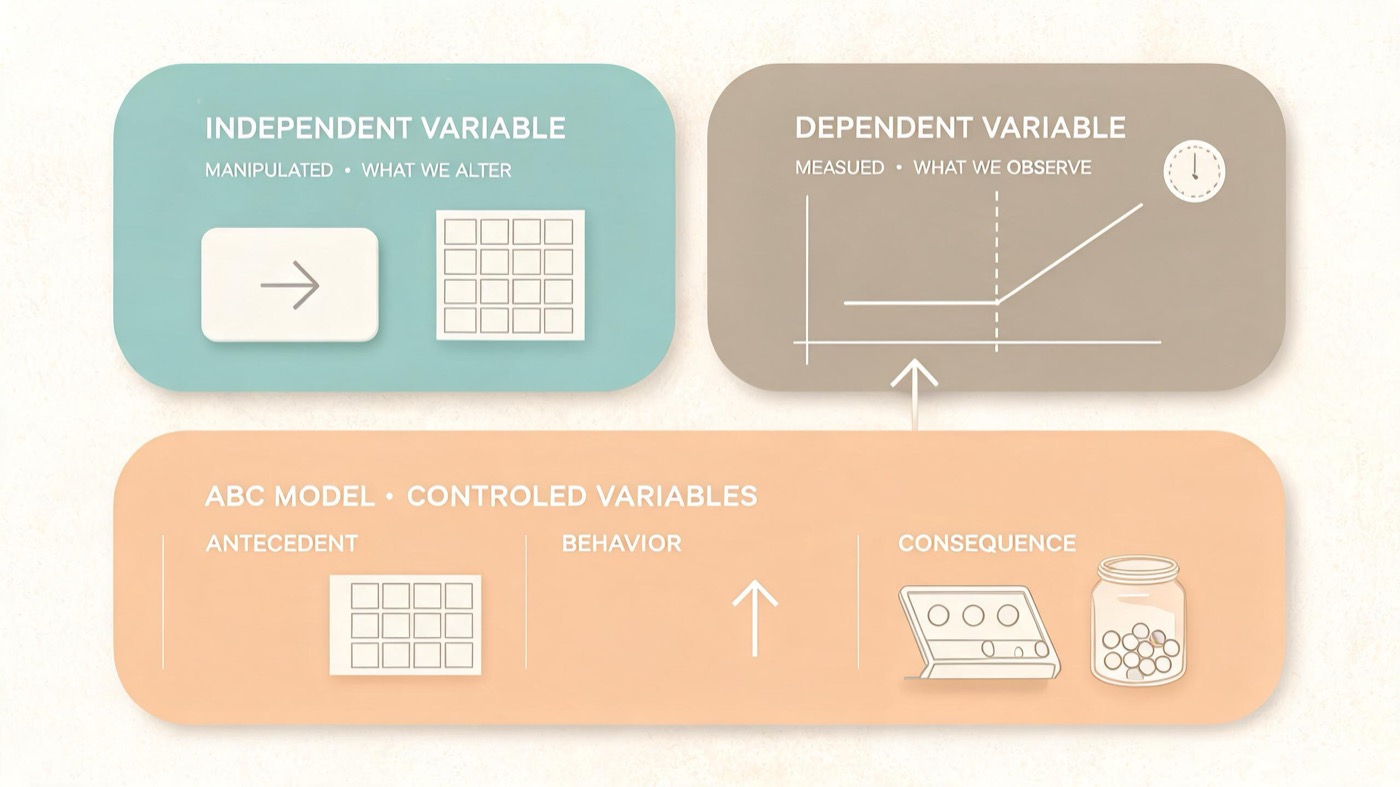
A child engages in aggression maintained by attention. The BCBA implements noncontingent reinforcement (NCR) by providing attention on a fixed-time schedule. Here, the IV is the NCR schedule, the DV is aggression frequency, and controlled variables include session duration (10 minutes), setting (classroom), and therapist (same staff). Because attention is given regardless of behavior, any reduction in aggression can be attributed to the IV rather than extraneous factors.
Example 2: Increasing Compliance with a Token System
A token economy is introduced to increase compliance with instructions. The IV is the token delivery schedule (fixed ratio 3), the DV is the number of compliant responses per session, and controlled variables include the time of day (morning) and the setting (therapy room). The token system is the only thing changed between baseline and intervention phases.
Example 3: DTT vs NET for Language Acquisition
A study compares discrete trial training (DTT) and natural environment training (NET) for teaching tacts. The IV is the teaching method (DTT vs NET), the DV is the number of correct tacts acquired, and controlled variables include session length (20 minutes), therapist experience, and the set of target words. By controlling these, differences in outcomes can be linked to the teaching method.
Exam Relevance and Common Traps
The BCBA exam tests your ability to identify controlled dependent and independent variables in single-subject designs. Questions may present a scenario and ask you to label each variable or spot a confound.
How the Task List Addresses Variable Types
The BACB 6th Edition Task List includes items under A-2 (distinguishing between independent and dependent variables) and A-3 (identifying variables that are controlled). You should be able to pinpoint the IV, DV, and CV in any experimental description. For example, in an ABAB reversal design, the IV is the presence or absence of the intervention, the DV is the behavior measured, and CVs are factors kept constant across phases.
Common Mistakes on the Exam
- Confusing DV with CV. The DV is what you measure, while CVs are things you hold constant. For instance, session duration is a CV, not the DV.
- Forgetting that controlled variables must be explicitly stated. Exam scenarios often omit some CVs, and you need to recognize that they are not controlled—a threat to internal validity.
- Misidentifying IV when multiple interventions are used. If you implement both a token system and reduced task difficulty simultaneously, the IV is the combination, not either alone. The exam may ask you to identify the independent variable in a multi-component package.
- Overlooking confounding variables. If the therapist changes midway, that becomes an uncontrolled variable. The exam might ask you to identify a potential confound.
Quick Checklist for Variable Identification
Use this checklist before your exam to ensure you correctly identify each variable in any scenario:
- Ask: What is being manipulated by the experimenter? That is the independent variable.
- Ask: What behavior is being measured to detect change? That is the dependent variable.
- Ask: What factors are kept the same across conditions? Those are controlled variables.
- Check for potential confounds: Is session duration constant? Same therapist? Same setting? Same time of day? If not, note them.
- In reversal designs, confirm that the IV is the only thing changing between phases.
- For multiple baseline designs, verify that the IV is introduced at different times across baselines while CVs remain consistent.
Summary: Master These Concepts for Exam Day
Identifying controlled dependent and independent variables is a core skill for the BCBA exam. Remember: the IV is what you change, the DV is what you measure, and CVs are what you hold constant. Practice with scenarios from your coursework or from BCBA mock exam questions. For further reading, review the BACB Task List and peer-reviewed ABA research to see how variables are operationalized. With consistent practice, you will handle any variable identification question with confidence.


