
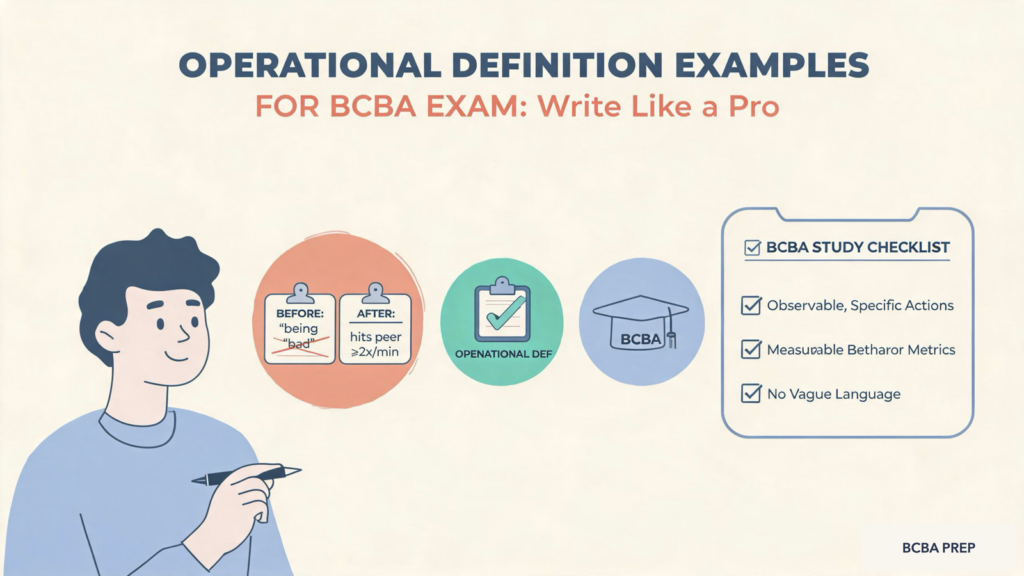
What Is an Operational Definition in ABA?
An operational definition in applied behavior analysis is a clear, precise, and complete description of a behavior that allows two independent observers to reliably identify and record it. Unlike vague labels such as ‘aggressive’ or ‘frustrated,’ an operational definition focuses on what you can see and measure. This is a cornerstone of the BCBA exam because it ensures data collection is objective and replicable.
Table of Contents
- What Is an Operational Definition in ABA?
- How to Write an Operational Definition for the BCBA Exam
- BCBA Exam Traps: What to Watch Out For
- Quick Checklist: Is Your Definition Exam-Ready?
- Practice Prompts: Write Your Own Operational Definitions
- Summary: Master Operational Definitions for Exam Day
Why does this matter for exam day? Questions often test your ability to identify or write an operational definition among distractors. Mastering this skill can make the difference between a correct and incorrect answer on measurement items.
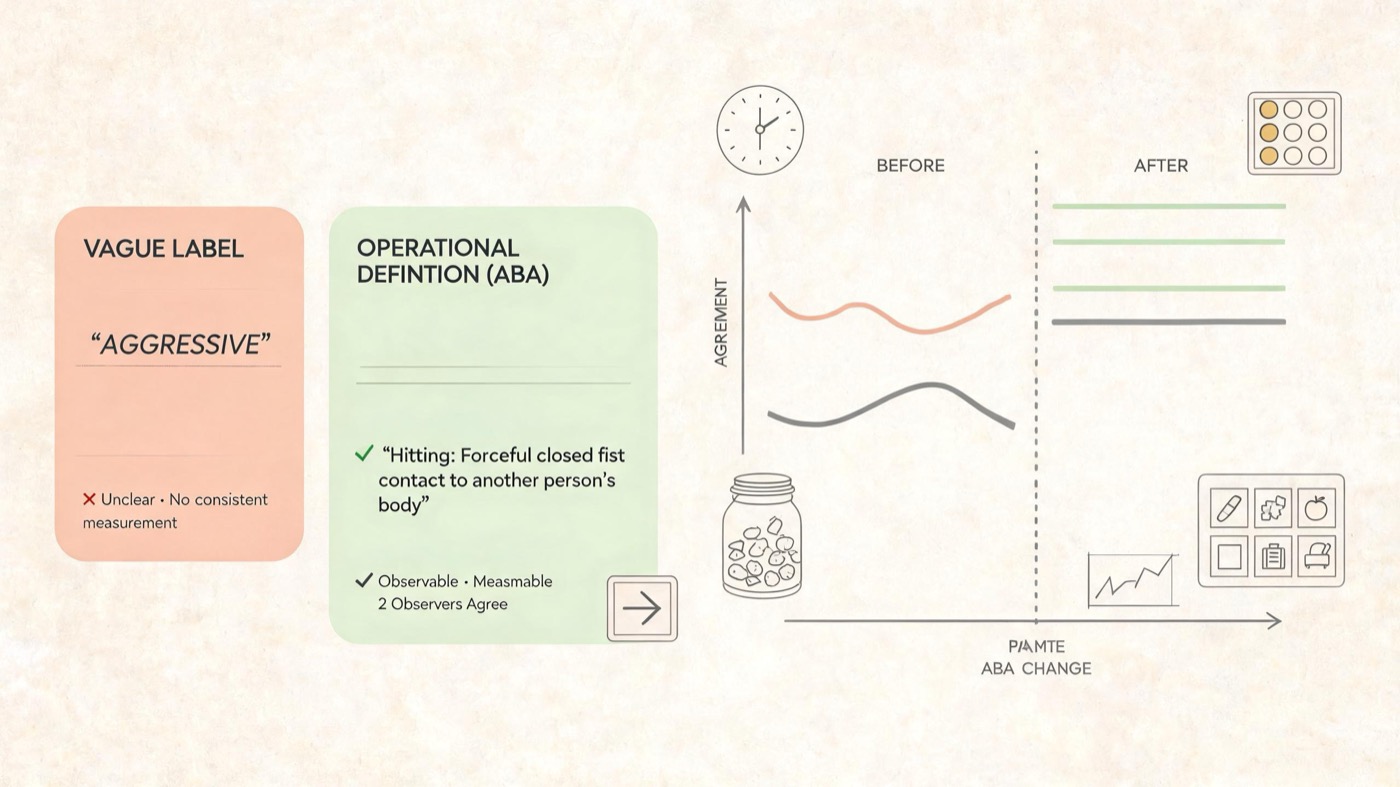
Operational vs. Non-Operational: Spot the Difference
Consider the difference between ‘feels sad’ (non-operational, subjective) and ‘cries with tears and audible sobs for at least 5 minutes’ (operational, observable). The first includes an inner state; the second describes a specific action with clear start and stop criteria. The BCBA exam will present similar pairs, and you must choose the operational one. Another example: ‘on-task behavior’ vs. ‘eyes oriented to worksheet, pencil contacting paper, or raising hand.’ The second version eliminates guesswork.
How to Write an Operational Definition for the BCBA Exam
Follow these steps when crafting or evaluating an operational definition. Each step builds on the previous to ensure your definition is measurable and observable.
- Step 1: Identify the exact topography of the behavior—what does it look like? Use action verbs (e.g., ‘hits,’ ‘cries,’ ‘leaves seat’).
- Step 2: Specify measurement criteria: frequency, duration, latency, or intensity. For example, ‘hits with open hand making audible contact.’
- Step 3: Define the start and stop of the behavior. Does it begin with the first hand-to-skin contact and end when the hand is lowered?
- Step 4: Test your definition by imagining two different observers. Would they agree on every instance? If not, revise for clarity.
Example 1: Aggression (Hitting)
Operational definition: Any instance where the client makes forceful contact between an open or closed hand and another person’s body, resulting in an audible sound or visible displacement. Includes slapping, punching, or swatting. Excludes high-fives or gentle taps.
- Antecedent: Peer touches client’s toy.
- Behavior: Client’s hand contacts peer’s arm with force.
- Consequence: Peer withdraws toy.
- Hypothesized function: Access to tangible items.
Example 2: On-Task Behavior
Operational definition: The client is engaged in the assigned activity as evidenced by: eyes oriented to the worksheet, pencil or marker contacting paper, writing or drawing, or raising hand to ask a question. Off-task defined as looking away from work for more than 3 seconds, playing with objects unrelated to task, or leaving seat without permission.
- Antecedent: Teacher gives instruction to complete math problems.
- Behavior: Client orients eyes to worksheet and writes answers for at least 2 consecutive minutes.
- Consequence: Teacher delivers praise.
- Hypothesized function: Attention (positive reinforcement).
Example 3: Self-Injury (Head Hitting)
Operational definition: Any instance where the client’s closed fist or open palm makes audible contact with their own forehead or temple, from a distance of at least 6 inches. Excludes rubbing or scratching scalp. Each contact is counted as a separate instance if at least 1 second separates hits.
- Antecedent: Therapist presents a non-preferred task demand (e.g., ‘Sort the blocks’).
- Behavior: Client brings hand to temple with force within 5 seconds of demand.
- Consequence: Therapist removes task materials.
- Hypothesized function: Escape from demands.
Example 4: Elopement (Running Away)
Operational definition: Any instance where the client moves more than 3 feet away from the designated area (e.g., classroom, therapy room) without permission, as measured by the client’s entire body crossing the boundary line. Includes walking quickly, running, or crawling. Excludes moving within the area for task-related reasons.
- Antecedent: Teacher transitions to a less preferred activity.
- Behavior: Client stands up and walks out the classroom door.
- Consequence: Staff follows and redirects.
- Hypothesized function: Escape from non-preferred activity or access to preferred environment.
BCBA Exam Traps: What to Watch Out For
The exam loves to test your ability to spot flawed definitions. Here are the most common traps and how to avoid them.
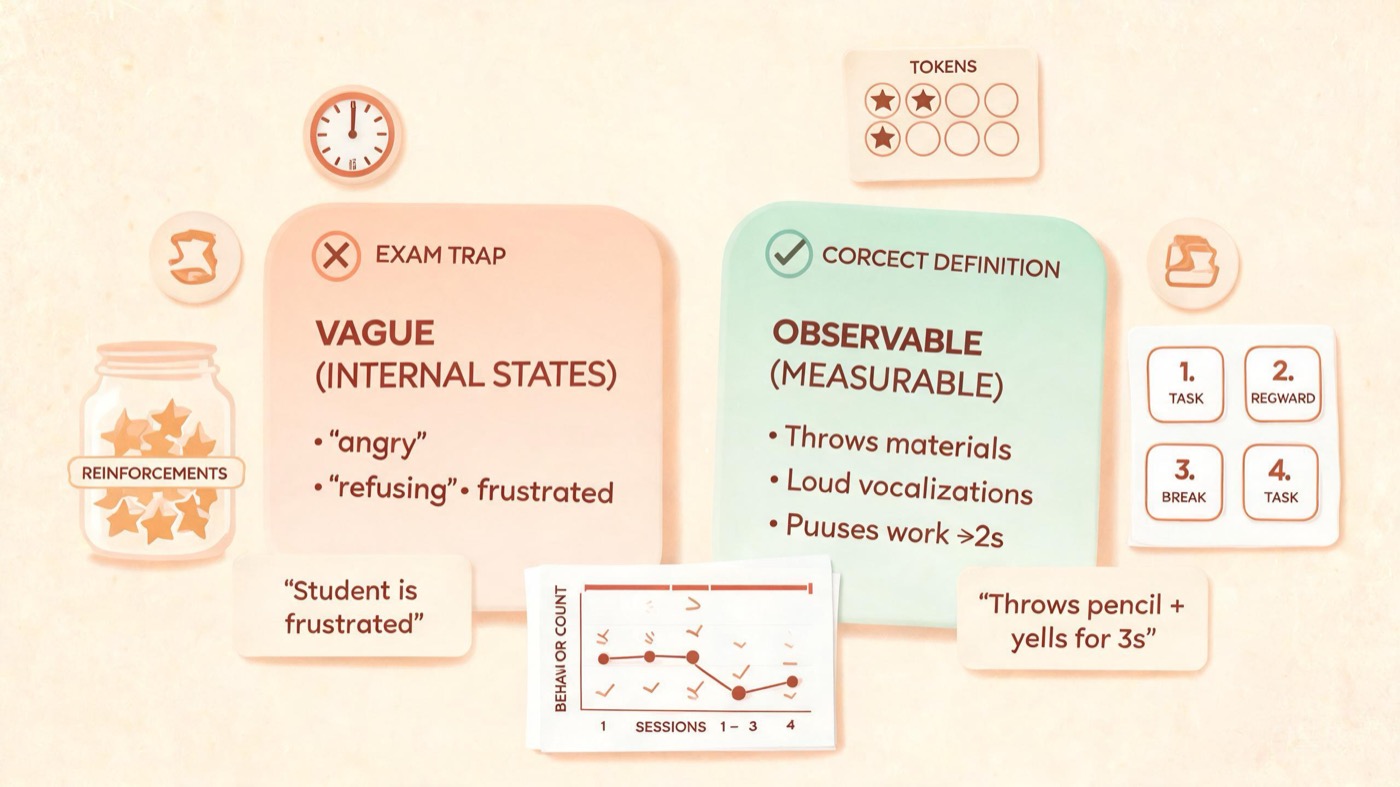
Including Inner States or Subjective Terms
Words like ‘angry,’ ‘frustrated,’ ‘trying,’ or ‘refusing’ are unacceptable because they infer internal experiences that cannot be observed. An exam question might list four definitions, and three will use such terms. Always choose the one describing external, measurable actions. Example: ‘The client refuses to comply’ is non-operational; ‘The client does not initiate the requested action within 5 seconds of the instruction’ is operational.
Overly Broad Definitions
Be wary of definitions that lump multiple behaviors together without clear boundaries. For instance, ‘noncompliance’ is too broad; better to define it as ‘failure to initiate the requested task within 10 seconds of the instruction.’ Another trap: using ‘aggression’ without specifying topography. The exam may present ‘aggression’ as a definition, but the correct answer will specify hitting, kicking, or biting with observable criteria.
Missing Start/Stop Criteria
A good definition tells you when a behavior begins and ends. For example, ‘tantrum’ defined as ‘crying and screaming’ is incomplete. A better version: ‘Any instance of crying (audible sobbing) and/or screaming (vocalizations above conversational level) lasting at least 10 seconds, where the client is on the floor or flailing limbs.’ Without start/stop rules, reliability suffers.
Quick Checklist: Is Your Definition Exam-Ready?
Use this checklist when reviewing definitions during study or on the exam. Each item is a critical criterion for a passing definition.
The Four-Question Test
- Is it observable? Can you see or hear the behavior? If it requires inference, rewrite it.
- Is it measurable? Can you count, time, or calculate it? Include units (e.g., seconds, inches, frequency).
- Does it avoid inner states? Replace ‘feeling,’ ‘thinking,’ ‘wanting’ with actions.
- Is it complete? Does it specify start and stop? Does it include examples and non-examples?
For extra practice, apply this test to a definition you wrote. If it fails any question, revise until it passes all four.
Practice Prompts: Write Your Own Operational Definitions
Test your skills with these two scenarios. Write a definition, then compare with the sample provided.
Prompt 1: Tantrum
Scenario: You need to define ‘tantrum’ for a 3-year-old in a preschool setting. The behavior includes crying, screaming, falling to the floor, and kicking. Write an operational definition that includes start/stop criteria and a measurement method.
Sample answer: Any instance of crying (audible sobbing) and/or screaming (vocalizations above conversational level) while the client is on the floor or flailing limbs, lasting at least 10 consecutive seconds. The episode ends when the client is quiet and upright for at least 30 seconds. Measure frequency of episodes per session.
Prompt 2: Elopement
Scenario: Define ‘running away’ for a 7-year-old in a classroom. The behavior involves leaving the classroom without permission. Write a definition that includes distance and context.
Sample answer: Any instance where the client’s entire body crosses the threshold of the classroom door without teacher permission. Includes walking, running, or crawling. Excludes leaving during a fire drill or when escorted by staff. Measure latency from instruction to elopement, or count frequency per day.
Summary: Master Operational Definitions for Exam Day
Operational definitions are the bedrock of reliable data collection in ABA. On the BCBA exam, you will be tested on your ability to distinguish operational from non-operational definitions, write clear definitions, and identify common errors. Use the examples and checklist in this guide as a study tool. For more practice, check out our free BCBA mock exam questions to test your skills. Additionally, the BACB website provides official task list resources that can help you align your study with exam content. Remember: a well-written operational definition is your first step toward passing the exam and becoming a competent behavior analyst.


