
What Are Preference Assessments in ABA?
In Applied Behavior Analysis (ABA), preference assessments are systematic procedures used to identify items, activities, or stimuli that an individual prefers. These assessments help clinicians predict which stimuli might function as reinforcers. However, it is crucial to understand that a preference does not guarantee reinforcement; a reinforcer assessment is needed to confirm that a stimulus actually increases behavior.
Table of Contents
- What Are Preference Assessments in ABA?
- Types of Preference Assessments You Need to Know
- Worked Examples with ABC Analysis
- Exam Relevance and Common Traps
- Putting It All Together: A Quick Checklist
- Summary: Preference Assessments Made Simple
- References
Definition and Rationale
A preference assessment involves presenting stimuli and measuring approach, engagement, or choice. The goal is to identify potential reinforcers for behavior change programs. For example, if a child consistently selects a toy car during a preference assessment, that toy may be used as a reward during therapy. But only a reinforcer assessment can confirm that the toy strengthens behavior.
Preference assessments are foundational to ABA practice because they ensure interventions are individualized and motivating. They also align with ethical guidelines by prioritizing the client’s interests.
Types of Preference Assessments You Need to Know
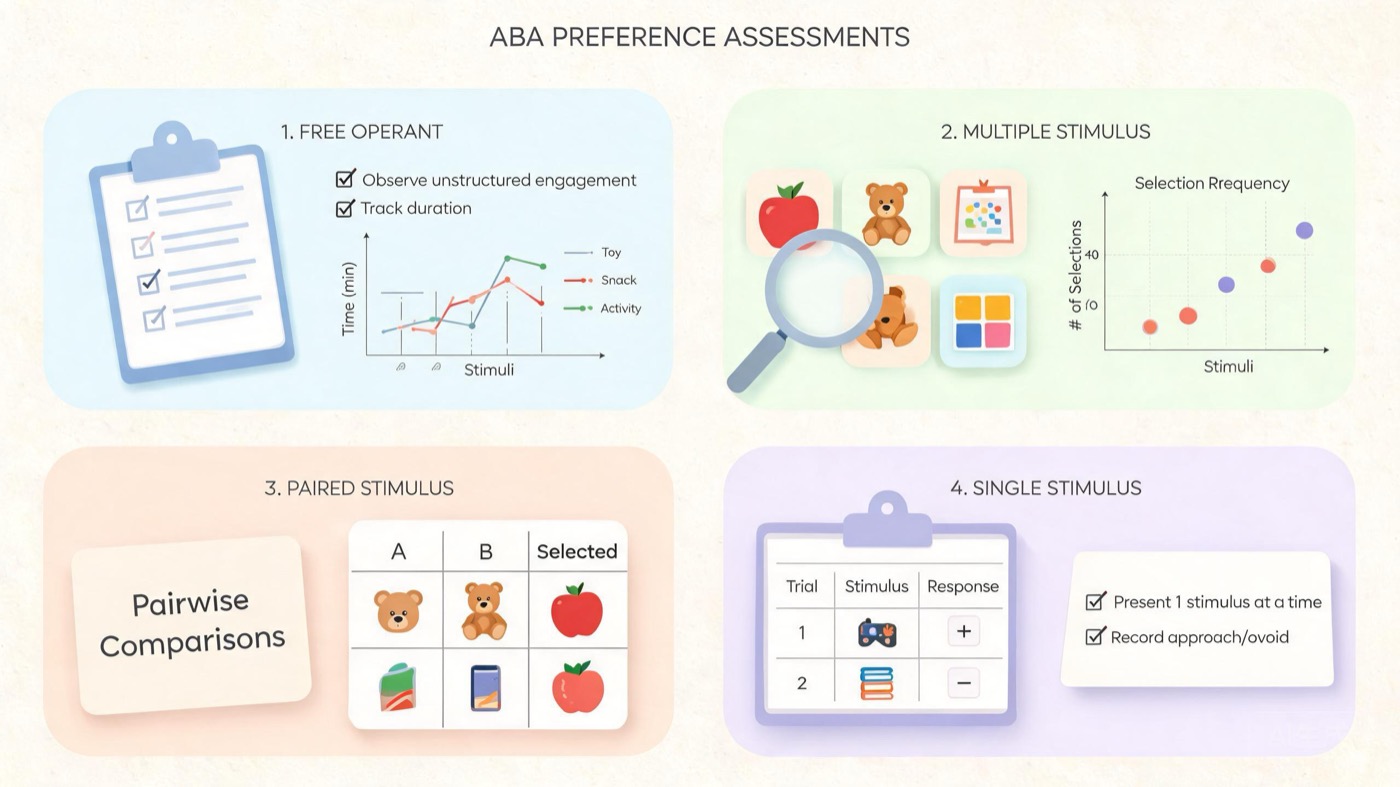
There are five main types of preference assessments commonly tested on the BCBA exam. Each has unique procedures and best-use cases.
- Free Operant Observation: The clinician observes the client in a natural environment without presenting specific stimuli. The client freely interacts with available items, and the duration of engagement is recorded. This is ideal for individuals with limited verbal skills or when you want to minimize reactivity.
- Single Stimulus Presentation: One item is presented at a time, and the client’s approach or engagement is recorded. This is useful for clients who have difficulty choosing between multiple options.
- Paired Stimulus (Forced Choice): Two items are presented simultaneously, and the client selects one. This method yields a clear hierarchy of preferences and is considered highly reliable for clients who can make choices.
- Multiple Stimulus Without Replacement (MSWO): An array of items is presented, and the client selects one. The selected item is removed from the array, and the process repeats. This produces a ranked preference hierarchy efficiently and is a common exam topic.
- Multiple Stimulus With Replacement (MSW): Similar to MSWO, but the selected item remains in the array. This allows the client to continue choosing the same item, which may indicate a strong preference but can also mask lower preferences.
When selecting a method, consider the client’s communication level, attention span, and the setting. For example, MSWO is efficient for higher-functioning clients, while free operant may be better for those with severe disabilities.
Worked Examples with ABC Analysis
Linking preference assessment results to behavior function is a key skill. Here are three practical examples that connect preference data to hypothesized functions and interventions.
Example 1: Paired Stimulus for Escape-Maintained Behavior
Scenario: A child engages in tantrums during task demands. A paired stimulus assessment shows high preference for ‘break’ cards. Hypothesized function: escape. Intervention: Provide a break card after completing a small amount of work, teaching the child to request breaks appropriately.
Example 2: MSWO for Tangible-Maintained Aggression
Scenario: A client becomes aggressive when a preferred toy is removed. MSWO results show the iPad as the top preference. Hypothesized function: tangible (access to items). Intervention: Schedule regular iPad time and teach a requesting response (e.g., handing a picture of the iPad).
Example 3: Free Operant for Attention-Maintained Behavior
Scenario: A student calls out in class. Free operant observation reveals the student spends most time in peer interaction. Hypothesized function: attention. Intervention: Provide adult attention for raising a hand, ignoring calling out.
These examples show how preference assessments directly inform function-based interventions, a core competency on the BCBA exam.
Exam Relevance and Common Traps
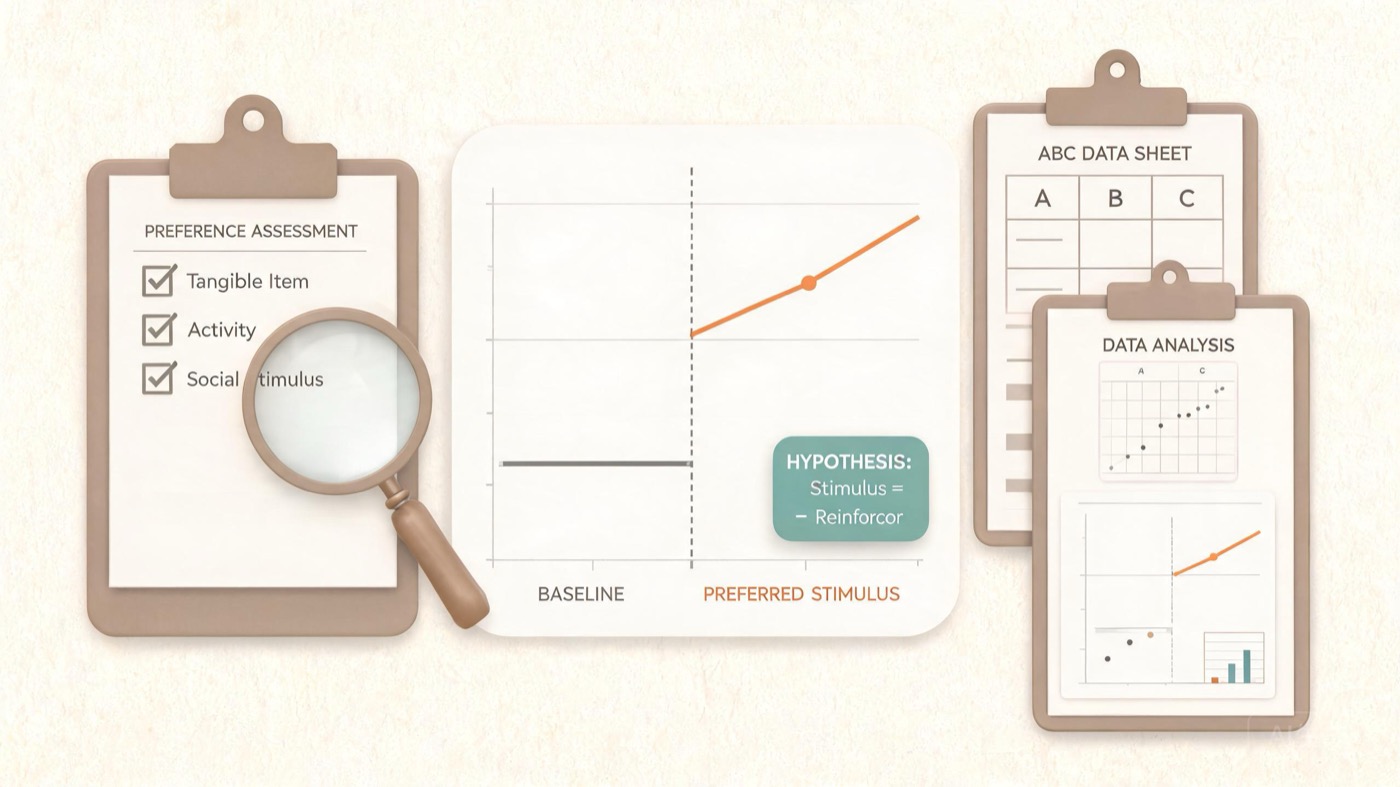
The BCBA exam frequently tests your understanding of preference assessments. Knowing key terms and avoiding common mistakes can boost your score.
Key Terms to Define
- Preference assessment: Systematic method to identify preferred stimuli.
- Reinforcer assessment: Confirms whether a stimulus increases behavior.
- Free operant: No item presentation; naturalistic observation.
- Forced choice: Synonym for paired stimulus.
- MSWO: Selected item removed; efficient hierarchy.
- MSW: Selected item stays; less common.
Common Traps on the Exam
- Confusing preference with reinforcer. A preferred item is not automatically a reinforcer. Always look for a reinforcer assessment in the scenario.
- Thinking MSWO and MSW are the same. The ‘with replacement’ vs. ‘without replacement’ distinction is critical.
- Forgetting that free operant does not involve presenting stimuli. It is purely observational.
- Not considering client abilities. For non-verbal clients, single stimulus or free operant may be more appropriate than paired choice.
Quick Checklist for Exam Day
- ✓ Can you define preference assessment?
- ✓ Can you list 5 types and when to use each?
- ✓ Can you identify the most appropriate type for a given client scenario?
- ✓ Can you interpret data from a preference assessment graph?
Review these points to avoid losing points on common exam questions. For a deeper dive, check out our BCBA exam guide on preference assessments.
Putting It All Together: A Quick Checklist
Use this final checklist to solidify your knowledge before the exam.
- Understand the purpose: to identify potential reinforcers, not confirm them.
- Know the 5 types: free operant, single stimulus, paired stimulus, MSWO, MSW.
- Match the assessment to the client’s abilities.
- Always follow up with a reinforcer assessment to verify.
- Practice interpreting data and graphs from each method.
- Review ethical considerations like client choice and ongoing assessment.
Summary: Preference Assessments Made Simple
Mastering preference assessments is essential for BCBA exam success and effective practice. Remember: preference assessments identify what clients like, while reinforcer assessments confirm what works. By knowing the types, examples, and common traps, you can confidently answer exam questions and design meaningful interventions. For more study resources, visit our BCBA exam prep page and explore additional guides. Good luck!


