
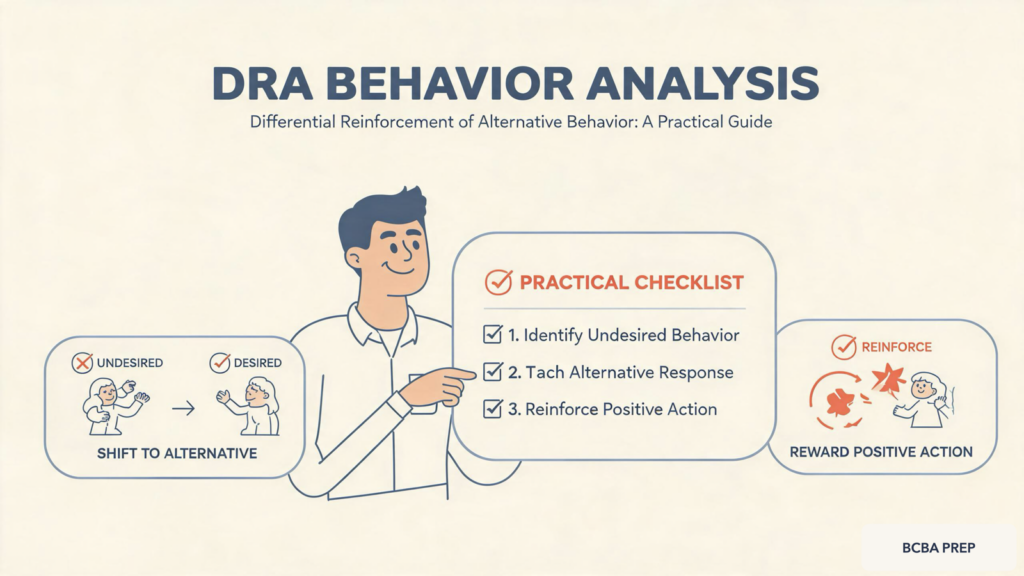
What Is DRA in Behavior Analysis?
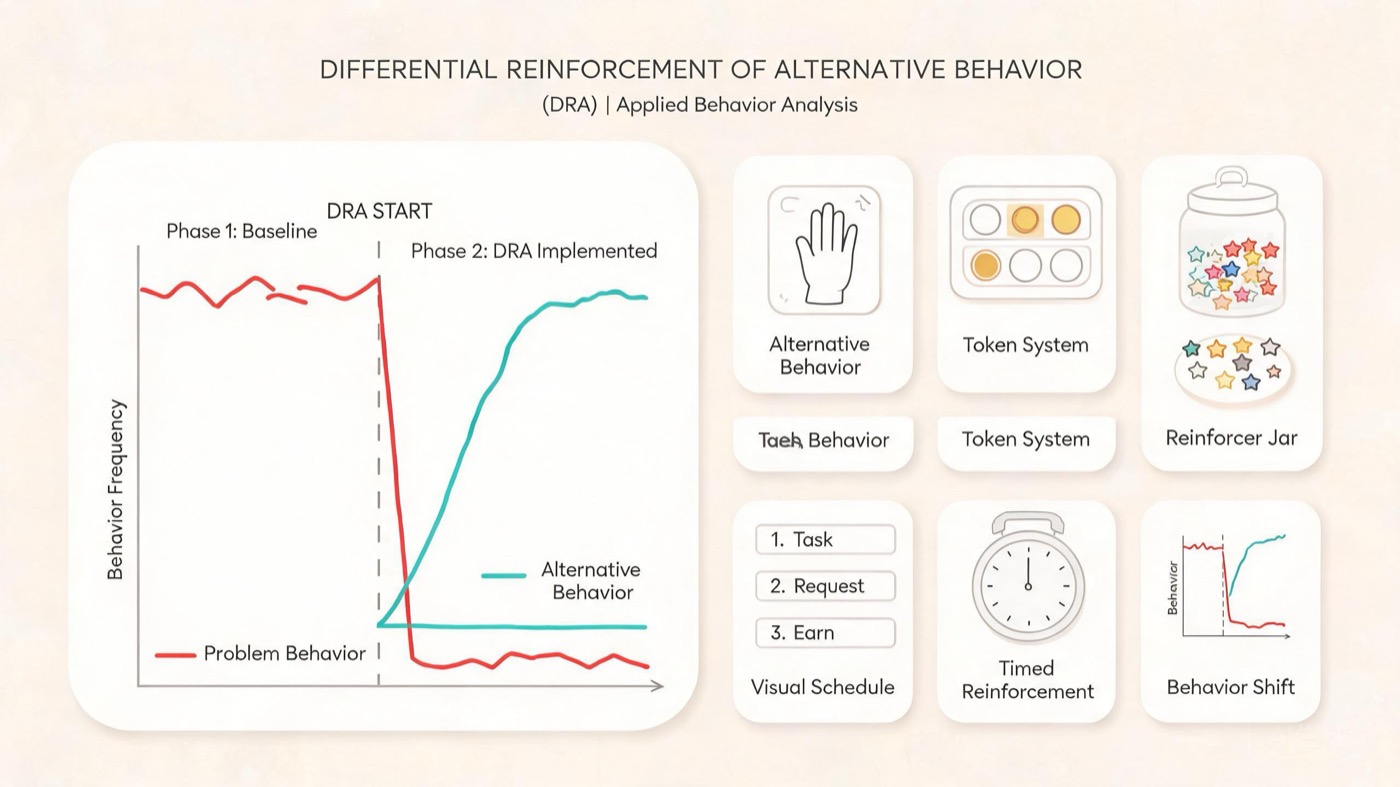
DRA behavior analysis refers to Differential Reinforcement of Alternative Behavior, a procedure where you reinforce a specific alternative behavior that serves the same function as the problem behavior, while withholding reinforcement for the problem behavior. This function-based logic is what makes DRA effective and ethical.
Table of Contents
- What Is DRA in Behavior Analysis?
- How to Implement DRA: Step-by-Step Process
- Applied DRA Examples with ABC Analysis
- Why DRA Matters for the BCBA Exam
- DRA Quick Reference Checklist
- Final Summary
Definition and Core Components
DRA requires three elements:
- Identify function: Determine what reinforcer maintains the problem behavior (e.g., escape, attention, access, automatic).
- Select alternative behavior: Choose a behavior that produces the same reinforcer but is socially acceptable and equally or less effortful.
- Withhold reinforcement: The problem behavior no longer produces the reinforcer (extinction), while the alternative is consistently reinforced.
Comparing DRA to Other Differential Reinforcement Procedures
DRA is often confused with other procedures. Here’s how it differs:
- DRA vs DRO: DRO reinforces the absence of the problem behavior; DRA reinforces a specific alternative.
- DRA vs DRI: DRI reinforces a behavior physically incompatible with the problem; DRA’s alternative may not be incompatible.
- DRA vs DRL: DRL reinforces lower rates of the problem behavior; DRA focuses on an entirely different behavior.
How to Implement DRA: Step-by-Step Process
Implementing DRA follows a systematic sequence grounded in functional behavior assessment.
Conduct a Functional Behavior Assessment (FBA)
Identify the function of the problem behavior. Common functions include escape from demands, attention from others, or access to tangibles. Use direct observation, interviews, and ABC data collection.
Select an Appropriate Alternative Behavior
The alternative must meet these criteria:
- Same function: Earning the same reinforcer as the problem behavior.
- Equal or lower effort: Should be easy for the learner to perform.
- Socially acceptable: Appropriate in the setting.
- Likely to be reinforced naturally: Once taught, the environment should maintain it.
Systematically Reinforce the Alternative and Extinguish the Problem Behavior
Initially, use a continuous reinforcement schedule (CRF) for the alternative to strengthen it. Simultaneously, place the problem behavior on extinction. Ensure safety is addressed, especially for behaviors like aggression or self-injury. For more on extinction, see our guide on extinction in ABA.
Applied DRA Examples with ABC Analysis
Real-world examples help solidify the concept for the BCBA exam. Below are two scenarios with ABC data.
Example 1: Aggression Maintained by Escape from Demands
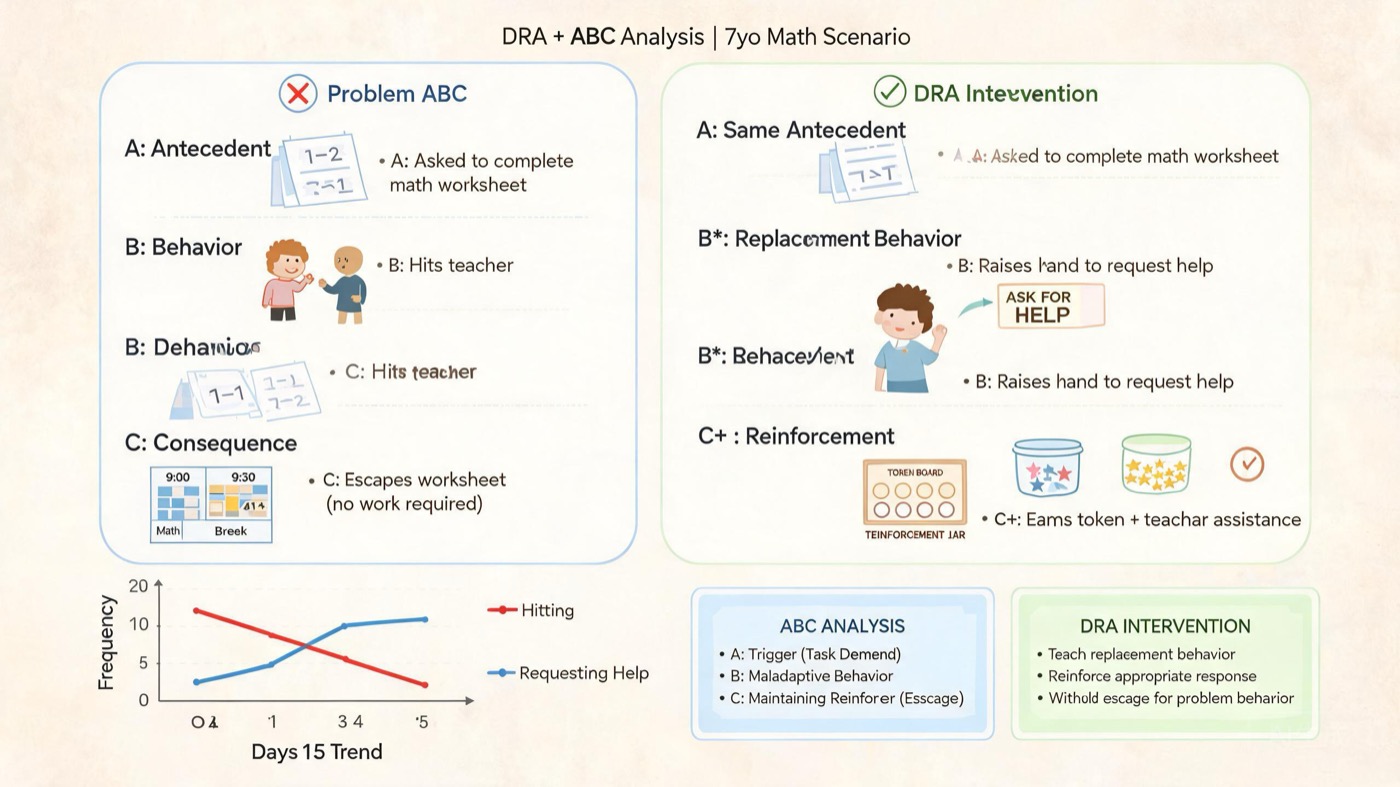
Scenario: A 7-year-old child hits the teacher when asked to complete a math worksheet.
- Antecedent: Teacher presents math worksheet.
- Behavior: Child hits the teacher.
- Consequence: Teacher removes the worksheet and says ‘No hitting, take a break.’
Hypothesized function: Negative reinforcement (escape). DRA implementation: Teach the child to request a break (e.g., ‘I need a break’ on a card or vocally). When the child requests a break appropriately, provide a short break. Hitting is ignored (extinction with safety plan).
Example 2: Screaming Maintained by Attention from Peers
Scenario: An adult with intellectual disability screams in a group home when peers are nearby.
- Antecedent: Peers talking in the common room.
- Behavior: Loud screaming.
- Consequence: Peers look over and say ‘What’s wrong?’ or ‘Shh.’
Hypothesized function: Positive reinforcement (attention). DRA implementation: Teach the individual to initiate a comment (e.g., ‘Hi everyone’ or ‘Can I join?’). When they do, peers provide attention. Screaming results in no attention (extinction).
Why DRA Matters for the BCBA Exam
The BCBA exam frequently tests DRA under the behavior change procedures domain. Understanding its nuances can make or break your score. For a broader review, check out our differential reinforcement BCBA exam guide.
Common Exam Traps When Answering DRA Questions
- Confusing DRA with DRI: An alternative behavior does not have to be incompatible. If the alternative is raising a hand and the problem is screaming, those can both occur simultaneously – yet DRA is still correct.
- Assuming DRA always uses extinction: While extinction is typical, sometimes reinforcement for the alternative is so powerful that extinction is not needed immediately.
- Forgetting function: The alternative must be functionally equivalent. Teaching a request for a break when the function is escape is correct; teaching a request for a hug for escape is not.
- Overlooking safety: When the problem behavior is dangerous, DRA must include a safety component, not just extinction.
Practice Prompts for Self-Testing
Prompt 1: A student yells out answers in class. Data show the behavior is maintained by teacher attention. Which differential reinforcement procedure is most appropriate?
Rationale: DRA – reinforce raising hand to answer (alternative behavior that also gets attention), and ignore yelling (extinction). DRO would reinforce not yelling, but DRA directly teaches a replacement.
Prompt 2: A child flaps hands when presented with difficult work. The function is automatic reinforcement (sensory). Can DRA be used?
Rationale: Yes, but the alternative must provide similar sensory input in a more acceptable form (e.g., squeezing a stress ball). Extinction may be challenging if the sensory consequence is automatic.
DRA Quick Reference Checklist
- Identify function of problem behavior via FBA.
- Select alternative behavior that matches the function, has lower or equal effort, and is socially valid.
- Reinforce alternative consistently (start with continuous schedule).
- Withhold reinforcement for problem behavior (extinction with safety).
- Monitor data to ensure the alternative increases and problem behavior decreases.
- Plan for generalization: Teach across settings and people.
For a deep dive into related procedures, read our article on functional communication training, a specific form of DRA.
Final Summary
DRA behavior analysis is a powerful, ethical intervention that replaces problem behaviors with adaptive ones by addressing the same function. Mastery of DRA requires understanding its components, distinguishing it from similar procedures, and applying it with real-world scenarios. Use this DRA behavior analysis guide as a study reference and revisit the common exam traps before test day. For additional practice, check out the BACB website for official task list details.


