
What Is Experimental Control in ABA?
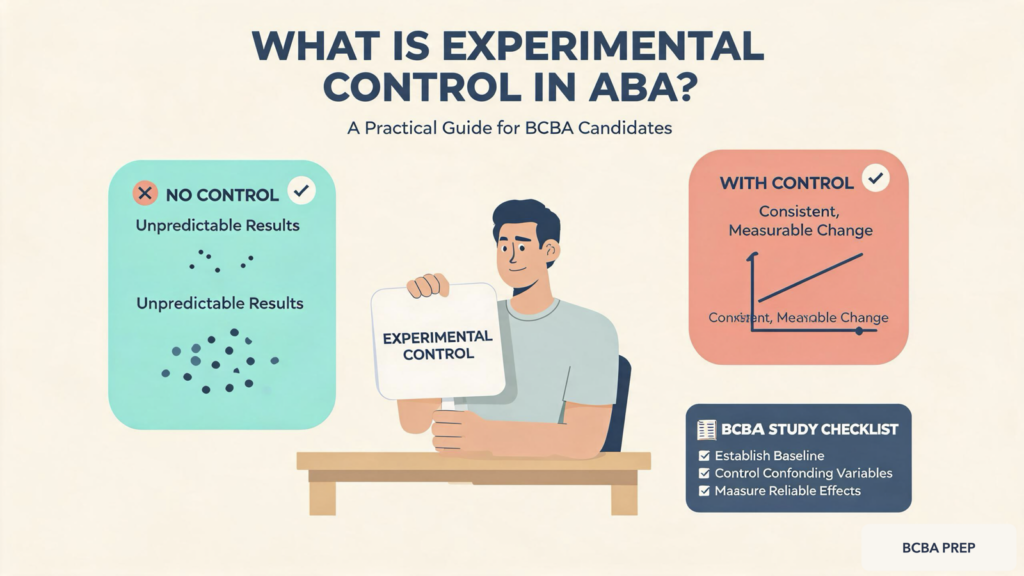
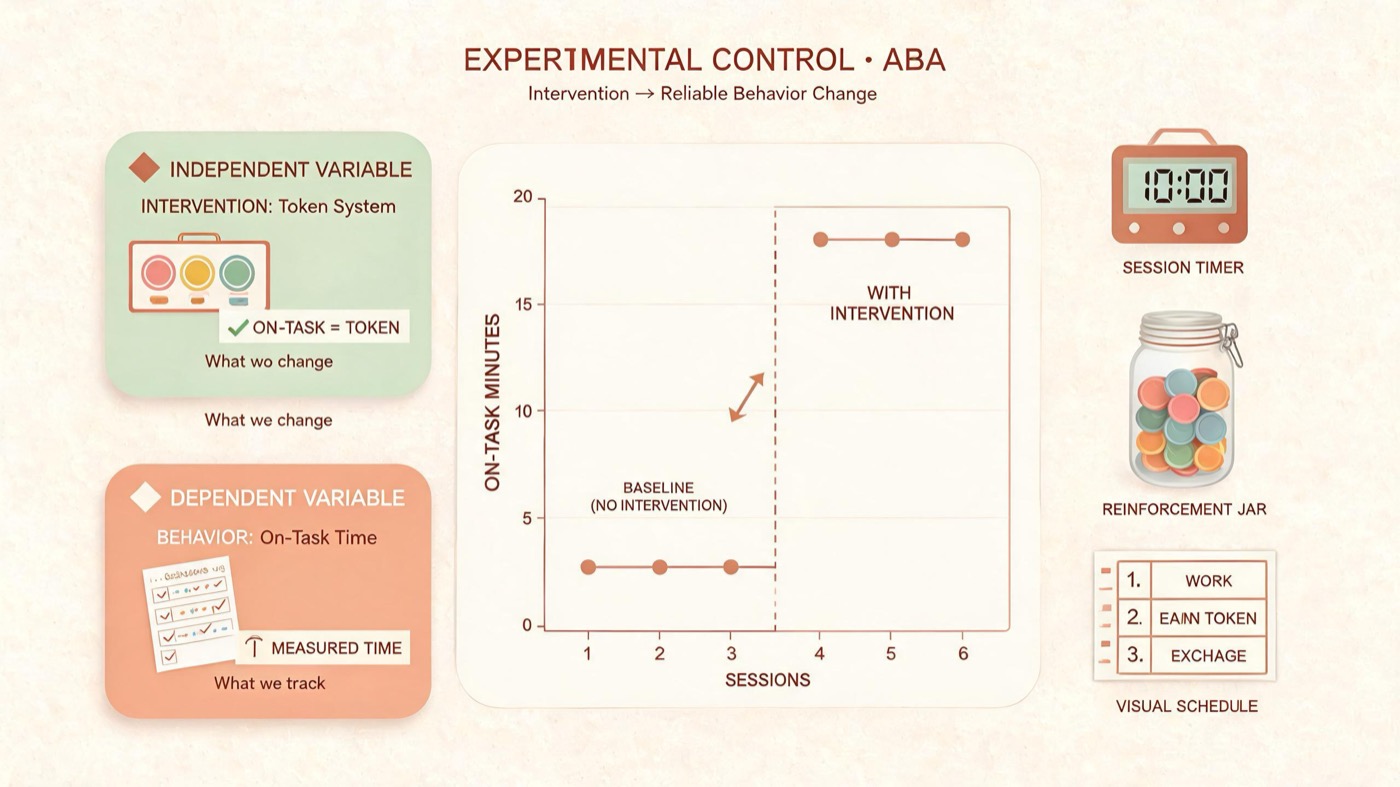
In applied behavior analysis, the definition for experimental control is the demonstration that a specific intervention (independent variable) reliably produces a change in behavior (dependent variable). When experimental control is achieved, you can confidently say the behavior change is due to the intervention and not some other factor. This is the bedrock of single-subject research and a core concept on the BCBA exam.
Table of Contents
- What Is Experimental Control in ABA?
- How Experimental Control Is Demonstrated: BCBA Exam Examples
- Exam Relevance and Common Traps
- Quick Checklist for Experimental Control
- Summary: Why Experimental Control Matters for BCBAs
Experimental Control vs Internal Validity
These two terms are often confused, but they are not the same. Experimental control refers to the visible, replicated effect of the intervention on behavior across phases. Internal validity is the degree of confidence that the change was caused by the independent variable. In ABA, experimental control is the method; internal validity is the outcome. For example, in an ABAB design, when the behavior systematically improves during intervention and worsens during baseline, experimental control is demonstrated. This bolsters internal validity because confounds like maturation or history are ruled out.
The Role of Functional Relations
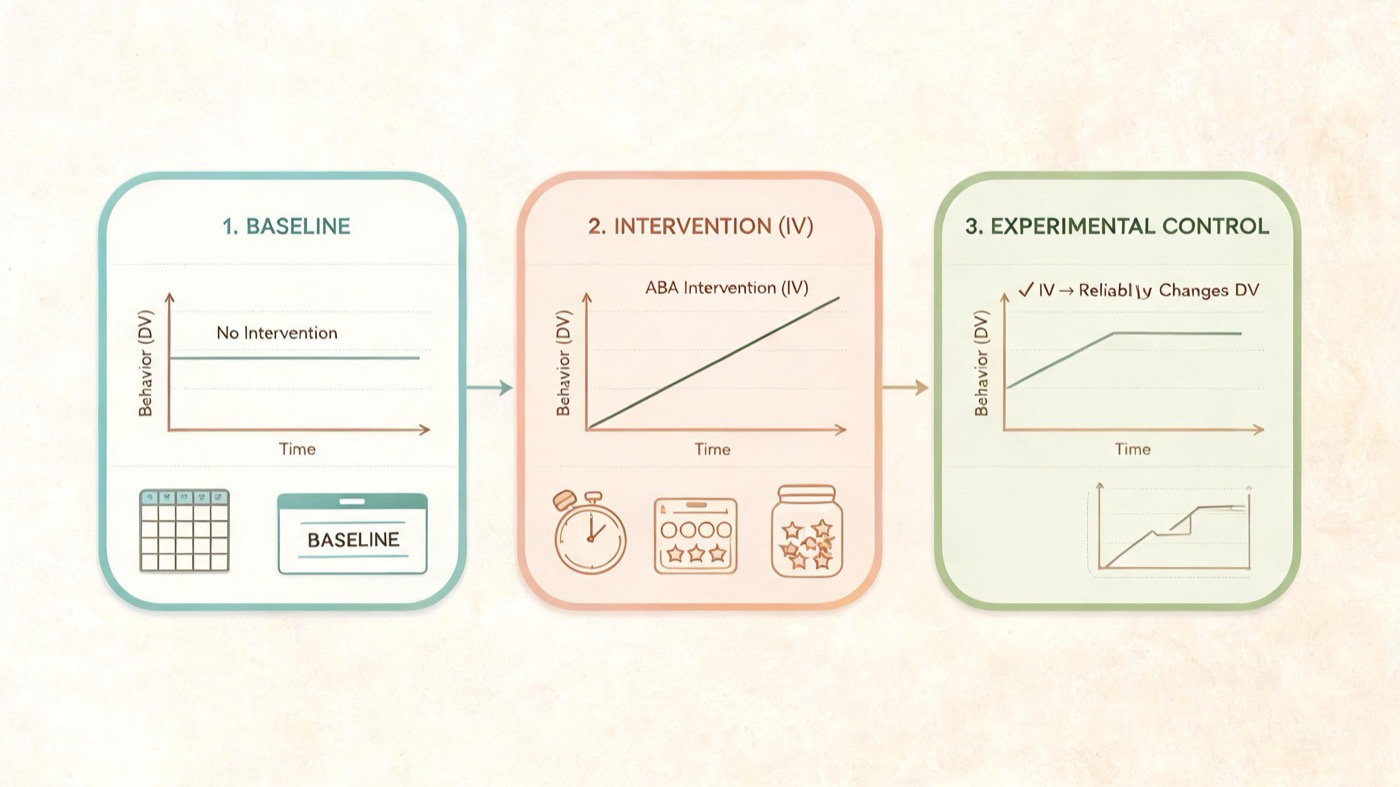
A functional relation is established when a change in the independent variable consistently produces a change in the dependent variable. Experimental control is the visible evidence of that functional relation. Without replication across conditions (e.g., baseline vs. intervention), you cannot claim a functional relation. This is why single-subject designs rely on baseline logic: prediction, verification, and replication.
How Experimental Control Is Demonstrated: BCBA Exam Examples
Exam questions often ask you to identify which design demonstrates experimental control or to interpret a graph. Here are two classic examples with ABC analysis and functional relations.
Example 1: Reversal Design (ABAB) for Self-Injury
ABC: Antecedent = demand placed; Behavior = self-injurious behavior (SIB); Consequence = removal of demand (negative reinforcement). Hypothesized function: escape. In an ABAB design, baseline shows high SIB. During intervention (B), SIB drops. When baseline is reinstated (A), SIB increases again. This reversal demonstrates experimental control because behavior systematically changes only when the intervention is applied or removed. The functional relation is clear: the intervention (escape extinction plus reinforcement of compliance) controls SIB.
Example 2: Multiple Baseline Across Subjects for On-Task Behavior
ABC: Antecedent = teacher instruction; Behavior = staying on task; Consequence = praise (positive reinforcement). Hypothesized function: attention. In a multiple baseline design, the intervention is introduced at different times across subjects. Experimental control is shown when on-task behavior improves only after the intervention starts for each subject, while others in baseline remain unchanged. The staggered replication rules out history effects and confirms the functional relation.
Key Components of a Functional Relation
- Replication: The effect is repeated across phases or participants.
- Prediction: Baseline data project a trend; the intervention changes that trend.
- Verification: Returning to baseline or withholding intervention shows the effect depends on the IV.
These three components are embedded in each experimental design. Mastering them is essential for interpreting graphs on the exam.
Exam Relevance and Common Traps
The BCBA exam frequently tests your ability to distinguish experimental control from related concepts. Here are three traps to avoid.
Trap: Confusing Experimental Control with Internal Validity
Candidates often blur these terms. Remember: experimental control is the visible replication of effect across conditions; internal validity is the confidence that the IV caused the change. A study can have high internal validity even without perfect experimental control (e.g., if confounds are ruled out statistically). But in ABA, we use experimental control to claim internal validity. On the exam, look for keywords like “replication” or “baseline logic” to identify experimental control questions.
Trap: Thinking Only Reversal Designs Show Experimental Control
Many students assume only ABAB designs demonstrate experimental control. In reality, multiple baseline, alternating treatments, and changing criterion designs all show experimental control when functional relations are replicated. For example, in an alternating treatments design, clear and consistent separation between conditions indicates experimental control. Know the unique features of each design.
Trap: Ignoring Baseline Logic
Without a stable baseline, experimental control cannot be claimed. Baseline logic (prediction, verification, replication) is the foundation. If baseline data are variable or trending, you cannot predict what would happen without intervention. On the exam, look for graphs with stable baselines before you evaluate experimental control. A lack of stability is a red flag.
Quick Checklist for Experimental Control
Use this checklist when reviewing graphs or study materials. Each design has specific indicators.
Questions to Ask Yourself
- Is there a clear baseline phase with stable data? Yes or No.
- Does the behavior change only when the intervention is introduced? Yes or No.
- Is the effect replicated within or across participants? Yes or No.
- Are confounds (history, maturation, etc.) ruled out? Yes or No.
Design-Specific Checks
- Reversal: Data returns to baseline levels when intervention is withdrawn.
- Multiple baseline: Behavior changes only after intervention is applied at each tier.
- Alternating treatments: Clear differentiation between conditions; data paths do not overlap much.
- Changing criterion: Behavior meets each successive criterion before the next step.
Memorizing these checks will help you answer interpretation questions quickly.
Summary: Why Experimental Control Matters for BCBAs
Understanding the definition for experimental control is not just about passing the exam. In practice, BCBAs must evaluate whether their interventions are actually working. Experimental control ensures that behavior change is functionally related to the treatment, not to extraneous variables. This leads to effective, ethical, and accountable practice. For more on interpreting graphs and designs, see our guide on single-subject experimental designs. Also, review the visual analysis of level, trend, and variability to strengthen your graph-reading skills. Finally, check the BACB website for the latest task list updates on experimental design.


