
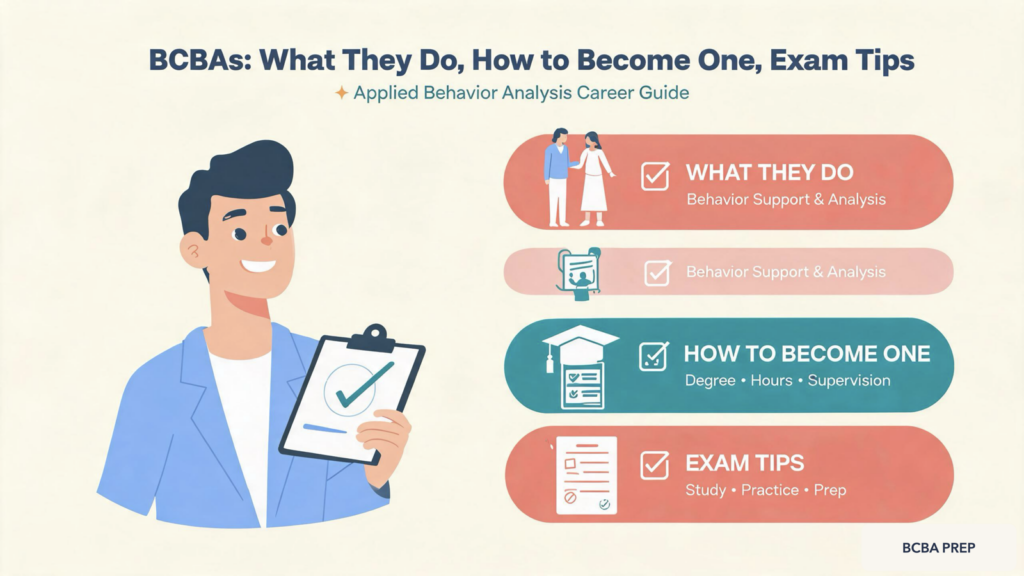
Board Certified Behavior Analysts (BCBAs) are highly skilled professionals who apply the science of applied behavior analysis (ABA) to improve socially significant behaviors. Whether you are considering this career path or preparing for the BCBA certification exam, understanding the role and the journey is essential. This BCBA certification guide covers what BCBAs do, how to become certified, practical ABA examples, common exam traps, and a study checklist to help you succeed.
Table of Contents
- What Is a BCBA?
- How to Become a BCBA: Certification Steps
- BCBA in Practice: ABA Examples with Analysis
- Common BCBA Exam Traps to Avoid
- Quick BCBA Study Checklist
- Final Summary
What Is a BCBA?
A BCBA is a graduate-level professional certified by the Behavior Analyst Certification Board (BACB). They design, implement, and oversee behavior-analytic interventions. Their core responsibilities include conducting functional behavior assessments, creating behavior intervention plans, supervising registered behavior technicians (RBTs), and analyzing data to ensure treatment effectiveness.
BCBA Meaning and Core Responsibilities
BCBA stands for Board Certified Behavior Analyst. These professionals often work in settings such as schools, clinics, homes, and community organizations. They serve diverse populations, including individuals with autism spectrum disorder, intellectual disabilities, and behavioral challenges like oppositional defiant disorder. The work involves collaboration with families, teachers, and other professionals to promote skill acquisition and reduce problem behaviors.
Setting and Client Populations
- Schools: Supporting students with behavioral challenges and IEP goals.
- Clinics: Providing intensive ABA therapy for young children with autism.
- Homes: Implementing parent training and in-home interventions.
- Hospitals: Addressing behaviors in medical and rehabilitation settings.
- Community: Promoting social skills and adaptive behaviors in natural environments.
How to Become a BCBA: Certification Steps
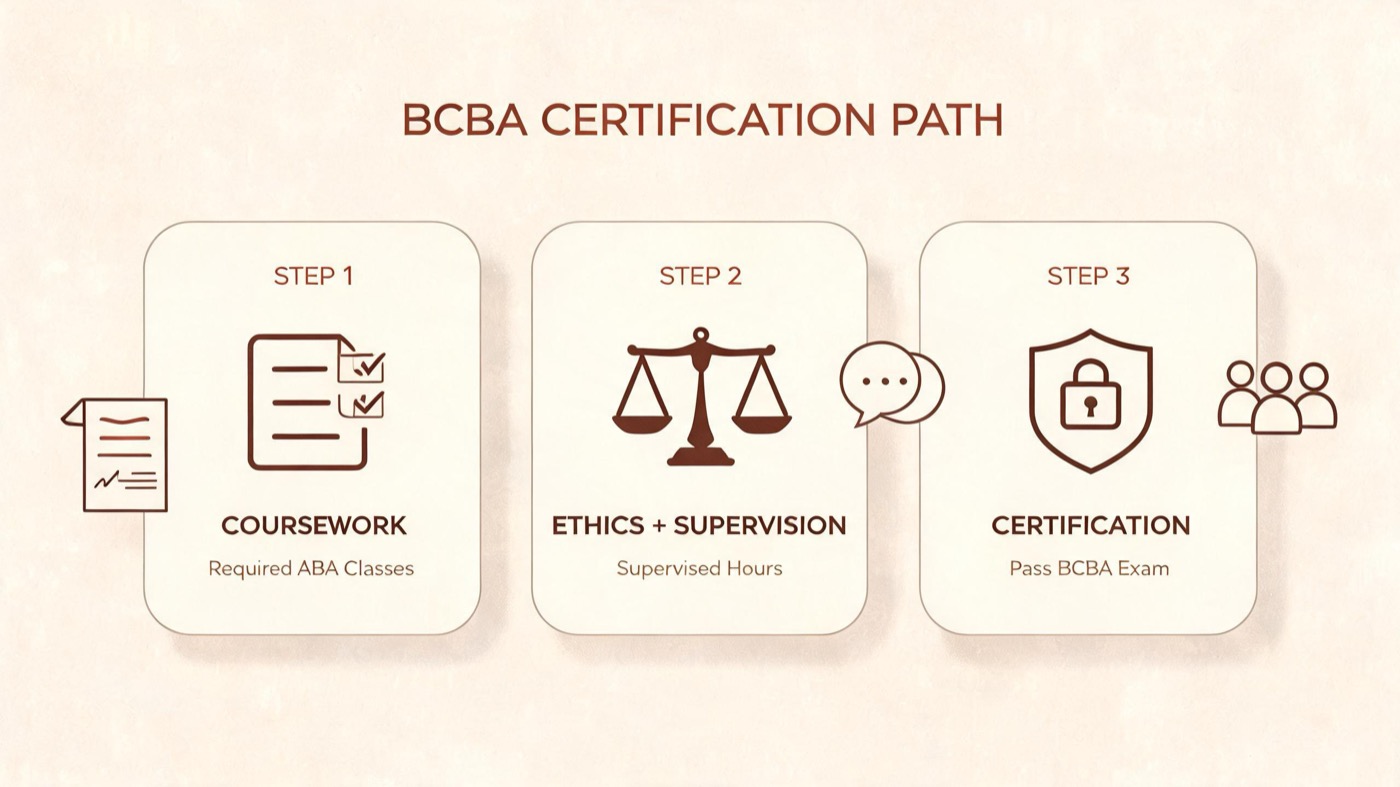
Becoming a BCBA requires completing a sequence of steps outlined by the BACB. Below is the pathway from education to certification.
Education and Coursework Requirements
Candidates must earn a master’s degree from an accredited institution and complete a BACB-approved course sequence. The coursework covers concepts such as behavior analysis principles, assessment, intervention, ethics, and research methods. Many universities offer verified course sequences (VCS) to meet this requirement.
Supervised Fieldwork Experience
After coursework, candidates must complete supervised fieldwork. The BACB requires 1500 hours (concentrated) or 2000 hours (standard) under a qualified supervisor. This experience involves direct client contact, data collection, supervision of RBTs, and program development. The supervisor provides ongoing feedback and evaluations to ensure competency.
Passing the BCBA Exam
The final step is passing the BCBA exam, a 150-question multiple-choice test covering the BACB Task List. Questions present applied scenarios requiring analysis of behavior function, ethical decision-making, and intervention strategies. The pass rate for first-time test-takers is approximately 60%, so thorough preparation is critical.
BCBA in Practice: ABA Examples with Analysis
Understanding how to apply ABA concepts to real-world behaviors is vital for both practice and the exam. Below are three examples with ABC analysis and hypothesized functions.
Example 1: Disruptive Behavior in Classroom
Antecedent: Teacher gives a math worksheet to a student. Behavior: Student throws the worksheet and screams. Consequence: Teacher removes the worksheet and sends student to a quiet area. Hypothesized function: Escape from the difficult task. Exam trap: Overlooking motivating operations (MO) such as hunger or fatigue that make the task more aversive.
Example 2: Self-Stimulation in Clinic
Antecedent: Child is alone in a play area with no toys. Behavior: Child engages in hand-flapping. Consequence: No social reaction; the behavior produces sensory stimulation. Hypothesized function: Automatic (sensory) reinforcement. Exam trap: Mislabeling as ‘sensory’ without considering non-social contingencies; remember that automatic reinforcement means the behavior itself produces the reinforcer.
Example 3: Aggression During Transitions
Antecedent: Therapist says ‘Time to clean up’ during play. Behavior: Child hits the therapist. Consequence: Therapist delays transition and redirects to a calming activity. Hypothesized function: Avoidance of transition. Exam trap: Forgetting to teach and reinforce alternative behaviors (e.g., requesting more time) while reducing the problem behavior.
Common BCBA Exam Traps to Avoid
The BCBA exam often includes distractors that test your ability to apply concepts precisely. Here are frequent pitfalls.
Overgeneralizing Function
A single behavior (e.g., hitting) can serve different functions across contexts. Avoid assuming the same function for all occurrences. For example, hitting may be escape in one setting and attention in another. Always analyze the specific ABC pattern.
Confusing Reinforcement and Punishment
Many candidates mix up positive versus negative and reinforcement versus punishment. Positive means adding a stimulus; negative means removing one. Reinforcement increases the behavior; punishment decreases it. Pay close attention to the effect on future behavior, not just the apparent pleasantness of the consequence.
Misreading Scenario Questions
Exam questions are often lengthy. Highlight key elements such as the immediate consequence, the behavior change, and the timing. For example, if a behavior increases after a toy is removed, that is negative reinforcement, not punishment.
Quick BCBA Study Checklist
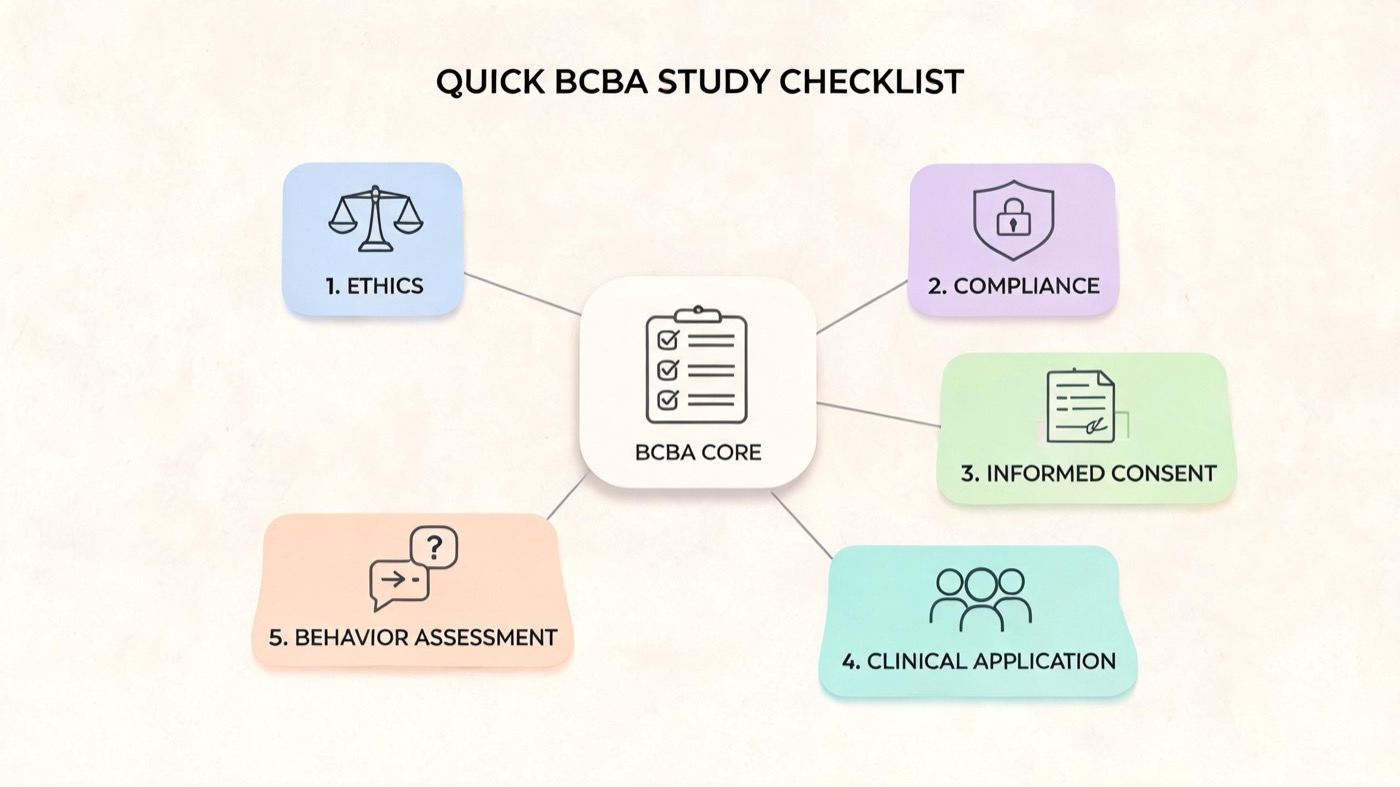
Use this checklist to stay on track during your exam preparation.
- Review BACB Task List – Know each content area and your weak points.
- Take mock exams – Use full-length practice tests to build stamina and identify gaps.
- Practice ABC analysis – Write out antecedents, behaviors, and consequences for sample scenarios.
- Study function-based interventions – Match intervention strategies to hypothesized functions.
- Master ethical decision-making – Review the Ethics Code for Behavior Analysts.
- Join a study group – Discuss complex concepts with peers.
- Focus on high-yield topics – Such as reinforcement schedules, motivating operations, and single-subject designs.
Final Summary
Becoming a BCBA requires dedication to graduate education, supervised fieldwork, and passing a rigorous exam. In practice, BCBAs use ABA principles to make meaningful changes in clients’ lives. On the exam, avoid common traps by carefully analyzing functions and consequences. Use the study checklist to organize your preparation. For additional resources, check out our BCBA exam prep guide and functions of behavior guide. For official information, visit the BACB website.


