
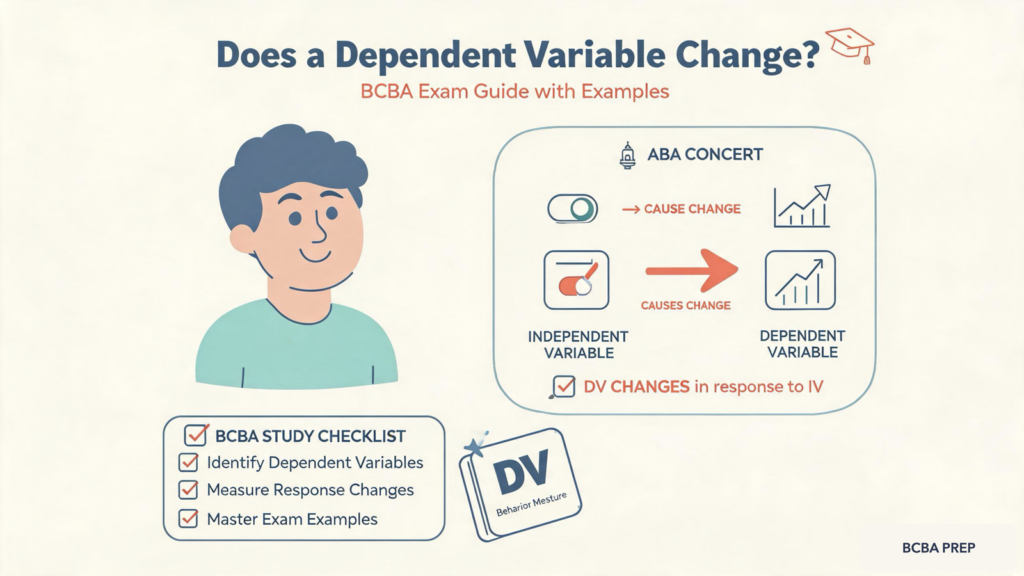
What Is a Dependent Variable in ABA?
In applied behavior analysis, the dependent variable is the behavior you measure. It is the target behavior that you expect to change as a result of your intervention. For example, if you are teaching a child to raise their hand, the number of hand raises per session is the dependent variable. The dependent variable is always the measured behavior in a study or intervention.
Table of Contents
- What Is a Dependent Variable in ABA?
- Does the Dependent Variable Change? (Yes, Here’s How)
- Real-World ABA Examples: Dependent Variable in Action
- Why This Matters for the BCBA Exam
- Quick Checklist: Dependent Variable Essentials
- Final Summary: The Dependent Variable Always Changes
Dependent vs. Independent Variables
The independent variable (IV) is what you manipulate or change. The dependent variable (DV) is what you observe and record. A simple way to remember: the IV is the cause, and the DV is the effect. For BCBA exam questions, you need to identify which is which. If the question describes a teacher providing a token after every correct response, the token delivery is the IV, and the rate of correct responses is the DV.
For more on how these variables work together, see our guide on independent and dependent variables in ABA.
Does the Dependent Variable Change? (Yes, Here’s How)
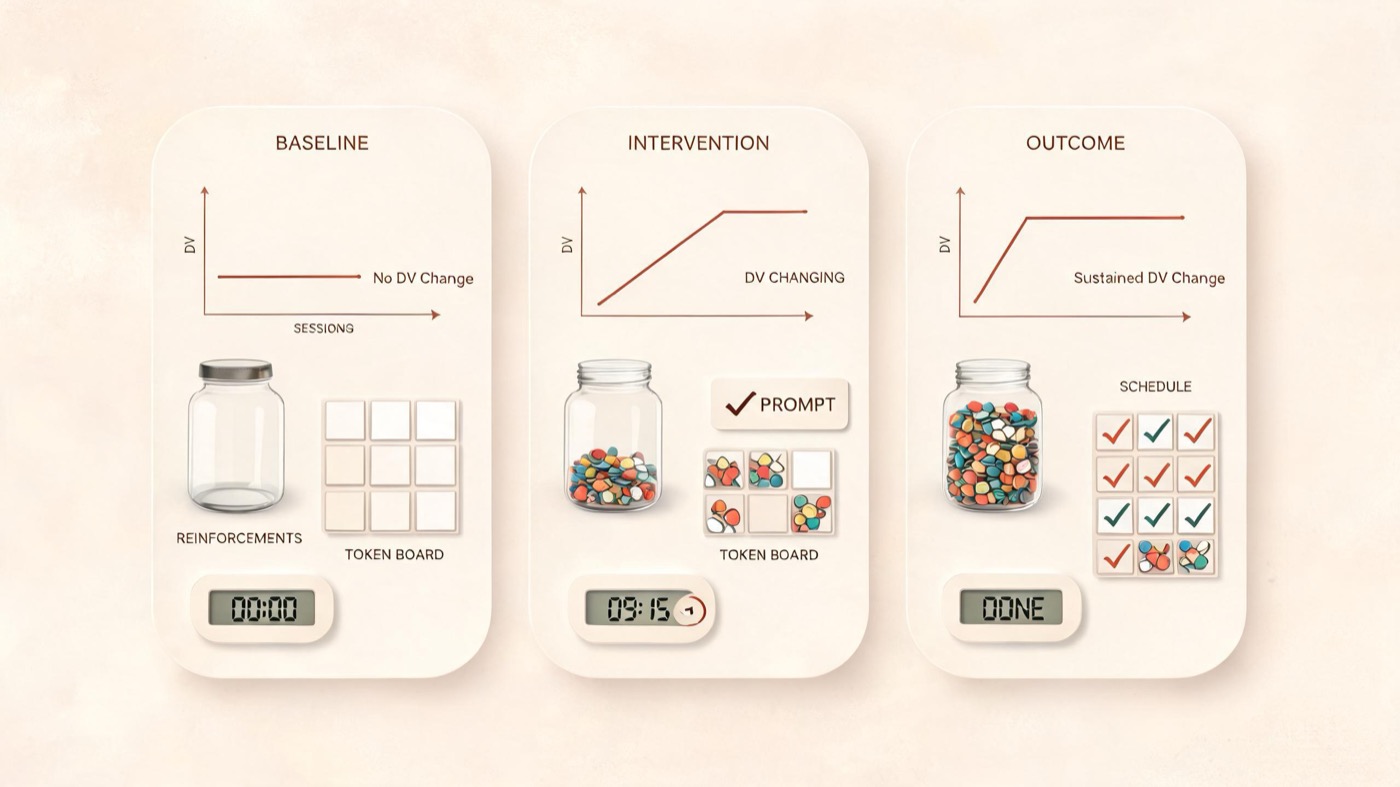
Yes, the dependent variable changes when the independent variable is applied. The entire purpose of an ABA intervention is to produce a change in the DV. Without a change in the dependent variable, the intervention would be ineffective. The change can be an increase (e.g., more on-task behavior) or a decrease (e.g., fewer aggressive acts).
From Baseline to Intervention
In a typical ABA design, you first collect baseline data on the DV before any intervention. Then you introduce the IV and continue measuring the DV. If the DV changes in the predicted direction, you have demonstrated experimental control. For instance, if baseline shows a child tantrums 10 times per day, and after introducing a functional communication training (the IV), tantrums drop to 2 per day, the DV (tantrum frequency) has changed.
This functional relationship is a core concept on the BCBA exam. You must be able to read a graph and state whether the DV changed. Look for a clear shift in level, trend, or variability between phases.
Real-World ABA Examples: Dependent Variable in Action
Let’s look at three concrete examples showing how the dependent variable changes under different interventions.
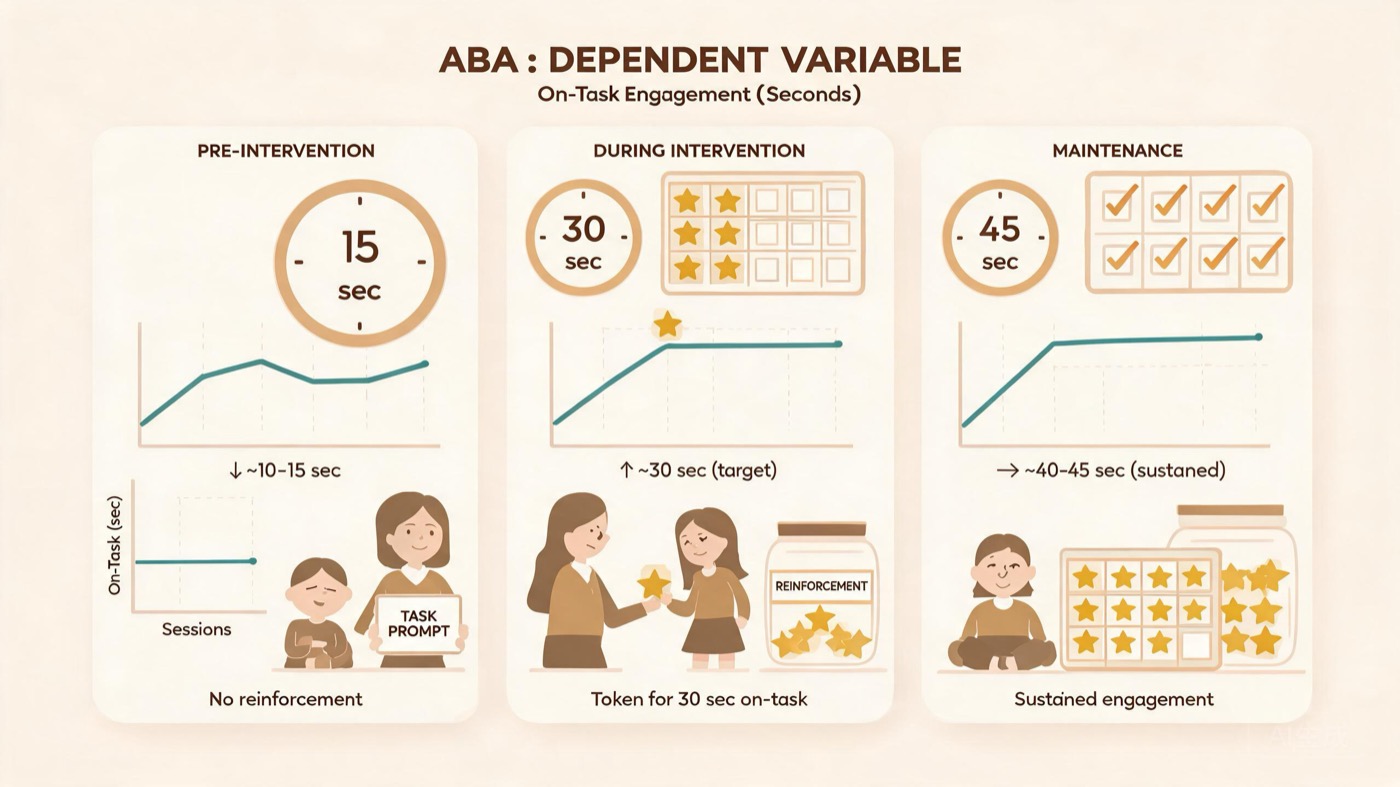
Example 1: Increasing On-Task Behavior
Antecedent: teacher gives instruction. Behavior: seconds of on-task engagement (the DV). Consequence: token delivered for every 30 seconds of on-task behavior. Hypothesized function: positive reinforcement. Result: the DV increases from a baseline average of 45% on-task to 85% on-task during intervention.
Example 2: Reducing Aggression
Antecedent: demand placed (e.g., “Clean up your toys”). Behavior: hitting (DV). Consequence: demand removed (escape). Hypothesized function: negative reinforcement. Result: the DV decreases from 8 hits per session to 1 hit per session after implementing a differential reinforcement alternative (DRA) procedure.
Example 3: Teaching Requesting (Manding)
Antecedent: child sees a preferred item. Behavior: pointing vs. saying “want” (DV is frequency of vocal mands). Consequence: item delivered. Hypothesized function: positive reinforcement. Result: the DV increases from 0 vocal mands per session to 12 vocal mands per session after using prompt delay.
In each case, the dependent variable changes because the intervention (IV) directly influences the behavior. For a deeper dive into single-subject designs that measure these changes, read our article on single-subject experimental designs.
Why This Matters for the BCBA Exam
Understanding the dependent variable is essential for interpreting graphs, designing interventions, and answering scenario-based questions. The BCBA exam frequently asks you to identify the DV or predict how it will change based on an intervention.
Common Exam Traps
- Confusing DV with IV: If the question says “the teacher delivers praise” that’s the IV, not the DV. The DV is the behavior that changes (e.g., student’s time on task).
- Misidentifying which variable changes: Remember, the IV is manipulated; it may not change. The DV is what you measure and expect to see a change in.
- Overlooking confounds: Threats to internal validity (e.g., history, maturation) can cause the DV to change for reasons other than the IV. The exam may ask you to identify these threats.
- Forgetting operational definitions: The DV must be defined clearly so it can be measured reliably. Vague definitions lead to measurement errors.
To avoid these traps, practice with mock questions that ask you to identify the DV in a paragraph. Our free BCBA mock exam practice questions can help you sharpen this skill.
Quick Checklist: Dependent Variable Essentials
- Identify the DV: Look for the behavior being measured (frequency, duration, latency, etc.).
- Check for change: Compare baseline and intervention data. Did the DV shift in the expected direction?
- Rule out confounds: Ensure that the change is due to the IV, not external factors.
- Define operationally: Write a clear, measurable definition so the DV can be reliably counted.
- Graph the data: Use line graphs to visually display changes in the DV across conditions.
Final Summary: The Dependent Variable Always Changes
In ABA, the dependent variable always changes if the intervention is effective. It is the behavior you target for improvement, and your job is to demonstrate that change through careful measurement and graphic display. For the BCBA exam, know the difference between DV and IV, recognize common traps, and practice interpreting graphs. The more you practice, the more automatic this skill becomes.
For additional study resources, check out the BACB website for official task list items related to measurement and experimental design. Also, explore research articles on single-subject designs to see how DVs are measured in real studies.


