
What Are Independent and Dependent Variables?
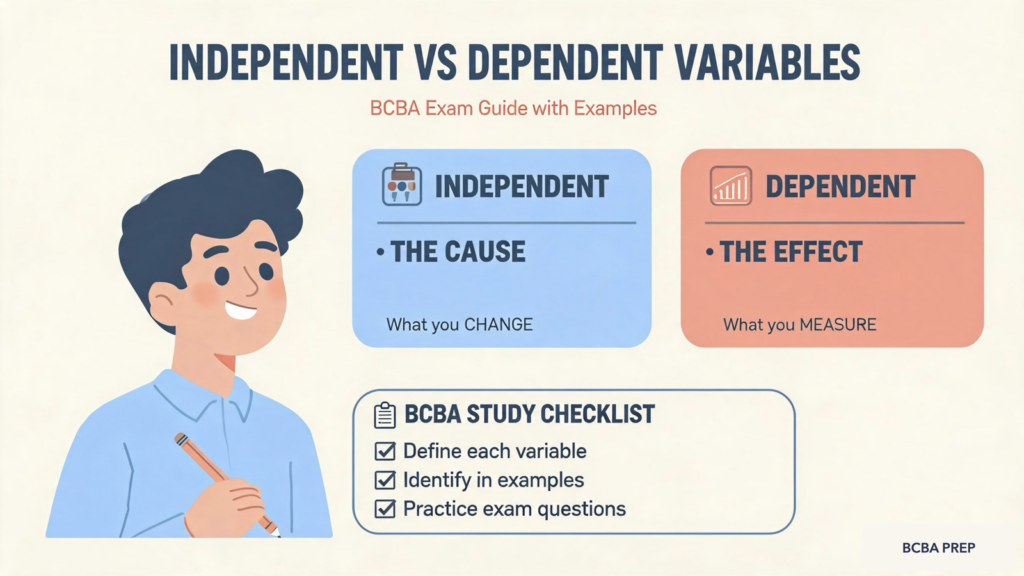
In behavioral research, every experiment involves two key components: the independent variable (IV) and the dependent variable (DV). The IV is the variable manipulated by the researcher to observe its effect. In ABA, this is often an intervention such as a prompting procedure, token system, or reinforcement schedule. The DV is the variable measured to assess the impact of the IV—in ABA, this is typically the target behavior (e.g., frequency of aggression, duration of on-task behavior).
Table of Contents
- What Are Independent and Dependent Variables?
- Independent and Dependent Variables in ABA: The ABC Connection
- Worked ABA Examples: Identifying Independent and Dependent Variables
- Why This Matters for the BCBA Exam: Common Traps and Test Strategies
- Quick Reference Checklist for Independent and Dependent Variables
- Final Summary
- References
Independent Variable Defined
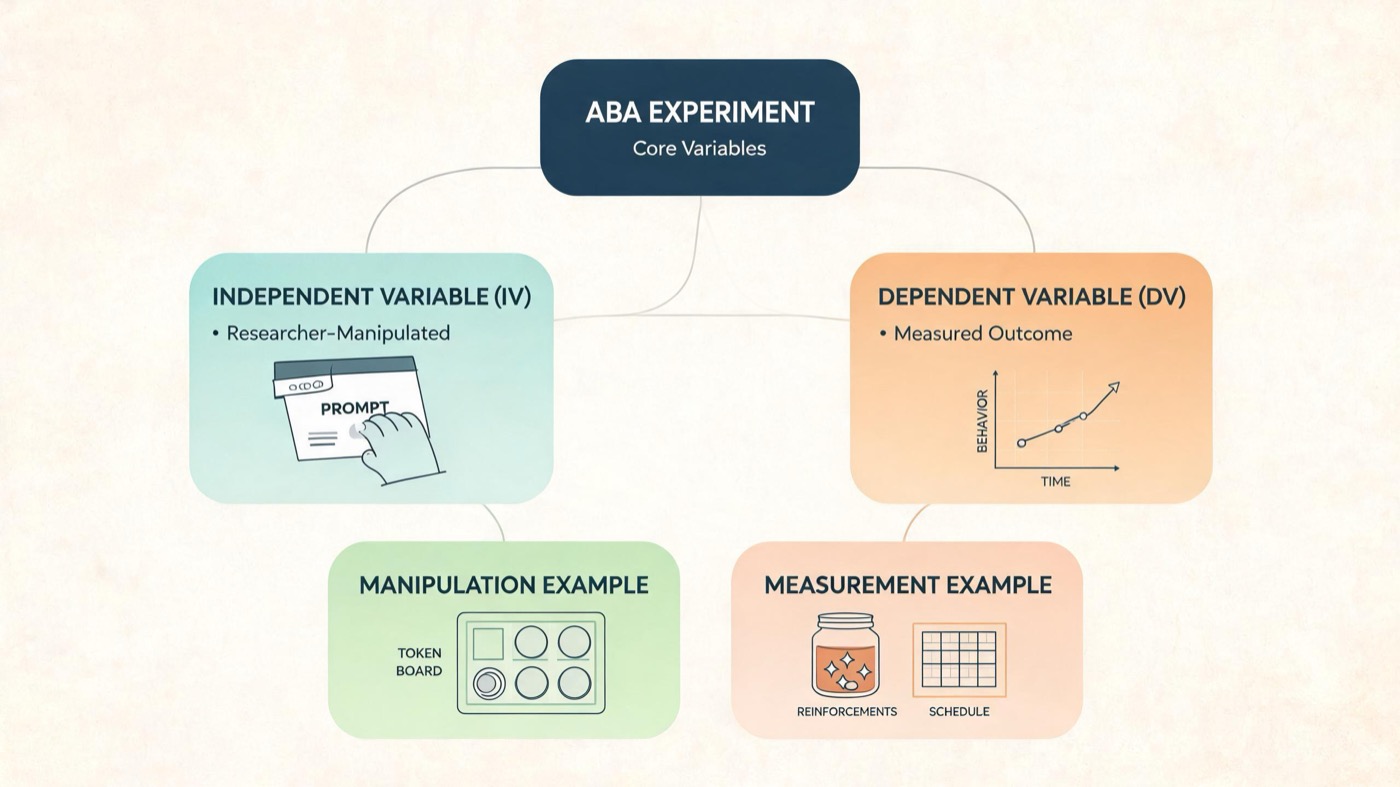
The independent variable is the condition you deliberately change. For example, you might implement a differential reinforcement of alternative behavior (DRA) procedure to reduce aggression. The DRA procedure is the IV. The IV is always under the control of the practitioner; it is what is systematically varied across conditions.
Dependent Variable Defined
The dependent variable is what you measure to determine if the IV had an effect. It is the outcome of interest. In ABA, the DV is the behavior that you are trying to increase or decrease. For instance, if you are measuring the number of times a child raises their hand before speaking, the frequency of hand-raising is the DV. The DV must be operationally defined so it can be observed and measured reliably.
Independent and Dependent Variables in ABA: The ABC Connection
In ABA, the relationship between IV and DV aligns closely with the three-term contingency (ABC). The IV often corresponds to antecedent or consequence manipulations, while the DV corresponds to the behavior itself.
How Independent Variables Map to Antecedents and Consequences
In a typical ABC analysis, the antecedent is what happens before the behavior, and the consequence is what happens after. The IV can be either an antecedent change (e.g., presenting a visual schedule) or a consequence change (e.g., providing token reinforcement). The key is that the IV is manipulated by the practitioner to evoke or strengthen a behavior.
How Dependent Variables Map to Behavior
The DV is the behavior measured. For example, if you implement a token economy (IV) to increase compliance (DV), the compliance rate is the behavior you track across conditions. The DV tells you whether the intervention is working. Remember, the DV is always the behavior you are trying to change; it is the observed outcome of your experimental manipulation.
For more on ABCs, see our guide on 4 functions of behavior.
Worked ABA Examples: Identifying Independent and Dependent Variables
Practice identifying IV and DV with these realistic scenarios.
Example 1: Reducing Aggression with DRA
A BCBA implements a DRA procedure that provides access to a preferred toy (tangible) contingent on requesting appropriately. The frequency of aggression is recorded daily. Here, the IV is the DRA procedure; the DV is the frequency of aggression. The hypothesized function is access to tangible items.
Example 2: Increasing Compliance with Token Economy
A token economy is introduced to increase compliance with teacher instructions. Compliance is measured as the percentage of instructions followed. The IV is the token delivery system; the DV is the compliance rate. The function is likely attention (from the teacher).
Example 3: Fading Prompts for Hand Washing
A therapist uses a prompt fading procedure to teach independent hand washing. The number of unprompted correct hand washes is counted. The IV is the level of prompting; the DV is the number of independent hand washes. The function may be automatic reinforcement (completing the routine).
Learn more about experimental control in our post on variable dependency and experimental control.
Why This Matters for the BCBA Exam: Common Traps and Test Strategies
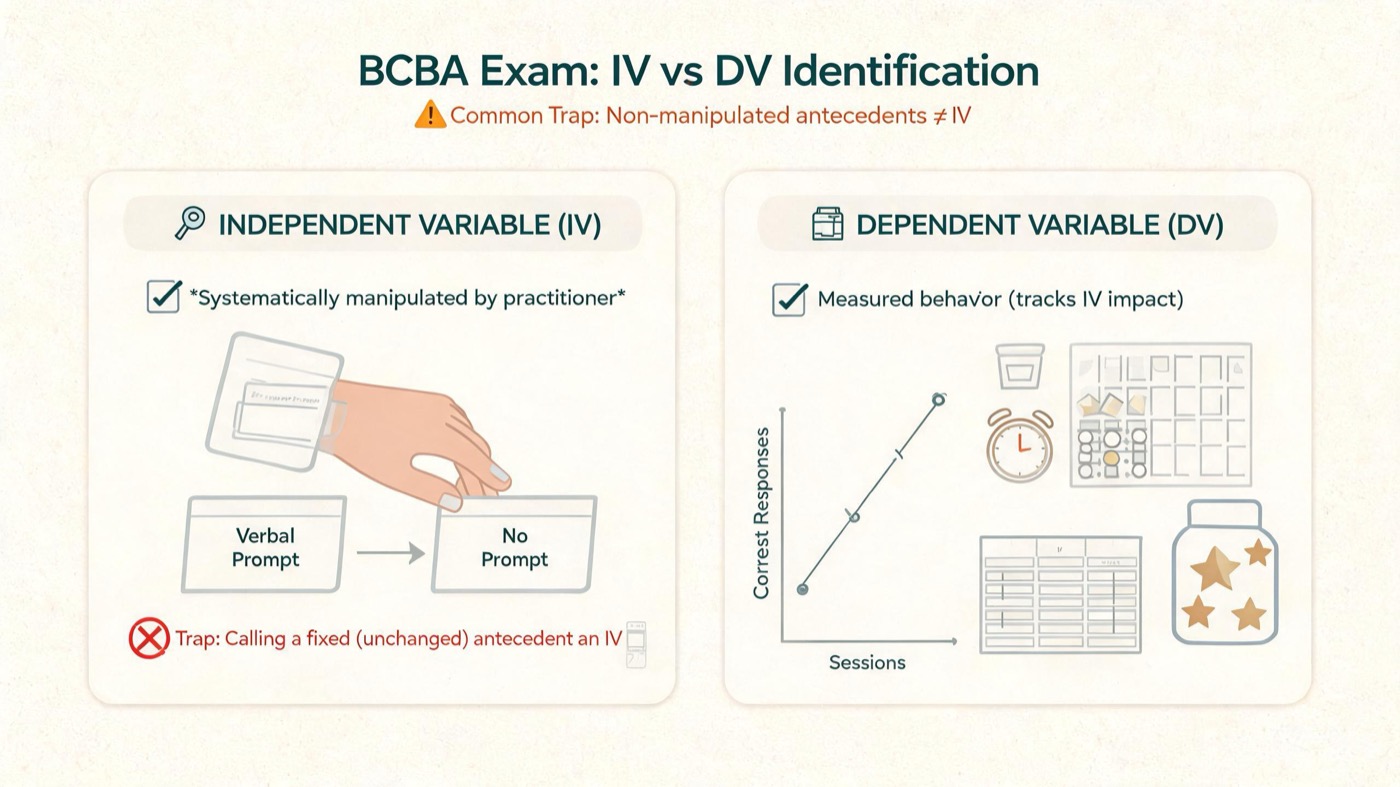
On the BCBA exam, questions often require you to identify the IV and DV from a scenario. A common mistake is confusing the IV with a simple antecedent that is not manipulated. Remember: the IV must be systematically changed by the practitioner. Another trap is misidentifying the DV as something other than the measurable behavior.
Common Trap: Confusing IV with Antecedent
- Not all antecedents are IVs. For example, the time of day is an antecedent but not manipulated—so it is not an IV.
- The IV is specifically the variable you manipulate (e.g., presence vs. absence of a token board).
Test Strategy: Look for the Manipulated and Measured Variable
- Ask yourself: What did the clinician change? That is the independent variable.
- Ask: What was tracked or recorded? That is the dependent variable.
- Check operational definitions: both IV and DV must be clearly defined in scenario questions.
See our guide on experimental design for more exam tips.
Quick Reference Checklist for Independent and Dependent Variables
- Identify the manipulated variable in the scenario (IV).
- Identify the measured behavior (DV).
- Ensure the IV is under practitioner control and changed across conditions.
- Ensure the DV is operationally defined and quantifiable.
- Confirm the IV is the only variable systematically altered to demonstrate experimental control.
Final Summary
The independent variable is the intervention you change; the dependent variable is the behavior you measure. In ABA, the IV often corresponds to antecedent or consequence manipulations, while the DV is the target behavior. Remember the ABC connection: antecedent/consequence changes are IVs, behavior is the DV. On the BCBA exam, carefully distinguish between what is manipulated and what is measured. For more practice, explore our free BCBA mock exam questions.
For authoritative definitions, refer to the BACB Task List and peer-reviewed literature on experimental design.


