
What Is Forward Chaining?
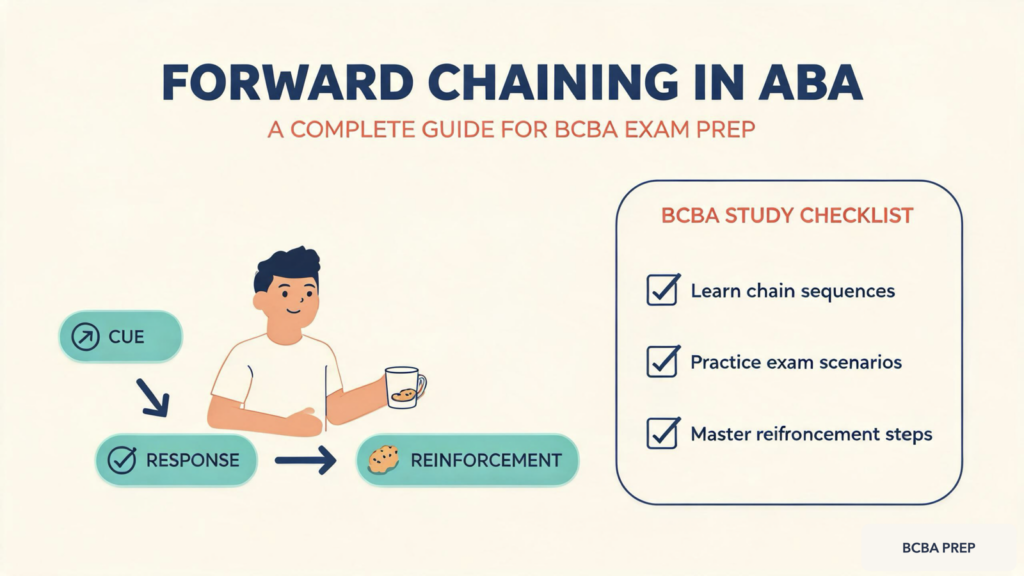
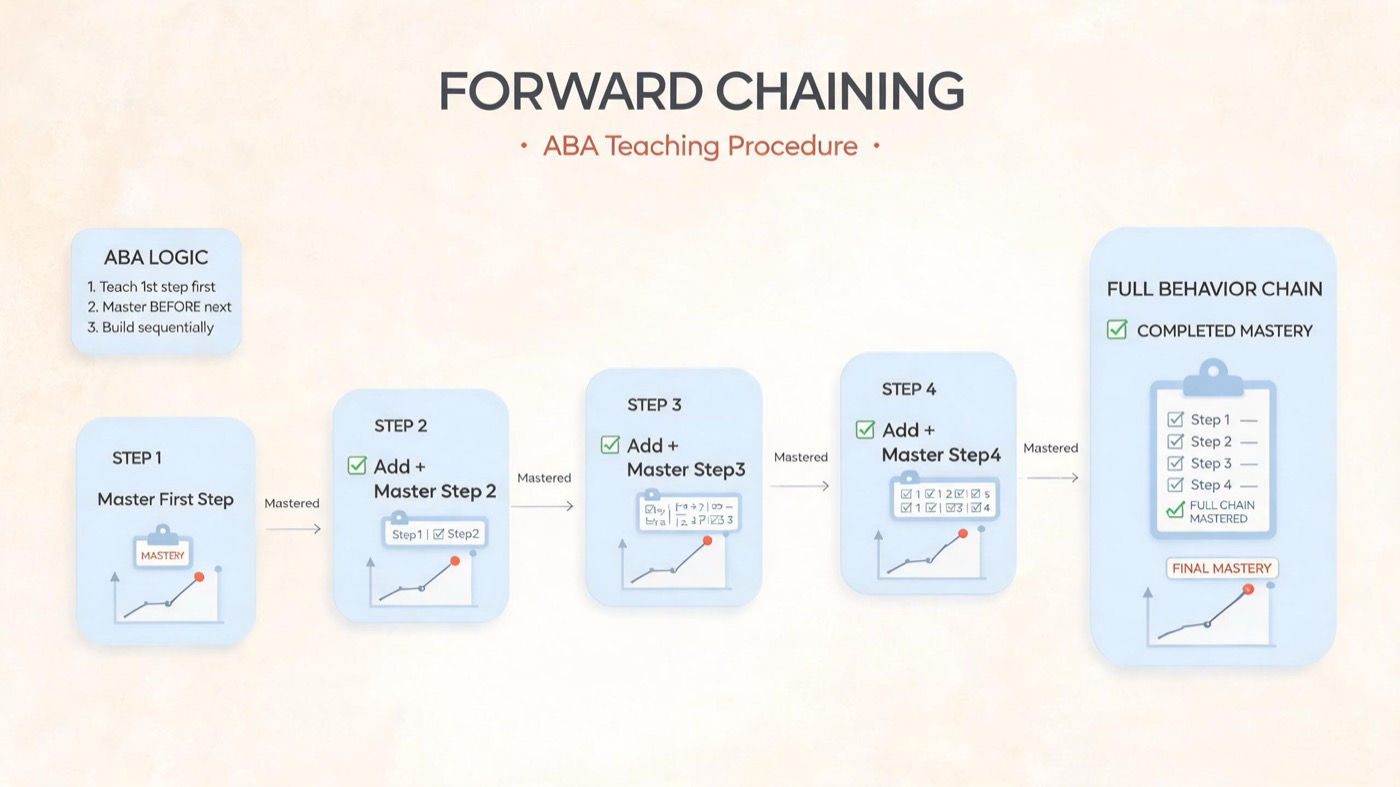
Forward chaining is a teaching procedure used in Applied Behavior Analysis (ABA) where you teach the first step of a behavior chain first, then the second step, and so on. The learner masters each step before the next is introduced. Reinforcement is delivered after the last mastered step of the chain.
Table of Contents
- What Is Forward Chaining?
- Forward Chaining Examples with ABC Analysis
- Exam Relevance and Common Traps
- Quick Checklist for Forward Chaining on Test Day
- Conclusion and Next Steps
To use forward chaining, you must first complete a task analysis—breaking a complex skill into smaller, teachable steps. For example, washing hands might include: (1) turn on water, (2) wet hands, (3) apply soap, (4) scrub, (5) rinse, (6) dry. In forward chaining, you teach step 1 alone with reinforcement, then step 2 plus step 1, etc.
Key Terms: Chaining, Task Analysis, and Reinforcement
Chaining refers to linking discrete behaviors into a sequence. Task analysis is the process of identifying each component behavior. Reinforcement is provided after the learner completes the highest mastered step. In forward chaining, the reinforcer is delivered at the end of the chain (or after each step initially) but the criterion for mastery is independent performance of the first step(s).
Forward chaining differs from backward chaining (where you teach the last step first) and total task chaining (where you prompt the entire chain each trial). On the BCBA exam, you may be asked to distinguish these.
When to Use Forward Chaining (and When Not To)
Forward chaining works well for:
- Early learners who need success from the start
- Tasks with a clear, linear sequence (e.g., hand washing, zipping a jacket)
- Behaviors where errors early in the chain are not dangerous
Use forward chaining less often when:
- The final step provides natural reinforcement (backward chaining may be better)
- The learner has difficulty with fine motor skills in early steps
- The task is short (total task may be more efficient)
Forward Chaining Examples with ABC Analysis
Here are three practical examples with antecedent-behavior-consequence (ABC) analysis to help you see how forward chaining works in real settings.
Example 1: Teaching Hand Washing
Task analysis: (1) turn on water, (2) wet hands, (3) apply soap, (4) scrub 20 seconds, (5) rinse, (6) dry. In forward chaining, you teach step 1 first.
- Antecedent: Teacher says ‘Wash your hands’ and points to sink
- Behavior: Learner turns on water
- Consequence: Teacher provides praise and a small edible
- Function: Positive reinforcement (access to adult attention and edible)
Once step 1 is mastered (no prompt), you add step 2 and reinforce after step 2, and so on.
Example 2: Teaching Zipping a Jacket
Task analysis: (1) align zipper base, (2) insert pin, (3) pull zipper up.
- Antecedent: Visual cue of a zipped jacket picture
- Behavior: Learner aligns zipper base
- Consequence: Token delivered (can be exchanged later)
- Function: Access to tangibles (tokens)
Example 3: Teaching a Daily Living Skill (Making a Sandwich)
Task analysis: (1) get bread, (2) get peanut butter, (3) spread peanut butter, (4) put top slice, (5) eat. Teach step 1 first.
- Antecedent: ‘Make a sandwich’ instruction
- Behavior: Learner retrieves bread bag
- Consequence: Edible reinforcer (a piece of fruit) automatically delivered after getting bread
- Function: Automatic reinforcement (eventually eating the sandwich)
Exam Relevance and Common Traps
Forward chaining is a popular topic on the BCBA exam. Questions often test your ability to identify the procedure based on a scenario or to compare it with other chaining methods.
How Forward Chaining Appears on the BCBA Exam
- Definition questions: ‘Which chaining procedure teaches the first step first?’
- Reinforcement schedule: ‘In forward chaining, when is reinforcement delivered?’ (Answer: after the last mastered step initially, then after the full chain)
- Scenario-based items: You read a case and must select the correct chaining method. Look for cues like ‘start with the first step’ or ‘they master each step sequentially.’
Remember: only the first step is taught in isolation at the beginning. All subsequent steps are added one at a time.
Common Mistakes Candidates Make
- Confusing forward chaining with backward chaining: In backward chaining, you teach the last step first (the one that produces natural reinforcement). On the exam, read carefully for which step is taught first.
- Thinking every step is taught at once: That is total task chaining, not forward chaining.
- Forgetting to conduct a task analysis first: You cannot chain without breaking the skill into parts.
- Not specifying the reinforcer: Exam questions often ask you to identify the maintaining function. Be ready to pair the consequence with a function.
Quick Checklist for Forward Chaining on Test Day
Use this checklist to review before your exam:
- Conduct a task analysis of the target skill
- Identify the first step to teach independently
- Plan reinforcement after the first step (and later after longer chains)
- Use prompting (e.g., physical, verbal) to ensure success initially
- Fade prompts gradually as the learner becomes independent
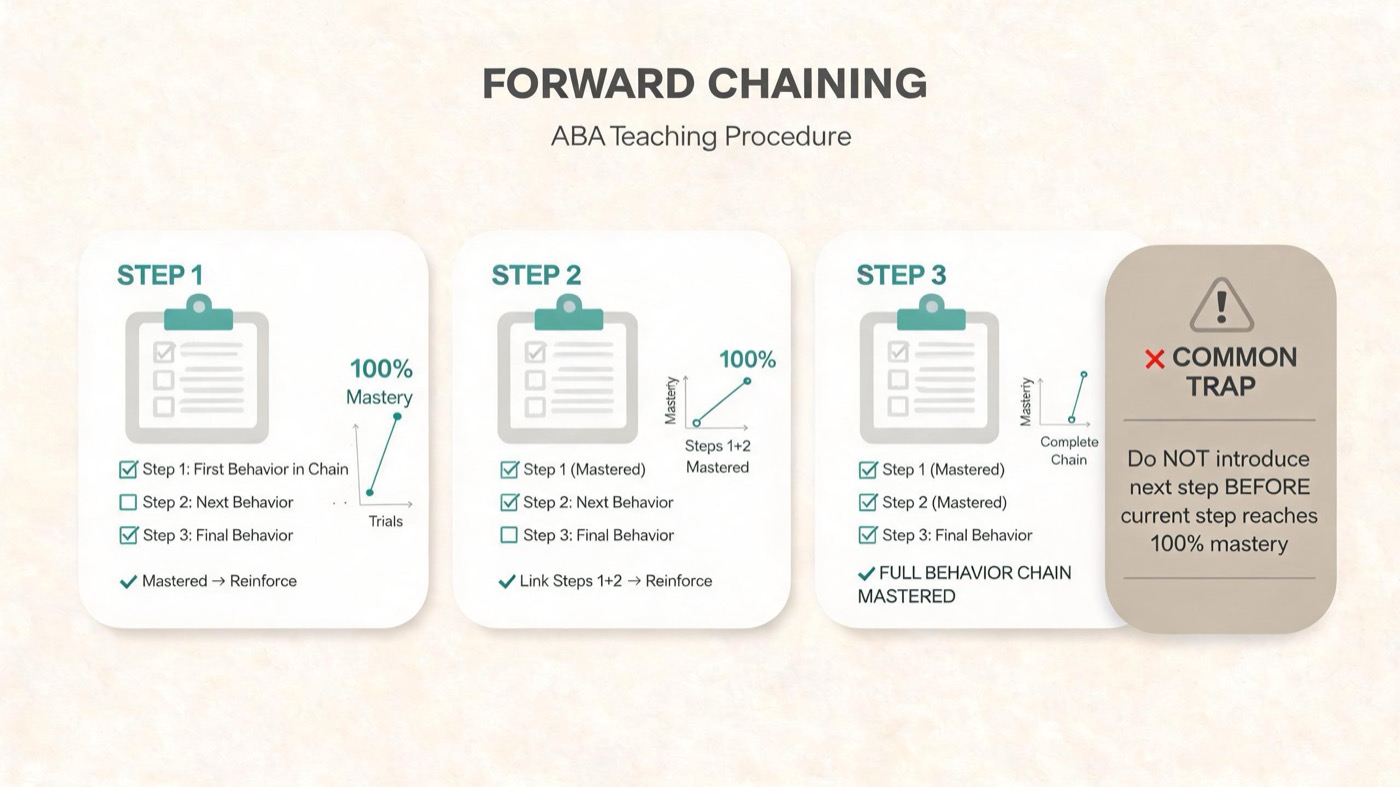
- Master one step before adding the next
- Continue until the entire chain is performed without prompts
Conclusion and Next Steps
Forward chaining is a powerful teaching tool for building complex behaviors step by step. On the BCBA exam, remember the core elements: task analysis, teaching the first step first, and delivering reinforcement after the mastered steps. Practice with mock scenarios to solidify your understanding.
For more exam strategies, check out our BCBA exam prep resources. You can also review chaining in ABA for a broader overview. Additionally, the BACB website provides official task list and ethics guidelines. Good luck on test day!


