
What Are the Seven Dimensions of Applied Behavior Analysis?
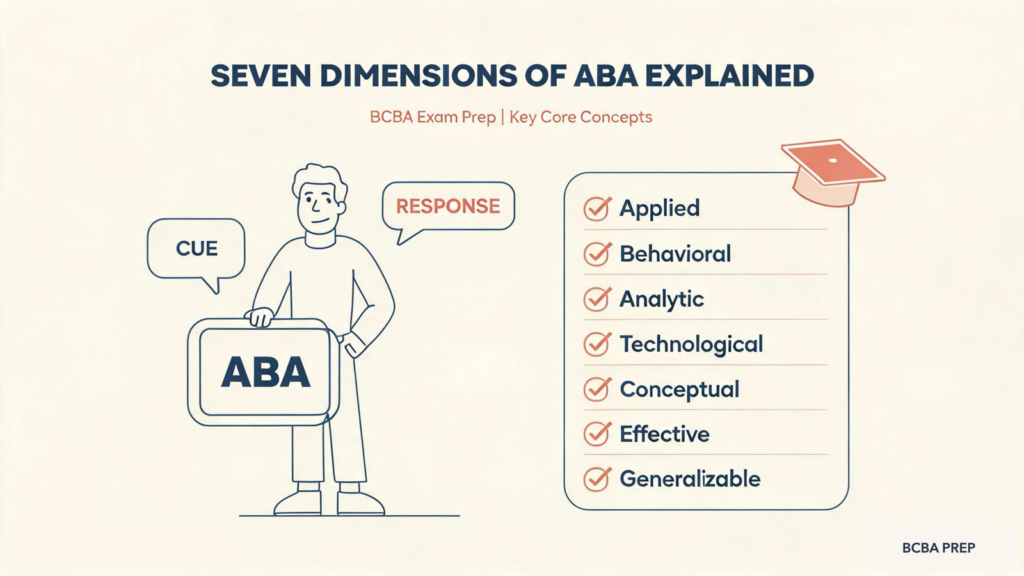
The seven dimensions of applied behavior analysis were first introduced by Baer, Wolf, and Risley in 1968 as a foundational framework for evaluating and implementing behavior-analytic interventions. They serve as a quality benchmark, ensuring that ABA is comprehensive, scientifically sound, and socially meaningful. For BCBA candidates, mastering these dimensions is essential because they are directly assessed on the BCBA task list and frequently appear in exam scenarios.
Table of Contents
- What Are the Seven Dimensions of Applied Behavior Analysis?
- The Seven Dimensions Explained with Exam-Focused Examples
- Worked Examples: Applying the Seven Dimensions
- Common Exam Traps and How to Avoid Them
- Quick Checklist for the Seven Dimensions
- Summary: Mastering the Dimensions for the BCBA Exam
Why the Seven Dimensions Matter for BCBA Candidates
Each dimension represents a core requirement of ethical and effective practice. Exam questions often present a scenario and ask you to identify which dimension is being addressed—or which is missing. Understanding not just definitions but also applied examples and common traps will help you select the correct answer confidently.
For more foundational reading, check out our guide on 7 dimensions of aba exam guide.
The Seven Dimensions Explained with Exam-Focused Examples
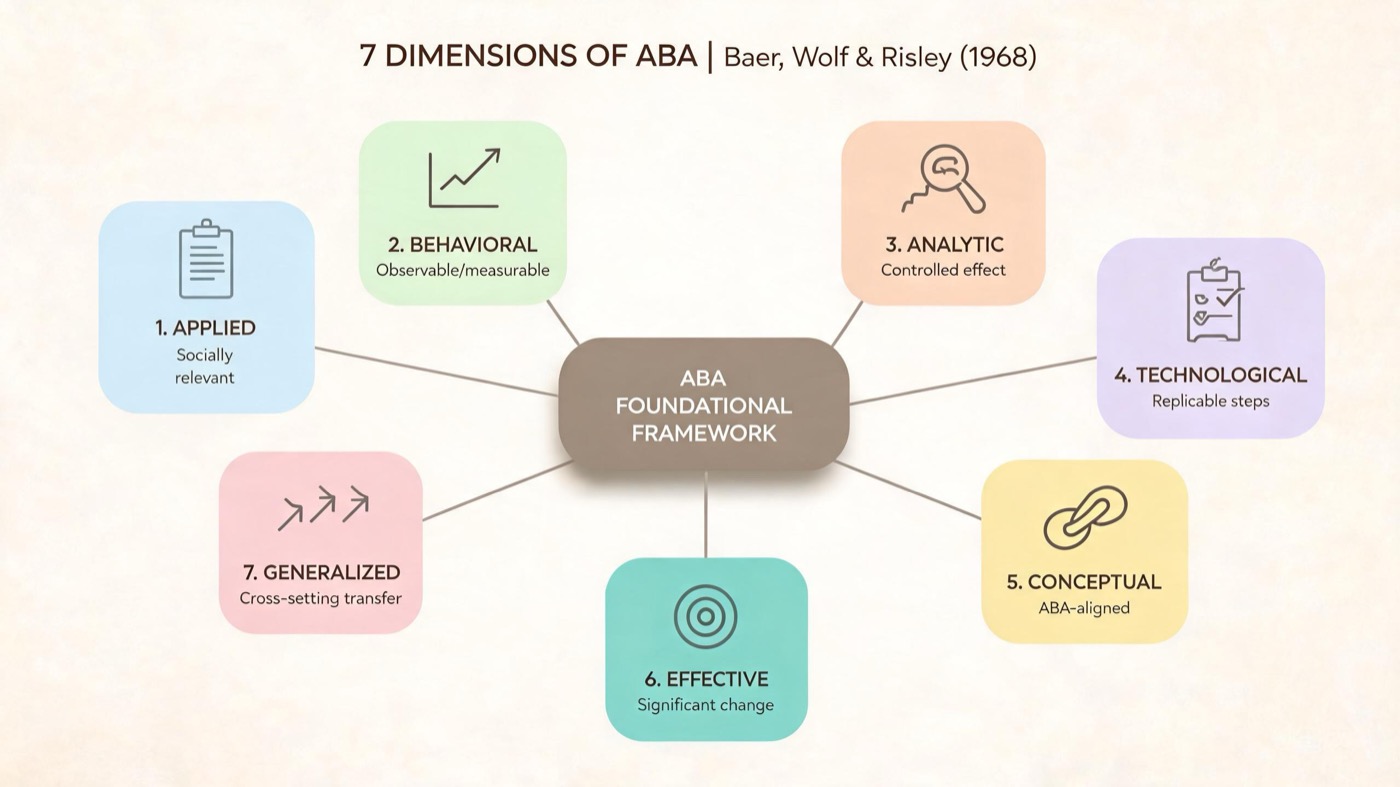
Each dimension is defined below with a practical example and an exam trap to watch out for.
Applied: Addressing Socially Significant Behaviors
The applied dimension requires that the target behavior is socially significant—meaning it improves the client’s quality of life. For example, teaching functional communication to replace aggression is applied because it directly affects the individual’s ability to get their needs met. Exam trap: Confusing ‘applied’ with ‘naturalistic.’ Applied does not mean the intervention must occur in the natural environment; it means the behavior matters to the client and society.
Behavioral: Focusing on Observable and Measurable Behavior
Behavioral interventions target behaviors that can be observed and measured. For instance, measuring the frequency of hand-raising during class is behavioral. Exam trap: Do not confuse behavioral with mentalistic explanations. Avoid terms like ‘feels like’ or ‘wants to’ in your descriptions; stick to observable events.
Analytic: Demonstrating a Functional Relation
Analytic means the intervention demonstrates a clear cause-and-effect relationship between the procedure and the behavior change. A reversal design (ABAB) that shows behavior improves only when the intervention is in place is analytic. Exam trap: Do not confuse analytic with experimental; analytic specifically requires experimental control.
Technological: Describing Procedures Replicably
Technological interventions are described in enough detail that another trained professional could replicate them exactly. For example, a step-by-step prompting protocol with specific criteria for fading prompts is technological. Exam trap: Avoid vague descriptions like ‘use reinforcement’—specify the schedule and type.
Conceptually Systematic: Grounding in Behavioral Principles
Interventions must be conceptually systematic, meaning they are based on established behavioral principles. For example, referring to ‘positive reinforcement’ rather than ‘reward’ ties the procedure to the science of behavior analysis. Exam trap: Using non-technical language may indicate a lack of conceptual systematicity.
Effective: Producing Practically Meaningful Change
Effective interventions produce behavior change that matters in the client’s daily life. A decrease in self-injurious behavior from 50 to 2 times per day is effective. Exam trap: Statistical significance is not sufficient—the change must be practically meaningful for the client.
Generality: Ensuring Behavior Change Endures and Spreads
Generality means the behavior change occurs across settings, people, and time, and continues after the intervention ends. For example, a child who uses mands at home, school, and in the community demonstrates generality. Exam trap: Do not assume generalization happens automatically; it must be programmed.
Worked Examples: Applying the Seven Dimensions
Example 1: Reducing Tantrums by Teaching Functional Communication
Setting: Home. Antecedent: Mother gives instruction to clean up toys. Behavior: Child screams and throws toys. Consequence: Mother removes instruction and provides attention. Hypothesized function: Escape from demand (and possibly attention). The applied dimension is met because tantrums interfere with daily life. Behavioral because frequency of tantrums is measured. Analytic if a reversal design shows reduction only with FCT. Technological if the prompting procedure is specified. Conceptually systematic because FCT is based on differential reinforcement. Effective if tantrums decrease to a tolerable level. Generality if the child uses the communication in other settings.
Example 2: Increasing On-Task Behavior in a Classroom
Setting: Classroom during independent work. Antecedent: Teacher instructs students to complete a worksheet. Behavior: Student looks away, talks to peers. Consequence: Peer attention. Function: Attention. Intervention: DRA with token economy for on-task behavior. Check each dimension: Applied (improves academic engagement), Behavioral (on-task defined and measured), Analytic (ABAB design shows effect), Technological (token system described step-by-step), Conceptually systematic (uses reinforcement principles), Effective (on-task increases from 30% to 90%), Generality (on-task maintains in other subjects).
Common Exam Traps and How to Avoid Them
The BCBA exam often tests your ability to distinguish between dimensions. Here are frequent pitfalls:
- Confusing ‘Applied’ with ‘Naturalistic’: Applied refers to social significance, not the setting. A clinic-based intervention can be applied if the target behavior improves daily life.
- Mixing Up ‘Analytic’ and ‘Behavioral’: Behavioral means observable and measurable; analytic means a functional relation is demonstrated. A study can be behavioral (clearly defined behavior) but not analytic (no experimental control).
- Forgetting ‘Generality’ in Treatment Planning: Many candidates assume generalization occurs naturally. Always program for it by teaching across stimuli and settings.
Quick Checklist for the Seven Dimensions
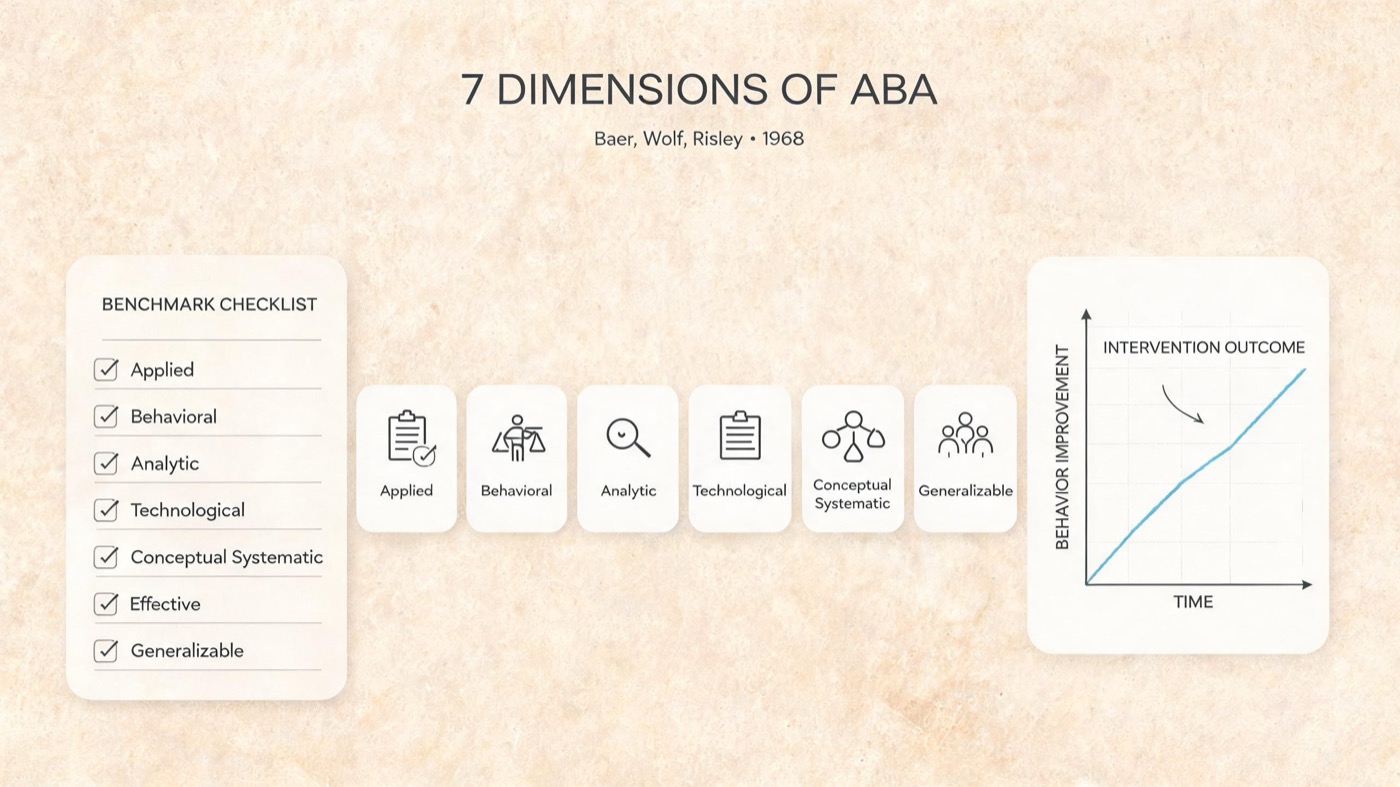
Use this checklist when evaluating an intervention for the exam or in practice:
- Applied: Does the target behavior improve the client’s life?
- Behavioral: Is the behavior observable and measurable?
- Analytic: Is there experimental control demonstrating a functional relation?
- Technological: Are procedures described so others can replicate?
- Conceptually Systematic: Are interventions based on behavioral principles?
- Effective: Does the change have practical significance?
- Generality: Does the behavior persist and spread across settings?
For more exam prep resources, visit our BCBA mock exam for 6th edition.
Summary: Mastering the Dimensions for the BCBA Exam
The seven dimensions of applied behavior analysis are a cornerstone of the BCBA task list. By understanding each dimension’s definition, applying real-world examples, and avoiding common traps, you will be well-prepared for exam scenarios. Regularly use the quick checklist to evaluate case studies and practice questions. For additional study, see the original article by Baer, Wolf, and Risley (1968) in the Journal of Applied Behavior Analysis.


