
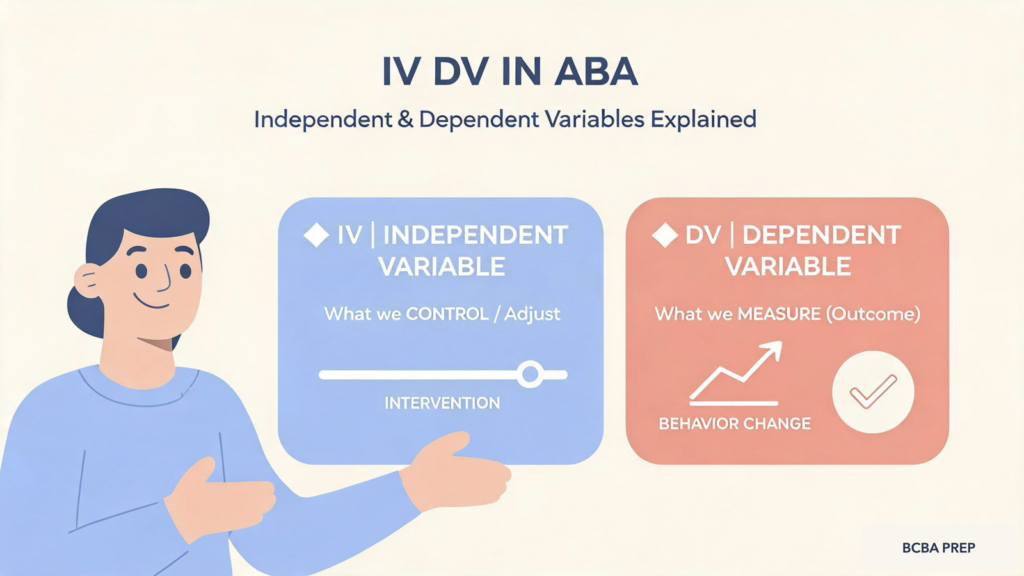
What Are IV and DV in ABA?
In applied behavior analysis, every experiment revolves around two core variables: the independent variable (IV) and the dependent variable (DV). Understanding IV DV in ABA is essential for designing experiments, interpreting data, and passing the BCBA exam.
Table of Contents
- What Are IV and DV in ABA?
- IV DV in Action: Worked ABA Examples
- Why IV DV Matters for the BCBA Exam
- Quick Checklist for Studying IV DV
- Final Summary
The IV is what you manipulate; the DV is what you measure. They form the backbone of experimental control.
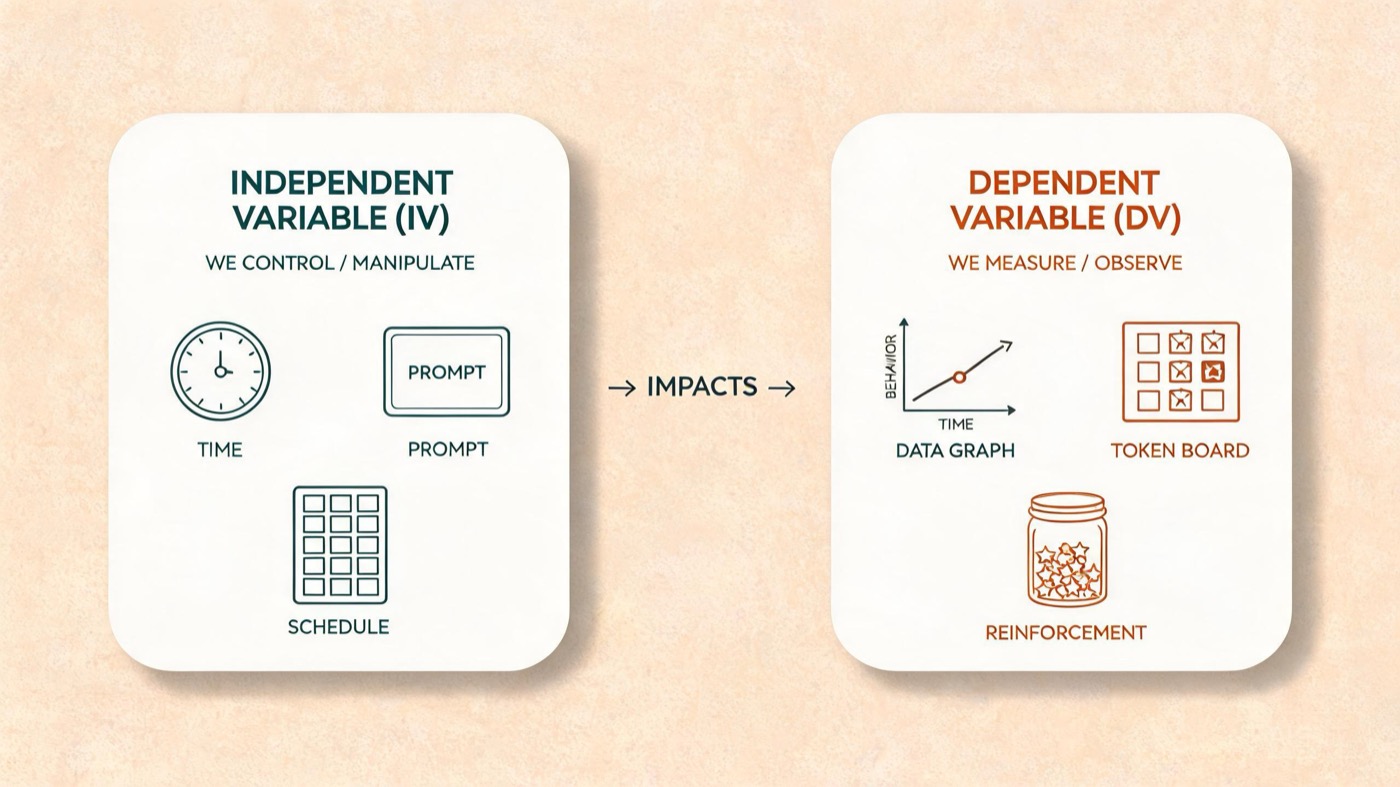
Independent Variable (IV): The Manipulated Component
The independent variable is the intervention or condition you deliberately change to see if it affects behavior. In ABA, the IV is often a treatment, such as a token economy, a prompt delay procedure, or a differential reinforcement schedule. It’s the “cause” in the cause-and-effect relationship.
- Always manipulated by the experimenter, not by the participant.
- Must be operationally defined so it can be replicated. For example, “token board present” versus “token board absent.”
- Can have multiple levels (e.g., baseline vs. intervention, or constant prompt delay vs. progressive delay).
Dependent Variable (DV): The Measured Behavior
The dependent variable is the target behavior you observe and record to see if the IV had an effect. It’s the “effect” and must be directly measurable. Common DVs include frequency of on-task behavior, number of errors, or rate of aggression.
- Must be objectively defined to ensure reliable data collection.
- Changes in the DV are attributed to the IV when confounds are controlled.
- The DV is plotted on the y-axis of a line graph, while the IV is on the x-axis.
IV DV in Action: Worked ABA Examples
Seeing IV and DV in real scenarios helps solidify the concept. Below are three concrete ABA examples with hypothesized functions and ABC data.
Example 1: Token Economy and On-Task Behavior
IV: Token board present vs. absent. DV: Percentage of intervals on-task. Hypothesized function: positive reinforcement. ABC: Antecedent: teacher says “time to work.” Behavior: student works. Consequence: token delivered. The IV (token board) is manipulated across phases to measure its effect on the DV (on-task behavior).
Example 2: Prompt Delay and Error Rate
IV: Constant prompt delay (0s) vs. progressive prompt delay (e.g., 2s, 5s). DV: Number of errors during skill acquisition. Hypothesized function: escape from demand. ABC: Antecedent: instruction “touch apple.” Behavior: error (touching banana). Consequence: prompt provided. The IV (delay type) is manipulated to reduce the DV (errors).
Example 3: Differential Reinforcement and Aggression
IV: Baseline (no intervention) vs. DRA (differential reinforcement of alternative behavior). DV: Frequency of aggression. Hypothesized function: access to tangible. ABC: Antecedent: denied toy. Baseline: aggression → toy delivered. DRA: calm request → toy delivered. The IV (DRA) is applied to decrease the DV (aggression).
Example 4: Visual Schedules and Transition Latency
IV: Verbal instruction alone vs. verbal instruction plus a visual schedule. DV: Latency (seconds) to begin the next activity. Hypothesized function: automatic reinforcement (predictability). ABC: Antecedent: “time for math.” Behavior: delayed transition. Consequence: more time with preferred activity. The IV (visual schedule) shortens the DV (latency).
For more practice with experimental manipulations, check out our guide on experimental design for the BCBA exam.
Why IV DV Matters for the BCBA Exam
The BCBA exam frequently tests your ability to identify the IV and DV in scenario questions, interpret graphed data, and spot confounds. Mastering IV DV in ABA will help you answer questions about experimental control and internal validity.
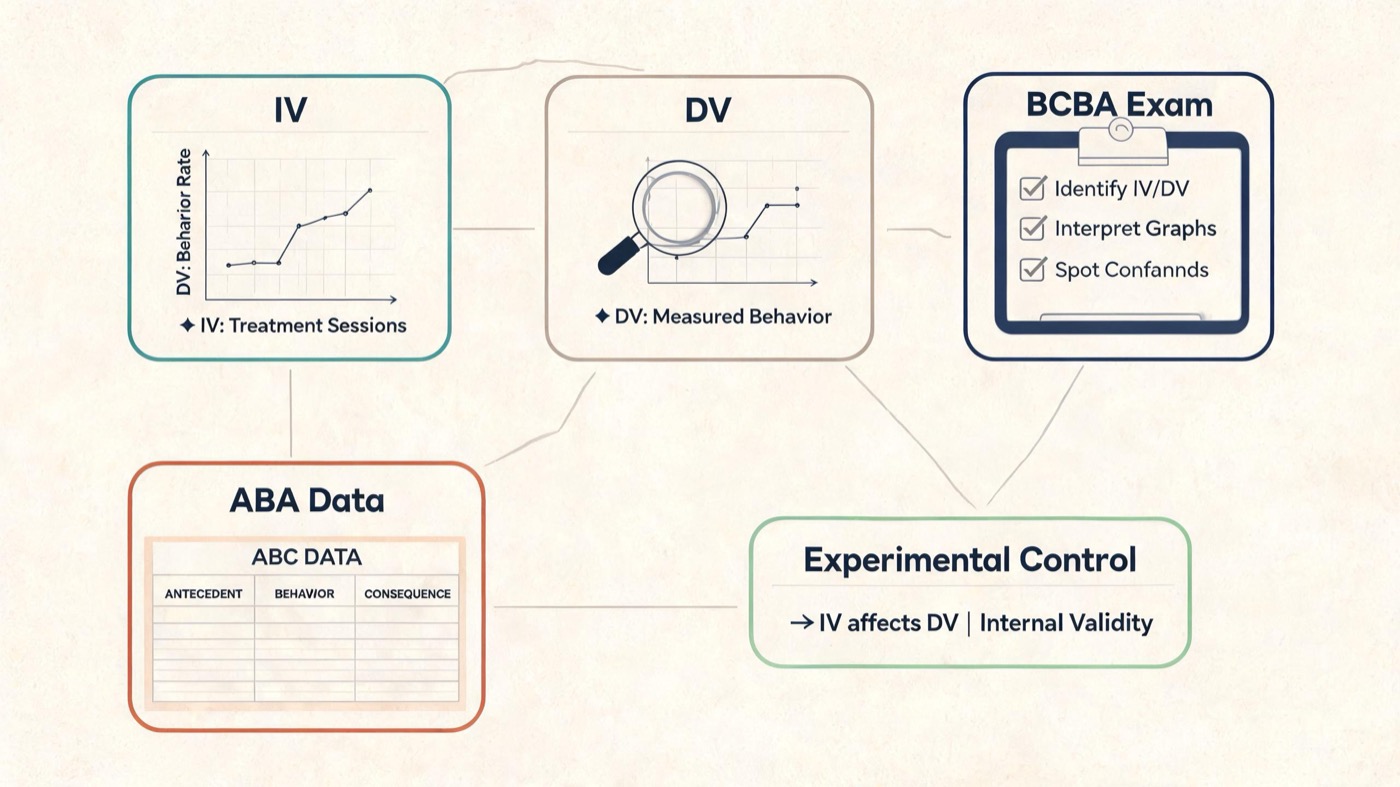
Common Exam Traps
- Confusing IV with DV: The IV is what you change; the DV is what changes. Example: “rewarding compliance” is the IV, “compliance rate” is the DV.
- Misidentifying confounds: A confound is an uncontrolled variable that affects the DV, like a change in therapist. Know how to identify threats to internal validity.
- Forgetting to operationalize the DV: The exam expects measurable definitions. “Being happy” is not a DV; “frequency of smiling” is.
- Graphing errors: The IV always goes on the x-axis; the DV on the y-axis. A question may ask you to interpret level or trend changes.
Graphing and Display
On line graphs, the IV is plotted on the x-axis (usually phases like baseline and intervention) and the DV on the y-axis (behavior measure). Changes in level, trend, or variability in the DV across phases indicate an effect. The exam may present a graph and ask whether the IV produced a meaningful change. Be ready to analyze visual data for experimental control.
For a deeper dive, see our article on graphing and visual analysis in ABA.
Quick Checklist for Studying IV DV
Use this checklist to review key points before your exam:
- Identify the IV in a scenario: it is the manipulated variable (e.g., type of prompt, schedule of reinforcement).
- Identify the DV: it is the measured behavior (e.g., number of correct responses, duration of tantrum).
- Ensure both IV and DV are operationally defined.
- Check for confounding variables that could affect the DV.
- Plot the IV on the x-axis, DV on the y-axis.
- Interpret changes in the DV across phases to determine if the IV had an effect.
For more study strategies, visit our BCBA exam prep guide.
Final Summary
The independent variable is what you change; the dependent variable is what you measure. In ABA, this distinction is critical for demonstrating experimental control. By practicing with examples, avoiding common traps, and using the checklist, you’ll be ready for any IV DV question on the BCBA exam. Remember that scientific integrity also relies on clearly defining these variables, as outlined in the BACB Ethics Code.


