
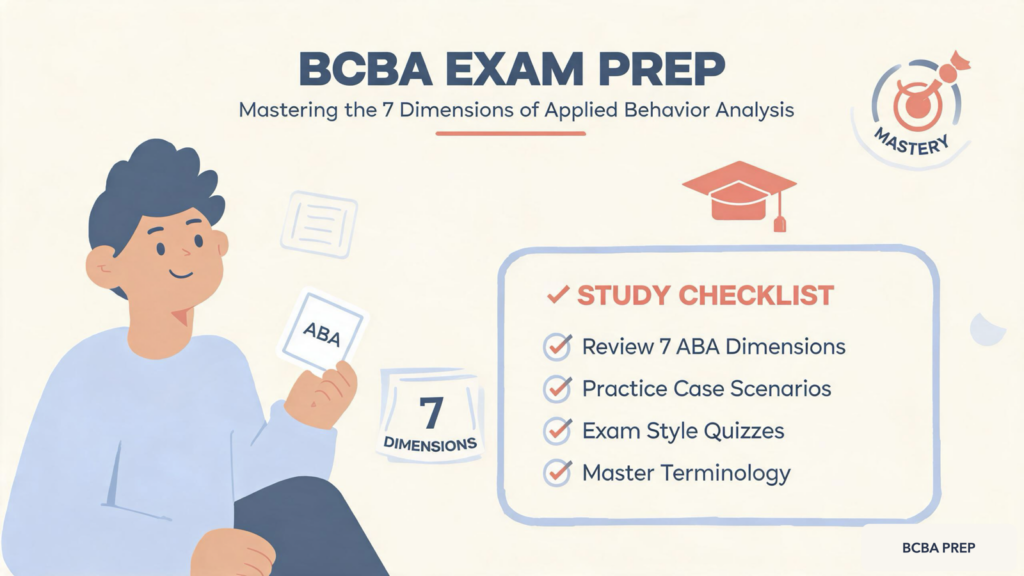
What Are the Seven Dimensions of ABA?
Introduced by Baer, Wolf, and Risley in 1968, the 7 dimensions of applied behavior analysis serve as the foundational framework for designing, implementing, and evaluating ABA interventions. For BCBA exam candidates, understanding these dimensions is not optional—they appear repeatedly across task list items and scenario-based questions. Each dimension ensures that ABA remains effective, ethical, and scientifically sound.
Table of Contents
- What Are the Seven Dimensions of ABA?
- Breaking Down Each Dimension
- ABA in Practice: Two Worked Examples
- BCBA Exam Tips for the 7 Dimensions
- Quick Checklist: Applying the 7 Dimensions
Think of the seven dimensions as a quality checklist: every behavior-change program should meet each criterion. When you can identify which dimension a scenario is targeting, you are one step closer to passing the exam.
Breaking Down Each Dimension
Below is a breakdown of each dimension with practical definitions and exam-focused examples.
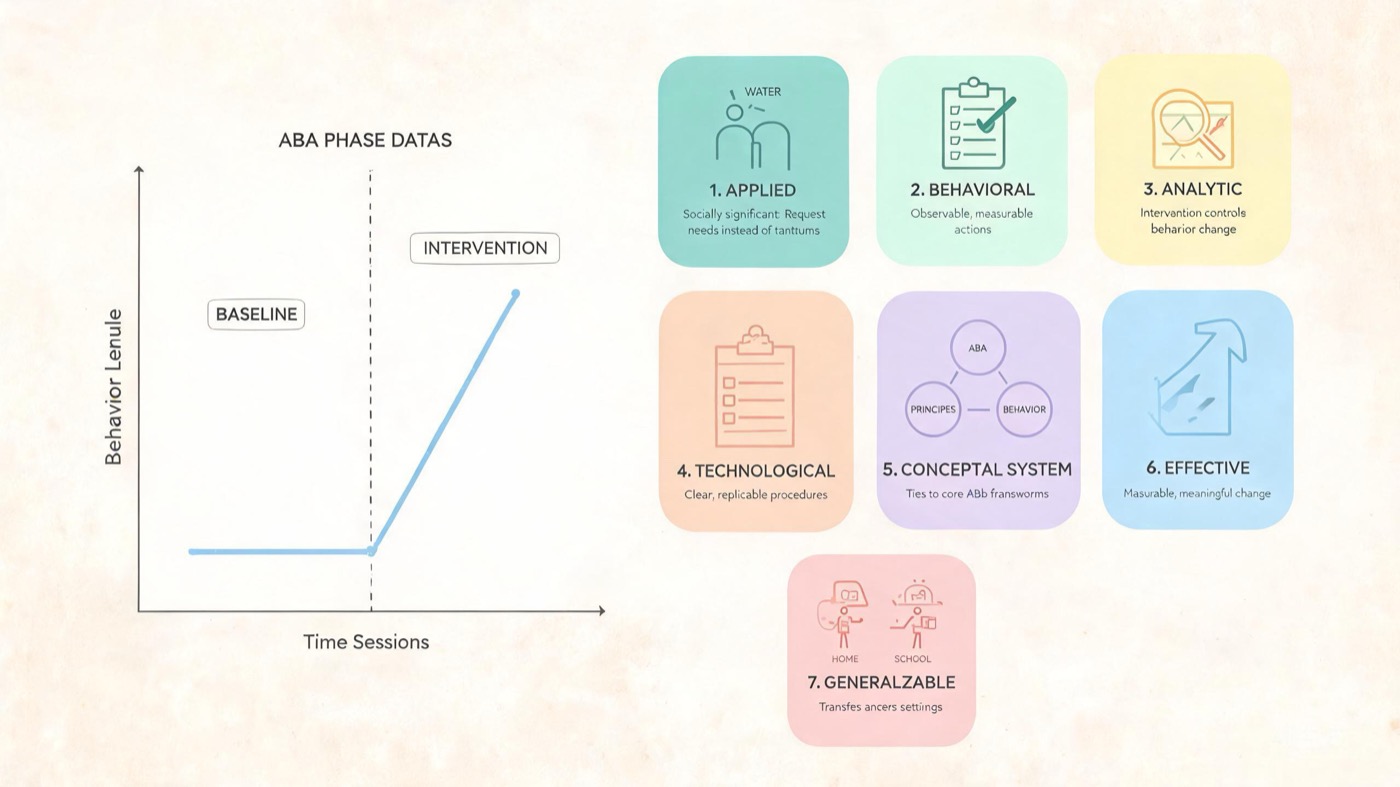
Applied
The behavior targeted must be socially significant to the client and stakeholders. You should ask: does this matter in the person’s daily life? For example, teaching a child to request a break instead of screaming is applied; teaching a child to stack blocks for no reason is not.
Behavioral
The dimension requires that the behavior in question is observable and measurable. Avoid vague labels like “being polite” and instead count specific instances, such as saying “please” or “thank you.” Operational definitions are critical here.
Analytic
A functional relationship must be demonstrated. Through experimental designs (e.g., reversal, multiple baseline), the practitioner shows that the intervention caused the behavior change. For instance, using an ABAB design to confirm that a token system reduces off-task behavior.
Technological
Procedures must be described in concrete, replicable detail. Anyone reading the intervention plan should be able to implement it exactly. Instead of “use praise,” specify: “Deliver behavior-specific praise (e.g., ‘Great job raising your hand’) on a fixed-ratio 3 schedule.”
Conceptually Systematic
Interventions should be grounded in the principles of behavior analysis. Avoid using generic strategies without linking them to ABA concepts. For example, rather than saying “reward good behavior,” explain that you are using positive reinforcement to strengthen a desired behavior.
Effective
Behavior change must be clinically meaningful. Statistical significance alone is insufficient; the improvement must make a real difference in the client’s life. For example, reducing tantrums from 10 per hour to 8 may be significant but not effective if the goal is 0.
Generality
Behavior change should generalize across settings, time, and related behaviors. A student who learns to greet peers at school should also greet family at home and maintain that skill months later. Planning for generalization from the start is essential.
ABA in Practice: Two Worked Examples
Seeing the dimensions in action clarifies how they interact. Here are two detailed examples.
Example 1: Reducing Tantrums in a Preschooler
- Applied: Tantrums interfere with social integration and learning.
- Behavioral: Measured duration of crying in minutes per hour.
- Analytic: ABAB design showed reduced crying only when intervention (extinction + DRA) was active.
- Technological: A script specified ignoring all crying and providing attention for calm requests.
- Conceptually Systematic: Used extinction (for crying) and differential reinforcement of alternative behavior (for requests).
- Effective: Crying reduced by 80%, and the child began using words more often.
- Generality: The child maintained low crying at home and preschool, and also reduced whining.
Example 2: Increasing On-Task Behavior in a Teen with ADHD
- Applied: Academic engagement is critical for school success.
- Behavioral: Measured on-task intervals via momentary time sampling.
- Analytic: Multiple baseline across subjects (math, English, science) showed increases only after intervention introduction.
- Technological: Used a timer set to 5-minute intervals and a token board for every 3 on-task checks.
- Conceptually Systematic: Implemented differential reinforcement of low rates? Actually, it was differential reinforcement of high rates of on-task behavior.
- Effective: Assignment completion increased from 40% to 90%.
- Generality: The teen remained on-task even after tokens were faded, and study skills improved at home.
BCBA Exam Tips for the 7 Dimensions
Exam questions often test your ability to distinguish among dimensions. Here are common traps and a mnemonic to help.
Common Traps
- Confusing applied with effective: Applied is about social significance; effective is about magnitude of change.
- Forgetting that behavioral requires measurement—not just observation.
- Mixing technological (clear procedures) with conceptually systematic (grounded in principles).
- Thinking generality is only about durability; it also includes setting and response generalization.
- Assuming a dimension is met just because it is mentioned in a scenario—look for active demonstration.
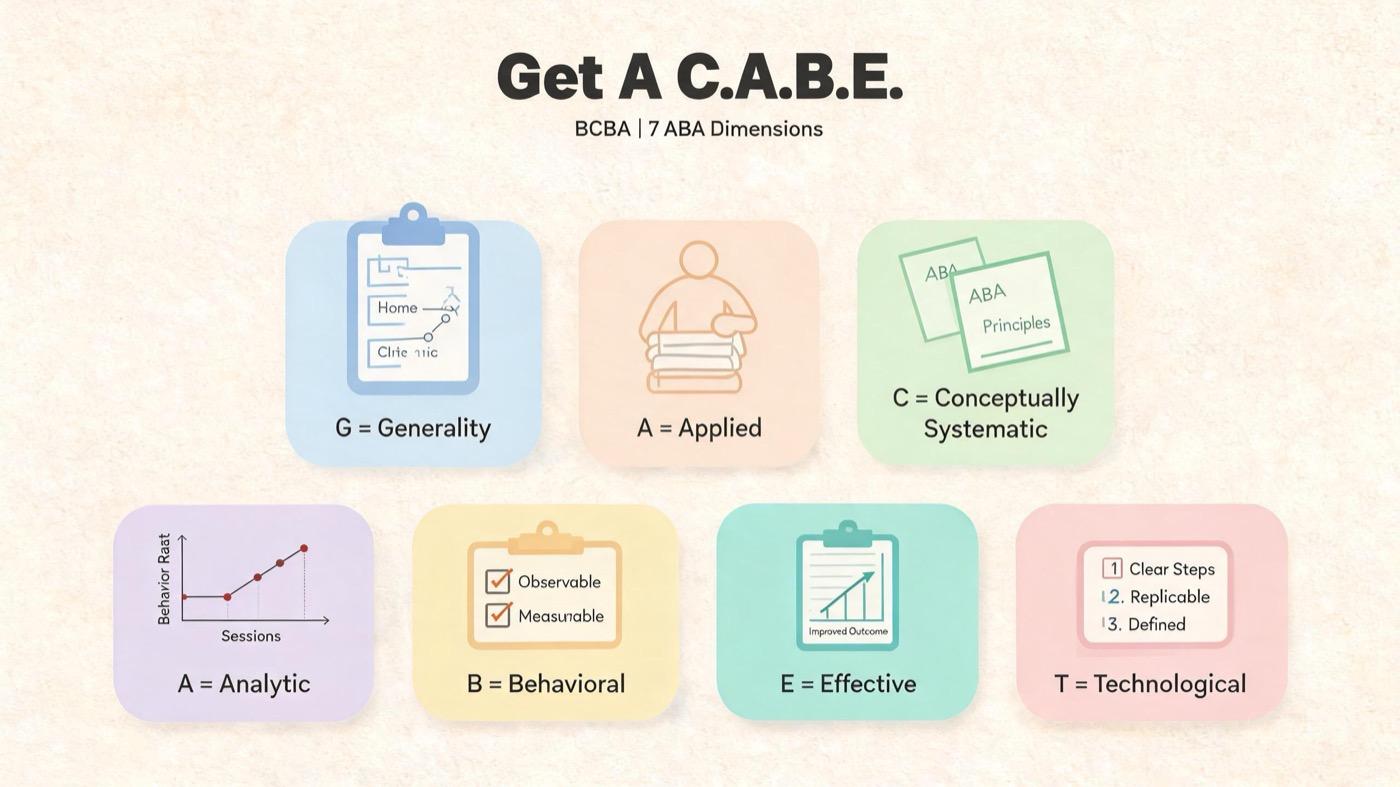
Mnemonic for Recall
Use ‘Get A C.A.B.E.‘ to remember the seven: Generality, Applied, Behavioral, Effective, Conceptually systematic, Analytic, Technological. Alternatively, you can use ‘G-A-B-E-C-A-T.’
Quick Checklist: Applying the 7 Dimensions
When reviewing a behavior-change plan, run through this checklist to verify all dimensions are addressed:
- Identify a socially significant behavior (Applied).
- Define the behavior in observable, measurable terms (Behavioral).
- Choose an experimental design to demonstrate a functional relation (Analytic).
- Write step-by-step procedures that can be replicated (Technological).
- Link every intervention to ABA principles (Conceptually Systematic).
- Set clinically meaningful goals and measure progress (Effective).
- Plan for generalization and maintenance from the start (Generality).
Use this checklist during study and in practice supervision to reinforce the dimensions. For more on building comprehensive programs, see our real-life case examples and exam guide. The original article by Baer, Wolf, and Risley (1968) is available through the Journal of Applied Behavior Analysis.
Mastering the 7 dimensions of applied behavior analysis ensures that your interventions are ethical, effective, and defensible. On the BCBA exam, expect at least a few questions asking you to identify which dimension a scenario illustrates. Practice with mock questions and always ask yourself: ‘Does this plan meet all seven?’


