
What Is an Equivalence Class in ABA? Definition and Core Concept
In applied behavior analysis, an equivalence class is a set of stimuli that a learner treats as interchangeable even though they are physically different. This occurs when an individual demonstrates reflexivity, symmetry, and transitivity among stimuli after being trained on specific conditional discriminations. These three properties are the foundation of stimulus equivalence, a concept that explains how new, untrained relations emerge from trained ones.
Table of Contents
- What Is an Equivalence Class in ABA? Definition and Core Concept
- Equivalence Class vs. Other Stimulus Relations: Why It Matters for the BCBA Exam
- Applied ABA Examples: Equivalence Classes in Action
- Common Exam Traps: Don’t Let These Trip You Up
- Quick Study Checklist for Equivalence Classes
- Summary: Equivalence Classes and Your BCBA Exam Success
Key Components of an Equivalence Class
To fully understand equivalence classes, it is essential to grasp each component. Reflexivity is the simplest: a stimulus matches itself. For example, when shown a picture of a cat, the learner selects the same picture from an array (A = A). This demonstrates identity matching and is often the first step in teaching equivalence. Symmetry involves bidirectional relations: if a learner learns that the written word ‘dog’ (A) matches a picture of a dog (B), they can also match the picture to the written word without direct training (B = A). Transitivity is the most complex: if ‘dog’ (A) matches a picture (B) and the picture matches a spoken word ‘dog’ (C), the learner can match the written word to the spoken word without being taught directly (A = C). Together, these properties allow for derived stimulus relations, where new relations emerge from trained ones, greatly expanding learning efficiency.
For example, teaching a child that the word ‘apple’ (A) matches a picture of an apple (B), and that the picture matches the spoken word ‘apple’ (C), can lead to the child spontaneously matching the written word to the spoken word (A = C). This is powerful because it reduces the number of direct teaching trials needed. On the BCBA exam, you may be asked to identify which property is demonstrated in a given scenario or to determine whether a set of stimuli forms an equivalence class. Mastery of these definitions is critical.
Equivalence Class vs. Other Stimulus Relations: Why It Matters for the BCBA Exam
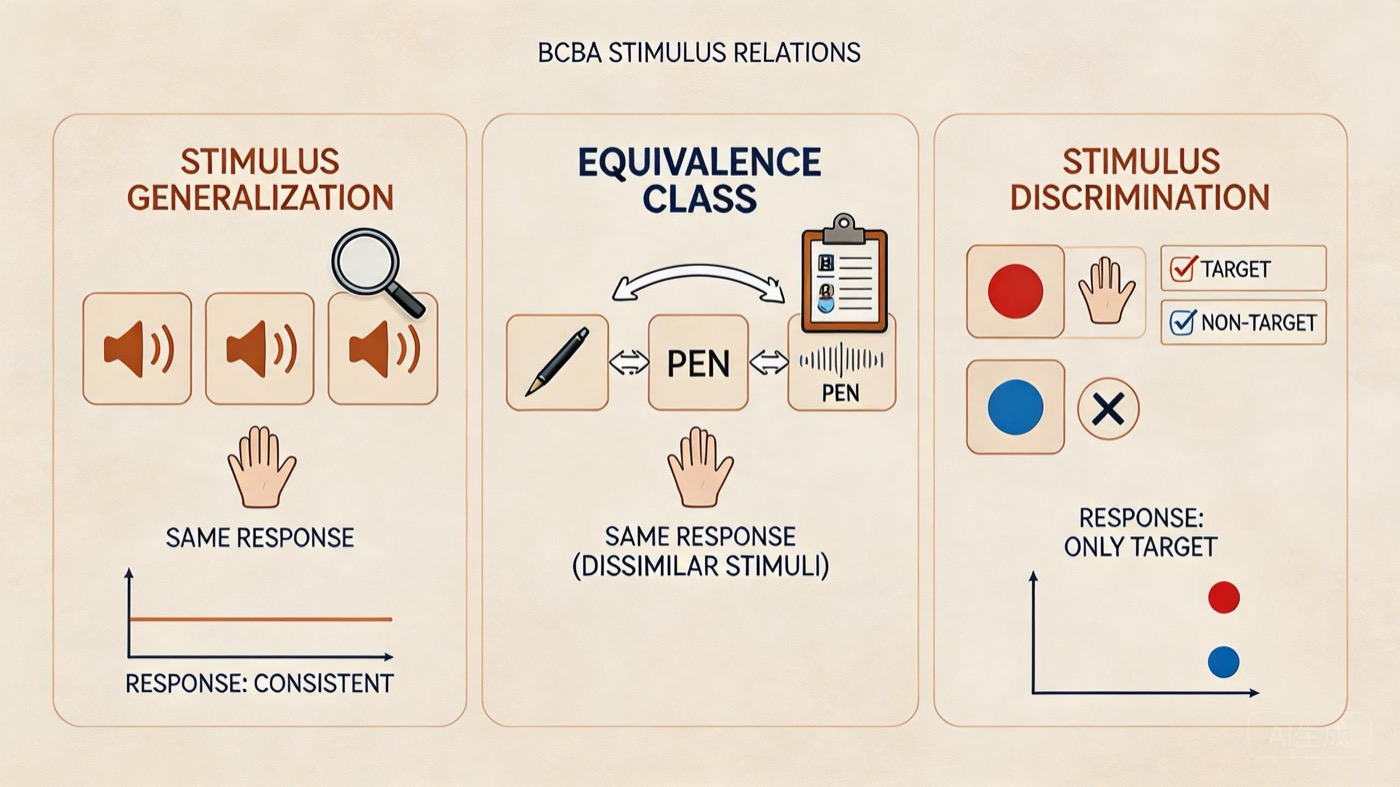
On the BCBA exam, you must distinguish equivalence classes from related concepts like stimulus generalization and discrimination. In generalization, physically similar stimuli evoke the same response. For example, a child who learns to say ‘dog’ when seeing a Golden Retriever may also say ‘dog’ when seeing a Poodle because they share physical features. In equivalence, physically dissimilar stimuli become functionally equivalent through trained relations. For instance, the written word ‘dog’, a picture of a dog, and the spoken word ‘dog’ share no physical similarity but become interchangeable through conditional discrimination training. Discrimination, conversely, involves responding differently to stimuli that differ physically (e.g., saying ‘dog’ to a dog and ‘cat’ to a cat). The exam often presents scenarios and asks you to classify the relation, so practicing with examples is essential.
How Stimulus Equivalence Fits into the BCBA Task List
Equivalence classes fall under Task List item B-15 (derived stimulus relations). Understanding these relations is crucial for concept formation and teaching academic skills. For instance, equivalence-based instruction is used to teach reading, math, and safety skills efficiently. The exam will test your ability to identify whether a set of stimuli meets the three properties of equivalence. You may also be asked to explain how equivalence promotes generalization across stimuli without direct training. For more on derived relations, check out our stimulus equivalence BCBA exam guide.
Applied ABA Examples: Equivalence Classes in Action
The following examples use an ABC format with hypothesized functions to make the concept concrete for exam questions. Each example highlights how equivalence classes can emerge in real-world teaching.
Example 1: Teaching a Child to Identify ‘Dog’ Across Contexts
Antecedent: Therapist shows a picture of a dog. Behavior: Child says ‘dog’. Consequence: Therapist says ‘Yes! That’s a dog!’ and gives a high-five. Hypothesized function: Positive reinforcement (social praise). Over time, the picture, spoken word, and written word ‘dog’ become an equivalence class. The child can then match the written word to the picture and the spoken word without additional training.
Example 2: Equivalence-Based Instruction in a Classroom Setting
Antecedent: Teacher writes ‘3+2’ on the board. Behavior: Student says ‘five’. Consequence: Teacher gives a token. Hypothesized function: Conditioned reinforcement (tokens). This teaches the numeral ‘5’, the word ‘five’, and the operation outcome as members of an equivalence class. The student can then match the numeral to the written word and vice versa without direct instruction.
Example 3: Derived Relations in Safety Signs
Antecedent: Fire alarm sounds. Behavior: Student exits the building. Consequence: Teacher gives a high-five and alarm stops. Hypothesized function: Negative reinforcement (escape from loud noise). The alarm, the exit sign, and the instruction ‘go out’ become an equivalence class. The student learns to respond to any of these stimuli as equivalent, enhancing safety in various settings.
Example 4: Teaching Academic Skills with Equivalence
Antecedent: Teacher shows a flashcard with the numeral ‘7’. Behavior: Student selects a picture of seven apples from an array. Consequence: Teacher provides verbal praise. Hypothesized function: Positive reinforcement (praise). After training, the student can match the numeral to the written word ‘seven’ and vice versa, forming an equivalence class that includes the numeral, the picture, and the word. This approach is often used in math instruction to build conceptual understanding.
Common Exam Traps: Don’t Let These Trip You Up
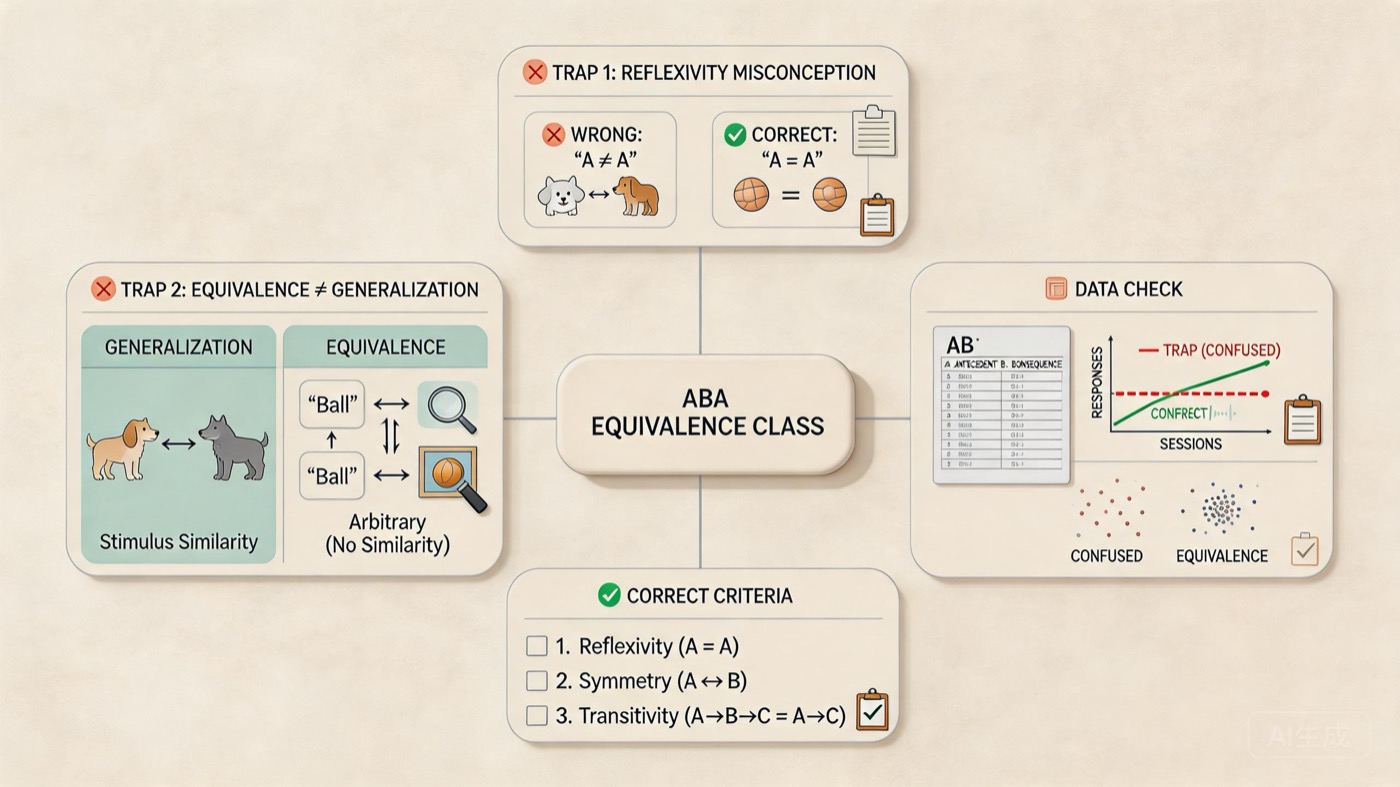
Candidates often confuse equivalence with generalization or misunderstand reflexivity in ABA contexts. Watch out for these pitfalls:
- Equivalence ≠ Generalization: Generalization occurs due to physical similarity; equivalence occurs through learned relations. The exam may present a scenario where a child calls all four-legged animals ‘dog’ (generalization) versus a scenario where the child matches the written word ‘dog’ to a picture of a dog after only being taught the spoken word to picture match (symmetry). Be careful to distinguish.
- Reflexivity Is Not Self-Matching in Reverse: Some candidates think reflexivity means the learner matches B to A when only A = B was taught. That is symmetry, not reflexivity. Reflexivity is always A = A (identity matching).
- All Three Properties Must Be Shown: A set of stimuli only forms an equivalence class when reflexivity, symmetry, and transitivity are all demonstrated. Missing one means it is not a true equivalence class. For example, if a learner shows symmetry but not transitivity, the relations are not fully equivalent.
- Derived Relations Require Conditional Discrimination Training First: Equivalence does not emerge spontaneously; it follows training in conditional discriminations (e.g., matching-to-sample). You must train specific relations (e.g., A = B, B = C) before derived relations (A = C) can be tested.
- Matching-to-Sample vs. Equivalence: Matching-to-sample is a training procedure used to establish conditional discriminations; equivalence is the outcome where stimuli become interchangeable. The exam may ask you to identify which procedure is being used or which outcome is demonstrated.
Quick Study Checklist for Equivalence Classes
Use this checklist to confirm you are ready for exam questions:
- Define reflexivity, symmetry, and transitivity in behavioral terms.
- Identify whether a scenario demonstrates stimulus equivalence or generalization.
- Apply the ABC contingency to equivalence-based instruction examples.
- Differentiate equivalence from matching-to-sample as a training procedure.
- Review Task List items B-15 and related concepts.
- Practice with free BCBA mock exam questions to test your ability to discriminate equivalence from other relations.
- Memorize the three properties and practice identifying them in vignettes. For example, if a question says ‘The learner matches a picture to a word after being taught the word to picture,’ that is symmetry.
Summary: Equivalence Classes and Your BCBA Exam Success
Equivalence classes are foundational for understanding derived stimulus relations, a key topic on the BCBA exam. By mastering the three properties and practicing with real-world examples, you will be prepared for scenario-based questions. Use our 6th edition mock exams to test your knowledge. For further reading, see the BACB website for the full Task List. Remember, equivalence classes enable efficient learning and are a powerful tool in ABA. Good luck with your exam preparation!


