
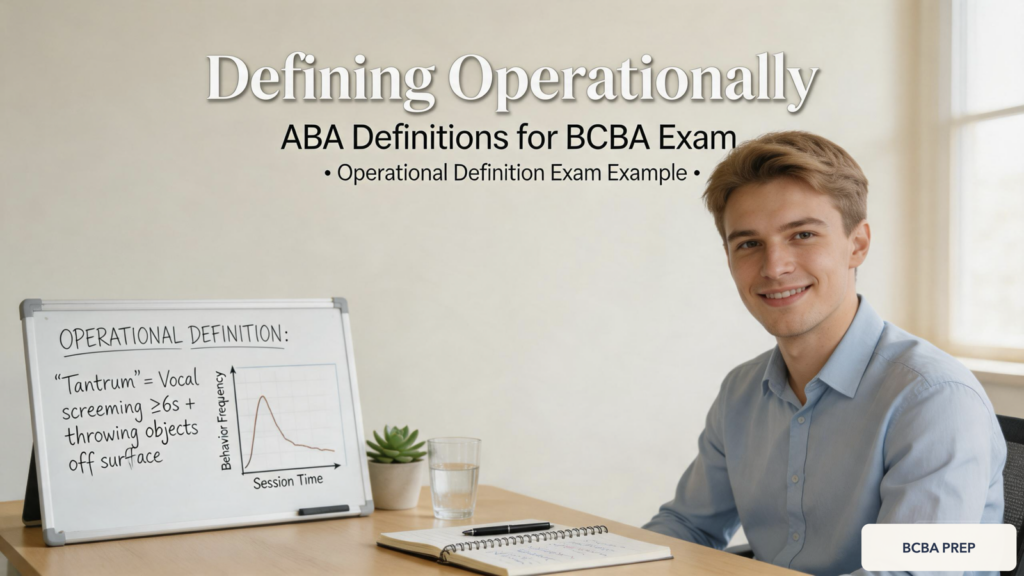
What Does Defining Operationally Mean in ABA?
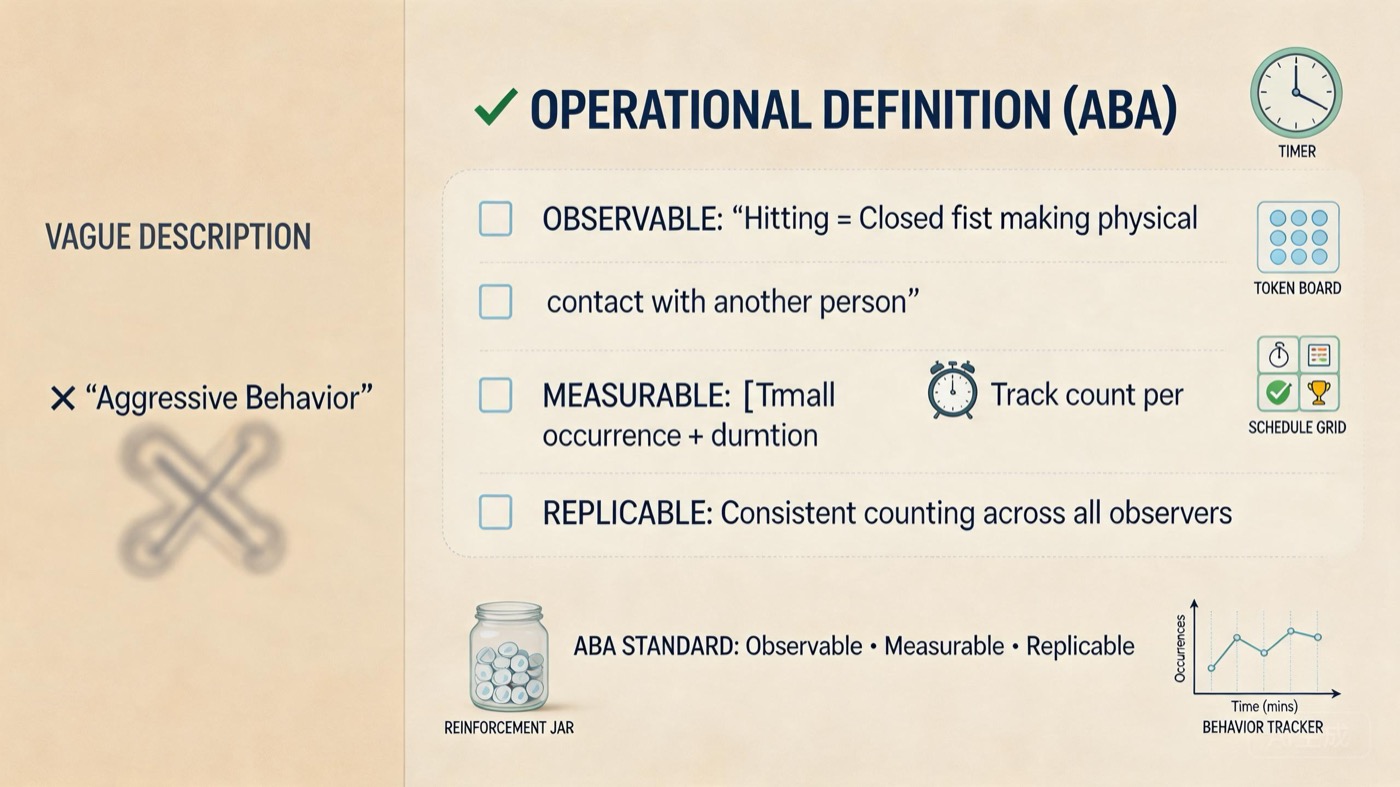
In applied behavior analysis, defining operationally means describing a behavior in observable, measurable, and replicable terms. Instead of using vague labels like ‘aggressive,’ an operational definition states exactly what the behavior looks like. For example, ‘forceful contact between an open hand and another person’s body’ is an operational definition of hitting. This approach is essential for objective measurement because it ensures that two independent observers can agree on whether the behavior occurred.
Table of Contents
- What Does Defining Operationally Mean in ABA?
- Worked ABA Example: Aggression
- Common BCBA Exam Traps When Defining Operationally
- Additional ABA Examples of Operational Definitions
- Quick Checklist for Writing Operational Definitions
- Practice Prompts & Summary
The keyphrase ‘defining operationally example’ appears in this article to reinforce how precise language drives reliable data collection. Without operational definitions, data becomes unreliable, making it impossible to accurately assess behavior change.
Why Operational Definitions Matter for the BCBA Exam
On the BCBA exam, questions about measurement systems and interobserver agreement frequently require you to identify or improve operational definitions. A well-written definition is the foundation for accurate data, which in turn supports valid conclusions about behavior change. Expect scenario-based questions where you must choose the best operational definition among multiple options. For a deeper dive, see our guide on data collection in ABA.
Worked ABA Example: Aggression
Let us walk through a common behavior: aggression. A non-operational definition might say ‘hits others.’ This is too vague because it does not specify what kind of contact counts. An operational definition for aggression could be: ‘Any instance of forceful contact between an open hand or closed fist and another person’s body, excluding accidental brushing during play.’ This is clear, observable, and replicable.
Non-Operational vs. Operational Version
- Non-operational: ‘Temper tantrum’ or ‘gets upset’ – these are subjective and not measurable.
- Operational: ‘Loud vocalizations above conversational level combined with stomping feet for at least 5 seconds’ – this is observable and countable.
ABC Data and Function
Once the definition is set, you can collect ABC data. For aggression, a common pattern is: Antecedent – a demand is placed; Behavior – forceful contact; Consequence – demand is removed. The hypothesized function is often escape from demands. This example shows how a clear operational definition supports functional behavior assessment.
Let us consider another scenario: a child named Sam engages in ‘elopement.’ A non-operational definition might be ‘runs away.’ However, an operational definition would be: ‘Any instance of Sam moving more than 3 feet from the designated area without permission, as marked by floor tape, while the activity is ongoing.’ This specificity allows staff to consistently identify elopement and collect data on frequency and duration. By defining operationally, we can measure the behavior’s baseline and track intervention effectiveness. For the BCBA exam, you might be asked to select the best operational definition from a list or to improve a vague one. Remember that the definition must be so clear that a stranger could apply it accurately.
Another crucial aspect of operational definitions is their role in treatment fidelity. When multiple staff members implement an intervention, they must agree on what the target behavior looks like. A precise operational definition minimizes drift and ensures that data is comparable across observers. For instance, if you define ‘aggression’ differently than a colleague, your interobserver agreement (IOA) scores will suffer. The exam often tests this concept: a low IOA is frequently due to poorly written operational definitions. Therefore, mastering ‘defining operationally example’ is not just about memorizing a phrase; it is about building a skill that underpins behavior analysis.
Common BCBA Exam Traps When Defining Operationally
Many candidates lose points on operational definition questions. Here are the most frequent mistakes to avoid.
Trap 1: Using Subjective Terms
Words like ‘angry,’ ‘hurt,’ or ‘upset’ describe internal states, not observable behavior. Stick to what you can see and count. For example, instead of ‘shows anger,’ write ‘clenches fists and raises voice above conversational level.’
Trap 2: Including Internal States
Phrases such as ‘because he feels anxious’ assume an internal cause. Focus on the behavior itself, not inferred motivations. An operational definition should only describe the observable topography.
Trap 3: Overcomplicating Definitions
While precision is important, avoid overly long or complex definitions. Keep it clear and replicable. If a definition requires a manual to interpret, simplify it.
Trap 4: Failing to Include Exclusion Criteria
A common oversight is not specifying what does not count as the behavior. For example, if defining ‘aggression,’ you should note that accidental physical contact during play is excluded. Inclusion and exclusion criteria make your definition airtight. On the exam, look for answer choices that add ‘excluding’ clauses to refine the definition.
Trap 5: Using Latency Instead of Topography
Occasionally, a candidate will define a behavior by its latency or duration rather than its occurrence. For instance, ‘aggression that lasts more than 5 seconds’ confuses duration with the behavior’s definition. The definition should first state what the behavior is (e.g., hitting), then you can add dimensions like duration if needed. Keep the core definition focused on the observable action.
Additional ABA Examples of Operational Definitions
Here are two more examples to solidify the concept.
- Self-injury: Any instance of head hitting a hard surface (e.g., wall, floor) from a distance of at least 6 inches, resulting in audible contact.
- On-task behavior: Eyes oriented toward the assigned worksheet, pencil in hand, and writing or erasing continuously for at least 3 seconds.
Notice how each definition includes measurable dimensions (distance, duration, objects involved) so that data collection is consistent.
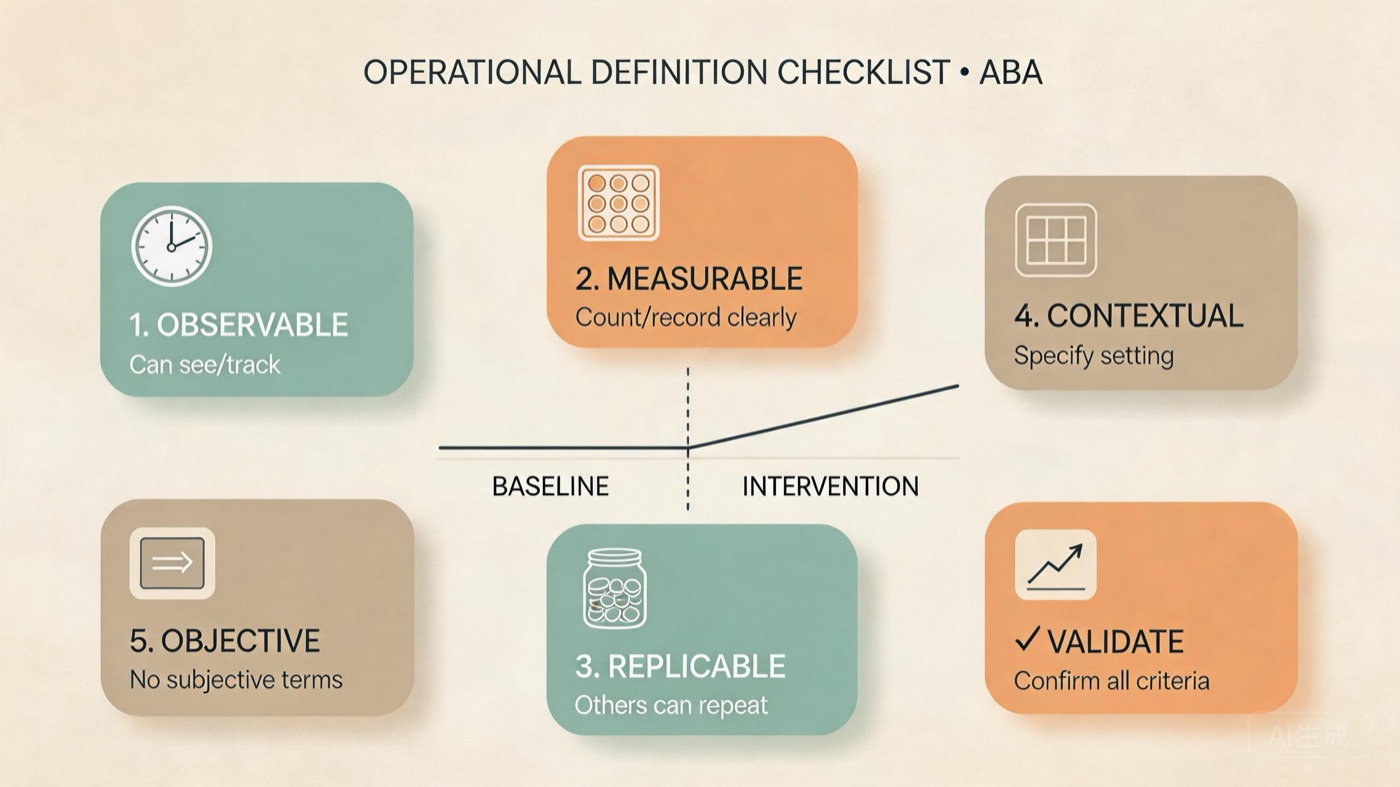
Quick Checklist for Writing Operational Definitions
Use this checklist when evaluating or writing operational definitions for the exam.
- Observable: Can the behavior be seen or heard?
- Measurable: Does it specify count, duration, or intensity?
- Clear boundaries: Does it state what is and is not an instance?
- Replicable: Would another person apply it the same way?
- No internal states: Does it avoid words like ‘feels’ or ‘wants’?
- Exclusion criteria: Are there examples of what does not count?
- Topography-focused: Does it describe the form of the behavior, not its function?
This checklist will help you quickly evaluate any definition you encounter. Practice using it on sample definitions from mock exams or journal articles. Over time, you will internalize these criteria and be able to spot errors instantly.
Practice Prompts & Summary
Try these exam-style prompts to test your skill. Then review the key takeaways.
Prompt 1: Write an operational definition for ‘off-task behavior’ during a math worksheet task.
Prompt 2: Identify the error in this definition: ‘The child cries because he is frustrated.’
Answers: 1) ‘Any time the student looks away from the worksheet for more than 3 seconds, or engages in any activity not related to the worksheet (e.g., drawing on desk, talking to peer).’ 2) The phrase ‘because he is frustrated’ includes an internal state. Remove it and describe only the observable crying behavior (e.g., ‘audible crying with tears for at least 5 seconds’).
Summary: Mastering operational definitions is crucial for the BCBA exam and future practice. Always ensure definitions are observable, measurable, and free of subjective language. Remember to include exclusion criteria and focus on topography. For more practice, explore our free BCBA mock exam questions to refine your measurement skills. Also, review the BACB’s official resources for additional guidelines.


