

What is a BCABA?
A Board Certified Assistant Behavior Analyst (BCABA) is an undergraduate-level certification in applied behavior analysis. BCABAs work under the supervision of a BCBA to implement behavior intervention plans, collect data, and support clients. The role is distinct from a BCBA in terms of independence and scope. BCABAs are essential in the field, often serving as the primary implementers of behavior plans and providing direct client support. They typically work in schools, clinics, or home settings, collaborating with families and other professionals.
Table of Contents
- What is a BCABA?
- Step-by-Step Path to Becoming a BCABA
- Practical ABC Examples You Must Know for the BCABA Exam
- Common BCABA Exam Traps and How to Avoid Them
- BCABA Quick Checklist
- Summary
BCABA vs BCBA: Key Differences
- Level of independence: BCABAs must practice under a BCBA supervisor, whereas BCBAs can practice independently.
- Supervision ratio: A BCBA can supervise multiple BCABAs and RBTs; BCABAs typically supervise RBTs.
- Scope of practice: BCABAs focus on implementation and data collection; BCBAs design assessments and programs.
- Education: BCABA requires a bachelor’s degree; BCBA requires a master’s degree.
Understanding these differences is essential for exam questions about supervision requirements and ethical responsibilities. Also note that BCABAs have a restricted scope compared to BCBAs, which may appear in questions about delegation and supervision.
Step-by-Step Path to Becoming a BCABA
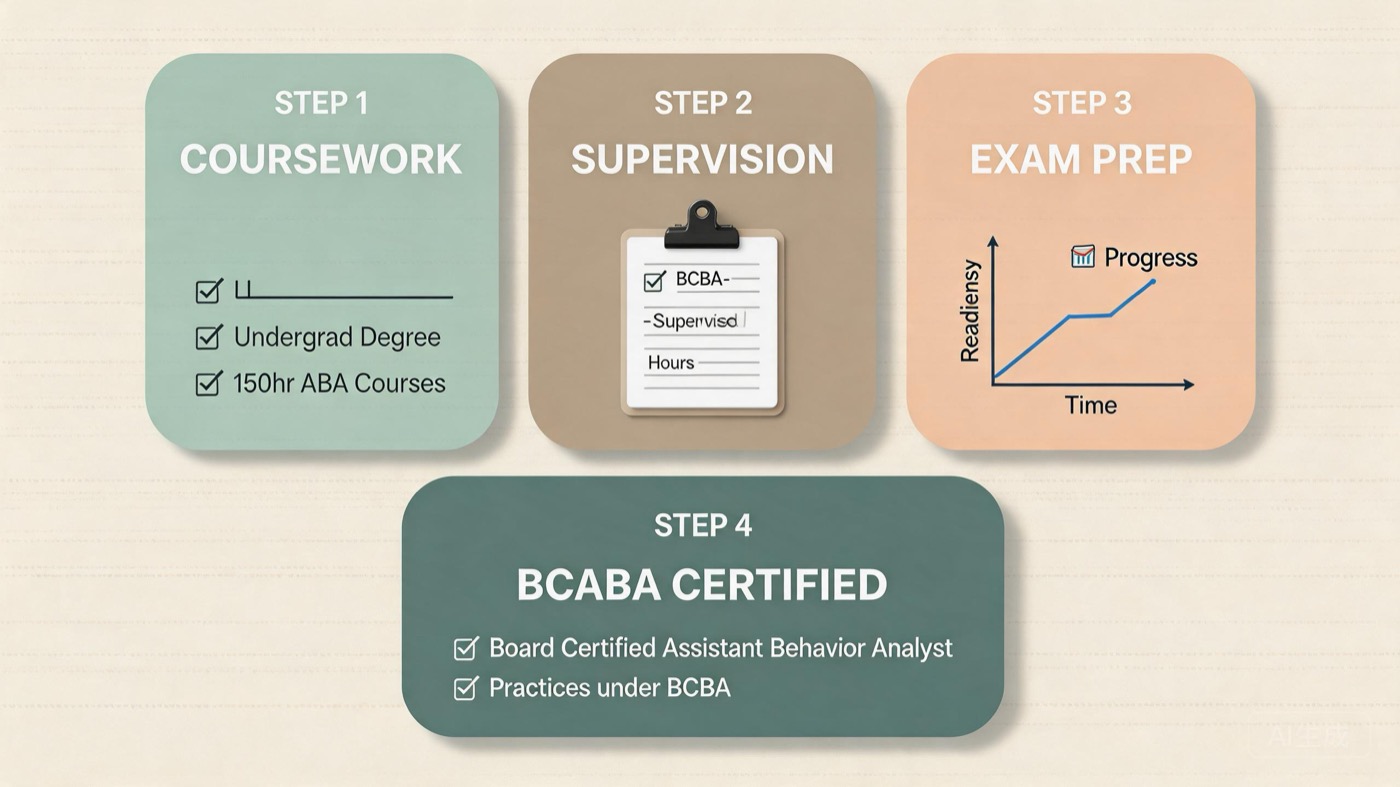
Step 1: Earn Your Bachelor’s Degree
You must have a bachelor’s degree from an accredited institution. Acceptable majors include behavior analysis, psychology, education, or a related field. Some programs offer a verified course sequence (VCS) that satisfies BACB coursework requirements. It’s important to check that your degree is from an institution recognized by the BACB, as degrees from unaccredited schools may not be accepted. Many students choose majors like psychology or education, but any major is acceptable as long as the required coursework is completed. However, if you major in a non-related field, you may need extra prerequisite courses to meet the content requirements.
Step 2: Complete BACB-Approved Coursework
Enroll in a BACB-approved course sequence covering core content: ethics, assessment, behavior-change procedures, and measurement. Most programs require 6-8 courses totaling around 180 classroom hours. You should verify that the course sequence is current and includes the latest BACB task list items. Some online programs also offer VCS, which can be flexible for working students. The coursework must be completed within a specific timeframe, typically five years before your application. Be sure to check with the BACB for any updates on approved sequences, as lists are updated regularly. Also note that you must receive a grade of C or better (or pass) in each course.
Step 3: Accumulate Supervised Fieldwork
You need 1,300 total hours of supervised experience (standard path). Alternatively, the concentrated path requires 1,000 hours completed in no less than 6 months. Fieldwork activities include direct intervention, data collection, and parent training. A sample breakdown: 60% direct client work, 20% supervision meetings, 20% documentation. It is crucial to track your hours accurately using BACB forms and have your supervisor sign off regularly. Common mistakes include counting hours that don’t qualify (e.g., travel time) or failing to meet supervision contact requirements. You need at least 60 minutes of supervision per week (standard) or 60 minutes per month (maybe different?) – actually, for the standard path, you need a minimum of 60 minutes of supervision per 2 weeks, and at least one supervision contact per 2 weeks. For concentrated, you need at least 60 minutes per week. Check the BACB handbook for precise details.
Step 4: Apply for the BCABA Exam
Submit your application through the BACB website, including official transcripts and supervisor verification. The application fee is currently $245. Ensure all documents are submitted before the deadline to avoid delays. The application window opens for specific periods; late submissions are not accepted. Once approved, you will receive an authorization to test (ATT) valid for 90 days. Schedule your exam at a Pearson VUE center as soon as possible to secure your preferred date. Processing times can vary, so apply early to avoid last-minute stress. Also, ensure your name matches exactly with your identification to avoid issues at the test center.
Step 5: Prepare and Take the BCABA Exam
The BCABA exam consists of 130 multiple-choice questions covering the BACB Task List. Use mock exams and focus on high-yield areas like ethics, measurement, and behavior-change procedures. For more study strategies, check out our BCBA exam prep guide (also applicable for BCABA). Create a study schedule that includes daily review of task list items, weekly practice tests, and group study sessions. Many candidates find it helpful to form study groups to discuss difficult concepts. Additionally, review the BACB’s provided resources, such as the task list and ethics code. Time management during the exam is key; you have about 3 hours to complete 130 questions, so allow about 1.5 minutes per question. Skim through the entire exam first to gauge difficulty, then work through confidently.
Practical ABC Examples You Must Know for the BCABA Exam
The exam often tests your ability to identify antecedent-behavior-consequence (ABC) patterns. Here are three common functions with sample scenarios.
Example 1: Escape-Maintained Behavior
A teacher presents a math worksheet (antecedent), a student rips the paper (behavior), and the teacher removes the task (consequence). The function is negative reinforcement (escape). Exam trap: Confusing escape with attention – always check if the consequence removes a demand. Another common trap is thinking negative punishment is at play; but if the behavior increases, it’s reinforcement. In this case, ripping the paper leads to task removal, which reinforces the behavior.
Example 2: Attention-Maintained Behavior
A parent is on the phone (antecedent), a child yells loudly (behavior), and the parent says ‘be quiet’ (consequence). The function is positive reinforcement (attention). Exam trap: Misidentifying as automatic reinforcement – if a social consequence follows, it’s not automatic. Even if the attention is reprimanding, it’s still attention. A common misconception is that only positive attention counts; but any social interaction can serve as reinforcement. Also, note that the antecedent (mom on phone) is an establishing operation that signals decreased attention, making yelling more likely.
Example 3: Automatic Reinforcement
A child is alone in a room (antecedent), engages in hand flapping (behavior), and receives sensory feedback (consequence). The function is automatic positive reinforcement. Exam trap: Failing to rule out social functions – if the behavior occurs in isolation, it’s likely automatic. But be careful: if the behavior is maintained by sensory stimulation, it’s automatic. However, if the behavior also produces a social response (e.g., someone entering the room), you need to consider if the social consequence is maintaining it. In exam scenarios, always look for whether the behavior is followed by a social consequence. If not, automatic reinforcement is likely.
Example 4: Tangible-Maintained Behavior (Extra Example)
A child sees a toy in a store (antecedent), cries and screams (behavior), and the parent buys the toy (consequence). The function is positive reinforcement (access to tangible). Exam trap: Confusing tangible with attention – the consequence is getting the item, not social interaction. In functional assessments, tangible functions are common when the behavior results in access to preferred items or activities. Always identify what is delivered after the behavior. If it’s an item or activity, it’s tangible; if it’s social interaction (even negative), it’s attention.
Common BCABA Exam Traps and How to Avoid Them
Many candidates lose points on subtle distinctions. Here are common exam traps:
- Confusing maintenance vs. generalization: Maintenance is behavior over time; generalization is across settings/people. For example, if a student continues to raise hand after intervention is faded, that’s maintenance. If they raise hand in different classrooms, that’s generalization.
- Misreading ‘negative reinforcement’ as punishment: Negative reinforcement increases behavior by removing an aversive; punishment decreases behavior. A good way to remember: reinforcement always increases behavior, punishment always decreases it, regardless of the ‘positive/negative’ prefix.
- Overlooking client preferences: Social validity requires involving the client in reinforcer selection. The exam may present a scenario where a practitioner chooses a reinforcer based on their own assumption, which is a violation of ethical practice. Always consider client input.
- Ignoring ethical obligations: Always prioritize client dignity and informed consent. Review the BACB Ethics Code for the latest standards. Common ethical traps include not obtaining consent before starting intervention, or failing to maintain confidentiality during data collection.
- Misidentifying functions in complex scenarios: Sometimes a behavior can have multiple functions. For example, a child might scream to both escape a task and get attention. The exam may ask for the most likely function based on the data. Look at the patterns across multiple incidents; if the behavior occurs most often after a demand, escape is primary.
BCABA Quick Checklist
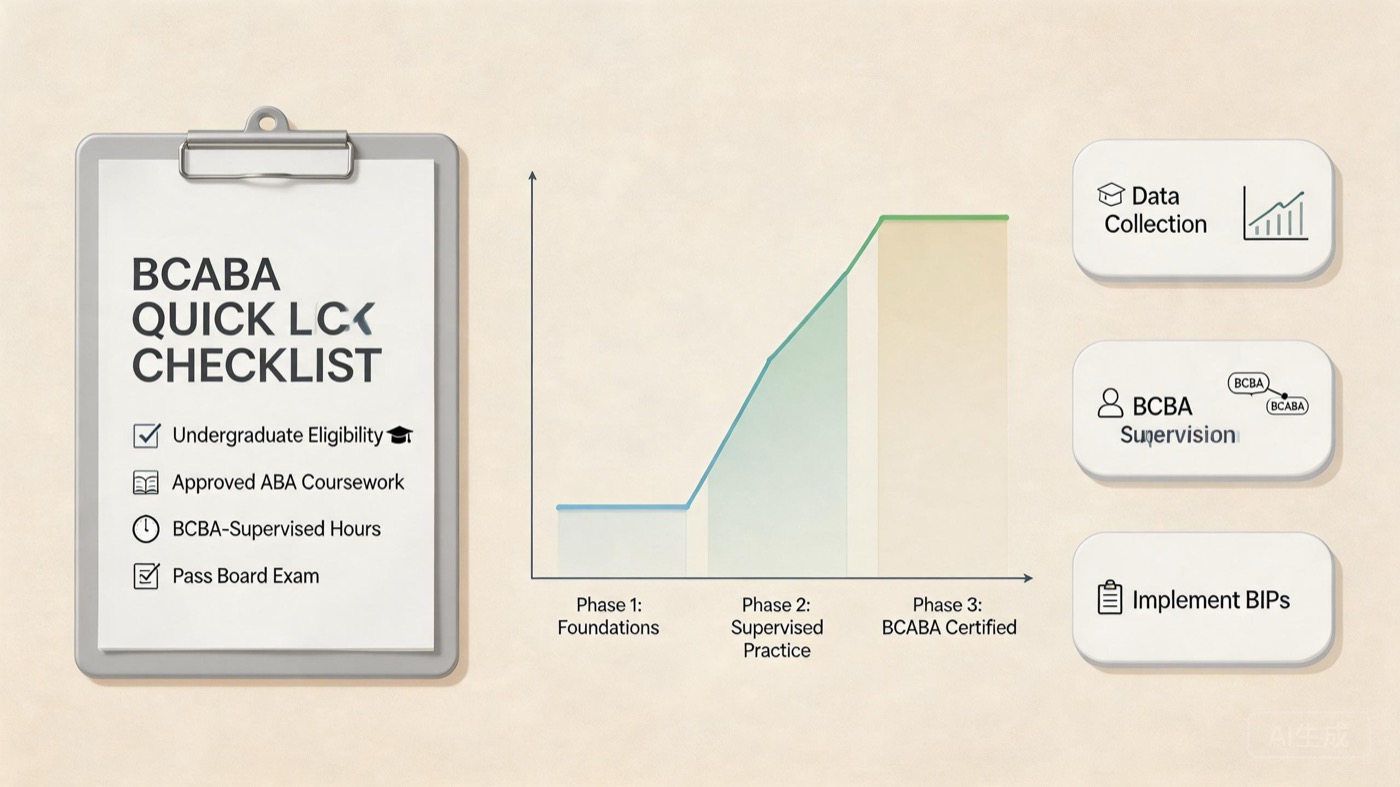
Use this checklist to track your progress. It covers all key milestones from start to exam day:
- Earn your bachelor’s degree from an accredited institution.
- Complete a BACB-approved course sequence (verify online).
- Accumulate 1,300 supervised fieldwork hours (standard) or 1,000 hours (concentrated).
- Gather all documentation: transcripts, supervisor verification, and application fee.
- Submit your BACB application and receive approval.
- Prepare with mock exams and review the task list.
- Schedule and take the exam at a Pearson VUE center.
- During the exam, read each question carefully, eliminate obviously wrong answers, and manage your time.
- After passing, maintain your certification by completing continuing education units (CEUs) and abiding by the BACB ethics code.
Summary
Becoming a BCABA requires a clear sequence: earn a bachelor’s, complete BACB coursework, finish supervised fieldwork, apply, and pass the exam. Understanding ABC functions and ethical principles is critical for exam success. Use structured study plans, mock tests, and the checklist above to build confidence. Avoid common traps by practicing with real-world scenarios and reviewing the task list thoroughly. For additional resources, visit our BCBA mock exam page for practice questions that also apply to the BCABA. Good luck on your journey!


